
LSAT-130 · Lesson 12 of 12 · 20 min
Capstone: timed practice prompts with a self-review rubric
▶ Video coming soon A video version of this lesson is on the way.
At the end of the November 14 session, Harriet assigned the capstone for the writing series: two complete timed essays, one on each of two new prompts, written at home between Sunday, November 15 and Thursday, November 19, at times that did not clash with the group's other sessions. Each essay would follow real conditions: 15 minutes of prewriting, 35 minutes of writing, typed in a plain text box, no grammar checker, no notes, phone in another room. Ji-won would use the timing in her approval. After each essay, members would score themselves on a rubric, wait a day, score again, and send both essays and both sets of scores to Harriet. She would email her comments on the morning of Saturday, November 21.
This lesson gives you the same capstone. Set aside two separate 50-minute blocks, ideally on different days. Do not read the model plans and essay below until you have written your own essays.
How to run the capstone
Prepare as you would on the day. Choose a quiet room, close every application except a plain text editor, set a timer for 15 minutes and read the first prompt. Use the prewriting minutes to produce a five-line plan. When the timer sounds, reset it for 35 minutes and write. Use the checkpoints from Lesson 10: body paragraph 1 done by minute 13, body paragraph 2 by minute 21, conclusion started by minute 29. Stop when the timer sounds, even mid-sentence, and note where you stopped.
Then score the essay on the rubric below. Put it away for at least a day, read it again as if someone else wrote it, and score it a second time. The gap between your first and second scores is useful information: most writers rate their essays more generously immediately after writing.
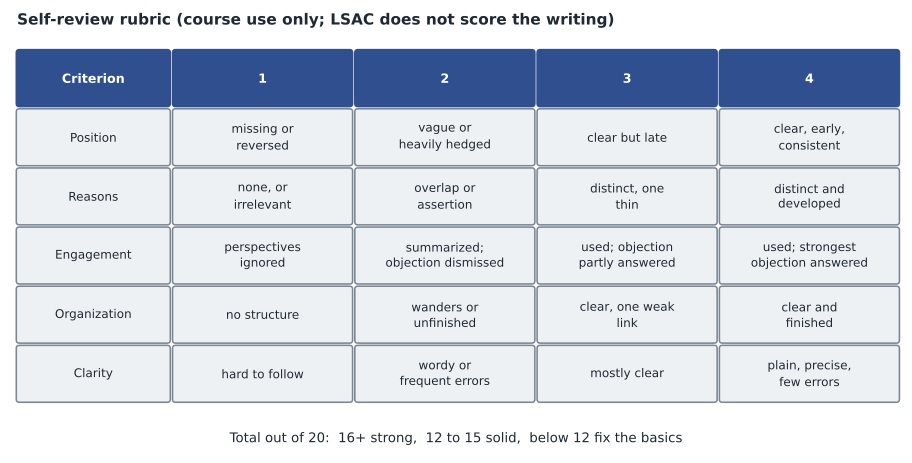
The self-review rubric
The rubric turns the four qualities from Lesson 1 into five scored criteria, splitting organization from clarity. Score each from 1 to 4.
- Position. 4: clear, stated in the introduction, consistent through the conclusion. 3: clear but late or slightly inconsistent. 2: present but vague or heavily hedged. 1: missing, or reversed by the conclusion.
- Reasons. 4: two or more distinct reasons, each developed with explanation and illustration. 3: distinct reasons, one thinly developed. 2: reasons overlap or rely on assertion. 1: no real reasons, or reasons that do not support the position.
- Engagement. 4: at least two perspectives used for a purpose, and the strongest objection answered with state, credit, answer, return. 3: perspectives used and an objection answered, but not the strongest one or not fully. 2: perspectives summarized rather than used; objection dismissed. 1: perspectives ignored.
- Organization. 4: topic sentences outline the argument, structure is clear and the essay is finished. 3: clear structure with one weak transition or a short conclusion. 2: order wanders or the essay is unfinished. 1: no discernible structure.
- Clarity. 4: plain, precise sentences with few errors. 3: generally clear, a few vague words or errors. 2: frequent wordiness, vague claims or errors that slow the reader. 1: hard to follow.
A total of 16 or more indicates a strong essay. Twelve to 15 indicates a solid essay with specific areas to improve. Below 12 means one or more basic elements, usually the position or the rebuttal, needs attention. These bands are the course's, for self-review only; LSAC does not score the writing.
Capstone prompt 1
Capstone prompt D: timed-entry reservations at busy parks (written for this course)
Issue. Some heavily visited national and provincial or state parks require visitors to reserve a timed entry slot in advance during peak season. Should busy parks adopt timed-entry reservation systems?
Perspective 1: Protection. Parks are set aside to preserve landscapes and wildlife for future generations. When crowds exceed what trails, roads and habitats can bear, damage follows and the experience that drew visitors disappears. Limiting entry is the only reliable way to keep a park worth visiting.
Perspective 2: Open access. Public lands belong to everyone, including people who cannot plan weeks ahead, lack reliable internet access or work schedules that change at short notice. Reservation systems quietly favor the organized and the well connected. Parks should manage crowds with shuttles, staggered hours and more staff, not booking windows.
Perspective 3: Local economies. Towns at park gates depend on visitors. Reservation systems that cap numbers can empty motels and restaurants on weekdays while turning away travelers who arrive without a slot. Any system should be designed with the people who live beside the park, not imposed from a distant office.
Prewriting questions (written for this course).
- What is the central question the issue asks you to decide?
- What value or goal does each perspective treat as most important?
- Where do two perspectives agree, and where do they conflict?
- Which perspective is strongest, and what is its weakest point?
- What position will you take, and what is the main reason for it?
- Which objection to your position must you answer, and how?
Capstone prompt 2
Capstone prompt E: later start times for high schools (written for this course)
Issue. Some school districts have moved high school start times later in the morning, citing research on adolescent sleep. Should high schools begin classes later in the morning?
Perspective 1: Student health. Teenagers' sleep patterns shift later during adolescence, and early start times leave many chronically tired. A schedule that fits how students actually sleep is a matter of health and learning, not convenience.
Perspective 2: Family and community logistics. School schedules are tied to parents' work hours, bus routes shared with younger students, part-time jobs and after-school sports. A later start shifts the whole day and may push activities into the evening, with costs that fall unevenly on families.
Perspective 3: Local decision. Communities differ in transportation, climate and family needs. Rather than a single rule, each school community should weigh the evidence and its own constraints, and be free to experiment and change course.
Prewriting questions (written for this course).
- What is the central question the issue asks you to decide?
- What value or goal does each perspective treat as most important?
- Where do two perspectives agree, and where do they conflict?
- Which perspective is strongest, and what is its weakest point?
- What position will you take, and what is the main reason for it?
- Which objection to your position must you answer, and how?
Stop here and write
Write both essays before reading further. The rest of this lesson contains a model plan and a model essay for prompt D, a model plan for prompt E and the group's results.
A model plan for prompt D (written for this course)
- Question: should busy parks require timed-entry reservations in peak season?
- Position: yes, as a peak-season tool, but with a share of entries held for same-day and walk-up visitors and designed with gateway towns.
- Reason 1 (protection perspective): crowding beyond capacity damages trails and habitat and destroys the experience visitors come for; a cap is the most reliable limit.
- Reason 2 (own reasoning): reservations spread visitors through the day and season, which can help gateway businesses by turning a few overcrowded peak days into steadier demand.
- Objection (open access perspective): reservations favor planners and the well connected. Reply: hold back a share of entries for same-day release and walk-up visitors, offer phone booking, and keep shuttles and staggered hours as complements.
- Closing idea: managed access is still public access; unmanaged crowding eventually limits everyone.
A model essay for prompt D (written for this course)
"Crowded parks present a familiar dilemma: the more people who love a place, the harder it is to protect what they came to see. Critics of reservation systems are right that public lands should be open to everyone, not only to those who plan weeks ahead. Even so, busy parks should adopt timed-entry reservations during peak season, provided they hold back a share of entries for same-day visitors and design the system with the towns at their gates.
The strongest reason for timed entry is that it is the most reliable way to keep crowds within what a park can bear. Trails erode, roadsides become informal parking lots and wildlife retreats when visitor numbers exceed what the landscape can absorb. Shuttles and extra staff help, but they move crowds around rather than limiting them. A timed-entry system sets a ceiling, and that ceiling protects both the land and the experience: a viewpoint shared with a manageable number of people is worth visiting; one reached after an hour in a traffic queue is not.
Timed entry can also serve the communities beside the park better than unmanaged crowding does. When everyone arrives at the same hours on the same summer weekends, motels and restaurants are overwhelmed for a few days and quiet the rest of the time. Entry slots spread across the day and the season can turn those spikes into steadier demand. That benefit depends on design, which is why gateway towns should help decide how many slots are offered and when, rather than learning of the system after it has been built elsewhere.
The most serious objection is that reservations favor the organized and the well connected. A family that decides on a Friday to visit, a worker whose shifts change at short notice, or a visitor without reliable internet access may find every slot taken. That concern goes to the heart of what public lands are for, and a system that ignored it would turn a public park into a members' club. But the answer is to design for it, not to abandon limits. Parks can release a substantial share of entries the day before or the same morning, keep some walk-up access, take bookings by phone and keep shuttles and early or late entry without reservations. These measures keep the door open to spontaneous visitors while still holding the total within safe limits.
Managed access is still public access. Timed-entry systems, designed fairly and with local communities, protect the places that make parks worth visiting, while unmanaged crowding eventually limits everyone."
Annotating the model essay
The model essay is about 500 words. Its position is qualified in one clause, "provided they hold back a share of entries for same-day visitors and design the system with the towns at their gates," and every part of that qualification is used later. Body paragraph 1 draws on the protection perspective and weighs reservations against shuttles by alternatives. Body paragraph 2 turns the local economies perspective from an objection into a design condition, which is an example of conceding in part while keeping the position. Body paragraph 3 answers the open access perspective with state, credit, answer, return, using the "another way to prevent the harm" answer type. The essay contains no statistics; its examples are hypotheticals drawn from ordinary experience.
A model plan for prompt E (written for this course)
- Question: should high schools begin classes later in the morning?
- Position: yes, schools should move toward later start times, phased in with local planning for buses, families and activities.
- Reason 1 (student health perspective): adolescent sleep shifts later; schedules that fit students' sleep serve health and learning, which are the school's purpose.
- Reason 2 (own reasoning): early schedules are a historical choice built around logistics, not a requirement of learning; logistics can be redesigned more easily than biology.
- Objection (family and community logistics): later starts disrupt jobs, sports and families, unevenly. Reply: phase the change, adjust bus tiers, offer early supervision for families who need it; the costs are real but manageable and fall mainly on adults, while the benefit falls on students.
- Closing idea: the local decision perspective is right about method, wrong if it means indefinite delay; communities should plan how, not whether.
The plan uses all three perspectives: the first for support, the second as the objection and the third in the conclusion, conceded in part. It avoids specific research figures, relying on the prompt's statement that districts cite research on adolescent sleep.
The group's results
Harriet's email on November 21 reported each member's second-day rubric totals for the two essays, followed by her own totals in brackets.
- Thomas: prompt D 15 (16), prompt E 16 (16). For the first time he finished both essays with time to reread, using the drafting rule and the two-body-paragraph structure on prompt E.
- Élodie: prompt D 17 (17), prompt E 16 (17). Harriet said her introductions were now three tight sentences and her transitions sounded natural.
- Dani: prompt D 14 (15), prompt E 15 (16). Both rebuttals followed state, credit, answer, return. Her remaining habit to watch was a tendency to over-qualify her positions.
- Ji-won: prompt D 16 (17), prompt E 17 (17), under her approval's timing. Her plans were complete before she wrote a sentence, and her essays followed them.
- Marcus: prompt D 15 (15), prompt E 14 (15). His paragraphs were longer and better explained; Harriet marked two places where an absolute word ("always," "never") invited an objection.
Harriet noted that every member's second-day score was the same as or lower than her own, the reverse of the usual pattern of over-rating. She said the group had become hard graders of their own work, which was a good sign.
After the capstone
The writing series ended with the capstone, and the members folded writing into their remaining plans. Élodie, Dani and Ji-won would each write one more timed practice essay in December and a warm-up plan, not a full essay, the day before their writing sessions in January. Thomas would write one essay a month until his April test. Marcus, with a sample on file, would keep his two capstone essays as a reference for law school exams.
Harriet's last message summarized the method in six steps, the same six that began the course: restate the question; map the perspectives; choose a position you can defend; plan two reasons and the strongest objection; write to the checkpoints; reread for your own errors. 'You will not remember every lesson on the day,' she wrote. 'You will remember those six steps, and they are enough.'
Common mistakes
MistakeReading the model essay before writing your own.
InsteadWrite both capstone essays first, then compare.
MistakeScoring your essay only immediately after writing it.
InsteadScore again after a day; first scores tend to be generous.
MistakeWriting past the timer to finish.
InsteadStop when time is up and note where you stopped.
MistakeTreating the rubric bands as an LSAC score.
InsteadUse them for self-review only; LSAC does not score the writing.
MistakeCopying the model essay's position.
InsteadDifferent positions can be equally strong; judge the method.
Summary and key terms
- Run the capstone under real conditions: 15 minutes of prewriting, 35 minutes of writing, typed, no grammar checker.
- Score each essay on the five-part rubric (position, reasons, engagement, organization, clarity), then rescore after a day.
- The model essay for prompt D shows a qualified position whose conditions are used throughout, and a full rebuttal.
- The model plan for prompt E shows all three perspectives used for different purposes without outside statistics.
- The six-step method (restate, map, choose, plan, write to checkpoints, reread) carries into test day.
- Self-review rubric
- A five-criterion scale, 1 to 4 each, for judging your own practice essays.
- Second-day score
- A rubric score given after waiting a day, usually more accurate than an immediate one.
- Design condition
- A qualification that turns an objection into a requirement for how the position is carried out.
- Six-step method
- Restate the question, map the perspectives, choose a position, plan, write to checkpoints, reread.
Practice problems
Work each problem on paper first, then reveal the answer to check.
What are the five rubric criteria?
Show answer
Position, reasons, engagement, organization and clarity.
Why rescore after a day?
Show answer
Immediate scores tend to be generous; a day later you read more like an outside reader.
How does the model essay use the local economies perspective?
Show answer
It turns it into a design condition: gateway towns help decide slots and timing.
Which answer type does the model rebuttal for prompt D use?
Show answer
Another way to prevent the harm: same-day release, walk-up access, phone booking and shuttles.
What are the six steps of the method?
Show answer
Restate the question, map the perspectives, choose a defensible position, plan two reasons and the strongest objection, write to the checkpoints, reread for your own errors.
Lesson quiz · 5 questions
Score 60% or more to complete this lesson.
Create a free account to save your progress, take quizzes and earn a certificate.