
LSAT-130 · Lesson 4 of 12 · 19 min
Planning with the prewriting questions
▶ Video coming soon A video version of this lesson is on the way.
After a short break on October 10, Harriet turned to the 15 minutes before the essay begins. 'This is where good essays are won,' she said. 'The prewriting stage looks like a formality, a few questions to answer before the real work. In fact it is the real work. If you leave it with a clear position, three reasons and an answer to the best objection, the 35 minutes become typing. If you leave it with vague notes, the 35 minutes become thinking, and thinking while typing is slow and messy.'
What the guided questions are for
LSAC describes the prewriting questions as a way to help you analyze the perspectives and generate ideas. They are not graded, and schools do not receive your answers. Their wording can vary, so this course does not try to predict it. Instead, it teaches you what any sensible set of analysis questions is trying to get you to work out, so that you can use whatever questions appear.
Harriet put a set of six questions on screen, written for the course in the same spirit. She said that if the real questions differ, the group should still make sure their notes answer all six by the end of the 15 minutes.
- What is the central question the issue asks you to decide?
- What value or goal does each perspective treat as most important?
- Where do two perspectives agree, and where do they conflict?
- Which perspective is strongest, and what is its weakest point?
- What position will you take, and what is the main reason for it?
- Which objection to your position must you answer, and how?
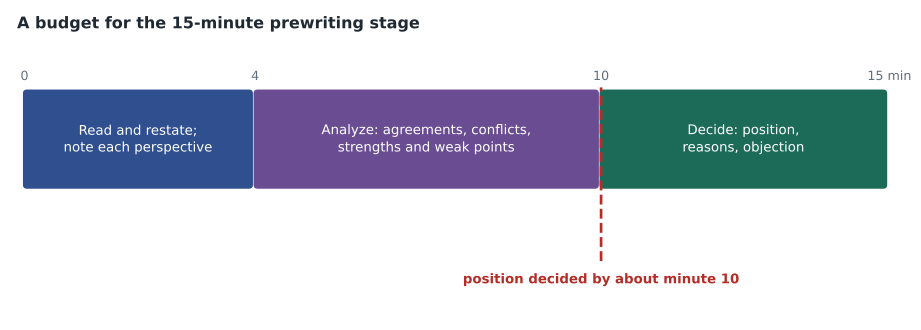
The first three questions are about understanding. The last three are about deciding. Most candidates spend too long on the first group and too little on the second. A useful rule: by the ten-minute mark, you should be writing your position.
Notes, not sentences
The notes you take in the prewriting stage should be short. Full sentences cost time and tempt you to polish. Abbreviations, arrows and fragments are fine, as long as you can read them five minutes later. Harriet showed her own notes for practice prompt A, written in about twelve minutes.
- Q: drop daily overdue fines? (scope: daily fines vs replacement charges)
- P1 access: equal access first; fines hit poor hardest, blocked cards keep people away.
- P2 responsibility: promise to return shared property; fines = reminder; others wait.
- P3 practical: decide by evidence; track returns, waits, costs; mixed options.
- Agree: library serves public; lateness hurts other borrowers.
- Conflict: P1 vs P2 on whether fines serve the mission. P3 says measure.
- Strongest: P2's point about other borrowers waiting. Weak point of P2: assumes fines are what bring items back.
- Position: drop daily fines; keep replacement charge for unreturned items; use reminders and holds limits.
- Reasons: (1) mission = access, fines block those who most need library; (2) small fines raise little and cost staff time to collect; (3) other tools protect waiting borrowers.
- Objection: P2, others wait. Reply: replacement charge + automatic reminders + borrowing limits on overdue accounts address waiting without daily fines.
Dani asked how Harriet could know that fines raise little. Harriet said she did not know a figure, and the essay should not invent one. Reason (2) can be stated as a consideration, "the sums raised by small daily fines are modest, while collecting them takes staff time," and framed as something a library should verify, which the third perspective supports. Lesson 9 returns to the difference between asserting facts and reasoning about them.
From analysis to decision
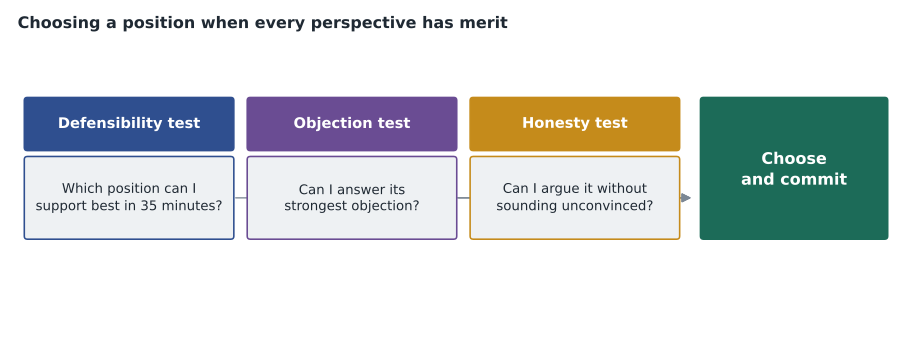
The decision questions are where many candidates stall. They see merit in every perspective and cannot choose. Harriet offered three tests to break the deadlock.
The first is the defensibility test: which position can you support with the strongest reasons in 35 minutes? Not which position is true, which nobody can settle, but which one you can argue best with the material available.
The second is the objection test: for each candidate position, what is the strongest objection, and do you have a good reply? A position whose best objection you cannot answer is a poor choice, however much you like it.
The third is the honesty test: can you write the position without sounding as if you do not believe it? Readers do not care which side you choose, but an essay written against your own inclinations often sounds hesitant. If two positions are equally defensible, choose the one you find more convincing.
Building a plan
Once the position is chosen, the plan almost writes itself. Harriet's template has five lines:
- Position: one sentence that answers the question, with any qualification.
- Reason 1: the strongest reason, in a few words, with the perspective it draws on.
- Reason 2: a second, different reason.
- Objection and reply: the strongest opposing point, which perspective it comes from, and your answer.
- Closing idea: what the essay shows, or a condition under which you would change your view.
That is an essay in outline: an introduction stating the position, two body paragraphs of reasons, one paragraph addressing the objection and a short conclusion. Lesson 8 covers this structure in detail. For now, the point is that the plan is built in the prewriting stage, not invented while typing.
Thomas asked whether three reasons were better than two. Harriet said two well-developed reasons plus a strong reply to an objection usually beat three thin reasons, given 35 minutes. Some writers prefer three reasons and a shorter rebuttal inside one of them. Either works if each paragraph has room to explain its point.
Using the perspectives in the plan
The plan should show where each perspective enters the essay. That does not mean every perspective needs its own paragraph, and LSAC's description asks only that you engage with some of the arguments and ideas in the perspectives. But a plan that names, for each reason or objection, the perspective involved makes the essay's engagement visible. Harriet's plan for prompt A draws reason 1 from the access perspective, reason 2 from the practical management perspective and the objection from the responsibility perspective. All three are used, each for a purpose.
Ji-won asked whether she should mention perspectives by number. Harriet said it is clearer to refer to them by their ideas: "those who emphasize responsibility to other borrowers" rather than "Perspective 2." Readers know the prompt, but an essay that refers only to numbers reads like an exam answer key, and it forces the reader to look back at the prompt to follow you.
What if the guided questions ask something different?
Élodie asked what to do if the official questions focus on something the six-question set does not cover, such as asking you to identify an assumption a perspective makes. Harriet said to answer what is asked, briefly, and then make sure your notes still end with a position, reasons and an objection with a reply. The guided questions are a tool, not a test. Answer them in a way that serves the plan.
Marcus asked whether you could skip the guided questions entirely and just plan. Harriet said that depends on the interface rules for your session, which LSAC describes in its instructions. Even where skipping is possible, the questions are usually worth a quick pass, because they force you to look at the perspectives you would rather ignore.
Practicing the prewriting stage alone
Because the prewriting stage is short, it is easy to practice in isolation. Harriet assigned an exercise for the following week: take three practice prompts, set a timer for 15 minutes each, and produce a five-line plan without writing the essay. Then compare the plans: is the position clear in one sentence? Are the reasons different from each other, or the same reason in two forms? Is the objection the strongest one, or a convenient one?
Thomas did the exercise twice before the next session and reported that his first plan took twenty minutes, but his third took thirteen. Dani said that writing plans without essays felt strange but made the structure stick: she started seeing every prompt as "position, two reasons, objection, reply." Ji-won said planning first was exactly the habit she needed, because without it her ideas came out in the order she thought of them.
The prewriting stage under accommodations
For candidates with approved accommodations, LawHub notes that timing for the prewriting stage may differ. Harriet told Ji-won to scale the internal budget proportionally: if her prewriting stage were longer, she should still aim to have her position decided about two thirds of the way through, leaving the final third for reasons and the objection. The proportions matter more than the absolute minutes.
A worked example from the group
At the end of the session, Harriet asked Élodie to share her plan for practice prompt A, because it differed from Harriet's. Élodie had chosen to keep fines for adults and drop them for children and teenagers. Her reasons were that children have the least control over whether items come back, since they depend on adults to bring them to the library, and that early exclusion from the library has long-term costs; while adults can reasonably be held to a promise. Her objection came from the access perspective: low-income adults are also deterred by fines. Her reply: the library could offer fine forgiveness through volunteering or reading programs.
Harriet said Élodie's plan was as good as hers, and different. That was the point: the readers are not looking for one answer. They are looking for a defensible position, clearly reasoned, that takes the perspectives seriously. Two strong essays can reach opposite conclusions.
When the guided questions push you toward one perspective
Some guided questions may ask you to explain one perspective in detail or to identify its strengths. Élodie worried that such a question would push her toward a position she did not want. Harriet said a guided question is not an instruction about what to argue. You can analyze a perspective's strengths carefully and still argue against it; in fact, that analysis is exactly what a good rebuttal needs. Treat every guided question as a chance to understand, then make your own decision at the end.
Testing the plan before you leave the prewriting stage
Harriet recommended a thirty-second test of the plan in the last minute of the prewriting stage. Read the position line and ask: does it answer the question? Read the two reasons and ask: are they different from each other, and does each support the position? Read the objection and ask: is it the strongest one, or merely a convenient one? If any answer is no, fix it now. Fixing a plan takes seconds; fixing an essay built on a weak plan takes far longer.
Marcus called it a design review. In engineering, he said, a design is checked before anyone builds it, because changes on paper are cheap and changes in concrete are expensive. Harriet said the analogy was exact: the plan is the paper, and the essay is the concrete.
Using the digital notes well
The prewriting notes are typed in the interface, and some candidates find it hard to organize typed notes quickly. Harriet suggested a fixed layout: one line for the restated question, one line for each perspective, a blank line, then the five plan lines. Using the same layout every time means you never waste time deciding where to write things, and the plan is easy to find when the essay stage begins. She also suggested writing the five plan lines in capitals or with a symbol at the start, so they stand out from the analysis.
Dani adopted the layout immediately. She said that at work she used the same templates every day for intake forms, and that a fixed layout for notes felt natural. Thomas said he would try it, though he suspected he would keep writing too much in the analysis lines. Harriet said the time budget would correct that: once the ten-minute mark arrives, the analysis stops and the plan begins, whatever state the notes are in.
Ji-won added one refinement for herself: after the plan test, she would read her five lines once more aloud in her head, as if explaining the essay to a friend in thirty seconds. If the explanation sounded coherent, the plan was ready. Harriet said that was a good final check for anyone, and especially for writers whose ideas tend to arrive faster than their structure.
Common mistakes
MistakeSpending the whole 15 minutes understanding the perspectives.
InsteadDecide your position by about the ten-minute mark.
MistakeWriting full sentences in the prewriting notes.
InsteadUse short fragments you can read five minutes later.
MistakeChoosing a position you cannot defend against its best objection.
InsteadApply the objection test before committing.
MistakeLeaving the prewriting stage without a plan.
InsteadFinish with a position, two reasons, an objection and a reply.
MistakeInventing statistics to support a reason.
InsteadState considerations and reason about them; do not make up figures.
Summary and key terms
- The prewriting questions help you analyze the perspectives and generate ideas; their wording varies and they are not sent to schools.
- Make sure your notes cover understanding (question, values, agreements and conflicts) and decision (strongest view, position, objection).
- Use the defensibility, objection and honesty tests to choose a position.
- A five-line plan (position, two reasons, objection and reply, closing idea) is an essay in outline.
- Practice the prewriting stage on its own until a clear plan takes no more than 15 minutes.
- Prewriting notes
- The short notes you type during the prewriting stage; for your use only.
- Defensibility test
- Choosing the position you can support best with the material available.
- Objection test
- Checking that you can answer the strongest objection to a position before choosing it.
- Five-line plan
- Position, reason 1, reason 2, objection and reply, closing idea.
Practice problems
Work each problem on paper first, then reveal the answer to check.
By what point in the prewriting stage should you be writing your position?
Show answer
By about the ten-minute mark.
What are the five lines of the plan?
Show answer
Position, reason 1, reason 2, objection and reply, closing idea.
How should you refer to perspectives in the essay?
Show answer
By their ideas, such as "those who emphasize responsibility," rather than by number alone.
What should you do if the official questions ask something unexpected?
Show answer
Answer briefly, then make sure your notes still end with a position, reasons and an objection with a reply.
How should a candidate with a longer prewriting stage budget it?
Show answer
Proportionally: decide the position about two thirds of the way through.
Lesson quiz · 5 questions
Score 60% or more to complete this lesson.
Create a free account to save your progress, take quizzes and earn a certificate.