
LSAT-121 · Lesson 8 of 12 · 25 min
Humanities and social science passages
▶ Video coming soon A video version of this lesson is on the way.
After the break on November 2, Marcus admitted his problem with humanities passages. 'Science passages tell me what they think and why,' he said. 'Humanities passages talk around the point for four paragraphs and then tell me the author thinks something subtle that I did not notice them thinking.' Harriet said that was a fair description of many humanities passages, and that the subtlety was learnable. Social science passages, she added, sit between the two: they argue about evidence like science passages, but the evidence is about people, and the conclusions are often about policy.
Humanities passages: arguments about interpretation
Humanities passages discuss literature, art, music, history, philosophy and similar fields. They tend to be about interpretation: how a work should be read, how a historical development should be understood, what a concept means, or how scholars' views have changed. They rarely present evidence in the scientific sense. Instead, they present readings, arguments and counterarguments, and the author's position often emerges gradually through qualified judgments.
Three features make humanities passages harder for many readers.
- Abstract vocabulary: words such as "fidelity," "anachronism," "contingency" and "aesthetic" carry the argument. If a word is unfamiliar, use context and the paragraph's role to infer its meaning, as you learned in Reading Comprehension I.
- Layered voices: the passage reports a tradition, then its critics, then a middle position, then the author's judgment, and the voices can blur.
- Understated conclusions: the author's view may appear in a single sentence, often in the final paragraph, and may take the form of qualified approval of one position: "has the merit of," "its difficulty lies in."
Social science passages: arguments about people and evidence
Social science passages discuss economics, psychology, sociology, political science, anthropology and related fields. Like science passages, they often present findings and competing explanations. Unlike science passages, the findings are frequently contested, the methods are open to challenge, and the conclusions often concern what policy should be. Pair K on the shorter working week was a typical example: a reported finding, an explanation of it, and a critique of the evidence's generality.
The tools from the Tuesday workshop on flaws apply directly to social science passages: sampling, self-selection, confounding causes, the difference between correlation and causation, and the gap between evidence and policy recommendations. Dani said her habit of writing "of what?" beside every percentage had proved useful on social science passages too. Harriet said that habit, along with asking "compared with what?", would catch many of the claims test writers like to distort.
A humanities passage
Harriet handed out a humanities passage. As you read, number the views and mark the one sentence where the author's own judgment is clearest.
Passage Q (humanities): should historians judge the past? (written for this course)
Few questions divide historians more persistently than whether they should pass moral judgment on the people they study. One tradition holds that judgment is no part of the historian's task. The historian's job, on this view, is to understand: to reconstruct how people in the past saw their world, what choices seemed open to them and why they acted as they did. To condemn a medieval ruler by the standards of a modern human rights charter is not history but a kind of self-congratulation, and it obstructs understanding by replacing curiosity with verdicts.
Critics of this tradition reply that the refusal to judge is itself a judgment. A history that describes a massacre in the same detached language it uses for a change in tax policy quietly tells its readers that the two are morally comparable. Moreover, the people of the past did not all share a single set of standards. Many of the practices that later generations condemned were condemned at the time as well, by victims, dissenters and reformers whose voices a purely "understanding" history may neglect. To judge the past by the standards available within it, these critics argue, is not anachronism but fidelity to the full range of contemporary opinion.
Some historians have sought a middle path. Judgment, they suggest, should come after understanding and should be proportionate to what the people concerned could reasonably have known and done. A historian may explain why an official enforced an unjust law, tracing the pressures and beliefs that shaped the decision, and still conclude that the law was unjust and that the official bore some responsibility for enforcing it. Understanding, on this view, does not require forgiving, and judging does not require refusing to understand.
The middle path has the merit of honesty about what historians actually do: few histories, however detached their tone, are free of evaluation, and readers are better served when evaluation is explicit and argued for than when it is smuggled in through word choice. Its difficulty lies in the measure of what people "could reasonably have known," a standard that historians apply inconsistently and that may itself reflect the values of the historian's own time.
The voices in Passage Q
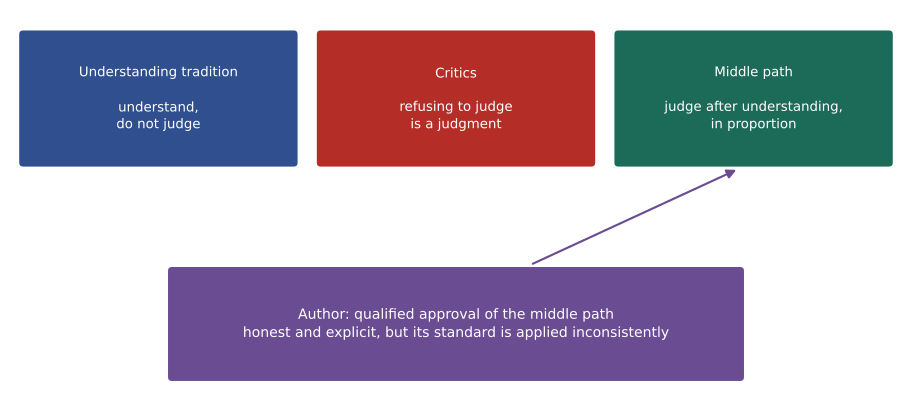
Passage Q has four voices.
- View 1, the understanding tradition (P1): the historian should understand, not judge; judging by modern standards obstructs understanding.
- View 2, the critics (P2): refusing to judge is itself a judgment; past standards were not uniform, and judging by standards available at the time is faithful, not anachronistic.
- View 3, the middle path (P3): judgment after understanding, proportionate to what people could reasonably have known and done; understanding does not require forgiving.
- The author (P4): the middle path is honest about what historians do and better for readers, but its standard of "what people could reasonably have known" is applied inconsistently and may reflect the historian's own values.
The author's attitude toward the middle path is qualified approval: it "has the merit of honesty," but its difficulty is real. The author does not fully endorse any of the three views, and the passage ends on a difficulty rather than a resolution. Marcus said that was exactly the kind of ending that had confused him before. Harriet said the key was to recognize that a passage can end on a difficulty and still have an author's view: here, that the middle path is the most honest approach but not a complete solution.
Worked problem
Sample question (written for this course)
Question: "The author of the passage would be most likely to agree with which one of the following statements?" (A) Historians should never evaluate the actions of people in the past. (B) The standards of the past were uniform and should be applied without exception. (C) The middle path resolves every difficulty raised by the other two views. (D) Evaluation in historical writing is better made explicit and argued for than conveyed only through word choice. (E) Judging the past by modern human rights standards is always appropriate.
Show solution
- (D) is correct. The final paragraph says readers are better served when evaluation is "explicit and argued for than when it is smuggled in through word choice."
- (A) is the understanding tradition's view, which the author does not adopt; the author says few histories are free of evaluation.
- (B) contradicts the critics' point, which the author does not dispute, that past standards were not uniform.
- (C) is too strong; the author identifies a difficulty with the middle path.
- (E) is too strong and is not any view in the passage.
Answer: (D). In humanities passages, the author's view is often a qualified judgment in the final paragraph.
Worked problem
Sample question (written for this course)
Question: "The critics described in the second paragraph would be most likely to regard a history that describes a massacre in neutral, detached language as" (A) implicitly suggesting that the massacre is morally comparable to ordinary events. (B) admirably free of moral judgment. (C) an example of the middle path. (D) appropriate for events in the distant past but not recent ones. (E) the only honest way to write history.
Show solution
- (A) is correct. The critics argue that detached language "quietly tells its readers that the two are morally comparable."
- (B) is the opposite of the critics' view; they say refusing to judge is itself a judgment.
- (C) misidentifies the approach; the middle path makes judgment explicit after understanding.
- (D) introduces a distinction no one in the passage makes.
- (E) contradicts the critics.
Answer: (A). Answer from the specific voice the question names.
Difficulty patterns
Many students find that humanities passages produce the most errors on attitude and main point questions, because the author's view is understated, while social science passages produce errors on inference and new-information questions, because the evidence invites overgeneralization. Science passages produce errors on detail questions when terminology distracts, and law passages produce errors when outside knowledge intrudes.
Harriet asked each student to look at their error logs from the Wednesday lab and count errors by passage type and question family. Marcus found that six of his last nine reading errors came from humanities passages, mostly on main point and attitude questions. Dani found her errors spread across types but concentrated on answers in the wrong voice. Élodie's were mostly timing-related guesses on whichever passage she reached last.
Choosing an order
On the digital test, you may move between passages within a section. Some students work the passages in order; others start with the type they find easiest. In the Wednesday lab, Marcus had already decided to take science first and humanities third. Harriet said that order was reasonable for him, but warned against spending time deciding during the test. 'Glance at the first sentence of each passage, pick your first passage within fifteen seconds, and start. If you deliberate longer than that, the deliberation costs more than the reordering saves.'
Élodie said she would keep working in order, since reordering made her anxious and her problem was pacing, not passage type. Harriet agreed that working in order was the right choice for her.
The second November 2 set
The evening ended with a timed humanities passage of seven questions. Ji-won answered seven; Thomas and Élodie six; Marcus six, his best humanities result yet; Dani five. Marcus said he had found the author's judgment by looking for evaluative words in the last paragraph before reading the questions, and that it had changed how the whole passage read. Harriet said that habit would serve him on every humanities passage he met.
Social science evidence in a single sentence
Social science passages often compress a study into one sentence: "Participating organizations commonly report that output held steady or improved." Each word matters. "Participating" tells you who was studied; "report" tells you how the evidence was gathered; "commonly" tells you it was not universal. Answers that say "all organizations improved output" or "output was measured objectively" go beyond the sentence. Harriet asked the group to rewrite three such sentences from earlier passages as lists of what was claimed, by whom and how. Dani said that exercise was exactly what her "of what?" card was for.
Worked problem
Sample question (written for this course)
Question: "Which one of the following is most strongly supported by the description of the pilot results in Passage A of pair K?" (A) Every participating organization increased its output. (B) Output was measured using independent records. (C) Many participating organizations reported that output did not fall. (D) Employees in all industries benefited from the shorter week. (E) The pilots lasted several years.
Show solution
- (C) is correct. "Commonly report that output held steady or improved" supports that many reported no fall in output.
- (A) is too strong: "commonly," not always, and "held steady or improved," not always improved.
- (B) is unsupported: the passage says organizations "report."
- (D) is too broad; Passage A says nothing about all industries, and Passage B notes many were absent.
- (E) is unsupported; Passage B describes pilots lasting several months.
Answer: (C). Read the compressed study sentence word by word.
Marcus said he now read social science passages the way he read test reports at work: who ran the test, on what, measured how. Harriet said that if he read humanities passages the way he read design reviews, he would be fine there too.
Thomas said that history passages were his favorite, given his degree, and that this was precisely why he had to be careful with them. Harriet reminded him of the law passage lesson: familiarity invites outside knowledge. A history passage should be read as a particular author's argument, not as a chance to recall what he learned at university.
Common mistakes
MistakeMissing an understated conclusion in a humanities passage.
InsteadLook for evaluative language, especially in the final paragraph: "has the merit of," "its difficulty lies in."
MistakeTreating a passage that ends on a difficulty as having no author's view.
InsteadAn author can approve of a position with reservations; that is a view.
MistakeOvergeneralizing from evidence in social science passages.
InsteadAsk who was studied, of what, compared with what and over what period.
MistakeBlurring layered voices.
InsteadNumber each view and mark which voice each sentence belongs to.
MistakeDeliberating at length over passage order.
InsteadIf you reorder, decide within about fifteen seconds.
Summary and key terms
- Humanities passages argue about interpretation; the author's view is often a qualified judgment near the end.
- Social science passages argue about evidence concerning people and often about policy; watch for overgeneralization.
- Each passage type has typical structures and typical errors; your error log shows which affect you.
- Separate layered voices and answer from the voice the question names.
- Reordering passages can help some students, but decide quickly or not at all.
- Anachronism
- Applying the ideas or standards of one time to another in a misleading way.
- Middle path
- A position that combines elements of two opposing views.
- Understated conclusion
- An author's view expressed briefly or with qualifications.
- Overgeneralization
- Drawing a broader conclusion than the evidence supports.
Practice problems
Work each problem on paper first, then reveal the answer to check.
What is the author's attitude toward the middle path in Passage Q?
Show answer
Qualified approval: it is honest about what historians do, but its standard is applied inconsistently.
What do the critics in Passage Q say about the refusal to judge?
Show answer
That it is itself a judgment.
Name two questions to ask about evidence in social science passages.
Show answer
Any two of: who was studied, of what, compared with what, over what period.
Where does the author's judgment appear most clearly in Passage Q?
Show answer
In the final paragraph.
How long should you spend deciding passage order?
Show answer
About fifteen seconds at most, if you reorder at all.
Lesson quiz · 5 questions
Score 60% or more to complete this lesson.
Create a free account to save your progress, take quizzes and earn a certificate.