
LSAT-121 · Lesson 3 of 12 · 23 min
Agreement, disagreement and relationship questions
▶ Video coming soon A video version of this lesson is on the way.
There was no session on Monday, October 12, which was Thanksgiving in Canada. Thomas spent it with family in Halifax and Élodie with hers in Gatineau. When the group met again on October 19, Harriet began with a tally: across the practice comparative sets the group had worked since the summer, more than half of the questions they had missed were about agreement, disagreement or how the passages related. 'These are the questions the comparison map was built for,' she said. 'Tonight we learn to answer them precisely.'
The family of relationship questions
Relationship questions come in several forms. The most common are:
- Agreement: "The authors of the two passages would be most likely to agree with which one of the following?" or "Both passages support which one of the following statements?"
- Disagreement: "The authors would be most likely to disagree about whether..." or "Which one of the following is a point of disagreement between the authors?"
- Overall relationship: "Which one of the following most accurately describes the relationship between Passage A and Passage B?"
- Response: "How would the author of Passage B most likely respond to the claim in Passage A that...?"
- Shared concern: "Both passages are concerned with answering which one of the following questions?"
Each form draws on a different part of the comparison map. Agreement questions draw on the "=" rows; disagreement questions on the "X" rows; overall relationship questions on the relationship sentence; response questions on how B treats A's reasoning; shared-concern questions on the topic and the points of contact together.
Agreement questions: both authors must support the answer
An answer to an agreement question must be supported by both passages. The most common trap is an answer supported by one passage and not contradicted by the other. Such answers feel safe, because nothing in the second passage rules them out, but "not contradicted" is not the same as "supported." The credited answer is usually something both authors say or clearly imply, often a shared premise or a fact both accept.
Harriet compared this to the point-at-issue questions in Logical Reasoning, which the group had studied on Sundays. 'There, you needed both speakers to have a view on the issue. Here, for an agreement question, you need both authors to hold the same view. Silence is not agreement.'
Disagreement questions: both authors must address the point
For a disagreement question, the credited answer is a statement on which both authors take a position, and those positions conflict. The common traps are mirror images of the agreement traps: a statement only one author addresses, or a statement on which the authors actually agree.
A useful test is to imagine asking each author to vote yes or no on the answer choice. The credited answer to a disagreement question gets one yes and one no. The credited answer to an agreement question gets two of the same vote. Any answer on which one author would have to abstain is wrong for both kinds of question.
Marcus said the voting test reminded him of a design review: if a reviewer has not looked at a component, you cannot record their approval or their objection. Harriet said that was exactly right.
A pair on painting conservation
Harriet handed out a humanities pair. Map it before reading the examples.
Comparative pair J (humanities): cleaning old paintings (written for this course)
Passage A
Most paintings made in Europe before the twentieth century were finished with a coat of varnish, which protected the paint and gave it depth and saturation. Natural varnishes, however, yellow and darken as they age, and after a century or two they can turn a blue sky green and a pale face brown. Generations of viewers have mistaken this discoloration for the painter's intention, admiring the "golden glow" of old masters that is in fact the effect of degraded resin.
Removing discolored varnish, a procedure conservators call cleaning, restores something much closer to what the artist and the first viewers saw. Modern cleaning is not the reckless scrubbing of earlier centuries. Conservators examine a painting under magnification and with techniques such as infrared and ultraviolet imaging before they begin, test solvents on tiny areas, and replace the old varnish with a stable synthetic one that can itself be removed later.
Public controversy has accompanied many celebrated cleanings, with critics complaining that the newly revealed colors look garish. Such reactions, though understandable, say more about viewers' habits than about the paintings. A painting cleaned with care is not a painting damaged; it is a painting finally seen.
Passage B
Few conservators today would defend leaving a heavily discolored varnish in place, but the confidence with which cleaning is sometimes presented deserves scrutiny. Painters did not always apply their final effects directly onto the paint. Some added thin translucent glazes, sometimes mixed with resins much like varnish, to soften transitions or adjust color. Where glaze and varnish are chemically similar, a solvent that removes one may remove the other, and an effect the painter intended can disappear along with the grime.
The idea of recovering the painting "as the artist saw it" also deserves caution. Pigments themselves change: some blues fade, some greens turn brown, and some whites become more transparent with age. Removing the varnish cannot reverse these changes, so a cleaned painting may present a balance of colors that never existed at any point in its history.
These concerns do not argue against cleaning, but they do argue for modesty. A partial cleaning that thins the varnish without removing it entirely may preserve more of what the painter intended than a complete one, and conservators should be candid that every treatment involves interpretation, not merely the uncovering of a fixed original.
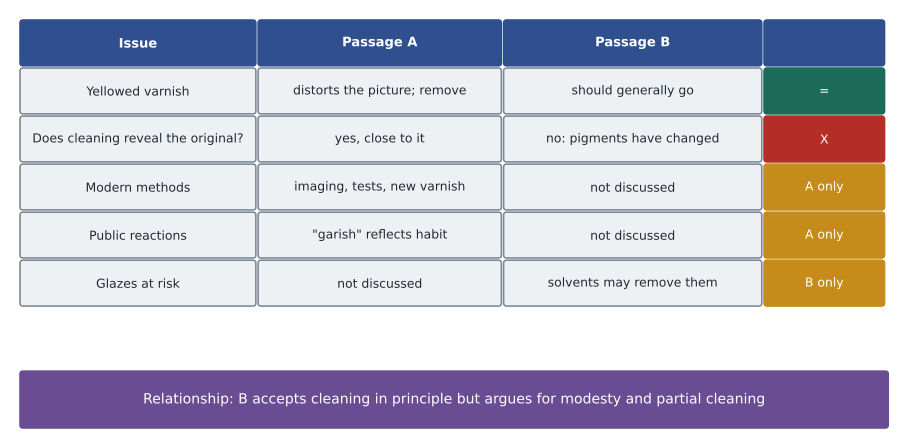
The map for pair J
- Position A: Removing discolored varnish restores something close to what the artist and first viewers saw; careful modern cleaning should be embraced, and objections reflect viewers' habits.
- Position B: Discolored varnish should generally be removed, but cleaning can remove glazes the painter intended and cannot restore the original colors, so it calls for modesty and sometimes partial cleaning.
- Varnish discolors and distorts colors: A says so at length; B accepts it ("few conservators today would defend leaving a heavily discolored varnish in place"). Agreement.
- Whether cleaning recovers what the artist saw: A says it restores "something much closer" to it; B says pigment changes mean a cleaned painting may present colors that never existed. Disagreement.
- Risk to the painter's own effects: only B (glazes chemically similar to varnish).
- Modern methods: only A describes them (magnification, imaging, solvent tests, removable synthetic varnish).
- Public reactions: only A (critics find colors garish).
- Relationship: B accepts cleaning in principle but questions A's confidence and argues for modesty. Claim and qualification, with a specific disagreement about whether cleaning reveals the original.
Worked problem
Sample question (written for this course)
Question: "The authors of the two passages would be most likely to disagree about whether" (A) natural varnishes darken as they age. (B) conservators use imaging techniques before cleaning a painting. (C) a carefully cleaned painting shows viewers essentially what its first viewers saw. (D) heavily discolored varnish should generally be removed. (E) some painters applied translucent glazes over their paint.
Show solution
- (C) is correct. A says cleaning restores "something much closer" to what the first viewers saw and that a cleaned painting is "finally seen"; B argues that changed pigments mean a cleaned painting may show a balance of colors that never existed. One yes, one no.
- (A) is a point of agreement: both accept that natural varnish discolors.
- (B) is discussed only in A; B neither affirms nor denies it.
- (D) is a point of agreement: B says few conservators would defend leaving heavily discolored varnish in place.
- (E) is raised only in B; A never discusses glazes.
Answer: (C). Use the voting test: only the credited answer gets one yes and one no.
Response questions
Some questions ask how one author would respond to a claim in the other passage. These require you to apply an author's reasoning to a claim that author never directly discusses. The answer must follow from what the author says, not from what a reasonable person might add.
For pair J, consider: "How would the author of Passage B most likely respond to the claim in Passage A that a cleaned painting is 'finally seen'?" B's reasons give a clear answer: cleaning may reveal changed pigments and may remove intended glazes, so a cleaned painting is not simply the original seen at last. The credited answer would say something like "it overstates what cleaning can achieve, because a cleaned painting reflects changes that cleaning cannot reverse."
Wrong answers to response questions are often too strong ("B would reject cleaning as vandalism") or off-target ("B would argue that public reaction is irrelevant", an issue B never addresses). Thomas noticed that the too-strong answers tended to use language from the critics A mentions, such as "garish," rather than language B itself uses. Harriet said that was a good catch: test writers sometimes give an author words that belong to a different voice.
Shared-concern questions
A shared-concern question asks which question both passages are trying to answer. The credited answer is usually broad enough to cover both passages but specific enough to exclude topics neither addresses. For pair J: "What should conservators do about discolored varnish on old paintings, and what can cleaning achieve?" A narrower answer such as "Do glazes survive solvent cleaning?" captures only B; a broader one such as "What is the purpose of art?" goes beyond both.
Overall relationship questions
The overall relationship question is the payoff of the relationship sentence on your map. The credited answer names the relationship accurately, and the most common wrong answers misjudge its strength: calling a qualification a refutation, or calling partial agreement complete agreement. Others reverse the roles of the passages, describing B as making A's claim.
Worked problem
Sample question (written for this course)
Question: "Which one of the following most accurately describes the relationship between the two passages?" (A) Passage B refutes the central claim of Passage A by showing that varnish does not discolor. (B) Passage B describes a method of cleaning that Passage A criticizes. (C) Passage A and Passage B discuss different art forms. (D) Passage A responds to objections raised in Passage B. (E) Passage B accepts the practice Passage A defends but challenges the confidence with which Passage A presents it.
Show solution
- (E) is correct. B agrees heavily discolored varnish should be removed but argues for modesty and partial cleaning.
- (A) is too strong and factually wrong: B accepts that varnish discolors.
- (B) reverses the roles: A describes and defends methods; B does not describe a method A criticizes.
- (C) is false: both discuss the cleaning of paintings.
- (D) reverses the order: A does not respond to B; B qualifies A.
Answer: (E). Match both the direction and the strength of the relationship.
The October 19 set
The first half of the evening ended with eight relationship questions drawn from three pairs. Ji-won answered all eight correctly; Thomas and Élodie seven; Marcus six; Dani six. Dani's two misses were both agreement questions where she chose an answer one author supported and the other ignored. She wrote the voting test on an index card: "Both vote. Same vote. Nobody abstains." Élodie said she would use it too.
Questions that combine families
Some questions combine relationship skills with other families. "Which one of the following is a claim made in Passage B that the author of Passage A would most likely reject?" combines a detail question (find the claim in B) with a response question (apply A's reasoning). Work it in two steps: first list the claims in B that bear on A's position, then apply the voting test to each candidate. For pair J, B's claim that "a cleaned painting may present a balance of colors that never existed" is one A would most likely reject, since A says a cleaned painting is "finally seen."
Élodie said that breaking combined questions into two steps slowed her down at first but saved time overall, because she stopped rereading both passages for every choice. Harriet said that was the pattern she expected: methods feel slow until they become automatic, and then they are faster than guessing.
Common mistakes
MistakeChoosing an agreement answer that one author supports and the other does not address.
InsteadBoth authors must support the answer; silence is not agreement.
MistakeChoosing a disagreement answer that only one author discusses.
InsteadBoth authors must take a position, and the positions must conflict.
MistakeCalling a qualification a refutation.
InsteadMatch the strength of the relationship as well as its direction.
MistakeAnswering a response question with what a reasonable person would say.
InsteadApply the author's own reasons to the claim.
MistakeGiving an author words that belong to another voice.
InsteadCheck that the answer's language fits the author it is attributed to.
Summary and key terms
- Relationship questions include agreement, disagreement, overall relationship, response and shared-concern questions.
- Agreement answers need support from both passages; disagreement answers need conflicting positions from both.
- The voting test: two of the same vote means agreement, one yes and one no means disagreement, any abstention means wrong.
- Response questions apply one author's reasons to a claim in the other passage.
- Overall relationship answers must match both direction and strength.
- Agreement question
- A question asking which statement both authors would accept.
- Disagreement question
- A question asking which statement the authors would judge differently.
- Voting test
- A check that asks how each author would vote on an answer choice.
- Response question
- A question asking how one author would answer a claim in the other passage.
- Shared-concern question
- A question asking which question both passages address.
Practice problems
Work each problem on paper first, then reveal the answer to check.
In pair J, on what point do the authors agree?
Show answer
That heavily discolored varnish distorts colors and should generally be removed.
Which issue in pair J is raised only by Passage B?
Show answer
That cleaning can remove glazes the painter intended, or that pigments change with age.
Why is "conservators use imaging before cleaning" wrong for a disagreement question on pair J?
Show answer
Only Passage A discusses it; B neither affirms nor denies it.
State the voting test for agreement questions.
Show answer
Both authors must vote the same way on the answer; neither may abstain.
Write a shared-concern question for pair J.
Show answer
What should conservators do about discolored varnish, and what can cleaning achieve?
Lesson quiz · 5 questions
Score 60% or more to complete this lesson.
Create a free account to save your progress, take quizzes and earn a certificate.