
LSAT-121 · Lesson 1 of 12 · 21 min
How comparative passage sets work
▶ Video coming soon A video version of this lesson is on the way.
On Monday, October 5, Harriet Nakamura-Fox opened a new series of evening sessions with a slide that showed only two words: "Passage A" and "Passage B." The Thursday Circle already met for Logical Reasoning, the Tuesday workshop covered flaws, the Sunday clinic covered inference and the Wednesday reading lab was working through the basics of Reading Comprehension. The Monday sessions, Harriet explained, would take the reading skills one level further: comparative passages, attitude and analogy questions, the hardest question families and the speed needed to finish a section without guessing.
'Everyone here has met a comparative set on a practice test,' she said. 'Most of you treated it as two short passages that happened to be printed together. That works until the questions start asking how the passages relate, and then it falls apart. Comparative reading is its own skill. Tonight we look at what the set is, how it is built, and why it rewards a different way of reading.'
Élodie said that comparative sets were where her timing problems had begun on the September diagnostic. She had read Passage A carefully, then reread it after reading Passage B because she could not remember what it said, and lost almost three minutes. Harriet said that was the most common pattern she saw, and that the fix was a method, not faster reading.
Where comparative sets appear
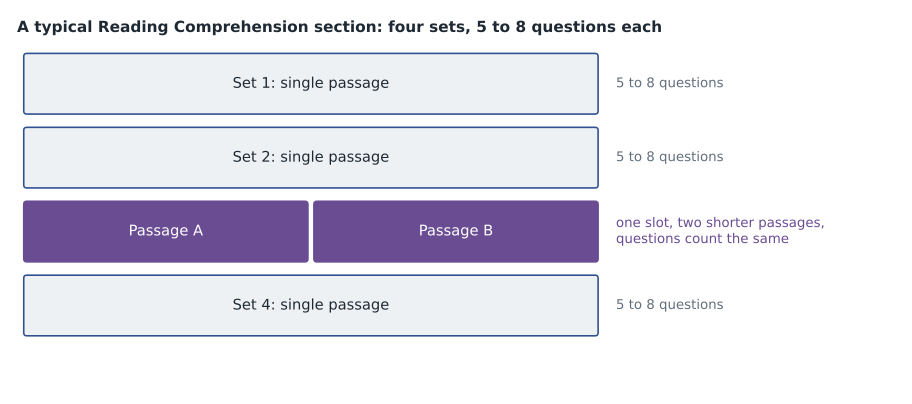
The scored Reading Comprehension section contains four sets of questions. According to LSAC, each set is based on a single passage or on a pair of related passages, and each is followed by five to eight questions. A typical section has three or four single passages and one or no comparative set. The comparative set is not a bonus passage; it occupies one of the four slots, and its questions count exactly as much as any others.
In the current format, through June 2027, the Reading Comprehension section lasts 35 minutes. LSAC has announced that from August 2027 the section will come first, last 52 minutes and contain 40 questions, 27 of them scored. LSAC has said the new format will test the same skills and question types, so the comparative skills in this course apply to both formats.
Two passages in a comparative set are usually shorter than a single passage. Their combined length is roughly that of one standard passage. The two passages are written by different authors, or at least present different perspectives, and they share a topic. They may agree on some points and disagree on others; one may respond to the kind of argument the other makes; or they may approach the same subject from different angles without engaging each other at all.
What makes a comparative set different
The questions in a comparative set fall into three groups. Some ask about only one passage: a detail in Passage A, the purpose of a paragraph in Passage B. These work exactly like questions about single passages, and the methods from Reading Comprehension I apply unchanged. Some ask about both passages separately but in parallel: "Which one of the following is mentioned in Passage A but not in Passage B?" And some ask about the relationship between them: whether the authors would agree on a point, how one author would respond to the other, or which relationship between two other texts is most like the relationship between Passage A and Passage B.
The relationship questions are what make the set distinctive. They cannot be answered by understanding each passage on its own; they require holding both in mind and comparing them. That is why rereading Passage A after Passage B is so costly. If you did not record what A said while you read it, you have to recover it later, under time pressure, and the comparison suffers.
Harriet put it this way: 'Reading a comparative set is like reading two witnesses' statements about the same event. You care about what each one says, but you care even more about where their stories line up and where they diverge.' Dani, who works as a paralegal, said she did exactly that at work when summarizing deposition transcripts, and that her summaries always had a column for points of agreement.
Reading Passage A with Passage B in mind
The core habit of comparative reading is simple to state: read Passage A as you would any passage, but finish it with a clear, short summary of its position. Then read Passage B looking for how it relates to A. Most of the comparison happens during the reading of B, not afterward.
For Passage A, record four things: the topic, the author's main claim, the main reasons given, and any qualifications or concessions. For Passage B, record the same four things, and add a fifth: the relationship to A. Does B agree with A? Disagree? Agree on the facts but draw a different conclusion? Discuss a different aspect of the same topic? Answer the question that A raises, or raise an objection A did not consider?
This is not extra work. It replaces the rereading that most students do anyway, and it puts the comparison where it belongs: in your notes, ready for the relationship questions.
A first comparative pair
Harriet handed out the first pair of the series. Read both passages, then write a one-sentence summary of each and one sentence describing how they relate.
Comparative pair H (law): the fine print (written for this course)
Passage A
Consumer law has long relied on disclosure. If a business must state its terms clearly before a customer agrees, the reasoning goes, the customer can compare offers, avoid unfair bargains and hold the business to what it promised. Legislatures have responded to nearly every new consumer problem by requiring more disclosure: longer notices, mandatory summaries, highlighted boxes and checkboxes confirming that the customer has read the terms.
The difficulty is that almost no one reads them. Studies of online shoppers have found that only a tiny fraction open the terms of service at all, and that those who do rarely stay long enough to read more than a few lines. This is not laziness. A typical consumer agrees to dozens of standard-form contracts a year, many of them thousands of words long, and could not read them all without giving up much of their working life. Adding more disclosure to this pile does not inform consumers; it buries the few terms that matter under many that do not.
The persistence of disclosure rules, then, owes less to their effectiveness than to their convenience. They are cheap for legislatures to enact and easy for businesses to satisfy, and they allow courts to say that a consumer who clicked "I agree" consented. Protecting consumers from unfair terms requires something disclosure cannot supply: rules that forbid certain terms outright, whatever the fine print says.
Passage B
Critics of mandatory disclosure are right that few consumers read contract terms, but they draw the wrong conclusion from that fact. Disclosure need not work by persuading every customer to read every word. It works if enough informed readers exist to discipline the market: consumer advocates, journalists, regulators and a small minority of careful buyers who publicize bad terms and steer others away from them.
Disclosure can also be redesigned. A short, standardized summary that presents the price, the cancellation terms and the few other provisions most consumers care about, in the same format across competing businesses, can be read in less than a minute. Machine-readable disclosure goes further, allowing comparison tools to read terms on a consumer's behalf and flag unusual ones.
Outright bans on particular terms have a place, but they are blunt. A term that is unfair in one market may be reasonable in another, and legislatures are slow to update lists of prohibited clauses. Well-designed disclosure, by contrast, lets markets adjust while keeping terms open to scrutiny. The goal should be better disclosure, not its abandonment.
Summaries and the relationship
Harriet's summaries:
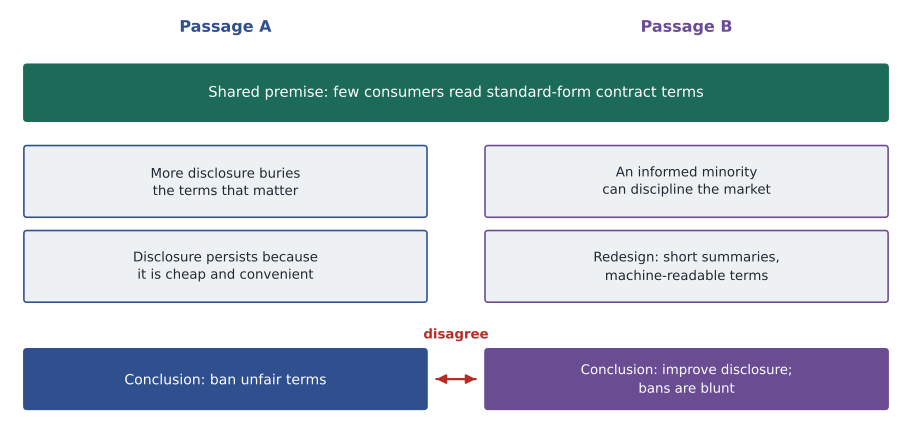
- Passage A: Mandatory disclosure fails because consumers do not and cannot read contract terms; protecting consumers requires banning unfair terms outright.
- Passage B: Disclosure can work even if most consumers do not read, through informed minorities and better design; bans are too blunt, so disclosure should be improved rather than abandoned.
- Relationship: Both authors agree that few consumers read contract terms. They disagree about what follows: A concludes that disclosure should give way to bans; B concludes that disclosure should be redesigned and bans used sparingly.
Thomas said he had written almost the same relationship sentence, but had missed that both authors accept the fact about reading. Harriet said that shared ground is often the most valuable thing to note, because the questions love to ask what the authors would both accept.
Kinds of relationships between passages
Over the series, the group would meet five common relationships between comparative passages. Harriet listed them on the first night so the group could start naming them.
- Direct disagreement: the authors take opposite positions on the same question.
- Same premises, different conclusions: the authors agree on the facts but draw different lessons, as in pair H.
- General and specific: one passage states a general principle and the other discusses a particular case, possibly one the principle would cover.
- Claim and qualification: one passage makes a claim and the other accepts it in part but limits or complicates it.
- Different angles: the passages discuss the same subject for different purposes, such as one describing a scientific finding and the other its policy implications, without engaging each other directly.
Ji-won said that this list was the same as a test plan with five categories, and that she would try to classify every pair before reading the questions. Harriet said that was exactly the habit she wanted.
Worked problem
Sample question (written for this course)
Question: "Which one of the following most accurately describes the relationship between Passage A and Passage B?" (A) Passage A proposes a reform that Passage B argues has already been adopted. (B) Passage B provides evidence that supports the conclusion of Passage A. (C) Passage A discusses consumer contracts in general, while Passage B discusses only online contracts. (D) The passages agree that consumers rarely read contract terms but disagree about whether disclosure can nonetheless protect them. (E) The passages disagree about whether most consumers read the contracts they sign.
Show solution
- (D) is correct. It captures both the shared premise and the disagreement about what follows from it.
- (A) misdescribes both passages: neither says any reform has been adopted.
- (B) reverses the relationship: B argues against A's conclusion.
- (C) invents a difference in scope; both passages discuss standard-form contracts generally.
- (E) gets the shared premise backwards: both authors agree that few consumers read contract terms.
Answer: (D). Name the shared ground and the point of difference before reading the choices.
The order of the questions
In a comparative set, the questions do not always follow the order of the passages. A question about Passage B may come before one about Passage A, and relationship questions may appear anywhere. Read each question stem carefully to see which passage it concerns. Words such as "the author of Passage A," "both passages," and "Passage B, but not Passage A" tell you where to look.
Marcus said he planned to underline the passage reference in every stem. Harriet suggested something faster: on the digital interface, simply say the reference to yourself before reading the choices. '"This is a B question." "This is a both question." Three seconds, and you avoid the most common careless error in comparative sets: answering about the wrong passage.'
Why comparative sets reward preparation
Students often fear comparative sets because they look unfamiliar. In practice, many students find that their accuracy on comparative sets rises faster with practice than on any other passage type, because the questions are predictable once the relationship is clear. If you know where the authors agree and disagree, a large share of the questions can be answered before you read the choices.
The session ended with a short timed pair. Thomas and Ji-won answered all six questions correctly; Élodie, Marcus and Dani answered five. Élodie finished a minute faster than on her diagnostic comparative set because she wrote a summary after Passage A instead of rereading it. Harriet said that one habit would carry the rest of the series.
A note on scratch paper and the screen
On test day the passages appear on screen beside the questions, and the interface lets you highlight text. Whether you write your summaries on scratch paper or keep them in your head, practice the same way you will test. LSAC's instructions for your test date set out what you may use; follow them rather than habits from earlier formats.
Common mistakes
MistakeTreating a comparative set as two unrelated short passages.
InsteadRead Passage B looking for how it relates to Passage A, and record the relationship.
MistakeRereading Passage A after finishing Passage B.
InsteadWrite a short summary of A before starting B, so you never have to reread it.
MistakeNoting only disagreements.
InsteadRecord shared premises too; questions often ask what both authors would accept.
MistakeAnswering a question about the wrong passage.
InsteadIdentify the passage reference in every stem before reading the choices.
MistakeAssuming comparative sets are worth more or less than single passages.
InsteadA comparative set fills one of the four slots, and its questions count the same.
Summary and key terms
- A Reading Comprehension section usually has three or four single passages and one or no comparative set; each set has five to eight questions.
- Comparative passages share a topic but present different perspectives; together they are about as long as one passage.
- Questions ask about one passage, about both in parallel, or about the relationship between them.
- Summarize Passage A before reading B; read B looking for agreement, disagreement and other relationships.
- Common relationships: direct disagreement, same premises with different conclusions, general and specific, claim and qualification, and different angles.
- Comparative passage set
- A pair of related passages by different authors, followed by questions about each passage and about their relationship.
- Relationship question
- A question about how two passages, or two parts of a passage, connect.
- Shared premise
- A claim that both authors accept, even if they disagree about what follows from it.
- Passage reference
- The words in a question stem that identify which passage the question is about.
Practice problems
Work each problem on paper first, then reveal the answer to check.
How many comparative sets does a typical Reading Comprehension section contain?
Show answer
One or none.
What should you record after reading Passage A?
Show answer
Its topic, main claim, main reasons and any qualifications.
What fifth item do you record for Passage B?
Show answer
Its relationship to Passage A.
In pair H, what do the authors agree on?
Show answer
That few consumers read the terms of standard-form contracts.
Which relationship type best describes pair H?
Show answer
Same premises, different conclusions.
Lesson quiz · 5 questions
Score 60% or more to complete this lesson.
Create a free account to save your progress, take quizzes and earn a certificate.