
LSAT-121 · Lesson 6 of 12 · 25 min
New-information questions
▶ Video coming soon A video version of this lesson is on the way.
After the break on October 26, Harriet asked who in the group felt confident about strengthen and weaken questions. Everyone raised a hand; the Tuesday workshop had spent a full evening on them. 'Good,' she said. 'Then you already know most of tonight's lesson. The Reading Comprehension versions use the same logic. What changes is that the argument is a whole passage long, and you have to find the claim the question is about before you can test anything.'
What new-information questions ask
New-information questions introduce a fact, finding or development that the passage does not mention, and ask how it bears on something in the passage. Typical stems include:
- "Which one of the following, if true, would most strengthen the radical-pair hypothesis as described in the passage?"
- "Which one of the following discoveries would most undermine the critics' objection described in the third paragraph?"
- "Which one of the following, if true, would provide the most support for the author's conclusion?"
- "The passage's account of X would be most called into question by which one of the following?"
Because these questions bring in information from outside the passage, they are among the few Reading Comprehension questions where the credited answer is not found in the text. The test is whether you understand the reasoning well enough to see what would help or hurt it.
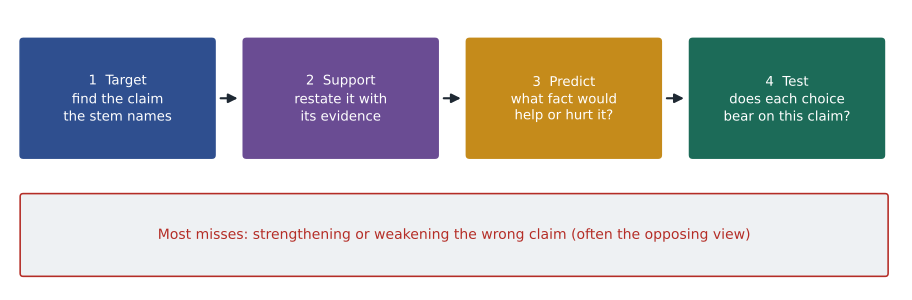
Step one: find the target claim
Every new-information question is about a particular claim: a hypothesis, an argument, an objection or the author's conclusion. The stem names it, sometimes directly ("the radical-pair hypothesis") and sometimes by location ("the objection described in the third paragraph"). Before reading the choices, locate the claim and restate it, together with the reasons or evidence the passage gives for it.
This step is where most errors happen. If the stem asks you to weaken a critic's objection and you instead weaken the author's view, you will choose the opposite of the credited answer. Harriet called this "aiming at the wrong target" and said it accounted for more misses on these questions than any failure of logic.
Step two: predict the kind of fact that matters
The tools from Logical Reasoning apply directly. For an explanation or hypothesis, strengthening facts confirm its predictions or rule out alternatives; weakening facts contradict its predictions or support a rival. For an argument from evidence, strengthening facts show the evidence is representative or reliable; weakening facts reveal bias, unrepresentative samples or confounding factors. For a recommendation, strengthening facts show it will work or that its costs are low; weakening facts show it will not work or has serious drawbacks.
Thomas said he now listed alternative causal stories before reading choices on Tuesday questions, and asked whether that habit applied here. Harriet said it did, especially in science passages, which often present competing hypotheses.
A science passage
Harriet handed out a passage on animal navigation. As you read, note each hypothesis and the evidence the passage gives for it.
Passage L (science): a compass in the eye (written for this course)
Many migratory birds can orient themselves using the Earth's magnetic field. Experiments beginning in the 1960s showed that caged songbirds, prevented from seeing the sky, still hopped in their seasonally appropriate migratory direction, and that altering the magnetic field around the cages shifted that direction predictably. How birds detect so weak a field, however, has proven far harder to establish than the fact that they do.
One long-standing hypothesis holds that birds carry tiny particles of magnetite, a magnetic iron oxide, that act like compass needles linked to nerve endings. Iron-rich structures found in the upper beak of pigeons seemed for a time to confirm the idea, but later work suggested that many of those structures were immune cells unrelated to sensing. The magnetite hypothesis has not been abandoned, but its supporting evidence is weaker than once believed.
A second hypothesis locates the compass in the eye. According to the radical-pair model, light striking certain proteins in the retina, called cryptochromes, produces pairs of molecules with unpaired electrons whose behavior is sensitive to the direction of a magnetic field. The bird might, in effect, see the field as a pattern overlaid on its vision. Several observations fit this model: the magnetic compass of some birds works only in certain wavelengths of light, and weak radio-frequency noise, which should disrupt radical pairs but not magnetite, can disorient birds in experiments.
The two hypotheses are not necessarily rivals. Some researchers suggest that birds use a light-dependent compass to determine direction and a separate magnetite-based sense to detect variations in field strength that could indicate position, much as a navigator uses both a compass and a map. Confirming either mechanism in a living bird remains one of the more difficult problems in sensory biology.
The claims and their support
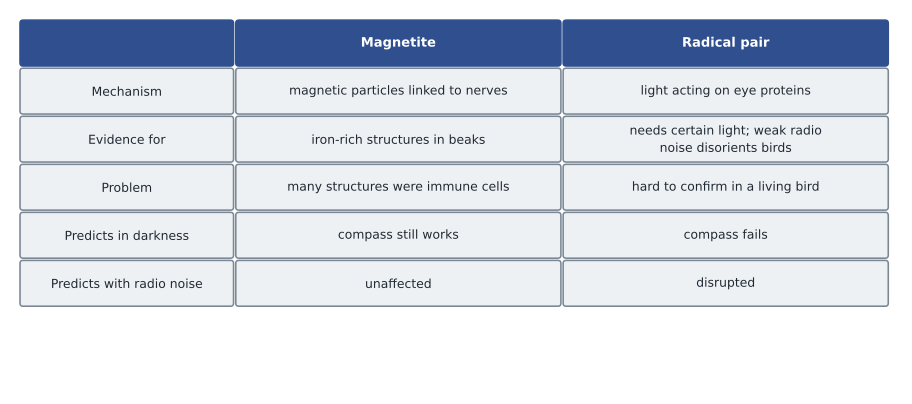
Passage L presents two hypotheses about how birds sense magnetic fields.
- Magnetite hypothesis: tiny magnetic particles linked to nerves act like compass needles. Support: iron-rich structures in pigeon beaks. Weakness: many of those structures turned out to be immune cells.
- Radical-pair hypothesis: light acting on cryptochrome proteins in the retina creates molecule pairs sensitive to field direction. Support: the compass works only in certain wavelengths of light; weak radio-frequency noise, which should disrupt radical pairs but not magnetite, disorients birds.
- Combined view: a light-dependent compass for direction plus a magnetite-based sense of field strength for position.
Look closely at the logic of the radio-frequency evidence. It distinguishes the hypotheses: the passage says the noise "should disrupt radical pairs but not magnetite." Evidence that discriminates between rival hypotheses is especially powerful, and new-information answers often work the same way.
Worked problem
Sample question (written for this course)
Question: "Which one of the following, if true, would most strengthen the radical-pair hypothesis as described in the passage?" (A) Pigeons have more iron-rich cells in their beaks than songbirds do. (B) Birds whose cryptochrome proteins have been altered so that they cannot form radical pairs lose the ability to orient by the magnetic field but retain normal vision. (C) Some migratory birds also use the positions of stars to navigate. (D) Weak radio-frequency noise disorients some insects as well as birds. (E) Magnetite is found in the bodies of many animals that do not migrate.
Show solution
- (B) is correct. It directly links the proposed mechanism to the ability: when cryptochromes cannot form radical pairs, magnetic orientation fails, while vision is unaffected, ruling out general blindness as the cause.
- (A) concerns the magnetite hypothesis and, if anything, recalls evidence the passage says was weaker than believed.
- (C) describes a different navigation method and does not bear on how the magnetic sense works.
- (D) is tempting but does not show how birds sense the field; insects might be disoriented for other reasons.
- (E) could weaken the idea that magnetite is used for navigation, but it says nothing directly in favor of the radical-pair mechanism.
Answer: (B). The strongest support tests the hypothesis's mechanism and rules out an alternative explanation.
Weakening a claim in the passage
Weakening questions follow the same pattern. To weaken the radical-pair hypothesis, look for a fact that contradicts its predictions: for example, birds orienting normally in complete darkness, where light-dependent proteins could not function. To weaken the critics' objection in a debate passage, look for a fact that removes the problem the critics identify.
Worked problem
Sample question (written for this course)
Question: "Which one of the following, if true, would most weaken the radical-pair hypothesis?" (A) Birds kept in total darkness orient in their migratory direction as accurately as birds kept in normal light. (B) The compass of a bird species can be disrupted by changing the color of light it receives. (C) Cryptochrome proteins are found in the retinas of several migratory species. (D) Some birds use landmarks when close to their destination. (E) Iron-rich structures in pigeon beaks are immune cells.
Show solution
- (A) is correct. The hypothesis depends on light acting on retinal proteins; accurate orientation in total darkness contradicts that prediction.
- (B) fits the hypothesis: wavelength dependence is evidence for it.
- (C) also supports it, by showing the proposed proteins are present.
- (D) is about a different navigation cue.
- (E) weakens the magnetite hypothesis, not the radical-pair hypothesis.
Answer: (A). Find the hypothesis's key prediction and look for a fact that contradicts it.
New information in comparative sets
In comparative sets, new-information questions often ask how a fact would bear on one author's argument, or which fact would support one passage and undermine the other. These are double tests: the credited answer must help one side and hurt the other, so you need both authors' positions clearly mapped.
Harriet returned to pair K on the shorter working week. Passage B argued that the pilots' results could not be generalized because volunteers were unrepresentative and the evidence relied on surveys. A fact that would weaken B's concern: "A later study that randomly assigned hospitals, factories and retailers to a four-day week found productivity gains similar to those reported in the pilots, measured by output records rather than surveys." That fact answers both of B's objections at once, and it would strengthen A.
Ji-won said the random assignment was the key detail, because it addressed self-selection directly. Harriet agreed. Facts that fix a design flaw the passage identifies are a very common form of credited answer.
Traps in new-information questions
- Wrong target: the answer strengthens or weakens a different claim, often the opposing view.
- Restating the passage: an answer that repeats evidence already in the passage adds nothing new and usually does not strengthen further. Some stems explicitly ask for information not already given.
- Out of scope: the answer is about the topic but does not bear on the specific claim, like the answers about star navigation and insects in the first sample.
- Wrong direction: the answer would help when the question asks you to hurt, or the reverse.
- Half-relevant: the answer bears on a related claim but not the one in the stem, like the answer about magnetite in non-migratory animals in the first sample, which bears on magnetite rather than radical pairs.
The October 26 set
The evening ended with eight new-information questions from three passages. Marcus answered all eight correctly; Ji-won seven; Thomas, Élodie and Dani six each. Thomas and Élodie each missed one wrong-target question. Élodie said she would write the target claim in two or three words at the top of her scratch paper before every new-information question. Marcus said science passages were where he felt most at home, because the logic was the logic of testing.
New information and the author's conclusion
Some new-information questions target the author's own conclusion rather than a reported view. In Passage L, the author's final suggestion is that the two hypotheses may not be rivals: birds might use a light-dependent compass for direction and a magnetite sense for position. A fact that would support that suggestion is one showing both systems at work: for example, "Birds whose light-dependent compass is disrupted can still detect changes in field strength, while birds whose iron-rich structures are inactivated can still orient by direction." A fact that would weaken it would show that one mechanism alone accounts for both abilities.
Ji-won said she found these questions easier when she wrote the author's conclusion in the form of a prediction: "If both systems exist, disabling one should leave the other's ability intact." Harriet said that turning a conclusion into a prediction was the single most useful habit for science passages.
Worked problem
Sample question (written for this course)
Question: "Which one of the following, if true, would most support the suggestion in the final paragraph of Passage L?" (A) Some birds orient poorly on overcast days. (B) Magnetite has been found in the beaks of several non-migratory birds. (C) Radio-frequency noise disrupts the compass of some birds. (D) Birds whose light-dependent compass is disrupted can still detect changes in magnetic field strength, and birds with inactivated iron-rich structures can still orient by direction. (E) The radical-pair model was first proposed decades ago.
Show solution
- (D) is correct. It shows two separable abilities supported by two different mechanisms, exactly what the combined suggestion predicts.
- (A) is about visual cues on cloudy days and does not bear on the two mechanisms.
- (B) concerns magnetite in non-migratory birds, which does not show a navigational role.
- (C) supports the radical-pair hypothesis alone, not the combination.
- (E) is about history, not evidence.
Answer: (D). Turn the conclusion into a prediction and look for a fact that confirms it.
Common mistakes
MistakeStrengthening or weakening the wrong claim.
InsteadLocate and restate the target claim named in the stem before reading the choices.
MistakeChoosing an answer that only repeats the passage's evidence.
InsteadLook for a new fact that bears on the claim.
MistakeChoosing an answer that is on topic but does not bear on the claim.
InsteadAsk how the fact would change your confidence in this particular claim.
MistakeIgnoring the mechanism of a hypothesis.
InsteadFacts that test the mechanism or its predictions are the strongest.
MistakeForgetting that in comparative sets an answer may help one author and hurt the other.
InsteadMap both positions so you can test each fact against both.
Summary and key terms
- New-information questions bring in an outside fact and ask how it bears on a claim in the passage.
- First locate and restate the target claim and its support.
- Predict the kind of fact that would help or hurt, using Logical Reasoning tools.
- Facts that test a hypothesis's mechanism or discriminate between rivals are especially strong.
- Traps: wrong target, restatement, out of scope, wrong direction and half-relevant answers.
- New-information question
- A question asking how an outside fact would affect a claim in the passage.
- Target claim
- The specific claim a new-information question asks about.
- Discriminating evidence
- Evidence that one hypothesis predicts and a rival does not.
- Mechanism
- The process by which a hypothesis says an effect is produced.
Practice problems
Work each problem on paper first, then reveal the answer to check.
What does the radical-pair hypothesis predict about birds in total darkness?
Show answer
That their magnetic compass should not work, since it depends on light acting on retinal proteins.
Why is the radio-frequency evidence especially strong?
Show answer
It discriminates between the hypotheses: the noise should disrupt radical pairs but not magnetite.
What is the most common error on new-information questions?
Show answer
Aiming at the wrong target claim.
What fact would weaken Passage B's concern about the four-day week pilots?
Show answer
A study randomly assigning varied workplaces to the shorter week and measuring output records found similar gains.
Name two traps besides wrong target.
Show answer
Any two of: restatement, out of scope, wrong direction, half-relevant.
Lesson quiz · 5 questions
Score 60% or more to complete this lesson.
Create a free account to save your progress, take quizzes and earn a certificate.