
LSAT-121 · Lesson 11 of 12 · 21 min
Review and the error log for Reading Comprehension
▶ Video coming soon A video version of this lesson is on the way.
Marcus was back on Monday, November 16, four days after his test. He said it had gone as he hoped in Logical Reasoning and about as he expected in Reading Comprehension, and that he would not know more until his score was released on December 2. Harriet welcomed him back and said that tonight's first hour was about something every member of the group needed regardless of test date: how to learn from Reading Comprehension mistakes. 'Most students review Reading Comprehension badly,' she said. 'They check the answer key, read the explanation, nod and move on. Then they make the same mistake two weeks later.'
Why Reading Comprehension review is different
In Logical Reasoning, each question is a self-contained argument, and reviewing a missed question means re-examining that argument. In Reading Comprehension, a missed question may trace back to the reading of the passage rather than to the question itself. A student who misread the author's attitude in the second paragraph may miss three questions in the set for the same underlying reason. Review has to look at the passage and the questions together.
Harriet described three levels at which a Reading Comprehension error can arise.
- Reading: the roadmap or comparison map was wrong or incomplete: a voice was misattributed, a relationship mislabeled, a turn missed.
- Question: the reading was sound, but the question was misread: wrong passage, wrong target, missed EXCEPT, wrong question family.
- Answer: the reading and the question were both sound, but the choice was wrong: a trap answer was accepted, or the credited answer was rejected for a bad reason.
Knowing the level tells you what to practice. Reading errors call for passage work; question errors call for stem discipline; answer errors call for study of trap types.
Blind review for passages
The group already used blind review in Logical Reasoning: after a timed set, rework flagged and uncertain questions without seeing the answers, then compare the timed and blind results. For Reading Comprehension, Harriet adds a step before the questions. In blind review, first rebuild your map of the passage, or the comparison map for a pair, carefully and without time pressure. Compare it with the map you made during the timed set. Differences between the two maps often explain the errors before you even look at the questions.
Thomas tried this on the comparative set from the November 9 drill. His timed comparison map had called the relationship "direct disagreement"; his blind review map called it "claim and qualification." The two questions he had missed on the set were both relationship questions that turned on that difference. He said that seeing the two maps side by side taught him more than either explanation had.
The error log
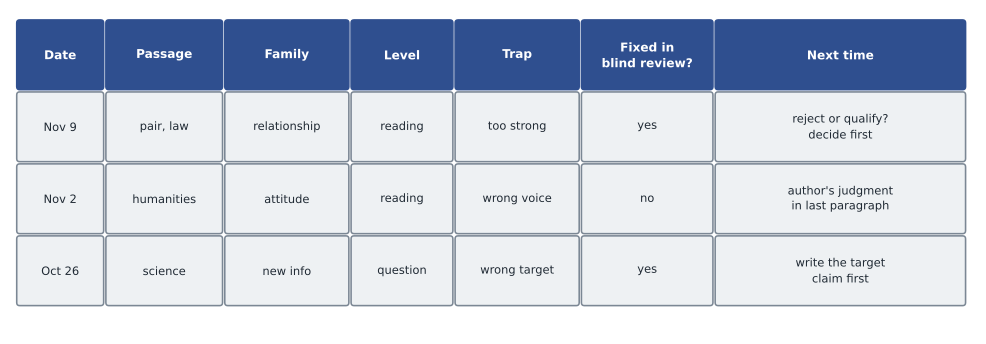
Every member of the group kept the shared error log template Harriet had introduced in September. For Reading Comprehension, she added columns. Each entry now records:
- the date, the set and the passage type (science, law, social science, humanities; single or comparative);
- the question family (main point, detail, inference, relationship, attitude, analogy, new information, EXCEPT and so on);
- the level of the error (reading, question or answer);
- the trap type, if any (wrong voice, too strong, topic match, wrong target, half-relevant);
- whether the error survived blind review (a "knowledge" error) or was fixed in blind review (a "pressure" error);
- one sentence on what to do differently.
The last column matters most. "Read more carefully" is not a useful entry. "In comparative sets, mark whether B rejects or qualifies A before labeling the relationship" is.
Reading the log for patterns
An error log becomes useful once it has enough entries to show patterns. Harriet asked each student to count their Reading Comprehension entries since September by question family and level. The patterns were different for each of them.
- Dani: most errors were answer-level wrong-voice traps, spread across passage types. Her plan: the voice check on every answer, and a weekly drill of attitude and agreement questions.
- Marcus: most errors were reading-level, on humanities passages, involving understated conclusions. His plan: read the last paragraph of every humanities passage for evaluative language before answering.
- Élodie: most early errors were timing-related guesses; since October, her errors had fallen sharply and were scattered. Her plan: keep the pacing plan, and add timed comparative sets twice a week.
- Thomas: most errors were question-level, on relationship and EXCEPT questions, nearly all fixed in blind review. His plan: seatbelt checks and a deliberate second pass with his spare time.
- Ji-won: very few errors; the most common were half-relevant answers on new-information questions. Her plan: write the target claim before reading choices.
Drilling by family
After diagnosis, practice the weak family deliberately. LSAC's LawHub offers official practice tests, and a student with access to them can collect the questions of one family from several tests and work them together, timed, followed by blind review. Harriet recommended drilling in sets of six to ten questions from at least three different passages, so that the skill is practiced across content rather than memorized for one passage.
Harriet warned against one common mistake: reworking the same passage too soon. Once you have seen a passage's answers, your second attempt measures memory, not skill. Wait several weeks before reusing a passage, and use fresh passages for timed practice whenever you can.
Full sections and stamina
Drills build skills, but the test is a full section, and a full test is long. Students who practice only in short sets sometimes find that their accuracy drops in the fourth passage of a section or in the last section of the day. Harriet recommended that, from about six weeks before the test, students take at least one full timed practice test each week, in conditions as close as possible to test day, and review it fully within two days.
Dani asked how to fit full tests around a full-time job. Harriet suggested Saturday mornings for the test and two weekday evenings for review, and reminded her that one fully reviewed practice test is worth more than three unreviewed ones.
Measuring progress
The most useful measures of progress in Reading Comprehension are accuracy by family over time, the gap between timed and blind review scores, and whether sections are finished without guessing. Scores on single practice sections fluctuate with the passages. Harriet suggested tracking a rolling average over the last three full sections rather than reacting to any single result.
Élodie's numbers showed the pattern Harriet hoped to see. Her timed Reading Comprehension accuracy had risen from 18 of 27 on the September diagnostic to around 23 of 27 on recent practice sections, her timed-to-blind gap had shrunk from seven questions to two, and she had not had to guess on a section since late October. Harriet said those three numbers together told a clear story: the method was becoming automatic.
Preparing for the capstone
Harriet ended the first hour by explaining the second. The capstone of the Monday series would be a timed set of two passages: one comparative pair and one single passage, thirteen questions in about seventeen minutes, with Ji-won scaled to about twenty-five and a half. After the set, each student would build blind review maps, complete their error logs and write one sentence about what they would change.
A worked blind review
Harriet walked through Dani's blind review of the comparative set from the November 9 drill. In the timed set, Dani had labeled the relationship "direct disagreement" and had missed two questions as a result. In blind review she rebuilt her map slowly. On the second pass she noticed that Passage B's final paragraph began "None of this argues against the practice," a sentence she had read during the timed set but not marked. With that sentence on her map, the relationship became claim and qualification, and both missed questions became easy.
Her error log entry read: "Pair, social science, relationship, reading level, too strong, fixed in blind review. Next time: before labeling a relationship, find B's sentence about A's basic position." Harriet said the entry was a model: specific, located at the right level, and actionable.
Worked problem
Sample question (written for this course)
Question: "A student misses an attitude question because she read a critic's word as the author's. At what level did the error begin, and what is the best practice response?" (A) Reading level; mark reported views and the author's voice separately while reading. (B) Answer level; memorize more vocabulary. (C) Question level; read the stem twice. (D) It was a timing error; read faster. (E) It cannot be diagnosed; move on.
Show solution
- (A) is correct. The misattribution happened while reading the passage, so the fix is in the reading habit: separating voices.
- (B) misplaces the level; the student knew the word but attributed it to the wrong voice.
- (C) misplaces the level; the stem was understood.
- (D) misdiagnoses the cause; speed was not the problem.
- (E) is unhelpful; this error has a clear diagnosis.
Answer: (A). Diagnose the level where the error began.
Using official explanations
Official practice materials and commercial courses offer explanations for every question. Explanations are useful, but only after blind review. Read them to check your reasoning, not to replace it. If an explanation's reasoning differs from yours on a question you answered correctly, read it anyway; you may have reached the right answer for a wrong reason, which is an error waiting to happen. Thomas said he had found two such cases in his Logical Reasoning log and was starting to check his correct Reading Comprehension answers the same way.
When the log shows no pattern
Sometimes an error log shows errors scattered across families and passage types with no obvious pattern. Harriet said that was usually good news: it often means the methods are sound and the remaining errors are ordinary noise. In that case, the best use of time is timed practice under realistic conditions, and the best measure of progress is the rolling average. Ji-won's log looked like that; Harriet told her to keep doing what she was doing and to add a second full practice test each week in December.
Reviewing correct answers
Students rarely review questions they answered correctly, but some correct answers deserve review: those where you guessed between two choices, those that took far longer than they should have, and those where you were unsure. Flag them during the timed set and include them in blind review. A correct answer reached by luck is an error the log has not yet recorded.
Marcus said that when he worked the November 9 hard-question set at home after his test, half his flagged questions had turned out to be right, and reviewing them anyway showed him he had been right for the right reasons on most but not all of them. Harriet said that was exactly why the flag existed.
A weekly review routine
Harriet suggested a simple routine for the weeks ahead. On Sunday, read the week's error log entries and count them by family and level. Choose one habit to practice that week. On two weekday evenings, drill the families where errors cluster. On Saturday, take a timed section or full test, complete blind review, and log the results. The routine takes about the same time as unstructured practice but produces steady, measurable improvement because each week builds on the last.
Sharing errors with a study group
The Thursday Circle shares error logs, and Harriet encourages students to explain their errors to each other. Explaining an error aloud forces you to state exactly where your reasoning went wrong, and hearing others' errors shows you traps you have not yet fallen into. The group agreed to spend ten minutes of each remaining Thursday session on one error from each member's log.
Dani said the first error she would bring was her November 9 relationship miss, because it was the clearest example of a habit she was still breaking. Élodie said she would bring a main point question from the Wednesday lab where she had chosen an answer about one paragraph. Harriet said both were exactly the kind of error worth sharing: specific, explainable and common.
Common mistakes
MistakeReviewing only the missed question, not the passage.
InsteadRebuild the passage map in blind review and compare it with your timed map.
MistakeWriting vague error log entries such as "read more carefully."
InsteadWrite one specific action for next time.
MistakeTreating every error as the same kind.
InsteadDiagnose the level: reading, question or answer.
MistakeReworking the same passage too soon.
InsteadWait several weeks; use fresh passages for timed practice.
MistakeReacting to single practice section scores.
InsteadTrack accuracy by family and a rolling average over several sections.
Summary and key terms
- Reading Comprehension errors arise at the level of reading, question or answer; practice the level where the error began.
- In blind review, rebuild your passage map first and compare it with your timed map.
- An error log records passage type, question family, level, trap type, whether blind review fixed it and a specific next step.
- Drill weak families across several passages, and avoid reusing passages too soon.
- Track accuracy by family, the timed-to-blind gap and whether you finish without guessing.
- Blind review
- Reworking questions without seeing the answers, to separate knowledge from time pressure.
- Error log
- A record of missed questions organized to reveal patterns.
- Pressure error
- An error fixed in blind review, showing a method that breaks down under time pressure.
- Knowledge error
- An error that survives blind review, showing a gap in understanding.
- Rolling average
- An average of the most recent results, used to smooth out fluctuations.
Practice problems
Work each problem on paper first, then reveal the answer to check.
Name the three levels at which a Reading Comprehension error can arise.
Show answer
Reading, question and answer.
What extra step does Harriet add to blind review for Reading Comprehension?
Show answer
Rebuild the passage or comparison map carefully before reworking the questions, and compare it with the timed map.
Why is "read more carefully" a poor error log entry?
Show answer
It is not specific enough to change behavior.
How soon should you rework a passage you have already reviewed?
Show answer
Not for several weeks.
What three numbers showed Élodie's progress?
Show answer
Her timed accuracy, her timed-to-blind gap and the end of guessing on sections.
Lesson quiz · 5 questions
Score 60% or more to complete this lesson.
Create a free account to save your progress, take quizzes and earn a certificate.