
LSAT-121 · Lesson 2 of 12 · 21 min
Comparative reading
▶ Video coming soon A video version of this lesson is on the way.
After a short break on October 5, Harriet turned from what comparative sets are to how to read them. 'In the first hour you learned to summarize Passage A before reading Passage B,' she said. 'Now we build the tool that makes the relationship questions easy: a comparison map. It takes about thirty seconds to make, and it answers half the questions in the set before you read them.'
The comparison map
A comparison map is a short set of notes, made during and just after reading, that places the two passages side by side. It has three parts.
- Positions: one line for each author's main claim.
- Points of contact: the specific issues both passages address, with each author's view on each issue.
- Relationship: one sentence naming how the passages relate overall.
The points of contact are the heart of the map. Two passages on the same topic rarely address exactly the same questions. Typically they overlap on two or three issues and each discusses one or two issues the other ignores. The questions concentrate on the overlap, because that is where comparison is possible, but they also test whether you notice what only one passage discusses.
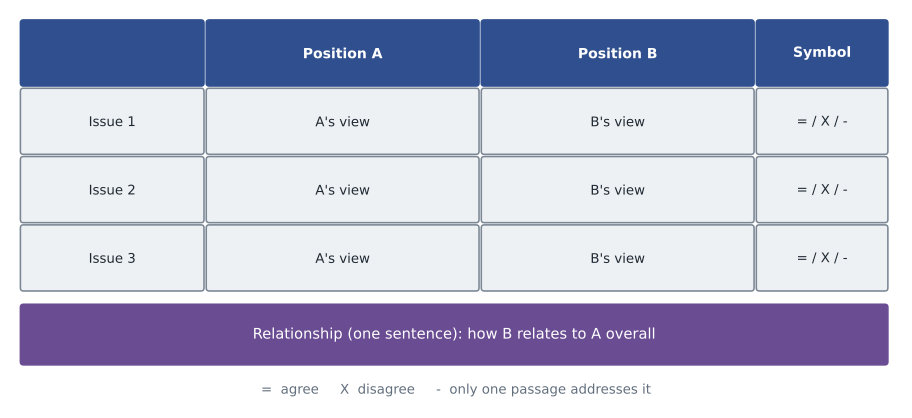
Marcus said the map looked like the comparison table engineers make when evaluating two designs: same rows, two columns, and a note on which design wins each row. Harriet said that was close, except that in a comparison map you never decide who wins. You record what each author thinks, not what you think.
Symbols for the points of contact
Harriet uses three symbols when mapping issues. An equals sign means the authors agree on the issue. A cross means they disagree. A dash in one column means only one author addresses the issue. She warned against a fourth category that many students invent: "they would probably agree." If an author does not address an issue, the map should say so. Whether that author would agree is a question the test may ask, but it must be answered from what the author does say, not assumed during reading.
Élodie asked whether to write the map on scratch paper or keep it in her head. Harriet said that depended on the student. For students who lose track of passages, as Élodie sometimes did, a few words on paper are worth the seconds they take. For students with strong working memory, saying the map to themselves may be enough. The important thing is that the map exists before the questions begin.
Reading Passage B actively
The map grows mainly while you read Passage B. As each claim appears, ask three questions. Does Passage A address this? If so, does A agree or disagree? If not, is this an issue A ignored, or an objection A did not anticipate?
Signal words in Passage B often mark points of contact. Phrases such as "critics are right that," "but they draw the wrong conclusion," "it is true that" and "this does not mean" frequently introduce concessions or responses to the kind of argument made in Passage A, even when B never mentions A directly. Comparative passages are usually written independently, so Passage B rarely says "Passage A argues." The relationship has to be inferred from content.
A second pair
Harriet handed out a science pair. Read both passages and build a comparison map before looking at Harriet's version below.
Comparative pair I (science): moving trees ahead of the climate (written for this course)
Passage A
As the climate warms, the ranges in which many tree species can grow are shifting toward the poles and to higher elevations. Trees, however, move slowly. Their seeds travel at most a few hundred meters a generation, and a generation may last decades. Many foresters now argue that the pace of climate change is outrunning the natural spread of trees, leaving forests populated by species increasingly poorly suited to the conditions around them.
One response is assisted migration: deliberately planting seedlings from warmer parts of a species' range, or from related species, in places where they are expected to thrive in coming decades. Several forestry agencies already adjust their seed transfer rules so that seed may be planted farther from where it was collected than older rules allowed. Supporters see these programs as a modest extension of what foresters have always done, choosing which trees to plant where, informed by better projections.
Waiting carries its own risks. A forest planted with seedlings adapted to the climate of the past may suffer drought stress, pest outbreaks and fire in the climate of the future. Since forests planted today will grow for a century, planting decisions are unavoidably bets on future conditions, and the safer bet is to plant for the climate that is coming rather than the one that is going.
Passage B
Ecologists have good reason to be wary of moving species into places they have never occupied. The history of introduced species is full of well-intended transfers that went wrong: animals released to control pests that became pests themselves, plants introduced for erosion control that overran native vegetation. Even a tree that grows well in its new location can carry fungi and insects, or alter soil and water conditions, in ways no one predicted.
Projections of future climate are also uncertain at the local scale where planting decisions are made. A site expected to become warmer and drier may instead experience more variable conditions, including late frosts that kill seedlings adapted to milder climates. Planting for a forecast that turns out to be wrong could leave a forest worse off than one left to change on its own.
None of this means that nothing should be done. Moving seed modest distances within a species' existing range carries far less risk than introducing a species to an entirely new region, and planting mixtures of seed sources hedges against uncertainty. Assisted migration should proceed cautiously, beginning with the least risky forms and with careful monitoring of the results.
Harriet's comparison map
- Position A: Because tree species cannot migrate as fast as the climate is changing, foresters should plant seedlings suited to future conditions; waiting is riskier.
- Position B: Moving species carries real risks and climate projections are uncertain, so assisted migration should proceed cautiously, starting with the least risky forms.
Points of contact:
- Need for some action: A says planting for the future is the safer bet. B says "none of this means that nothing should be done." Agreement, with a difference in emphasis.
- Risk of acting: A treats assisted migration as a modest extension of normal forestry. B emphasizes the history of introduced species going wrong. Disagreement in emphasis about how risky the practice is.
- Risk of not acting: A stresses drought, pests and fire in poorly suited forests. B does not directly address the risk of waiting. Only A.
- Reliability of projections: A treats planting as a bet on future conditions. B stresses that local projections are uncertain and may be wrong. Disagreement about how much the projections can be trusted.
- Kinds of assisted migration: B distinguishes moving seed within a species' range from introducing species to new regions. A mentions both but does not distinguish their risks. Mainly B.
- Relationship: B accepts the problem A describes and does not reject assisted migration, but argues for a more cautious, graduated version than A's confident endorsement. Claim and qualification.
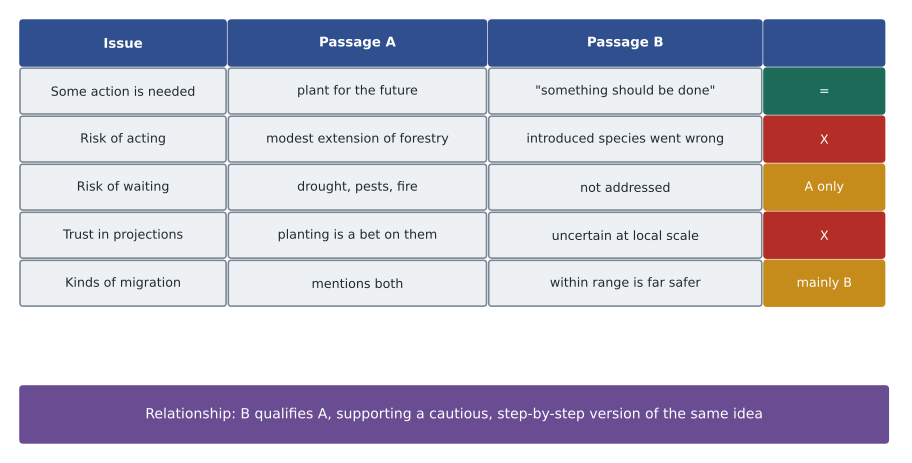
Dani said she had labeled the relationship "direct disagreement" at first, because the tone of Passage B was so cautious. Harriet said this was the most common misreading of claim-and-qualification pairs. 'Tone is not position. Passage B never says assisted migration is wrong. It says do it carefully. If you call that disagreement, you will choose answers saying the author of B opposes assisted migration, and those answers will be too strong.'
Worked problem
Sample question (written for this course)
Question: "The authors of the two passages would be most likely to agree with which one of the following statements?" (A) Foresters should not simply rely on trees spreading naturally as the climate changes. (B) Assisted migration should be abandoned until climate projections become more reliable. (C) Introducing a tree species to an entirely new region carries no greater risk than moving seed within its range. (D) The history of introduced species shows that assisted migration will fail. (E) Seed transfer rules should remain as they were before climate change was recognized.
Show solution
- (A) is correct. A argues that natural spread is too slow; B says "none of this means that nothing should be done" and endorses cautious action. Both reject pure reliance on natural spread.
- (B) is too strong for B, which supports cautious action now, and contradicts A.
- (C) contradicts B, which says moving seed within a range carries far less risk than introducing a species to a new region.
- (D) is too strong for B, which cites failures as reasons for caution, not proof of failure, and A would reject it.
- (E) contradicts A, which approves of adjusted seed transfer rules, and B never defends the old rules.
Answer: (A). Agreement questions are answered from the "=" rows of your map.
What only one passage discusses
The rows marked with a dash are easy to overlook, but they produce a predictable family of questions: "Which one of the following is discussed in Passage B but not in Passage A?" or "Passage A, unlike Passage B, addresses..." For pair I, the risk of waiting appears only in A, and the distinction between kinds of assisted migration is developed only in B. A student with a map can answer such questions in seconds. A student without one must search both passages for each answer choice.
Thomas said this was where he had lost time on practice tests: checking each choice against both passages. Harriet said the map would not eliminate the need to check, but it would tell him where to look first.
How long should a map take?
Students worry that building a map costs time. Harriet timed the group. Making a written map after reading pair I took between 25 and 50 seconds. Answering the six questions that followed took the group an average of under four minutes, compared with more than five minutes on the September diagnostic, where no one had mapped. The map paid for itself on the first two questions.
Ji-won, who has 50 percent extra time, said the map was even more valuable for her, because her extra time was best spent reading carefully, not searching. Harriet agreed: accommodations give you more time, and a good method makes sure that time goes to reading and thinking rather than hunting through the text.
Mapping without writing too much
A map is not a summary of each passage. It should contain only positions, points of contact and the relationship, in a handful of words each. Harriet showed the group two maps of pair I made by former students. One filled half a page with paraphrased sentences and took over two minutes. The other used about twenty words and abbreviations: "A: plant for future, waiting worse. B: careful, uncertain forecasts, start small. = do something. X how risky. X trust forecasts. A only: waiting risks. B only: within-range vs new region. Rel: B qualifies A." The second map was faster and more useful.
Élodie said she would write her maps partly in French abbreviations, since they came to her faster. Harriet said that was fine as long as she could read them back under pressure.
The October 5 pair
The night ended with a timed comparative set on a humanities topic. Ji-won and Thomas answered six of six; Élodie and Marcus five; Dani four. Dani's two misses were both answers that described a disagreement where the passages actually agreed on the point in question. Harriet suggested that Dani add one more check to her routine: before choosing an answer about disagreement, find the "X" row on her map that supports it.
Mapping when the passages do not engage
Some pairs barely address each other: one passage describes a scientific finding, the other its policy implications. The map still helps. When there are few points of contact, the questions tend to ask about what each passage discusses separately and about the overall relationship ("different angles"). A map with mostly dash rows is a signal to expect those question types and to read each passage as carefully as a single passage.
Common mistakes
MistakeWriting a full summary of each passage instead of a map.
InsteadRecord only positions, points of contact and the relationship, in a few words each.
MistakeTreating a cautious tone as disagreement.
InsteadTone is not position; check whether the author actually rejects the other view.
MistakeRecording what an author "would probably" think.
InsteadRecord only what each passage says; decide inferences when a question asks.
MistakeIgnoring issues that only one passage discusses.
InsteadMark them; questions about what one passage includes and the other omits are common.
MistakeWaiting until the questions to compare the passages.
InsteadBuild the comparison while reading Passage B.
Summary and key terms
- A comparison map records each author's position, the specific issues both passages address, and the overall relationship.
- Mark each point of contact as agreement, disagreement or addressed by only one passage.
- Build the map while reading Passage B, using signal words such as "critics are right that" and "this does not mean."
- Cautious tone does not equal disagreement; claim-and-qualification pairs are often misread as opposition.
- A short map takes under a minute and saves more than that on the questions.
- Comparison map
- Short notes placing two passages side by side: positions, points of contact and relationship.
- Point of contact
- A specific issue that both passages address.
- Claim and qualification
- A relationship in which one passage accepts another's claim in part but limits or complicates it.
- Concession
- A statement in which an author grants part of an opposing view.
Practice problems
Work each problem on paper first, then reveal the answer to check.
What are the three parts of a comparison map?
Show answer
Positions, points of contact and the overall relationship.
In pair I, which issue does only Passage A discuss?
Show answer
The risks of not acting: drought, pests and fire in forests poorly suited to the future climate.
Why is "direct disagreement" the wrong label for pair I?
Show answer
Passage B does not reject assisted migration; it supports a more cautious version.
What phrase in Passage B signals that it does not reject Passage A's goal?
Show answer
"None of this means that nothing should be done."
What should you check before choosing an answer that says the authors disagree?
Show answer
That a disagreement row on your map supports it.
Lesson quiz · 5 questions
Score 60% or more to complete this lesson.
Create a free account to save your progress, take quizzes and earn a certificate.