
LSAT-121 · Lesson 10 of 12 · 21 min
Speed and accuracy
▶ Video coming soon A video version of this lesson is on the way.
The second half of the November 9 session was devoted to the topic Élodie had been waiting for since September. Her diagnostic Reading Comprehension section had ended with five guesses. In the Wednesday lab she had built a pacing plan with checkpoints at 9, 18 and 27 minutes and a rule she had written on a card: "Flag sooner, never read faster." Tonight Harriet wanted to look at how that plan handled comparative sets, and at the trade-off between speed and accuracy that every reader faces in the last third of a section.
The basic budget
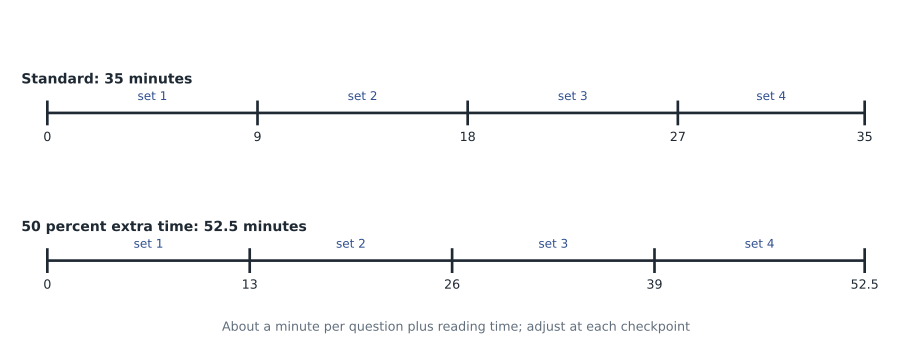
A 35-minute section with four sets gives an average of about 8 minutes 45 seconds per set. That average hides real variation. Sets with eight questions deserve more time than sets with five; a dense passage you find difficult deserves more than one you read easily. A practical budget gives each set roughly a minute per question plus two and a half to three minutes for reading, and then adjusts at the checkpoints.
For accommodated test takers the arithmetic scales. Ji-won's 50 percent extra time gives her 52 minutes 30 seconds, and her checkpoints from the Wednesday lab, at 13, 26 and 39 minutes, are simply the standard checkpoints multiplied by one and a half. Harriet reminded the group that from August 2027, LSAC has announced a 52-minute Reading Comprehension section with 40 questions, of which 27 are scored; anyone testing in that format will need a new budget, built the same way.
Where comparative sets fit
Comparative sets do not need more time than single passages if you map them as you read. Passage A and Passage B together are about as long as one passage, and the comparison map replaces the rereading that otherwise eats time. In the first session, Élodie saved more than a minute on her first comparative set by writing a summary of Passage A instead of rereading it. Since then she had been timing her comparative sets separately, and her average had dropped from about 11 minutes on the September diagnostic to just under 9.
The danger in comparative sets is a different one: a student who is behind at the checkpoint may be tempted to skim Passage B, since Passage A is already summarized. Skimming B destroys the relationship, which is where most of the questions live. Harriet's rule: if you must save time in a comparative set, save it on the questions about only one passage, not on reading B.
The speed-accuracy trade-off
Reading faster is rarely the answer to a timing problem. Most students who try to read faster understand less and then spend the saved time rereading. The time is better saved elsewhere:
- Decide faster between two close answers. Most lost time in Reading Comprehension is spent agonizing over two remaining choices. Set a limit: if you have eliminated three answers and cannot decide within thirty seconds, choose the better one, flag the question and move on.
- Predict before reading choices. A prediction lets you recognize the credited answer quickly and reject others without rereading each against the passage.
- Locate efficiently. A roadmap tells you where a detail lives, so you go straight to the right paragraph.
- Skip strategically. If a single question in a set is consuming time, guess, flag and return if time allows. One question is worth no more than any other.
Thomas said his own timing problem was the opposite of Élodie's: he finished with time to spare but made careless errors. Harriet said that, for him, the trade-off ran the other way. He could afford to spend his spare minutes on a deliberate second check of relationship and EXCEPT questions, the two families where carelessness cost him most.
Flagging and returning
The digital interface lets you flag questions and return to them within the section. Flagging works only if you return with enough time to make it useful. Harriet's guidance: aim to finish the last set with at least a minute in hand; use that minute on flagged questions in reverse order of how close you were to an answer; and never leave a question unanswered, since there is no penalty for wrong answers.
Ji-won said she had found flagging dangerous at first, because she flagged too many questions and returned to none of them. She now limits herself to two flags per set. Harriet said that was an excellent rule: a flag is a promise to return, and too many promises cannot be kept.
Accuracy checks that cost little time
Some checks take only seconds and prevent the most expensive errors.
- The passage reference check: say "A question," "B question" or "both question" before reading choices in a comparative set.
- The voice check: before choosing, confirm the answer belongs to the voice the question names.
- The strength check: before choosing, confirm the answer is no stronger than the passage supports.
- The EXCEPT label check: never choose on an EXCEPT question until every choice is labeled.
Harriet called these "seatbelt checks": they take a moment, they do not feel necessary most of the time, and they matter enormously when they do.
A pacing drill
Harriet ran a drill designed to make the checkpoints automatic. Each student worked a three-set mini section of 26 minutes 15 seconds (Ji-won 39 minutes 22 seconds), with checkpoints called out by a timer on the video call at 9 and 18 minutes (13 and 26 for Ji-won). The second set was a comparative pair.
Results: Élodie reached both checkpoints on time and answered 18 of 20 without a single guess; she spent 8 minutes 40 seconds on the comparative set. Thomas finished two minutes early, used the time on his flagged questions and answered 19. Ji-won reached her checkpoints with seconds to spare and answered 19. Dani answered 16, losing time on the comparative set when she reread Passage A. Marcus, three days from his test, watched rather than worked.
Élodie said that it was the first time she had finished a mini section feeling she had read every passage properly. Harriet said that was the goal of the plan: not more speed, but no wasted time.
Building your own plan
Each student wrote a one-page pacing plan. The plans differed because the students differed.
- Élodie: work sets in order; checkpoints 9, 18, 27; summarize Passage A, never reread; thirty-second limit on two-answer decisions; two flags per set.
- Thomas: checkpoints as standard; finish early, then second-check relationship and EXCEPT questions; seatbelt checks on every comparative question.
- Ji-won: scaled checkpoints 13, 26, 39; two flags per set; read the last passage as carefully as the first.
- Dani: checkpoints as standard; map comparative pairs in writing; voice check on every answer.
- Marcus, written later for a future attempt if he needed one: science first, humanities third; look for the author's judgment in the last paragraph of humanities passages; thirty-second limit.
When timing is not the real problem
Harriet closed by warning that slow progress sometimes signals a reading problem rather than a timing problem. A student who rereads constantly may not be reading actively; a student who agonizes between answers may not be predicting. Fix the method, and speed usually follows. A student whose blind review score is much higher than their timed score, as Élodie's had been in September, has a method problem under pressure, not a knowledge problem, and the cure is practice under realistic timing until the method runs automatically.
Pacing a comparative set, minute by minute
Harriet walked through Élodie's comparative set from the drill to show what nine minutes looked like in practice. She spent about 1 minute 40 seconds reading Passage A and writing a one-line summary; 2 minutes reading Passage B and completing her map; and the remaining time on seven questions, averaging about 45 seconds each. Two questions took over a minute; she flagged one and returned to it at the end of the section. The plan was not to spend equal time on each question but to keep the total within the budget, letting easy questions pay for hard ones.
Dani compared her own timing on the same set. She had spent nearly three minutes on Passage A because she reread its second paragraph twice, then reread A again while answering the first relationship question. Her total was over twelve minutes. Harriet pointed out that Dani's understanding of the passages was good; her time went to rereading, which the summary habit was designed to remove.
A worked example of the thirty-second rule
Harriet showed a question on which the group had spent the most time in the drill. Two answers remained after quick elimination, and several students had spent more than a minute choosing between them.
Worked problem
Sample question (written for this course)
Question: "Which one of the following most accurately states the main point of Passage B in pair I?" (A) Assisted migration has failed wherever it has been attempted. (B) Climate projections are too uncertain to guide any forestry decisions. (C) Assisted migration should proceed cautiously, beginning with lower-risk forms and careful monitoring. (D) Foresters should never move seed beyond the place it was collected. (E) The history of introduced species is mostly a record of success.
Show solution
- (C) is correct. It matches B's final paragraph, which states its recommendation.
- (A) is unsupported: B cites failures of introduced species in general, not of assisted migration.
- (B) is too strong: B says projections are uncertain at the local scale, and it still recommends cautious action.
- (D) contradicts B, which says moving seed modest distances within a range carries less risk.
- (E) contradicts B.
Answer: (C). Choosing between the two finalists should take seconds: one of them says "any," which B never supports.
Most students had narrowed the choices to two quickly. Those who spent a minute between them were rereading the second paragraph, looking for support for the answer about projections. Harriet said the thirty-second rule exists for exactly this moment: compare the two choices on strength and scope, notice the absolute word "any," choose, and move on.
Practicing under realistic conditions
Since August 2026, nearly everyone takes the LSAT at a test center, with remote testing limited to specific exceptions. Harriet urged everyone testing in January to take at least some practice tests away from home: at a library, an office or anywhere with unfamiliar noise. Reading comprehension suffers more than most skills from distraction, and test-day conditions are rarely as quiet as a familiar desk. Élodie, who will test at a center in Ottawa, said she would take her next two practice tests in a university library carrel. Ji-won said she would practice with the timing of her accommodation in a busy café, since she had no idea how quiet her test room would be.
Stamina
Reading Comprehension is mentally tiring, and accuracy often falls late in a section or late in the test. The pacing plan protects against this by keeping you from spending extra effort early, but stamina also needs practice. Harriet recommended that, in the final weeks, students take full practice tests at the same time of day as their scheduled test, so that their concentration peaks when it will be needed.
Pacing when a passage is unusually hard
Every so often a section contains a passage that is far harder than the others: dense terminology, an unfamiliar subject or an elusive structure. The worst response is to fight it at length while the clock runs. Harriet's advice is to read it once, actively, build the best map you can, answer the questions you can answer with confidence, make sensible eliminations and guesses on the rest, flag them and move on. If time remains at the end, return to the flagged questions with fresh eyes. Students are often surprised how much clearer a hard passage looks after they have worked an easier one.
Thomas said this advice ran against his instincts, because he liked to finish what he started. Harriet said that finishing what you start is a virtue in most of life and a vice in a timed section, where every question counts the same and the hard passage is worth no more than the easy one.
Recovering from a bad set
A set that goes badly can affect the next one, because worry about lost time pushes readers to rush. Harriet's rule is to take one slow breath between sets and to read the first sentence of the next passage as if the section had just begun. The checkpoint plan already accounts for variation; a set that runs long is recovered over the next two sets, not by rushing the very next passage.
Common mistakes
MistakeTrying to read faster to solve a timing problem.
InsteadSave time on decisions, prediction and location instead; read at your normal pace.
MistakeSkimming Passage B in a comparative set to catch up.
InsteadSave time on questions about one passage, not on reading B.
MistakeAgonizing over two remaining answers.
InsteadSet a thirty-second limit, choose the better one, flag and move on.
MistakeFlagging too many questions.
InsteadLimit flags so that you can actually return to them.
MistakeLeaving questions blank.
InsteadThere is no penalty for wrong answers; answer every question.
Summary and key terms
- Budget about a minute per question plus reading time, and adjust at checkpoints; scale by any accommodation.
- Comparative sets need no extra time if you map them; never save time by skimming Passage B.
- Save time on decisions, prediction and location, not on reading speed.
- Use a small number of flags and return to them with time in hand; answer every question.
- Seatbelt checks: passage reference, voice, strength and EXCEPT labels.
- Checkpoint
- A planned time by which you should have finished a set.
- Flag
- A marker on a question you intend to revisit.
- Seatbelt check
- A quick accuracy check that prevents a costly error.
- Pacing plan
- A personal plan of checkpoints and rules for managing a section's time.
Practice problems
Work each problem on paper first, then reveal the answer to check.
What is the average time per set in a 35-minute section with four sets?
Show answer
About 8 minutes 45 seconds.
What are Ji-won's scaled checkpoints?
Show answer
13, 26 and 39 minutes.
Where should you save time in a comparative set if you are behind?
Show answer
On questions about only one passage, never on reading Passage B.
What is the thirty-second rule?
Show answer
If you cannot decide between two remaining answers in about thirty seconds, choose the better one, flag and move on.
Name the four seatbelt checks.
Show answer
Passage reference, voice, strength and EXCEPT labels.
Lesson quiz · 5 questions
Score 60% or more to complete this lesson.
Create a free account to save your progress, take quizzes and earn a certificate.