
LSAT-101 · Lesson 8 of 12 · 18 min
Test day: in-center and remote testing
▶ Video coming soon A video version of this lesson is on the way.
Marcus tested on Thursday, November 12, 2026, at a test center across Columbus. At the next Thursday Circle session, the group wanted to hear everything: what time he arrived, what the room was like, what he was allowed to bring, what happened at the break. Nobody asked what his score was. They knew it would not be released until December 2. Marcus was grateful.
This lesson explains how and where the LSAT is given from August 2026, who can still test remotely, what to expect on test day, and how to plan the days around it. Rules about check-in, identification and permitted items come from LSAC and the testing site and are updated from time to time. Read the instructions LSAC sends you for your own test, and treat them as the final word.
The move to test centers
For most of the 2020s, many LSAT candidates tested at home. The LSAT-Flex began in 2020 as a remote test, and when LSAC added a test center option in 2023, most candidates still had a choice between home and a center. Starting with the August 2026 administration, LSAC moved the multiple-choice LSAT to in-person testing at test centers for almost all test takers, with limited exceptions.
LSAC said the change was meant to protect the long-term security and integrity of the test and to reduce technology and proctoring problems. It reported that remote test takers made up about 40 percent of all test takers but accounted for most score holds, which delay results while security issues are investigated. News coverage connected the decision to a 2025 cheating-services scandal involving the remotely administered LSAT in mainland China. The centers are run by Prometric, a testing company that operates centers for many professional exams.
Argumentative Writing did not move. It stays an online, remotely proctored task taken on your own computer, as Lesson 4 explained.
Who can still test remotely
LSAC allows remote testing for the multiple-choice LSAT only in limited situations:
- Distance. Test takers in the US, US territories and Canada who live more than 180 miles, or three hours' driving time, from a test center with available capacity can request a distance exception.
- Disability. Candidates whose approved accommodations require remote testing for a given administration.
- Military service abroad. Test takers stationed abroad on active US military duty, and their spouses and dependents stationed abroad with them.
- Center closures. If a center closes because of bad weather or other unforeseen circumstances and the candidate cannot readily be moved, LSAC will contact the candidate with other options.
Distance exception requests go through the LSAT Status page in your LSAC account, from the day after registration closes until four days before test center scheduling closes. You must provide proof of your physical address. Requests are handled first come, first served, and LSAC states that preferred days or times are not accommodated. Late requests are not accepted. Decisions are made case by case and are final, and a candidate approved for remote testing is limited to the remote format for that administration. From August 2026, approved remote candidates must also use a smartphone as a second camera during testing.
Thomas checked the nearest center to Halifax and found one in the city, well inside the distance limit. Élodie, in Gatineau, had a different situation: LSAC does not offer in-person LSAT administration in Quebec, so she planned to test at a center in Ottawa, twenty minutes away. A Quebec resident living far from the Ontario or New Brunswick borders might well qualify for the distance exception, but would need to request it within the window.
| Situation | How you test the multiple-choice LSAT | What to do |
|---|---|---|
| Most candidates | At a test center | Register, then schedule a center, day and time early |
| More than 180 miles or 3 hours from a center with capacity (US, territories, Canada) | Remotely, if the distance exception is approved | Request through the LSAT Status page in the window, with proof of address |
| Approved accommodation that requires remote testing | Remotely | Request accommodations by the registration deadline |
| Active US military duty abroad, or spouse or dependent stationed with them | Remotely | Follow LSAC's exception process |
| Any candidate | Argumentative Writing is always remote | Complete it online, as early as eight days before the test |
What test day at a center looks like
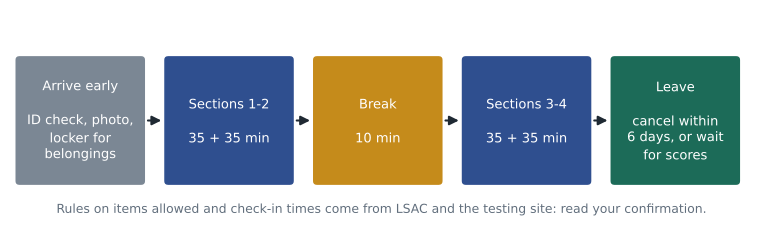
Marcus described his day. He arrived early, as his confirmation recommended. At check-in, staff checked his government-issued photo ID against his registration, took his photograph, and asked him to put his phone, watch, wallet and jacket in a locker. Testing centers for professional exams typically use security procedures such as these, and some check pockets, eyeglasses and sleeves. He was assigned a workstation in a quiet room shared with other candidates, some taking different exams, which meant people came and went at different times. Earplugs or noise-reducing headphones may be provided or allowed; his center offered headphones.
The test ran in the familiar LawHub interface. LSAC had introduced a new delivery platform in LawHub for the in-person test with what it called minor interface changes, and had released practice tests in the new interface beforehand. Marcus had done three of them. 'Nothing on screen surprised me,' he said. 'The room surprised me. Someone two seats over was typing an essay for a different exam the entire time.'
At the break he went to the locker for water and a granola bar, walked the hallway for a minute and was back at his seat with time to spare. Harriet stressed why that matters: LSAC treats a failure to check back in for section 3 after the intermission as a cancellation, recorded as a candidate cancel and reported to schools. 'The break is ten minutes. It is not eleven.'
Scratch work
Scratch work is allowed for working notes. How scratch materials are provided depends on how and where you test, and the rules are in LSAC's instructions for your administration. At test centers, scratch materials are typically provided by the center and collected at the end, and personal paper is not allowed; follow the instructions for your administration. Practice with plain scratch paper, and do not build habits, such as elaborate diagrams, that depend on large amounts of paper or particular tools.
Identification and names
Bring the identification LSAC specifies, and make sure the name matches your LSAC account exactly. If your legal name has changed, update LSAC well before test day. Arriving with the wrong ID is one of the few test-day problems you cannot solve on the spot.
If you test remotely
Candidates approved for remote testing take the test on their own computer with secure proctoring software, a webcam and, from August 2026, a smartphone as a second camera. Expect an identity check and a room scan at the start. The room must be private and quiet, the desk clear, and the computer must meet LSAC's current technical requirements. Run every system check well before test day, and plan what you will do if your internet connection fails: know how to contact LSAC and keep their instructions handy.
The days before
Harriet gave the group her checklist for the final week. She was clear that it reflected good practice, not rules.
- Do your last full practice test four or five days before the test, not the day before.
- Complete Argumentative Writing in its window, ideally early in the week, so it is done.
- Confirm your appointment, center address, travel time and parking. Visit the center beforehand if it is unfamiliar.
- Check your ID and the LSAC instructions for permitted items.
- Keep your sleep schedule steady. If your test is in the morning, practice waking at that time for a week.
- The day before, do a light review at most: a few questions, then stop. Prepare your bag and snack.
Ji-won asked about the day itself. Harriet's answer was simple: eat a normal breakfast, arrive early, and expect to feel nervous. 'Nervousness is not a sign you are unprepared. It is a sign you care. Use the first question of each section to settle in by reading carefully, not quickly.'
During the test: mindset
Every LSAT has questions that feel impossible. Most strong test takers miss several. The danger is not the hard question itself but what it does to the next three. Practice moving on: make your best choice, flag it if there is time to return, and give the next question your full attention. Lesson 11 builds this into a pacing plan.
Do not try to guess which section is unscored, and do not judge your performance during the break. Students who decide after section 2 that the test is going badly often perform worse on sections 3 and 4 than those who simply carry on.
After the test
Without Score Preview, you have six calendar days after your test date to cancel your score, as Lesson 5 explained. Make that decision on facts, not feelings. Ask yourself whether something specific went wrong, such as illness, a technical failure or losing track of time in a section, or whether you simply felt uncertain, which nearly everyone does. Candidates who cancel because a test "felt hard" often discover on later attempts that the hard feeling was normal.
Marcus, with Score Preview, did not need to decide anything yet. He would see his score on December 2 and then have six days. In the meantime he had agreed to keep coming to the group and to help the others with Logical Reasoning drills, which Harriet pointed out was also excellent preparation if he decided to test again.
Worked problem
Planning the travel and timing
Élodie's test is at 8:30 a.m. at an Ottawa center on Saturday, January 16, 2027. Her confirmation asks candidates to arrive 30 minutes early. Travel normally takes 20 minutes, but snow is likely. When should she leave home?
Show solution
- Arrival target: 8:00 a.m., thirty minutes before the start.
- Normal travel: 20 minutes, so 7:40 a.m. at the latest in good conditions.
- Add a winter buffer of at least 30 minutes for snow, parking and finding the room.
Answer: Around 7:10 a.m. Arriving early and waiting costs nothing; arriving late can cost the test.
If something goes wrong
Most test days go smoothly, but it helps to know in advance what to do if they do not.
- If you are ill on test day, consider whether you can test at all. Withdrawing or changing your date before the test does not count toward the testing limits; canceling after testing does.
- If something goes wrong at the center, such as a computer problem, a disruptive noise or a delay, tell the staff immediately, before you leave, and follow up with LSAC as soon as possible. Problems reported on the day are much easier to address than problems reported later.
- If you are running late, contact the center and check LSAC's instructions. Late arrival can mean you are not admitted.
- If a center closes for weather or other emergencies, LSAC contacts affected candidates with options.
Ji-won asked whether candidates with accommodations test in a separate room. Harriet said arrangements depend on the accommodation and the center, and that LSAC's approval letter and confirmation instructions would explain what to expect. The important thing was to read those instructions carefully, not to assume.
Sleep, food and nerves
The basics matter more than any last-minute strategy. Keep your sleep steady in the final week, eat what you normally eat, and avoid trying new caffeine routines on test day. Bring the snack and water you practiced with, if the rules allow you to access them at the break. And expect some nerves: a racing heart in the first minutes is normal and usually settles once you are working.
Common mistakes
MistakeEveryone can still choose to take the LSAT at home.
InsteadSince August 2026 almost all candidates test at a center; remote testing is limited to exceptions such as distance, certain accommodations and military service abroad.
MistakeYou can request a distance exception any time before your test.
InsteadRequests open the day after registration closes and end four days before test center scheduling closes.
MistakeA few extra minutes at the break do not matter.
InsteadFailing to check in for section 3 is treated as a cancellation reported to schools.
MistakeIf the test felt hard, you should cancel.
InsteadNearly every test feels hard; cancel only for a specific problem, within six days.
Summary and key terms
- From August 2026 the multiple-choice LSAT is given at Prometric test centers for almost all candidates, to improve security and reduce technical problems.
- Remote testing is allowed for distance (more than 180 miles or three hours from a center with capacity), some accommodations, US military abroad, and center closures.
- LSAC offers no in-person LSAT in Quebec, so Quebec residents test at a center outside the province or seek an exception.
- Arrive early with matching ID, use the break carefully, and return in time for section 3.
- Argumentative Writing remains remote for everyone.
- Distance exception
- Permission to test remotely for candidates far from a test center with capacity.
- Score hold
- A delay in releasing a score while LSAC reviews an issue such as test security.
- Candidate cancel
- A cancellation recorded by LSAC, for example when a candidate fails to return after the break.
- Prometric
- The company whose test centers deliver the in-person LSAT.
- Second camera
- A smartphone camera that approved remote candidates must use from August 2026.
Practice problems
Work each problem on paper first, then reveal the answer to check.
Name two groups who may still take the multiple-choice LSAT remotely from August 2026.
Show answer
Any two of: candidates more than 180 miles or three hours from a center with capacity; candidates whose accommodations require remote testing; US active-duty military abroad and their spouses or dependents; candidates whose center closes unexpectedly.
Why did LSAC move to test centers?
Show answer
To protect test security and integrity and reduce technical and proctoring problems; remote testers were about 40 percent of candidates but most score holds.
What happens if a candidate does not return for section 3 after the break?
Show answer
LSAC records a candidate cancel and reports it to schools.
Lesson quiz · 5 questions
Score 60% or more to complete this lesson.
Create a free account to save your progress, take quizzes and earn a certificate.