
LSAT-101 · Lesson 6 of 12 · 19 min
How law schools use your score
▶ Video coming soon A video version of this lesson is on the way.
Halfway through October, the Thursday Circle spent a session on a question that had nothing to do with logic. Where does the score actually go, and what happens to it there? The answer turned out to be different for every member of the group. Dani and Ji-won would apply to American schools through LSAC. Thomas would apply to Dalhousie directly and to Ontario schools through a separate service. Élodie would apply to the University of Ottawa through that same Ontario service and to McGill, which does not require the LSAT at all. Marcus, who wanted schools in Ohio and Pennsylvania, had questions about how they would treat two scores.
This lesson follows a score from LSAC to an admission committee in each country. Policies change and differ from school to school, so treat this as a map of how the systems work, and confirm the details with each school you apply to.
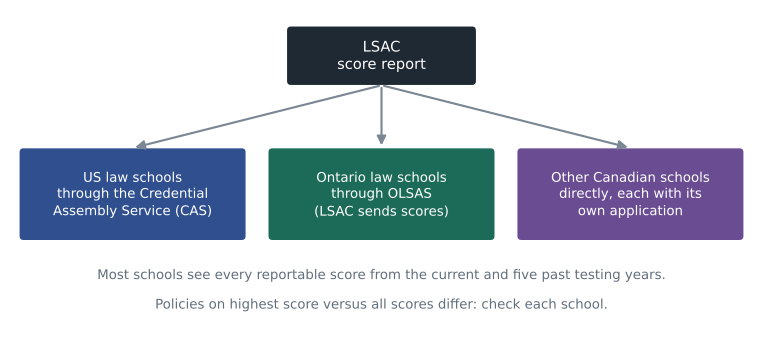
In the United States: the Credential Assembly Service
Nearly every ABA-approved law school requires applicants to use LSAC's Credential Assembly Service, known as CAS. You pay for a CAS subscription (219 US dollars on LSAC's current fee page), send your undergraduate and graduate transcripts to LSAC, and have your letters of recommendation sent through LSAC. For each school you apply to, you buy a CAS law school report (45 US dollars each). The report bundles your LSAT scores, your Argumentative Writing sample, a summary of your academic record with a standardized grade point average, copies of your transcripts and your letters.
The standardized grade point average matters. Universities grade differently, so LSAC converts grades to a common 4.33 scale using its own rules. Your CAS average can differ from the one on your transcript. Applicants are sometimes surprised that a pass/fail course, a repeated course or a grade from a second university is treated differently than they expected.
Marcus had already bought his CAS subscription in 2025. LSAC's fee waiver includes a five-year CAS subscription, so Dani would not have to buy one.
How US schools weigh the score
American law schools publish detailed admissions data each year in what are called Standard 509 disclosures, required by the ABA. They include the 25th, 50th and 75th percentile LSAT scores and grade point averages of the students who enrolled. Those numbers also feed into published rankings, which is one reason many schools pay close attention to them.
Since 2006, ABA rules have had schools report the highest LSAT score of each entering student in that data. Many US schools therefore evaluate applicants mainly on their highest score, though each school sets its own policy and some say they consider all scores. Read each school's statement carefully. A school that says it "considers the highest score but reviews all scores" may still notice a large gap between attempts.
Some US schools also combine the LSAT and grade point average into an index number for an initial sort. Others say they do not. Either way, the LSAT is usually one of the strongest single factors in American admissions, alongside grades. A score well above a school's median can also make an applicant more likely to receive merit scholarship offers.
The testing requirement and alternatives
The ABA's Standard 503 requires accredited schools to use a valid and reliable admission test. In 2022 the ABA council voted to make admission tests optional, but in February 2023 the ABA House of Delegates declined to concur, and the requirement stayed. Many schools accept the GRE as an alternative, and in November 2024 the council allowed schools to seek a variance to admit students without any admission test score, so that the ABA could gather data over several years. In practice, the LSAT remains the test the vast majority of applicants take, and a school that accepts the GRE may still prefer the LSAT. Check how each school treats other tests before deciding the LSAT is unnecessary.
| Item | What it is | Cost (current LSAC fee page) |
|---|---|---|
| CAS subscription | Collects transcripts and letters; required by most US schools | 219 US dollars |
| CAS law school report | Your file as sent to one school | 45 US dollars per school |
| LSAT-only law school report | Scores and writing sample only, for schools that don't use CAS | 45 US dollars per school |
| Fee waiver | Covers LSATs, a five-year CAS subscription and some reports for eligible candidates | No charge if approved |
In Canada: Ontario through OLSAS
Ontario's common law schools take applications through the Ontario Law School Application Service, OLSAS, run by the Ontario Universities' Application Center. You submit one application through OLSAS and choose the Ontario schools you want. OLSAS receives your LSAT results from LSAC. To make that work, your LSAC account must be active, and you must give your LSAC account number on the application.
Schools set their own requirements within that system. The University of Toronto's Faculty of Law, for example, sets out the following for applicants seeking first-year entry in 2027: the OLSAS application deadline was November 1, 2026; the LSAT must have been taken between July 2021 and November 2026; applicants testing after November 1 should still apply on time and list future test dates; the LSAT is required without exception and no other test, such as the GRE, is accepted; and the admissions committee sees and considers every score on the applicant's report from the prior five years. Toronto also tells applicants not to use LSAC's Credential Assembly Service, since Ontario applications go through OLSAS instead.
Osgoode Hall Law School at York University describes a holistic admission policy in which LSAT scores are one of several factors reviewed, alongside others such as academic record and written and oral communication. It notes that successful applicants typically score around the 85th percentile or higher, while stressing that this is not a minimum.
Thomas, aiming for fall 2028, noted that if Toronto kept the same pattern, a November 2027 test would be the latest he could use for that cycle, and that schools like Toronto would see all his scores. 'So no throwaway attempts,' he said. Harriet agreed: 'In a system that sees everything, every attempt should be a real attempt.'
In Canada: other provinces
Law schools outside Ontario generally take applications directly through their own online systems. They receive your LSAT scores from LSAC, typically through an LSAT-only law school report or a similar process each school describes. Deadlines vary but commonly fall in the late fall or early winter for entry the following September, and each school says which LSAT dates it will accept for a given cycle. Policies on multiple scores also vary: some schools use the highest score, some consider all scores, and some combine scores in other ways. Dalhousie, the University of British Columbia, the University of Alberta and every other school publish their own rules.
Canadian schools commonly read an application in categories. A general or regular category may rely heavily on grades and the LSAT. Many schools also have categories for mature applicants, applicants facing access barriers such as disability or financial hardship, and Indigenous applicants, in which the LSAT is weighed alongside other evidence. If one of those categories might apply to you, read its requirements early, since some ask for additional essays or documentation.
In Quebec
Quebec's civil law faculties admit students mainly on academic record, and the LSAT is generally not part of the process. McGill's Faculty of Law, which teaches civil law and common law together in a joint program, states that applicants are not required to take the LSAT. But if you have taken it, or will take it, you must report your test dates, give your LSAT identification number and release your scores, whether or not you think they help. McGill treats a failure to disclose as a material misrepresentation that can lead to an offer being revoked.
There is also a practical point for Quebec residents. LSAC states that it does not offer in-person LSAT administration in Quebec. Since August 2026, when the multiple-choice LSAT moved to test centers for almost everyone, a test taker living in Quebec has generally had to travel to a center outside the province. Élodie, who lives in Gatineau, simply planned to test at a center across the river in Ottawa. For candidates farther from the border, LSAC's distance exception for remote testing, covered in Lesson 8, may apply.
| Member | Applying to | Route | Score policy to check |
|---|---|---|---|
| Thomas | Dalhousie; Ontario schools | Dalhousie directly; Ontario through OLSAS | Whether all scores are considered; latest accepted test date |
| Élodie | University of Ottawa (common law); McGill | Ottawa through OLSAS; McGill directly | Ottawa's score policy; McGill's disclosure rule |
| Dani | US schools in Arizona and nearby states | LSAC CAS | Highest-score policies; scholarship ranges |
| Marcus | US schools in Ohio and Pennsylvania | LSAC CAS | How a second score is weighed |
| Ji-won | US schools in Washington and Oregon | LSAC CAS | Published 509 ranges |
Reading a school's published numbers
For US schools, the 509 disclosure is the most reliable source for the LSAT range of enrolled students. The middle half of the class, from the 25th to the 75th percentile, gives a realistic picture. If your score is at or above a school's median, your score is likely helping your application; if it is below the 25th percentile, the rest of your file has to carry more weight.
Canadian schools publish less standardized data. Many publish averages or medians for the entering class, sometimes with ranges by category, and some publish only general statements. Admissions offices often explain how they weigh scores at information sessions or in frequently asked questions. When a school publishes a percentile, such as Osgoode's statement about the 85th percentile, you can translate it into a score using LSAC's percentile table from Lesson 5.
Worked problem
Translating a percentile into a target score
A school says successful applicants typically score around the 85th percentile or higher. Using LSAC's 2023-24 to 2025-26 table, roughly what score is that?
Show solution
- The table shows 85.17 percent of scores below 165.
- It shows 71.06 percent below 160, so the 85th percentile falls near 165.
- Scores in the low 160s fall below that percentile, and scores above 165 above it.
Answer: About 165. A school's statement like this is a description of typical admits, not a cutoff, so treat it as a target rather than a rule.
What else the score affects
In the United States, scores also influence merit scholarships, which many schools award heavily on LSAT and grades. An applicant a few points above a school's median may receive a significant scholarship offer, while one at the median may receive less. That is one reason some US applicants retake even after reaching a school's median. Canadian schools award most financial aid based on need, though some entrance scholarships consider academic merit.
What the score does not decide
Every school says it reads applications as a whole, and that is not just a slogan. Strong grades, meaningful work experience, a well-reasoned personal statement and good letters can carry an application with a score somewhat below a school's typical range, especially in categories designed for that. A high score does not rescue a careless application either. Harriet put it this way: 'Your score opens doors. Your file decides whether you walk through them.'
Questions worth asking each school
Admissions offices answer many of the same questions every year, and their websites and information sessions usually cover them. Before you finalize your test plan, find each school's answer to these questions:
- Which LSAT administrations will it accept for the cycle you are applying in?
- Does it use the highest score, consider all scores, or use some other method?
- Does it accept any test other than the LSAT, and if so, does it prefer one?
- Does it read Argumentative Writing, and does it ask for any other writing sample?
- Does it have special admission categories that might apply to you, and what do they require?
Write the answers in your school spreadsheet with the date you checked them and a link to the page. Policies change from one cycle to the next, and a note of where you found an answer makes it easy to recheck.
Common mistakes
MistakeAll law schools average your LSAT scores.
InsteadPolicies vary: many US schools focus on the highest score, while some schools, including Toronto, consider every reportable score.
MistakeOntario applicants send their file through LSAC's Credential Assembly Service.
InsteadOntario applications go through OLSAS, which receives LSAT scores from LSAC.
MistakeBecause McGill doesn't require the LSAT, you can leave a score off your application.
InsteadMcGill requires disclosure of any LSAT you have taken; hiding it is a misrepresentation.
MistakeThe ABA removed the LSAT requirement in 2023.
InsteadThe House of Delegates declined to concur in 2023; Standard 503 still requires a valid and reliable test, with GRE acceptance and variances as alternatives.
Summary and key terms
- Most US schools use LSAC's Credential Assembly Service, which sends your scores, writing sample, transcripts summary and letters to each school.
- US schools publish Standard 509 data, including LSAT percentiles of enrolled students, and report each student's highest score to the ABA.
- Ontario applications go through OLSAS; schools elsewhere in Canada take applications directly, and policies on multiple scores vary.
- McGill does not require the LSAT but requires any scores you have to be disclosed; LSAC offers no in-person LSAT in Quebec.
- The score affects admission and, especially in the US, merit scholarships, but files are read as a whole.
- CAS
- LSAC's Credential Assembly Service, which assembles and sends applicant files to US law schools.
- Standard 509 disclosure
- Annual admissions and outcomes data that ABA-approved schools must publish.
- LSAT-only law school report
- An LSAC report containing scores and the writing sample, for schools that do not use CAS.
- Holistic review
- Assessing an application as a whole rather than by a formula.
- Access category
- An admission category for applicants who have faced barriers such as disability or financial hardship.
Practice problems
Work each problem on paper first, then reveal the answer to check.
Dani's target school reports a 25th to 75th percentile LSAT range of 152 to 158. Where does her diagnostic of 148 sit, and what does that suggest?
Show answer
Below the 25th percentile, so she should aim to raise her score into the range and make the rest of her file strong.
Why did Thomas say "no throwaway attempts"?
Show answer
Ontario schools such as Toronto see and consider every reportable score, so a weak practice-style attempt would remain visible.
Élodie lives in Gatineau, Quebec. Where can she take the multiple-choice LSAT in person, and why?
Show answer
At a test center outside Quebec, such as in Ottawa, because LSAC does not offer in-person LSAT administration in Quebec.
Lesson quiz · 5 questions
Score 60% or more to complete this lesson.
Create a free account to save your progress, take quizzes and earn a certificate.