
LSAT-101 · Lesson 11 of 12 · 19 min
Study methods, review and pacing
▶ Video coming soon A video version of this lesson is on the way.
In the first week of November, Harriet asked each member of the Thursday Circle to share their screen and open their error log. Thomas's had 140 entries, each with a question type and a one-line reason. Dani's had color codes. Élodie's was organized by passage. Ji-won's had a column she had added herself, headed "Changed answer?", with a lot of yeses in it. Marcus's had 38 entries. He had started it late, but every entry was detailed. 'I am finally doing what you told me in September,' he said.
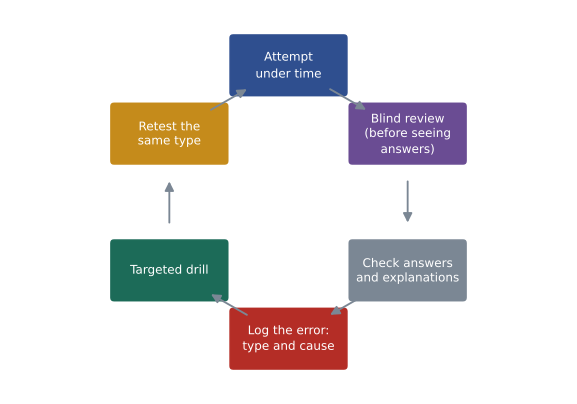
This lesson covers the methods that turn practice into improvement: blind review, the error log, learning from wrong answers, spacing practice, and a pacing plan for test day.
Blind review
Blind review is the single most useful habit in LSAT preparation. After a timed section or test, before you look at the answers, go back to every question you flagged or felt unsure about. Work each one again with no time limit, as carefully as you can, and write down your final answer and a one-sentence reason. Only then check your answers.
Blind review separates two different problems that a timed score mixes together. If you get a question right in blind review that you got wrong under time, you know the skill but lost it to the clock. If you get it wrong both times, you have a concept gap. Comparing your timed score with your blind review score is one of the best measures of where you stand: the timed score is what you can do now, and the blind review score is roughly what you could do with better pacing.
- Mark questions as you go: flag any question where you were less than confident, even if you chose an answer.
- Do blind review the same day or the next day, while you remember your reasoning.
- Write your reasoning down. Thinking "I guess it is C" is not blind review.
- Only after finishing, check the answers and read explanations for every question you missed or were unsure of.
The error log
An error log is a record of every question you miss or guess on, with enough detail to find patterns. It can be a spreadsheet, a notebook or a template like Harriet's.
| Column | What to write | Example (Thomas) |
|---|---|---|
| Source | Test, section and question number | PrepTest, section 2, question 14 |
| Question type | The family from Lesson 3 | Necessary assumption |
| My answer / correct answer | Both letters | D / B |
| Cause | Misread, concept gap, trap, time or second-guessing | Trap: chose an answer that would strengthen but was not required |
| Why the right answer is right | One sentence | Without B, the conclusion fails: the argument needs the survey to be representative |
| Lesson | What you will do differently | Use the negation test on necessary assumption answers |
The last column is the one most students skip and the one that matters most. An entry like "careless" teaches nothing. An entry like "I read 'some' as 'most'; circle quantity words in the stimulus" changes what you do next time.
Review the log itself every week. Count entries by question type and by cause. Thomas found that more than a third of his entries were assumption questions, and that most of those were the same mistake: choosing an answer that would help the argument instead of one the argument requires. Once he learned to test answers by negating them, asking whether the argument falls apart if the answer is false, his assumption accuracy rose from about 41 percent at the diagnostic to about 70 percent by early November.
Learning from wrong answers
Wrong answers on the LSAT are written carefully, and they fall into recognizable patterns. Learning those patterns helps you eliminate faster and more confidently.
- Too strong: the answer says "always", "never" or "proves" when the passage supports only "often" or "suggests".
- Out of scope: the answer brings in something the passage does not discuss, such as a different group or time period.
- Reversal: the answer flips a relationship, such as treating a cause as an effect or a necessary condition as a sufficient one.
- Half right: the first part matches the passage and the second part does not. Read every word of an answer.
- True but irrelevant: the statement is accurate but does not do what the question asks.
- Wrong task: for example, a strengthener offered in a weaken question.
When you review, name the pattern for each wrong answer you seriously considered. Over time you will recognize them in seconds.
Spacing, mixing and retesting
Research on learning offers a few principles that suit LSAT preparation well.
- Spacing: study a question type several times over weeks rather than all at once. Short, repeated practice sticks better than one long session.
- Mixing: once you know the types, practice mixed sets, as the real test does. Blocked practice of one type feels easier but trains you less well to recognize types.
- Retesting: return to questions you missed a week or two later and try them again. If you get them right for the right reason, the lesson has stuck. If you only remember the answer letter, it has not.
Harriet built these into the group's routine: a mixed set of 15 Logical Reasoning questions at the start of each Thursday session, drawn partly from questions members had missed weeks before.
Pacing
Pacing is about using 35 minutes well, not about going as fast as possible. Average times give a starting point: about 84 seconds per Logical Reasoning question and about 78 seconds per Reading Comprehension question, according to LSAC. But averages hide the fact that questions differ in difficulty and that harder Logical Reasoning questions tend to appear more often in the middle and later parts of a section.
Logical Reasoning
For a Logical Reasoning section of about 25 questions, an even pace means about 11 minutes at question 8 and about 22 minutes at question 16. Harriet gave the group slightly faster checkpoints, 10 minutes at question 8 and 21 minutes at question 16, to bank time for harder questions later in the section.
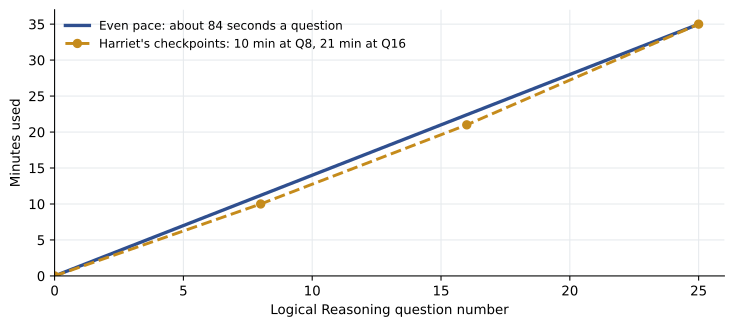
Checkpoints are guides, not rules. If you are behind at a checkpoint, do not panic or rush every remaining question; instead, be quicker to skip a question that is taking too long. If you are ahead, use the time to be careful, not to race.
Reading Comprehension
With four passage sets in 35 minutes, an even pace is a little under nine minutes per set, including reading. Many students aim for about three to four minutes reading and mapping the passage, then five minutes on the questions. Élodie, who reread passages, set herself a rule: one careful read, a passage map of one line per paragraph, then questions. If she needed details, she would go back to the passage for the specific lines a question asked about. Her timing improved within three weeks, and she began finishing all four sets.
Skipping and returning
The most important pacing skill is knowing when to move on. If a question has taken twice its average time and you are not close to an answer, choose your best guess, flag it and move on. A question you skip costs at most one point; a question that eats four minutes can cost you three or four easier questions at the end of the section.
- Answer every question before moving on, even if it is a guess. Never leave blanks to "come back to later", in case time runs out.
- Use the flag to mark questions worth returning to if time allows.
- In the last minute, make sure every question has an answer.
Answer changes
Ji-won's "Changed answer?" column showed a clear pattern: when she changed answers, she more often changed from right to wrong than from wrong to right. That is not true for everyone, and research on test taking suggests answer changes can help when they are based on a specific reason. The problem was the reason. Ji-won changed answers based on a feeling of doubt rather than a specific error.
Harriet gave her a rule: change an answer only if you can name exactly what was wrong with your first choice, such as a word you misread or a part of the argument you missed. "It just feels wrong now" is not a reason. Over the next four practice tests, Ji-won's wrong-way changes fell from four or five a test to one.
Tracking progress
Keep a simple record of every timed section and practice test: date, score or raw score, blind review score, and accuracy by question type. Track a rolling average of your last three practice tests. Plot it if that helps. By November, the group's rolling averages had moved: Thomas from 151 to 157, Élodie from 156 to 160, Dani from 148 to 153, and Ji-won from 160 to 163 at her extended timing. Marcus had taken the November test and was waiting.
| Member | Diagnostic (September) | Rolling average (early November) | Biggest change |
|---|---|---|---|
| Thomas | 151 | 157 | Assumption accuracy from about 41 to about 70 percent |
| Élodie | 156 | 160 | Finishing all four Reading Comprehension sets |
| Dani | 148 | 153 | Conditional language and inference questions |
| Ji-won | 160 (extended time) | 163 (extended time) | Fewer right-to-wrong answer changes |
| Marcus | 157 (practice) | Tested November 12 | Late-section accuracy |
Harriet warned against reading too much into these numbers. Practice test scores can run a little higher or lower than official scores, and the last weeks before a test often bring a plateau. 'The trend is real,' she said. 'The exact number on test day is not something any of us controls.'
Worked problem
Using blind review to decide what to study
On a timed Logical Reasoning section, Marcus scores 19 of 25. In blind review he scores 23 of 25. Of the six questions he missed under time, four were in the last eight questions. What should he work on?
Show solution
- The gap between timed (19) and blind review (23) is four questions, which points mainly to time pressure.
- Most misses came late in the section, which suggests he is spending too long early and rushing at the end.
- The two questions he missed in blind review point to concept gaps worth logging.
Answer: Mainly pacing: use checkpoints and skip earlier. Secondarily, study the two concept gaps.
Drilling well
Drilling means practicing one question type intensively. Done well, it is one of the fastest ways to fix a weakness; done badly, it just repeats mistakes. A good drill session has a clear target and a progression.
- Start untimed with a small set, perhaps eight to ten questions of one type, and write your reasoning for each.
- When your untimed accuracy is high, time the same type at the normal pace.
- Then mix the type into general sets, so you practice recognizing it as well as solving it.
- Review every drill the same way you review a full section, including the error log.
Short drills work better than marathon sessions. Thirty focused minutes on assumption questions, followed by a careful review, usually teaches more than two hours of tired, unreviewed practice.
Reviewing Reading Comprehension
Review Reading Comprehension a little differently from Logical Reasoning. After a passage, compare your passage map with the passage itself: did you identify the main point and each paragraph's role correctly? Did you notice the author's attitude words, such as "persuasive", "overstated" or "fits less well"? Many Reading Comprehension errors come from a map that was slightly off, so fixing the map often fixes several questions at once.
Élodie began writing a one-sentence summary of the author's position after each passage in her reviews, then checking whether each question she missed would have been answered correctly from that summary. More than half of her errors were. 'I was reading carefully,' she said, 'but I was not deciding what the author actually thought.'
Harriet added one more review habit near the end of the course: explaining a missed question to someone else, or to an empty room, in under a minute. If you cannot explain why the right answer is right and the tempting answer is wrong in that time, you have not finished reviewing it.
Common mistakes
MistakeChecking answers immediately after a section is the fastest way to learn.
InsteadBlind review first, then check; otherwise you cannot tell timing problems from concept gaps.
MistakeAn error log entry of "careless" is good enough.
InsteadRecord the specific cause and what you will do differently.
MistakeLeave hard questions blank and come back if there is time.
InsteadAnswer every question before moving on, then flag the ones worth revisiting.
MistakeAlways trust your first instinct, or always reconsider.
InsteadChange an answer only for a specific, nameable reason.
Summary and key terms
- Blind review, reworking uncertain questions before checking answers, separates timing problems from concept gaps.
- An error log with question type, cause and a specific lesson reveals the patterns to study.
- Wrong answers follow patterns such as too strong, out of scope, reversal, half right and wrong task.
- Use spacing, mixed sets and retesting to make learning stick.
- Pace with checkpoints, skip and flag questions that take too long, answer everything, and change answers only for a specific reason.
- Error log
- A record of missed and guessed questions with type, cause and lesson.
- Negation test
- Checking a necessary assumption answer by asking whether the argument fails if the answer is false.
- Checkpoint (pacing)
- A target time at a given question number within a section.
- Spacing
- Spreading practice of a skill over time rather than massing it in one session.
- Mixed practice
- Practicing different question types together, as on the real test.
Practice problems
Work each problem on paper first, then reveal the answer to check.
Élodie has 35 minutes for four Reading Comprehension sets. About how long is an even pace per set?
Show answer
About 8 minutes 45 seconds per set, including reading.
A student's timed score is 18 of 25 and her blind review score is 18 of 25. What does that suggest?
Show answer
Time is not her main problem; she has concept gaps to study before working on speed.
Name three wrong-answer patterns.
Show answer
Any three of: too strong, out of scope, reversal, half right, true but irrelevant, wrong task.
Lesson quiz · 5 questions
Score 60% or more to complete this lesson.
Create a free account to save your progress, take quizzes and earn a certificate.