
LSAT-101 · Lesson 3 of 12 · 21 min
Logical Reasoning and Reading Comprehension at a glance
▶ Video coming soon A video version of this lesson is on the way.
Before anyone in the Thursday Circle took a full diagnostic test, Harriet wanted them to see one question of each kind up close, slowly, with no clock running. 'People rush into timed tests and form habits before they understand what the questions are asking,' she said. 'Tonight we go slowly on purpose.'
This lesson introduces the two scored question types. It is a tour, not a full course: later courses in the program spend three courses on Logical Reasoning and two on Reading Comprehension. Every sample question in this lesson was written for this course in the style of the LSAT; none is an actual LSAT question.
Logical Reasoning: the basic shape
Every Logical Reasoning question has three parts: a short passage, which LSAC calls the stimulus; a question stem that tells you what to do; and five answer choices, exactly one of which is correct. Most stimuli contain an argument, which has two kinds of statement: premises, the reasons or evidence offered, and a conclusion, the claim the reasons are meant to support.
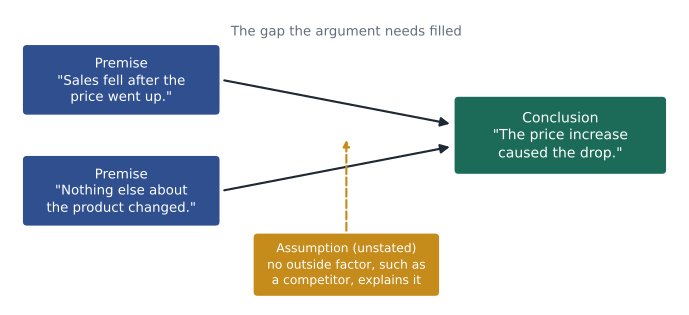
Here is the argument in the figure written out. A company raised the price of its sparkling water, and sales fell the next month. Nothing about the product changed. So the price increase caused the drop. It sounds reasonable, but the argument quietly assumes that nothing outside the product explains the drop. Perhaps a competitor launched a cheaper drink that month, or the weather turned cold. An argument's unstated assumptions are where many LSAT questions live.
The families of Logical Reasoning questions
LSAC and prep companies use slightly different names, but Logical Reasoning questions fall into a handful of families.
| Family | What the stem asks | Example stem wording |
|---|---|---|
| Structure | Identify parts of the argument or how it proceeds | Which one of the following most accurately expresses the main conclusion? |
| Assumption | Find what the argument depends on or what would make it work | The argument relies on which one of the following assumptions? |
| Strengthen and weaken | Find new information that helps or hurts the argument | Which one of the following, if true, most seriously weakens the argument? |
| Flaw | Describe the error in reasoning | The reasoning is most vulnerable to criticism on the grounds that it... |
| Inference | Decide what follows from the statements | If the statements above are true, which one of the following must also be true? |
| Principle and parallel | Match the reasoning to a general rule or to another argument | Which one of the following arguments is most similar in its reasoning? |
| Resolve and explain | Find what reconciles an apparent conflict | Which one of the following, if true, most helps to resolve the apparent discrepancy? |
The phrase "if true" matters. In strengthen, weaken and resolve questions you must accept each answer choice as true, even if it seems unlikely, and ask what it would do to the argument. In inference questions there is no "if true" for the answers: you must accept the stimulus as true and find the answer it supports.
A sample Logical Reasoning question
Worked problem
Sample Logical Reasoning question (written for this course)
Stimulus: "Riverbend's library extended its weekend hours last spring. Since then, the number of library cards issued to teenagers has doubled. Clearly, longer weekend hours make teenagers more interested in reading." Question: Which one of the following, if true, most seriously weakens the argument? (A) Many adults also visited the library on weekends. (B) Last spring Riverbend's high school began requiring every student to have a library card to use the school's online research databases. (C) The library's weekend staff were mostly volunteers. (D) Teenagers in nearby towns also read a great deal. (E) The library added more young adult novels to its collection.
Show solution
- Find the conclusion: longer weekend hours make teenagers more interested in reading.
- Find the evidence: after the hours were extended, teen library cards doubled.
- Spot the gap: the argument assumes the cards reflect interest in reading caused by the hours, and that nothing else explains the rise.
- Test each answer as true. (B) gives a different cause for the rise in cards, a school requirement, and it suggests the cards may not reflect interest in reading at all. That seriously weakens the argument.
- Check the others: (A) and (D) are about other people, and (C) is irrelevant. (E) offers another possible influence on teenagers, but it does not account for the doubling as directly as (B), and it leaves the idea that the cards reflect interest in reading untouched.
Answer: (B). A weakener often offers an alternative cause for the observed effect or shows the evidence does not measure what the conclusion claims.
Thomas chose (E) at first. 'It also explains why teenagers might come,' he said. Harriet agreed that (E) was tempting, then pointed out the difference in strength: (E) adds another possible influence, but it leaves open that the hours mattered too, while (B) supplies a strong rival explanation for the doubling and undercuts the idea that cards measure interest in reading. 'On weaken questions, you are not looking for something negative. You are looking for the answer that most damages the link between this evidence and this conclusion.'
The language Logical Reasoning rewards
Logical Reasoning tests careful attention to a small set of words. These are worth learning early:
- Quantity words: all, most, many, some, few, none. "Most" means more than half; "some" means at least one; neither implies the other's opposite.
- Conditional words: if, only if, unless, requires, whenever. "Only if" introduces a necessary condition; "if" introduces a sufficient one. "You can vote only if you are registered" does not mean that being registered guarantees you can vote.
- Causal words: causes, leads to, results in, because. Many flawed arguments treat two things that happen together as cause and effect.
- Strength words: proves, suggests, may, likely, certainly. An argument that concludes something "certainly" is easier to attack than one that says "likely".
Dani, who reads immigration regulations at work, recognized much of this. 'Regulations are full of "only if",' she said. 'One misread condition and a client misses a deadline.' Harriet said that kind of reading habit transfers directly.
Reading Comprehension: the basic shape
A Reading Comprehension set gives you a passage, usually around 450 to 500 words, or a pair of shorter comparative passages, followed by five to eight questions. Passages come from four broad areas: law, the natural sciences, the humanities and the social sciences. Each section has four sets, and one of them is usually a comparative pair.
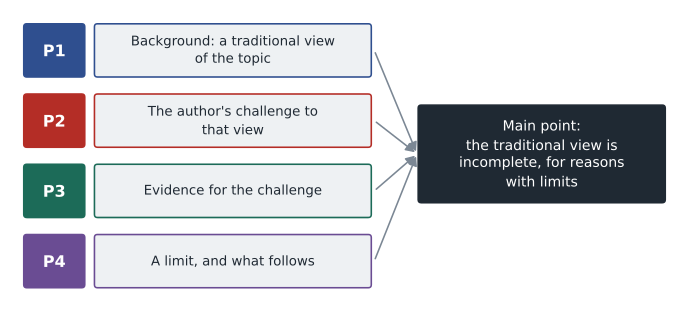
Strong readers do not try to memorize details on a first read. They read for structure: what is the passage about, what is the author's main point, what job does each paragraph do, and where does the author stand? Details can be looked up when a question asks for them; structure has to be built while reading.
The families of Reading Comprehension questions
- Main point and primary purpose: what the passage as a whole argues or does.
- Structure and function: why the author includes a particular sentence, example or paragraph, or how the passage is organized.
- Author's attitude: how the author regards a view, a person or a finding, often a careful mix such as "qualified approval".
- Detail: what the passage explicitly says. The answer is usually a paraphrase, not a copy.
- Inference: what the passage strongly supports without saying outright.
- Application and analogy: which situation is most like one described, or how a principle in the passage applies to a new case.
- Comparative questions (for paired passages): how the two passages relate, where they agree, and where they differ.
A short sample passage
Real LSAT passages are longer than the one below, but this one shows the habits Harriet wanted the group to build.
Worked problem
Sample Reading Comprehension set (written for this course)
Passage: "For much of the twentieth century, historians of household technology argued that washing machines, vacuum cleaners and electric stoves freed women from domestic labor. Later scholars noticed a puzzle: surveys showed that the hours spent on housework barely fell as these machines spread. One explanation is that standards rose along with the machines. Clothes that once were washed weekly were washed after every wearing; rooms once swept were now vacuumed daily. The machines made each task easier, but households did more tasks. This explanation is persuasive for laundry and cleaning, but it fits cooking less well, where the time spent did fall in many surveyed households, partly because of prepared foods rather than appliances." Question 1: The primary purpose of the passage is to (A) argue that household appliances were a failure (B) present a puzzle about household technology and evaluate one explanation for it (C) show that women did more housework than men (D) describe how washing machines work (E) defend the twentieth-century historians against criticism. Question 2: The author's attitude toward the "rising standards" explanation is best described as (A) complete rejection (B) uncritical enthusiasm (C) qualified acceptance (D) indifference (E) confusion.
Show solution
- Map it: sentence 1 states an older view; sentences 2 to 5 give a puzzle and an explanation; the last sentence limits the explanation.
- Question 1: the passage sets out a puzzle and weighs an explanation, including its limits. That is (B). (A) is too extreme; (E) is the opposite of what happens.
- Question 2: the author calls the explanation "persuasive" for laundry and cleaning but says it "fits cooking less well". That is approval with a limit, (C).
Answer: Question 1: (B). Question 2: (C). Notice that the last sentence, the limit, decided the attitude question.
Élodie answered both correctly in under a minute and then admitted something. 'On a long passage, I read every sentence as if it might be on an exam. I read the whole thing twice. That is where my time goes.' Harriet said that was common among strong students and that learning to read once, for structure, would be one of her main projects.
How the two types differ in practice
| Logical Reasoning | Reading Comprehension | |
|---|---|---|
| Text per question | A new short stimulus for each question | One long passage shared by five to eight questions |
| Main demand | Precise analysis of a single argument | Building and holding a mental map of a complex text |
| Typical trap | An answer that is related but does not do what the stem asks | An answer that is true in the world, or true of part of the passage, but not supported or not the point |
| Time pressure | Steady: about 84 seconds a question | Front-loaded: reading the passage, then faster questions |
How the right answer is right
One idea runs through both question types: exactly one answer is defensibly correct, and the other four have a specific reason for being wrong. Wrong answers are not random. They are written to be attractive to someone who reads carelessly or brings in outside knowledge. Common patterns include an answer that goes too far ("always" when the passage says "often"), one that addresses a different issue, one that reverses a relationship, and one that is true but irrelevant to the question asked.
This is why Harriet asked the group, from the first week, to justify every answer in a single sentence and to say for at least one wrong answer exactly why it was wrong. 'If you can only say why your answer feels right,' she said, 'you have not finished the question.'
Outside knowledge
The LSAT often uses topics you may know something about: economics, medicine, art history, environmental science. Your knowledge can hurt you if you let it decide answers. In Logical Reasoning and Reading Comprehension, the test asks what follows from the text, not what is true in the world. Marcus, an engineer, ran into this on a passage about bridge design. He knew the passage's claim was an oversimplification, and he chose an answer reflecting what he knew. It was wrong, because the passage supported a different answer. 'Read like a judge,' Harriet told him. 'Decide on the record in front of you.'
Common mistakes
MistakeIn a weaken question, any negative-sounding answer is a good choice.
InsteadThe correct answer most damages the link between the evidence and the conclusion; tone is irrelevant.
Mistake"Some" means "not all".
InsteadOn the LSAT, "some" means at least one, and it is consistent with "all".
MistakeYou should memorize the details of a Reading Comprehension passage as you read.
InsteadRead for structure and the author's point; look up details when a question asks for them.
MistakeIf you know a topic well, use what you know to pick the answer.
InsteadAnswer from the text; outside knowledge can lead you to answers the passage does not support.
Summary and key terms
- Each Logical Reasoning question has a stimulus, a question stem and five answer choices; most stimuli are arguments with premises and a conclusion.
- Logical Reasoning question families include structure, assumption, strengthen and weaken, flaw, inference, principle and parallel, and resolve.
- Reading Comprehension sets use passages of roughly 450 to 500 words, or comparative pairs, from law, science, the humanities and social sciences.
- Strong readers map a passage's structure and the author's view rather than memorizing details.
- Exactly one answer is right, and each wrong answer has a specific flaw you should be able to name.
- Stimulus
- The short passage in a Logical Reasoning question.
- Premise
- A statement offered as a reason or evidence for a conclusion.
- Conclusion
- The claim an argument tries to support.
- Assumption
- An unstated premise that an argument depends on.
- Necessary condition
- Something required for an outcome, often introduced by "only if" or "requires".
- Sufficient condition
- Something that guarantees an outcome, often introduced by "if".
- Passage map
- A brief note of each paragraph's role and the passage's main point.
Practice problems
Work each problem on paper first, then reveal the answer to check.
In "Only members may use the pool," is membership necessary or sufficient for using the pool?
Show answer
Necessary: it is required, but the statement does not say every member may use the pool.
What is the difference between how you treat answer choices in a weaken question and in a must-be-true question?
Show answer
In a weaken question you accept each answer as true and test its effect; in a must-be-true question you accept the stimulus as true and find the answer it guarantees.
Write a one-line passage map entry for a paragraph that presents data contradicting the theory described in the paragraph before it.
Show answer
For example: "P2: evidence against the theory in P1."
Lesson quiz · 5 questions
Score 60% or more to complete this lesson.
Create a free account to save your progress, take quizzes and earn a certificate.