
LSAT-101 · Lesson 1 of 12 · 21 min
What the LSAT measures and who uses it
▶ Video coming soon A video version of this lesson is on the way.
On the second Thursday of September 2026, five people who had never met logged into the same video call. Thomas Okafor-Reid joined from a credit union break room in Halifax. Élodie Brassard was in a library carrel at the University of Ottawa. Danielle Ruiz, who everyone soon called Dani, was at her kitchen table in Tucson after a long day at the immigration firm where she has worked as a paralegal for six years. Marcus Feld, a civil engineer in Columbus, had his camera pointed at a whiteboard covered in old LSAT notes. Ji-won Park, a software tester in Seattle, had a timer already running on a second screen.
Their tutor, Harriet Nakamura-Fox, let everyone introduce themselves and then asked a question that seemed too simple. 'What do you think the LSAT is testing?' Thomas said logic. Élodie said reading speed. Dani said, half joking, whether you can think like a lawyer before anyone has taught you how. Marcus said it tests whether you studied for the LSAT. Ji-won said she honestly did not know, which was why she was there.
'Each of you has part of it,' Harriet said. 'And Marcus is more right than he wants to be. The skills the test measures can be learned. That is the good news, and it is the reason this course exists.'
This first lesson explains what the Law School Admission Test is for, who makes it, what skills it measures, which schools use it, and what a score can and cannot tell anyone about you. The rest of the course follows the Thursday Circle, as the group came to call itself, from their first diagnostic test to a mini diagnostic in November.
A test built for one purpose
The LSAT is a standardized test used in admission to law school. It is written and administered by the Law School Admission Council, usually shortened to LSAC, a not-for-profit organization whose members are law schools in the United States, Canada and Australia. LSAC also runs the application services most American law schools use, keeps candidates' score records, and publishes official practice tests through its online platform, LawHub.
Unlike a final exam in a university course, the LSAT does not test what you know about law, history, politics or any other subject. You do not need a law-related degree, and you are not expected to know any legal rules. Everything you need to answer each question is in front of you on the screen. What the test measures is how well you read and reason with that material: whether you can find the point of an argument, see what it takes for granted, judge whether evidence supports a claim, and keep track of complex ideas across a long passage.
Those are skills that first-year law students use every day. A first-year student reads judicial decisions that run for dozens of pages, picks out the reasoning that decided the case, and compares it with the reasoning in other cases. On exams they apply rules to new facts and argue both sides. The LSAT was designed to predict how well applicants will handle that kind of work, and LSAC regularly studies how well scores predict first-year grades at its member schools.
The skills, one at a time
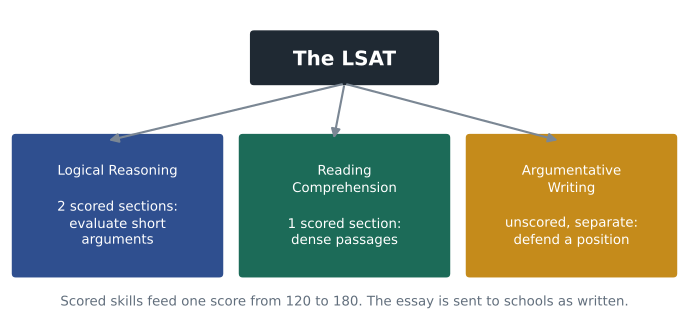
Logical Reasoning
A Logical Reasoning question gives you a short passage, often only a few sentences, and a question about it. Most passages contain an argument: someone draws a conclusion from evidence. You might be asked what the main conclusion is, which statement would weaken the argument, what assumption the argument depends on, or what flaw it contains. Some passages are not arguments at all but sets of facts, and you are asked what must be true or could be true given those facts.
Logical Reasoning rewards precise reading. The difference between "some" and "most", or between a claim that something is necessary and a claim that it is enough, often decides the answer. Dani noticed this right away. 'At work, if a client says "usually", I hear "always" and plan for the worst,' she said. 'Here I have to hear exactly "usually".'
Reading Comprehension
Reading Comprehension gives you longer passages, usually around 450 to 500 words, drawn from law, the sciences, the humanities and the social sciences. Each passage is followed by several questions about its main point, the author's attitude, the function of a particular sentence, details stated in the passage, and inferences you can draw from it. One set in each section is usually a pair of shorter passages that you compare.
The passages are not chosen to be entertaining. They are dense, careful and sometimes dry, much like the scholarly articles and judgments law students read. Élodie, who reads political theory in two languages, expected this section to be her best. Her diagnostic told a more complicated story, which you will see in a later lesson.
Argumentative Writing
Every candidate also completes LSAT Argumentative Writing, an essay task taken separately from the multiple-choice test. You are given a debatable issue with several perspectives, work through some guided prewriting questions, and then write an essay that takes a position and engages with the other views. The essay is not scored by LSAC. Instead, a copy is sent to the law schools you apply to, and admission committees can read it as a sample of how you reason and write under time pressure.
What is no longer on the test
Older prep books and online forums talk about a third kind of question: Analytical Reasoning, better known as "logic games", in which you placed people or things in order or groups according to rules. Logic games were retired after the June 2024 administration and replaced by a second scored Logical Reasoning section. If a book or video spends chapters on games, it was written for the old test. Harriet asked everyone to put such books away. 'They are not useless,' she said, 'but they will spend your hours on a section you will never see.'
Who uses the LSAT
The LSAT is used by law schools in both Canada and the United States, and by some schools elsewhere. How it is used differs between the two countries, and you will look at that closely in a later lesson. For now, the broad picture is enough.
In the United States
Law schools in the United States that are approved by the American Bar Association must, under the ABA's accreditation standards, use a valid and reliable admission test. For decades that test was almost always the LSAT. Since the late 2010s many schools have also accepted the GRE, and in November 2024 the ABA council allowed schools to apply for a variance to admit some or all of a class without any test score, so that it could collect data on how those students perform. A 2022 to 2023 attempt to remove the testing requirement from the standards altogether did not succeed. In practice, the LSAT remains the test that nearly all American law school applicants take, and most schools say they prefer it.
In Canada
Canada's common law schools generally require the LSAT. Applicants to Ontario's law schools apply through a central service, the Ontario Law School Application Service (OLSAS), which receives LSAT results from LSAC. Schools in other provinces take applications directly. The University of Toronto, for example, states that the LSAT is the only standardized test it accepts and that every score on a candidate's report from the past five years will be seen by its admissions committee.
Quebec is different. Its civil law programs generally admit students without the LSAT, and McGill University's Faculty of Law, which teaches both civil and common law, says applicants are not required to take it. McGill adds an important condition: if you have taken the LSAT, you must disclose your scores, and failing to do so is treated as a misrepresentation. This matters to Élodie, who is applying both to the University of Ottawa's common law program and to McGill.
| Where you apply | Is the LSAT used? | How scores travel |
|---|---|---|
| ABA-approved US law schools | Required at most schools; some also accept the GRE or have a variance | LSAC's Credential Assembly Service (CAS) |
| Ontario common law schools | Required (each school sets its own policies) | LSAC sends scores to OLSAS |
| Other Canadian common law schools | Generally required | Directly to each school, which receives your LSAC report |
| McGill (BCL/JD) and Quebec civil law programs | Not required at McGill; any scores you have must be disclosed | As each school directs |
What a score means, and what it does not
An LSAT score is a number from 120 to 180. It summarizes how many scored multiple-choice questions you answered correctly, converted to a common scale so that scores from different test dates mean the same thing. Lesson 5 explains the conversion in detail.
Admission committees use the score because it is the same measure for everyone. Undergraduate grades are hard to compare across universities, programs and countries. Letters of reference and personal statements vary even more. A standardized score gives schools one piece of evidence that every applicant shares. That is why it often carries a lot of weight, and why many schools publish the range of scores of the students they admit.
But a score is not a measure of intelligence, character or your future as a lawyer. It measures performance on particular kinds of reading and reasoning tasks on one day. It also measures, to a real degree, preparation. Students who learn the question types, practice under time and review their mistakes carefully tend to improve, often a great deal. Harriet told the group that in eleven years she had seen many students gain ten points or more, and some gain much more, with steady work over several months. She also said plainly that she had seen students gain very little, usually because they did practice tests without reviewing them.
How a score fits into the whole application
Law schools in both countries say they read applications as a whole. A typical file includes your undergraduate transcripts, your LSAT score or scores, your Argumentative Writing sample, a personal statement, letters of reference, a résumé, and sometimes short essays about diversity, hardship or your interest in a particular school. Some Canadian schools ask for a list of activities with contacts who can confirm them. Many schools have special categories, such as access, mature or Indigenous applicant categories, in which the score is weighed alongside other evidence in a different way.
Still, because the score is easy to compare, it often affects decisions more than candidates expect. For many applicants, the score and the grade point average together decide whether a file gets a close reading at all. That is not a reason to panic. It is a reason to plan, to prepare properly, and to give yourself enough time to retake the test if your first official score is lower than you hoped.
Why the test can be learned
Marcus pushed back on the idea that the test is learnable. He had taken the LSAT once before, in April 2025, and scored 158. 'I did a lot of practice,' he said. 'I just did not get much better.'
Harriet asked how he had practiced. He had worked through about twenty full practice tests, checked his score each time, and moved on. 'That is practice,' Harriet said, 'but it is not training. Doing a test tells you your score. Reviewing it tells you why. Most of the improvement happens in the why.' She explained that LSAT questions are built on a limited number of recurring patterns. Arguments confuse correlation with causation. They treat a necessary condition as a sufficient one. They assume that what is true of a group is true of each member. Reading Comprehension passages follow recognizable structures. Once you can see those patterns quickly and accurately, the test feels very different.
Marcus was not fully convinced, but he agreed to keep an error log, which you will learn to build in Lesson 11. He had already registered for the November 2026 test.
Who takes the LSAT
LSAT candidates are a varied group. Some take the test in their final undergraduate year and go straight to law school. Many, like Dani and Marcus, take it after years of work. Some are changing careers in their thirties, forties or later. Some test once; others test two or three times. LSAC limits how often anyone can test, a rule covered in Lesson 7, so a sensible plan avoids wasting attempts.
The Thursday Circle reflected that variety. Thomas wanted to apply for fall 2028 and had more than a year to prepare. Élodie, Dani and Ji-won had registered for the January 2027 test. Ji-won had applied to LSAC for testing accommodations because of her ADHD and was waiting for a decision. Dani had applied for an LSAC fee waiver, which would cover much of the cost. Marcus's second attempt was only two months away.
| Member | Where | Background | Plan as of September 2026 |
|---|---|---|---|
| Thomas Okafor-Reid | Halifax, Nova Scotia | Credit union staff; history degree | Apply for fall 2028; test in spring 2027 |
| Élodie Brassard | Gatineau, Quebec | Political science student, bilingual | January 2027 test; Ottawa and McGill |
| Dani Ruiz | Tucson, Arizona | Paralegal for six years | January 2027 test; fee waiver applied for |
| Marcus Feld | Columbus, Ohio | Civil engineer; scored 158 in April 2025 | Retake in November 2026 |
| Ji-won Park | Seattle, Washington | Software tester | January 2027 test; accommodation requested |
How this course is organized
The twelve lessons move from understanding the test to preparing for it. Lessons 2 to 4 explain the format and each part of the test. Lessons 5 and 6 cover scoring and how law schools use scores in each country. Lessons 7 and 8 deal with registration, accommodations, fees and test day. Lessons 9 to 11 show you how to take a diagnostic test, build a study plan, and study and review effectively. Lesson 12 brings everything together in a short practice set with a full debrief.
Later courses in the LSAT Prep program go deep on each skill: three courses on Logical Reasoning, two on Reading Comprehension, one on Argumentative Writing, and two on timed practice and test-day strategy. This course gives you the map before you set out.
A note on official information
LSAC changes its policies from time to time, and the test itself is changing again in August 2027, when the format moves to three sections. This course was checked against LSAC's own pages in November 2026. Before you register or make a decision that costs money, check LSAC's current pages and the website of every school you plan to apply to. Harriet put it this way: 'Prep companies, forums and friends are useful. LSAC and the schools are authoritative.'
Common mistakes
MistakeYou need to know some law to do well on the LSAT.
InsteadThe LSAT tests reading and reasoning; every question can be answered from the material given.
MistakeLogic games are a third of the test.
InsteadLogic games were retired after June 2024 and replaced by a second scored Logical Reasoning section.
MistakeThe essay is scored and averaged into your LSAT score.
InsteadLSAT Argumentative Writing is unscored; schools receive and read the essay itself.
MistakeEvery law school in Canada requires the LSAT.
InsteadCommon law schools generally do, but McGill does not require it (though scores you have must be disclosed).
MistakeYour score is fixed, so practice cannot change it much.
InsteadThe skills can be trained; careful review of practice work is what usually drives improvement.
Summary and key terms
- The LSAT is written and administered by the Law School Admission Council (LSAC) and measures reading and reasoning, not legal knowledge.
- The scored test has two Logical Reasoning sections and one Reading Comprehension section; LSAT Argumentative Writing is unscored and sent to schools.
- Logic games were retired after the June 2024 test.
- ABA standards still require a valid and reliable admission test, though many US schools accept the GRE and some have a variance; Canadian common law schools generally require the LSAT.
- A score from 120 to 180 is one important piece of an application, and the skills behind it can be learned through careful practice and review.
- LSAC
- The Law School Admission Council, the not-for-profit organization of law schools that writes and administers the LSAT.
- Logical Reasoning
- The LSAT question type based on short passages, usually arguments, that you analyze and evaluate.
- Reading Comprehension
- The LSAT question type based on long passages and sets of questions about structure, detail and inference.
- LSAT Argumentative Writing
- The unscored essay component, taken separately, in which you take and defend a position on a debatable issue.
- OLSAS
- The Ontario Law School Application Service, through which applicants apply to Ontario law schools.
- Standard 503
- The ABA accreditation standard requiring US law schools to use a valid and reliable admission test.
Practice problems
Work each problem on paper first, then reveal the answer to check.
Does the LSAT expect you to know legal rules? Explain in one sentence.
Show answer
No; every question can be answered from the passage given, because the test measures reading and reasoning rather than legal knowledge.
Name the two scored question types on the current LSAT.
Show answer
Logical Reasoning (two scored sections) and Reading Comprehension (one scored section).
Why would Élodie need to tell McGill about an LSAT score, even though McGill does not require the test?
Show answer
McGill requires applicants who have taken the LSAT to disclose and release their scores; failing to disclose is treated as a misrepresentation.
What did Harriet mean by the difference between practice and training?
Show answer
Taking tests only tells you your score; reviewing them to understand why you missed questions is what builds the skills.
Lesson quiz · 5 questions
Score 60% or more to complete this lesson.
Create a free account to save your progress, take quizzes and earn a certificate.