
LSAT-101 · Lesson 4 of 12 · 19 min
LSAT Argumentative Writing
▶ Video coming soon A video version of this lesson is on the way.
Of everything on the LSAT, the essay was the part the Thursday Circle knew least about. Thomas assumed it was optional. Marcus had written the older version in 2025 and remembered almost nothing about it. Dani, who drafts letters and declarations at work every week, was the only one who looked forward to it. 'Finally,' she said, 'a part of this test that looks like my job.'
This lesson explains what LSAT Argumentative Writing is, how and when you take it, what the task asks of you, how law schools use it, and how to prepare without letting it eat into time you need for the scored sections. A later course in the program covers the writing in depth.
What it is
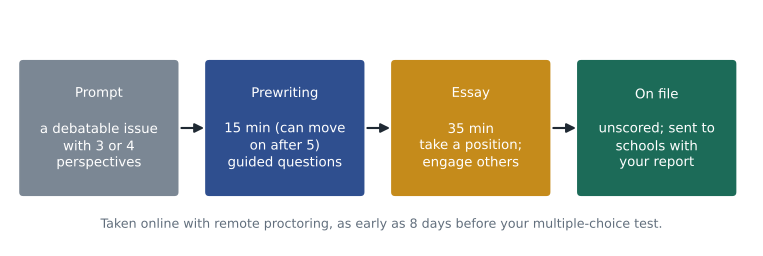
LSAT Argumentative Writing is an essay task that every LSAT candidate completes. It replaced the older LSAT Writing in 2024. You are given a debatable issue along with three or four perspectives on it. You first work through prewriting questions that help you analyze the issue and the perspectives, and then you write an essay that takes a position and engages with some of the other views.
LSAC describes the task as an argumentative essay in which there are no right or wrong positions. What matters is how well you reason: whether your position is clear, whether you support it, whether you deal fairly with opposing views, and whether your writing is organized and readable.
How and when you take it
Argumentative Writing is a separate session from the multiple-choice test. It is taken online, with secure proctoring software installed on your own computer, and a webcam is required. It is remote for everyone; it is not offered at test centers. That stays true even after the multiple-choice test moved to test centers for almost everyone in August 2026.
The session opens as early as eight days before your multiple-choice test date. Many students prefer to do it in that window, before the main test, so it is not hanging over them afterward. The task itself takes 50 minutes: up to 15 minutes for prewriting analysis, with the option to move on after five minutes, and 35 minutes to write the essay.
| Part | Time | What you do |
|---|---|---|
| Prewriting analysis | Up to 15 minutes (may move on after 5) | Answer guided questions about the issue and the perspectives; your notes help you plan |
| Essay | 35 minutes | Write an argumentative essay that takes a position and engages other perspectives |
| Total | 50 minutes | Plus check-in for the remote proctoring software |
Why it matters even though it is unscored
LSAC does not score the essay. But an approved writing sample must be on file before LSAC will release your LSAT score. If you are taking the LSAT for the first time, you must complete Argumentative Writing before your score can be released, and LSAC notes that processing a writing sample can take up to three weeks. A writing sample from the current reportable period, which LSAC dates from July 2021, stays valid, so a retaker who already has one on file does not need to write another.
Thomas went quiet at this. 'So if I skip it, I never see my score?' Exactly, Harriet said. 'Schedule the essay as seriously as the test itself.'
Then there is the question of how schools use it. Your essay is sent to the law schools that receive your LSAC report. Admission committees can read it for evidence of reasoning, clarity, organization, language use and writing mechanics. How much weight it gets varies from school to school and from file to file. Many schools say they rarely make decisions on the essay alone, but a confusing or careless essay can raise doubts, especially if it contrasts sharply with a polished personal statement written with unlimited time and possibly help. The essay is one of the few samples of your unaided writing a school sees.
The task in detail
The prompt presents an issue that reasonable people disagree about, usually a policy question or a question about how an institution should act. Then it lists three or four perspectives, each a short paragraph that takes a different view, often for different reasons. The perspectives are not simply "for" and "against"; they may agree on a goal and disagree about the means, or emphasize different values.
The prewriting questions guide you through the issue. They ask you to think about things such as the strongest considerations behind each perspective, where the perspectives conflict, what evidence would matter, and what your own view is. Your answers are for your planning. They help you go into the essay with a structure in mind.
In the essay itself, you should:
- State a clear position early. You may adopt one of the perspectives, combine elements of several, or take your own position, as long as it responds to the issue.
- Support it with reasons and, where useful, examples. Examples can come from your own knowledge and experience; they do not need to be from the prompt.
- Engage with at least some of the other perspectives, explaining where they are right, where they fall short, and why your position handles the issue better.
- Organize your essay so a reader can follow it: an introduction that states your position, body paragraphs that each do one job, and a short conclusion.
- Write clearly and correctly. You do not need elaborate vocabulary; you need precise sentences.
A sample prompt
This prompt was written for this course in the style of the task. It is not an LSAC prompt.
Worked problem
Sample issue and perspectives (written for this course)
Issue: Should public libraries eliminate overdue fines? Perspective 1: Fines discourage the people who most need libraries, especially children and low-income families, and recover little money; libraries should drop them. Perspective 2: Without fines, borrowers have no reason to return items on time, and shared collections suffer; fines teach responsibility. Perspective 3: Libraries should replace fines with other tools, such as automatic renewals, reminders and temporary borrowing limits, which protect collections without excluding people.
Show solution
- Identify the real disagreement: all three perspectives want collections returned and libraries used; they differ on whether money penalties are the right tool.
- Choose a position: for example, agree largely with Perspective 3, while accepting Perspective 1's point about who fines exclude.
- Plan: introduction stating the position; a paragraph on why fines exclude the people libraries serve; a paragraph answering Perspective 2 by showing other tools can protect collections; a paragraph on a limit, such as when a long-overdue item might justify a replacement charge; a conclusion.
- Draft with the time you have, leaving two or three minutes to read through and fix errors that change meaning.
Answer: A strong essay states a position, gives reasons, deals fairly with the other perspectives and stays organized. The position chosen matters less than the reasoning behind it.
What a strong introduction looks like
Harriet showed the group two opening paragraphs for the sample prompt. The first began, "Libraries are very important to society and have been for many centuries." The second began, "Libraries should stop charging overdue fines and rely instead on reminders, automatic renewals and borrowing limits. Fines fall hardest on the borrowers libraries most want to reach, while the evidence that they bring materials back faster is weak compared with the alternatives." The group agreed the second was better, and Harriet explained why: it answers the question in the first sentence and previews the reasons. 'Thirty-five minutes is not long,' she said. 'Do not spend a paragraph warming up.'
Notice one feature of that second paragraph: it makes a factual claim about evidence ("the evidence that they bring materials back faster is weak"). On the real task you are not expected to cite studies, and you should be careful not to invent statistics. It is fine to reason from general knowledge and experience, and to frame claims with appropriate care.
How to prepare
Because the essay is unscored, students sometimes ignore it until the last week. Because it must be on file and schools read it, that is a mistake. But it also does not need a large share of your study hours. A sensible plan for most students looks like this:
- Early on, read LSAC's description of the task and its sample prompts, and work through the official practice writing tool in LawHub if it is available to you.
- Write two or three practice essays under real timing spread over your preparation, using sample prompts. Type them; you will type on the real task.
- After each, check: is the position clear in the first paragraph? Does each body paragraph have one job? Did you engage with at least one other perspective fairly? Are there sentences a reader would have to reread?
- Do the real task in the eight-day window before your test date, on a day when you are not exhausted, with your computer and room set up as the proctoring rules require.
Logical Reasoning practice helps the essay too. Identifying assumptions and weaknesses in other people's arguments is exactly what you do when you respond to the other perspectives.
Technical setup
Because the writing session is remotely proctored on your own computer, technical preparation matters. Check LSAC's current system requirements well before your window opens, install and test the proctoring software, and plan a quiet, private room with a clear desk. Remote proctoring sessions typically include an identity check and a scan of your room. Problems during check-in are a common source of stress, and solving them a day early is far better than solving them with the clock running.
Ji-won, who works in software testing, ran the system check three times on two different days. 'Occupational habit,' she said. Harriet said it was a habit everyone should borrow.
| Before the window opens | On the day |
|---|---|
| Check system requirements and install the proctoring software | Close other programs; silence your phone and keep it as the rules allow |
| Run the system check, including camera and microphone | Clear your desk and have your ID ready |
| Choose a quiet, private room you can control | Allow extra time for check-in before you plan to start |
| Write at least two timed practice essays | Spend the first minutes on prewriting; do not skip planning |
Common questions
Can you retake the essay? LSAC's pages direct candidates with questions about a further writing sample to contact LSAC. In general, because a sample from the current reportable period stays valid, most retakers do not write a new one.
Does the essay have to be on the same topic as anything else? No. It is independent of the multiple-choice sections.
Is there a word count? LSAC does not set a minimum. Most well-organized essays written in 35 minutes run to several paragraphs. Clarity matters more than length.
What admission readers notice
LSAC tells candidates that schools look at reasoning, clarity, organization, language usage and writing mechanics. In practice, a reader skimming a stack of essays notices a few things quickly: whether the position is stated early, whether paragraphs each make one point, whether the writer engages fairly with opposing views, and whether sentences can be understood on a first reading.
| Habit that weakens an essay | Habit that strengthens it |
|---|---|
| Restating the prompt for a paragraph | Stating a position in the first two sentences |
| Listing every perspective without choosing | Choosing a position and explaining why it is better |
| Dismissing other views as obviously wrong | Acknowledging what other views get right before answering them |
| One long block of text | Short paragraphs, each with one job |
| Inventing statistics | Reasoning from general knowledge, with appropriate caution |
Dani noticed that her work habits helped here. Legal declarations she drafts must be clear to a judge who reads them quickly, so she already wrote short paragraphs with a clear point. Her risk was the opposite of most students': she tended to be too cautious, qualifying every claim. Harriet advised her to take a firm position and save qualifications for where they mattered.
Common mistakes
MistakeThe essay is optional because it is unscored.
InsteadAn approved writing sample must be on file before LSAC releases your score.
MistakeYou take the essay at the test center after the multiple-choice sections.
InsteadIt is taken online with remote proctoring on your own computer, as early as eight days before your test date.
MistakeYou must choose one of the listed perspectives.
InsteadYou may adopt, combine or go beyond the perspectives, as long as you take a clear position and engage with other views.
MistakeSchools never read the essay.
InsteadSchools receive it and may read it as a sample of your unaided writing.
Summary and key terms
- LSAT Argumentative Writing gives a debatable issue with three or four perspectives; you take and defend a position.
- It takes 50 minutes: up to 15 minutes of prewriting (move on after 5) and 35 minutes of writing.
- It is taken online with remote proctoring, separately from the multiple-choice test, as early as eight days before the test date.
- It is unscored, but a writing sample must be on file before scores are released; a sample from the reportable period since July 2021 stays valid.
- Schools receive the essay and can read it for reasoning, organization and clarity.
- Prewriting analysis
- The first part of the writing task, in which guided questions help you analyze the issue and perspectives.
- Perspective
- One of the three or four short positions on the issue presented in the prompt.
- Remote proctoring
- Supervision of a test through software, camera and microphone on the test taker's own computer.
- Writing sample on file
- A completed, approved Argumentative Writing essay held by LSAC, required for score release.
Practice problems
Work each problem on paper first, then reveal the answer to check.
Élodie's multiple-choice test is on Saturday, January 16, 2027. What is the earliest day she can complete Argumentative Writing?
Show answer
January 8, 2027, eight days before her test date.
Marcus wrote an LSAT writing sample in 2025. Must he write another for his November 2026 retake?
Show answer
No; a writing sample from the current reportable period (since July 2021) stays valid.
Rewrite this opening so it states a position: "There are many views about overdue fines."
Show answer
For example: "Libraries should replace overdue fines with reminders and borrowing limits, because fines exclude the borrowers libraries most need to reach."
Lesson quiz · 5 questions
Score 60% or more to complete this lesson.
Create a free account to save your progress, take quizzes and earn a certificate.