
LSAT-101 · Lesson 5 of 12 · 18 min
Scoring and percentiles
▶ Video coming soon A video version of this lesson is on the way.
On the night the Thursday Circle discussed scoring, Marcus had a particular reason to pay attention. He had tested on November 12, 2026, and his score would be released on December 2. He had bought Score Preview before test day. 'So I will see the number before any school does,' he said, 'and then I decide whether it exists.' Harriet said that was a fair summary, and that the group should understand everything about how that number is made before deciding what to do with it.
This lesson explains how the LSAT is scored, what the 120 to 180 scale means, how percentiles work, when scores are released, and the options you have to preview or cancel a score.
From right answers to a scaled score
Your LSAT score starts with a simple count: the number of scored multiple-choice questions you answered correctly. This is your raw score. Questions in the unscored section, or unscored pretest questions, do not count. Every scored question is worth the same, whether it is easy or hard. And there is no deduction for wrong answers, so a wrong answer and a blank are worth exactly the same: nothing.
The raw score is then converted to a scaled score between 120 and 180, using a conversion table built for that particular test form. This process is called equating. Its purpose is fairness. No two test forms are exactly equal in difficulty, and the number of scored questions can differ by a question or two. Equating adjusts for this so that a 160 on one test date means the same level of performance as a 160 on another.
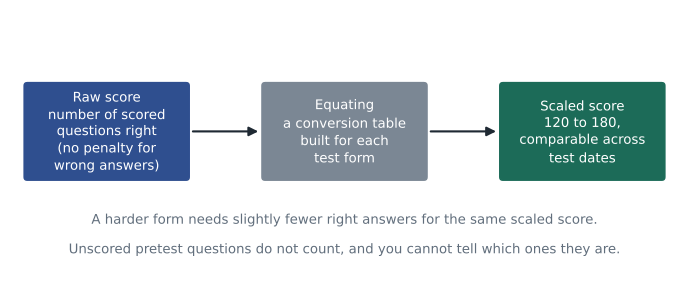
In practice, on a harder form you need slightly fewer right answers to reach a given scaled score, and on an easier form slightly more. The adjustment is usually only a question or two at any point on the scale. LSAC publishes conversion tables with its official practice tests, so you can see exactly how raw scores convert on each one.
Roughly how many questions is each point?
With roughly 75 to 78 scored questions spread across 61 scaled points, the relationship is not one question per point. In the middle of the scale, one additional right answer often moves a scaled score by about one point. Near the top, the scale stretches: going from 175 to 180 can require getting almost every remaining question right, because few test takers score there. Near the bottom, it compresses in the other direction. The exact numbers vary by form, so always use the conversion chart for the test you took.
Worked problem
Reading a conversion chart
On one practice test, Harriet's chart shows that 58 right answers convert to 157, 59 to 158, and 60 to 158 as well. Thomas gets 59 right. On his next practice test he gets 60 right. Did he improve?
Show solution
- On the first chart, 59 right converts to 158.
- The second test uses a different form with its own chart. Thomas must look up 60 on that chart, not the first one.
- Even on a single chart, adjacent raw scores can share a scaled score, as 59 and 60 do here, because the conversion is not perfectly one to one.
Answer: You cannot tell from raw scores alone across different forms. Compare scaled scores, and remember that a single point of movement is within normal test-to-test variation.
What a scaled score means: percentiles
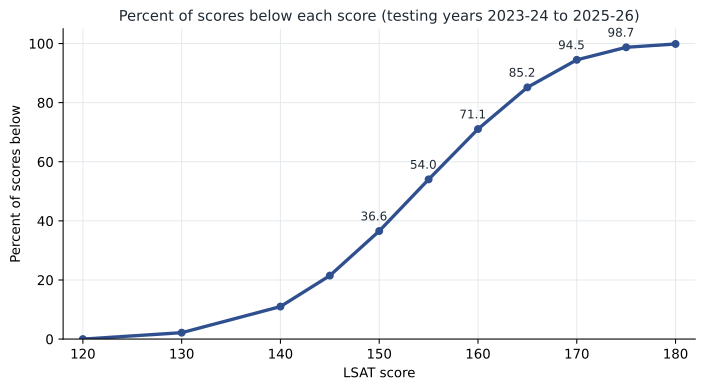
A scaled score becomes meaningful when you compare it with other test takers. LSAC publishes percentile ranks: for each scaled score, the percentage of scores from recent testing years that fall below it. The table LSAC published covering the 2023 to 2024, 2024 to 2025 and 2025 to 2026 testing years shows the pattern in the figure.
| Scaled score | Percent of scores below |
|---|---|
| 140 | 11.00 |
| 145 | 21.48 |
| 150 | 36.56 |
| 155 | 54.03 |
| 160 | 71.06 |
| 165 | 85.17 |
| 170 | 94.48 |
| 175 | 98.72 |
| 180 | 99.85 |
Three things are worth noticing. First, the middle of the scale is crowded. Moving from 150 to 160 jumps you past about a third of all test takers. Second, the top is sparse: a 170 is better than about 94 percent of scores. Third, percentiles change over time as the population of test takers changes. In this table a score of 155 sat just above the middle of the scale. Always use the most recent table.
Percentiles are calculated from scores, not from people. Someone who takes the test three times contributes three scores. That is a technical point, but it is why LSAC describes the table as the percent of test scores below each score.
Measurement error and score variation
No test measures anyone perfectly. If you took two different LSAT forms on the same day with no learning in between, your two scores would probably differ by a few points. That variation is called measurement error, and it is a normal property of any test. It is one reason admission committees treat scores as approximate and why a difference of a point or two between applicants means very little.
For your preparation, measurement error has a practical lesson: do not overreact to a single practice test. A three-point drop from one week to the next is often noise. A trend across five or six tests is information. Harriet asked the group to track a rolling average of their last three practice tests rather than reacting to each one.
When scores are released
LSAC releases scores on a scheduled date for each administration, at 9 a.m. Eastern time, usually about three weeks after the testing window. For the 2026 to 2027 testing year, examples include October 28, 2026 for the October test, December 2, 2026 for the November test, and February 3, 2027 for the January test. Scores are released to you and to the law schools you have applied to at the same time, unless you bought Score Preview.
Two conditions must be met before your score is released: an approved Argumentative Writing sample must be on file, and your account must have no holds, such as an unresolved fee waiver review or an open test security matter.
Score Preview and canceling a score
You can cancel a score in two ways, and both matter for how schools see your record.
Canceling without seeing the score
Without Score Preview, you can cancel your score within six calendar days after your test date, before you see it. Candidates sometimes do this after a test day that went badly: illness, a technical problem, or a section where they lost track of time. The cancellation still counts toward LSAC's limits on how many times you can test.
Score Preview
Score Preview lets you see your score first and then decide whether to keep it or cancel it. It costs 46 US dollars if you buy it before the first day of testing for your administration, or 87 US dollars if you buy it during a set period after testing ends. Once your score is released to you, you have six calendar days to cancel or keep it. If you do nothing, the score is added to your record and sent to schools when that period ends.
Marcus explained why he had bought it. His previous score was 158. If his November score were below that, he would cancel it, so schools would see only the 158 and no lower result. If it were higher, he would keep it. Harriet agreed this was a reasonable use of Score Preview for a retaker, but she added a caution: a canceled test still counts toward the testing limits, and a school receiving his report can see that a test was canceled even though it sees no score. 'Cancellation is a tool, not a reset button.'
| Option | Cost (2026-27) | When you decide | Do you see the score first? |
|---|---|---|---|
| Keep the score (default) | Included in the LSAT fee | Nothing to decide | Released to you and schools together |
| Cancel without Score Preview | No charge | Within 6 calendar days after the test date | No |
| Score Preview, bought before testing begins | 46 US dollars | Within 6 calendar days after release | Yes |
| Score Preview, bought after testing ends | 87 US dollars | Within 6 calendar days after release | Yes |
If you have an LSAC fee waiver, it includes Score Preview for the tests it covers, as Lesson 7 explains.
What schools see when you test more than once
LSAC reports your scores from the current testing year and the five previous testing years to the schools you apply to. Canceled tests show no score. Many applicants test more than once, and schools treat multiple scores differently. Since 2006, the ABA has had law schools report the highest LSAT score of each entering student in their required admissions data, which encourages many US schools to focus on the highest score, but each school decides how it actually evaluates applicants. Canadian schools set their own policies; some look mainly at the highest score and some consider every score. The University of Toronto, for example, says its committee will see and consider every score on a candidate's report from the five prior years. Lesson 6 looks at these policies more closely.
Other score services
LSAC offers two further services you are unlikely to need but should know about. An Official Candidate LSAT Score Report, 50 US dollars, lists all your scores, including older ones that are no longer reported to schools. A Score Audit, 150 US dollars (75 with a pre-approved fee waiver), has LSAC manually verify the scoring of your answers. Audits very rarely change a score, because the scoring is automated, but the option exists.
What scores mean for your plan
Harriet ended the session by tying scoring back to planning. 'Look up the score ranges of the schools you care about. Most schools publish a middle range for their admitted or enrolled students. Then look at what those scores mean as percentiles. That tells you how far you need to travel from your diagnostic. It does not tell you that you cannot get there.'
Dani looked up the schools near Tucson and Phoenix she was considering and wrote down their published ranges. Her diagnostic, 148, sat just below the low end of the range at the school she most wanted. 'So I need about eight to ten points,' she said. 'That feels possible over three months.' Harriet agreed it was possible and warned that it would take steady work, not a burst.
Reading the shape of the curve
The percentile curve is steepest in the middle. That affects how you think about goals. Using LSAC's 2023-24 to 2025-26 table, moving from 150 to 155 passes about 17.5 percent of all scores (from 36.56 to 54.03 percent below). Moving from 165 to 170 passes about 9.3 percent (85.17 to 94.48). Each point in the middle of the scale represents a larger share of test takers than each point near the top.
This does not mean high-end points are worth less in admissions. At very selective schools, the difference between 168 and 172 can matter a great deal, because so many applicants are clustered there. It does mean that the effort per point usually rises as scores rise. Students moving through the low and middle 150s often gain points faster than students moving through the high 160s.
Dani worked out what her target meant: a 156 would put her above about 58 percent of recent scores (57.62 in LSAC's table), compared with about 30 percent at 148. 'So I am not trying to become a genius,' she said. 'I am trying to pass about a quarter of the scores between me and the top.' Harriet corrected her gently: about 28 percent of all recent scores sit between 148 and 156. 'Fine,' Dani said. 'Still not a genius.''
Common mistakes
MistakeHard questions are worth more points than easy ones.
InsteadEvery scored question counts equally toward the raw score.
MistakeWrong answers cost you a fraction of a point.
InsteadThere is no penalty for wrong answers; answer every question.
MistakeA 160 always means the same number of right answers.
InsteadEquating means the raw score needed for 160 differs slightly from form to form.
MistakeCanceling a score erases the attempt.
InsteadCanceled tests show no score but still count toward LSAC's testing limits.
MistakeA two-point drop on a practice test means you are getting worse.
InsteadSmall changes are normal variation; look at trends over several tests.
Summary and key terms
- Your raw score is the number of scored questions right; there is no penalty for wrong answers.
- Equating converts raw scores to a 120 to 180 scale so that scores mean the same thing across test forms.
- Percentile ranks show the percent of recent scores below each score; in LSAC's 2023-24 to 2025-26 table, 160 was above about 71 percent of scores and 170 above about 94 percent.
- Scores are released about three weeks after testing, at 9 a.m. Eastern, once a writing sample is on file and there are no holds.
- You can cancel within six days after the test date, or buy Score Preview to see your score and decide within six days of release; cancellations still count toward testing limits.
- Scaled score
- The reported LSAT score, from 120 to 180.
- Equating
- The statistical process that converts raw scores on each test form to the common scale.
- Percentile rank
- The percentage of scores in a reference period that fall below a given score.
- Measurement error
- The natural variation in scores that comes from any test's imperfect measurement.
- Score Preview
- An LSAC option that lets you see your score before deciding whether to keep or cancel it.
- Score Audit
- An LSAC service that manually checks the scoring of your answers.
Practice problems
Work each problem on paper first, then reveal the answer to check.
In LSAC's 2023-24 to 2025-26 table, roughly what percent of scores fell below 155?
Show answer
About 54 percent (54.03).
A test taker scores 151 on one practice test and 149 the next week. What should she conclude?
Show answer
Very little; a two-point change is within normal variation. She should look at the trend over several tests.
Marcus bought Score Preview before his test. His score is released on December 2, 2026. By when must he decide?
Show answer
Within six calendar days of release, by December 8, 2026; if he does nothing, the score is kept and sent to schools.
Lesson quiz · 5 questions
Score 60% or more to complete this lesson.
Create a free account to save your progress, take quizzes and earn a certificate.