
LES-215 · Lesson 8 of 12 · 20 min
Interviews: competencies, behavioral questions and the panel
▶ Video coming soon A video version of this lesson is on the way.
Priya Sandhu has an oral board interview booked with the Ohio State Highway Patrol for early December. She has read that the panel will ask about past experiences and how she would handle situations, and that the scores are added to the rest of her file. She has written out twenty examples from her life and work and practiced them aloud until she could recite them. In a mock interview with Boyce, she answers the first question in three minutes, fluently, with a clear situation, task, action and result. Boyce stops her. 'That was a good answer,' she says, 'to a different question.'
The question had been about a time Priya disagreed with a supervisor's decision and what she did about it. Her answer was about a time she found a fraud pattern her team had missed. It had a disagreement in it, but the disagreement was a sentence; the answer was really about her analytical skill. 'Interviewers score what you say against the competency they are asking about,' Boyce says. 'If the answer does not show that competency, it does not matter how good the story is.' This lesson is about how police interviews work and how to prepare for them without turning into a recording.
What police interviews assess
Police services have studied what makes officers successful and identified the competencies that matter most. The lists differ in wording but overlap heavily: communication, problem-solving and judgment, self-control and composure under pressure, teamwork, respect for diversity and inclusion, integrity, adaptability, service orientation and the courage to act on one's values. Ohio departments commonly use an oral board of two to five panel members, often a mix of officers, supervisors and sometimes civilians or community members, who ask the same questions of every candidate and score the answers on a rating scale. Some departments add a final interview with the chief or sheriff.
Most questions are behavioral: they ask what you did in a real past situation, on the principle that past behavior is the best predictor of future behavior. Typical openings are 'Tell us about a time when...' or 'Describe a situation in which...'. Some questions are situational, asking what you would do in a hypothetical situation, and a few are general, about your motivation, your knowledge of the service, or your understanding of the job.
The STAR structure
STAR is a simple structure for behavioral answers. Situation: briefly describe the context, including when, where and who. Task: say what you were responsible for or what needed to be done. Action: describe what you did, step by step, using 'I' rather than 'we'. Result: say how it turned out and, if relevant, what you learned. The action section should be the longest, because that is where the competency shows. A common fault is a long situation, a short action and no result.
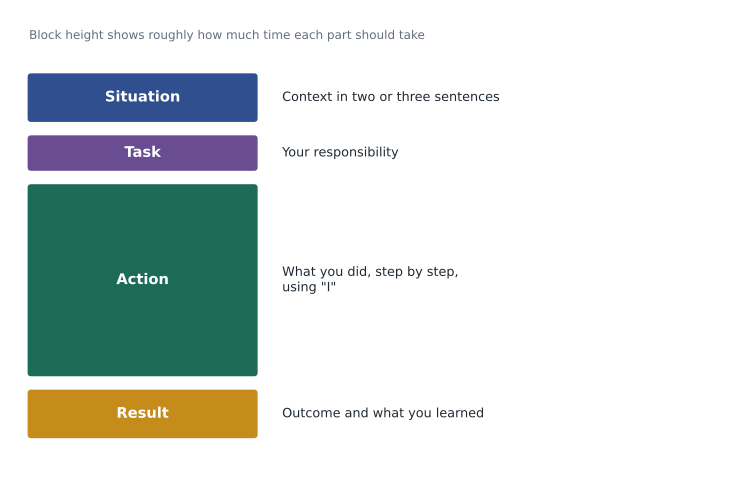
Boyce suggests a rough timing guide for a two- to three-minute answer: about twenty seconds for the situation, ten for the task, a minute and a half for the action, and twenty seconds for the result. She also suggests choosing examples where the stakes were real, the applicant's own actions made a difference, and the outcome can be described honestly, even if it was not perfect. 'A story where it went wrong and you learned something is often better than a story where you were the hero,' she says. 'Panels have heard a lot of heroes.'
| Attempt | Situation | Task | Action | Result | Total | Action's share |
|---|---|---|---|---|---|---|
| First try | 75 | 20 | 55 | 30 | 180 | 0.31 |
| Second try | 25 | 10 | 95 | 25 | 155 | 0.61 |
The action's share is the action time divided by the total: 55 ÷ 180 ≈ 0.31 the first time and 95 ÷ 155 ≈ 0.61 the second. The second answer was also shorter, which matters in a panel interview with a fixed number of questions. Boyce suggests a simple practice routine: record an answer on a phone, time each part, and rebuild it until the action is at least half of the answer and the whole thing fits in about two and a half minutes.
In Priya's first answer, the action was less than a third of the time. In her second, rebuilt around the question she was actually asked, it was about two thirds. The second answer described how she raised her disagreement privately with her supervisor, explained her reasoning with data, accepted the decision when it went the other way, and later saw the decision revised when new evidence emerged. It showed communication, self-control and courage of convictions, which was what the question was about.
Preparing examples
Preparation is essential, but memorizing scripts is not the goal. Boyce recommends that applicants build a bank of ten to fifteen real experiences, each written out briefly in STAR form, and then map each one to the competencies it could show. One good experience can often answer several questions, depending on which part you emphasize. During the interview, the applicant chooses the example that best fits the question asked and tells it naturally, emphasizing the competency being assessed.
| Competency | Example question | What a strong answer shows |
|---|---|---|
| Self-control and composure | Tell us about a time someone was verbally abusive to you. | Staying calm, not retaliating, de-escalating, following up appropriately |
| Teamwork | Describe a time you had to work with someone you found difficult. | Putting the goal first, communicating, sharing credit, resolving conflict |
| Problem-solving | Tell us about a decision you had to make without all the information. | Gathering what you could, weighing options, acting, reviewing the outcome |
| Integrity and courage of convictions | Describe a time you saw a colleague do something wrong. | Acting despite pressure, using proper channels, honesty about difficulty |
| Respect for diversity | Tell us about a time you had to understand someone very different from you. | Curiosity, listening, adapting your approach, avoiding assumptions |
| Communication | Describe a time you had to explain something complicated to someone upset. | Plain language, checking understanding, patience |
Each student builds a bank. Marco's has examples from the army, including a night he talked a drunk and armed soldier into handing over a rifle, and from his job managing a warehouse shift. Jesse's comes from coaching, the summer land-based program and a time he helped search for a missing teenager at Nimkii Bay. Linh's comes almost entirely from call-taking. Amara worries that hers, from retail and volunteering, are too ordinary. Boyce disagrees. 'Dealing with an angry customer who is shouting at a sixteen-year-old cashier is exactly what we want to hear about,' she says. 'What matters is what you did, not where you were.'
Situational and motivational questions
Situational questions ask what you would do: for example, 'You see a senior officer take a wallet from a prisoner's property and put it in his pocket. What do you do?' The panel is looking for sound values and a sensible process: identify the issue, act within your role, ensure safety, follow policy, report through the proper channel and document what you saw. Panels distrust answers that are either passive ('I would mind my own business') or wildly heroic ('I would arrest him on the spot'). It is fine to think for a moment before answering.
Motivational questions, such as 'Why do you want to be a police officer?' and 'Why this service?', are asked in almost every interview, and most applicants answer them badly. Generic answers about wanting to help people or make a difference do not distinguish anyone. Strong answers are specific: what in your own experience led you here, what you know about this service and this community, and what you have already done to test the decision, such as ride-alongs and volunteer work. 'Tell us something only you could say,' Boyce advises.
Practicing without scripting
Boyce runs mock interviews for each student twice during the term. She asks questions they have not seen, scores the answers on the service's scale, and gives feedback. The students also practice with each other, with one asking questions, one answering and one timing and taking notes. Recording a practice answer on a phone and watching it back is uncomfortable but useful: most people discover that they talk faster than they thought, say 'um' more often, or never actually state the result.
She warns against over-rehearsal. Panels hear many applicants who have memorized answers from books or online forums, and those answers sound alike and rarely fit the question exactly. 'Know your stories so well that you can tell them in any order, starting from any part,' she says. 'Then listen to the question and tell the one that fits.' If no example fits perfectly, it is acceptable to say so briefly and choose the closest, or to describe what you would do and why. It is also acceptable to ask the panel to repeat a question, and to take a moment to think before answering.
On the day
Practical details make a difference. Dress as you would for any professional interview; most applicants wear a suit or equivalent. Arrive early, and be courteous to everyone you meet, including reception staff. Bring copies of anything you were asked to bring. Turn off your phone. Make eye contact with all panel members, not only the one who asked the question. Panel members will usually take notes while you speak; that is normal and not a sign that something is wrong. At the end, you will usually be asked if you have any questions. A thoughtful question about training, the community or the service's priorities shows interest; questions about pay and holidays are better saved for later.
Nerves are normal and panels expect them. Slow breathing before you go in, a glass of water, and a deliberate pause before each answer help. Marco, who has faced armed soldiers more calmly than he faced his first mock panel, finds that the tactical breathing he learned in the army works here too. 'It is the same body,' Grant tells him when he mentions it. 'It does not know the difference between a panel and a threat. You have to tell it.'
After the interview
After an interview, write down the questions you were asked and how you answered, while they are fresh. If you are unsuccessful, ask for feedback; many services will provide it, and it is the best guide to preparing for the next attempt. If you are successful, the information may help in later interviews within the same process. Either way, a brief thank-you note or email is courteous, though it will rarely change a score.
Linh asks how to talk about weaknesses, a question that comes up in many interviews. Boyce suggests choosing a real weakness that is not central to the job, explaining briefly how it has affected you, and describing specifically what you are doing about it. Linh's honest answer is that she undersells herself and tends to wait to be asked; she is working on it by volunteering to lead the shift debrief at the communications center once a week. 'That is believable,' Boyce says, 'and it shows you know yourself.'
Worked problem
Rebuilding an answer
Jesse is asked: 'Tell us about a time you had to deal with someone who was very upset.' His first answer starts with five sentences about the history of the summer land-based program, mentions that a parent arrived angry because her son had been sent home, and ends with 'and we sorted it out.' How should he rebuild it?
Show solution
- Cut the situation to two sentences: he was leading the program, and a parent arrived shouting because her son had been sent home after a fight.
- State his task: to calm the situation, keep the other teenagers safe and resolve the parent's concern.
- Describe his actions in order, using 'I': he asked a co-leader to take the group away, invited the parent to sit down out of sight of the teenagers, listened without interrupting, acknowledged that she had been called at work, explained what had happened and why the rule existed, and asked what she needed.
- Give the result honestly: she was still unhappy about the rule but agreed to a meeting with the program coordinator the next day, and her son returned the following week.
- Add what he learned: to call parents himself before sending a child home, so they hear it from a person rather than a text.
Answer: The rebuilt answer is shorter, centered on his own actions, honest about an imperfect outcome, and clearly shows composure and communication.
Common mistakes
MistakeMemorized answers are the safest.
InsteadPrepare real examples, but tell them naturally and fit them to the question.
MistakeSay 'we' to show teamwork.
InsteadSay 'I' to show what you did; mention the team where it matters.
MistakeOnly dramatic stories impress panels.
InsteadOrdinary situations handled well are often better evidence.
Mistake'I want to help people' is a strong motivation answer.
InsteadSpecific experiences and knowledge of the service distinguish strong answers.
Summary and key terms
- Police interviews assess competencies such as communication, problem-solving, self-control, teamwork, integrity and respect for diversity.
- Behavioral questions ask about real past situations; situational questions ask what you would do.
- STAR answers should spend most of the time on the action, told in the first person.
- Build a bank of real examples mapped to competencies, and choose the one that fits each question.
- Motivation answers should be specific to your experience and to the service.
- Oral board
- A structured panel interview scored by several raters.
- Behavioral question
- A question about what you actually did in a past situation.
- Situational question
- A question about what you would do in a hypothetical situation.
- STAR
- Situation, task, action, result: a structure for behavioral answers.
- Competency
- A skill or behavior the service has identified as essential to the job.
Practice problems
Work each problem on paper first, then reveal the answer to check.
What was wrong with Priya's first mock answer?
Show answer
It answered a different question; the disagreement was a sentence and the answer was really about her analysis.
Roughly how long should the action part of a two- to three-minute answer take?
Show answer
About a minute and a half.
Why did Boyce say Amara's retail examples were not too ordinary?
Show answer
Handling an angry customer well is exactly the kind of behavior panels want to hear about.
What two kinds of answers do panels distrust on situational misconduct questions?
Show answer
Passive answers and wildly heroic ones.
Lesson quiz · 5 questions
Score 60% or more to complete this lesson.
Create a free account to save your progress, take quizzes and earn a certificate.