
LES-215 · Lesson 12 of 12 · 20 min
Capstone: a career plan and portfolio
▶ Video coming soon A video version of this lesson is on the way.
On Tuesday, November 10, 2026, the five students present their capstone career plans to a panel: Desjardins, Boyce, and Margaret Liu, the prosecutor who visited the class in the investigation course. Each student has twenty minutes to present a written plan and a portfolio and ten minutes to answer questions. Before they begin, Desjardins turns over the sheets they filled in on the first day of the course and hands each one back. 'Tell us what has changed,' he says.
This lesson walks through what a career plan and portfolio contain, using the students' work as examples, and ends with the panel's feedback. The plan is the last assessment in the program. It is also, Boyce points out, something they will use: almost every element of it will appear again in an application, an interview or a background file.
What a career plan contains
A good career plan answers five questions. Where do I want to be, and why? What does that employer or job require? Where am I now against those requirements? What will I do, and by when, to close the gaps? And what will I do if the first plan does not work? Desjardins asks for the plan to be specific, written, dated and realistic, and for every goal to have a measure and a deadline.
| Section | What it includes | Example from the class |
|---|---|---|
| Goal and reasons | The job, the employer and the honest reasons for choosing them | Jesse: serve as a constable or officer in his own community, near his family and the land he knows |
| Requirements | Every requirement from the employer's published standards, with sources | Amara: the Port Ardent list of thirteen requirements, from first aid to the physical test standard |
| Self-assessment | Current standing against each requirement, with evidence | Marco: physical test baseline and retest results, documents gathered, history written out |
| Action plan | Specific steps with dates and measures | Priya: interview preparation, fitness plan, application dates |
| Alternatives | A second path and what would trigger it | Linh: analyst roles in three services, or call-taking while she studies |
| Supports | Mentors, references, family arrangements, health and finances | Marco: shared calendar and childcare plan with his partner |
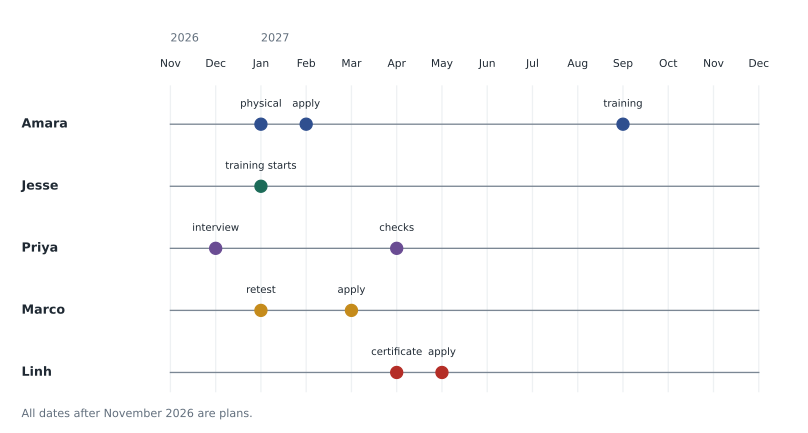
The students' plans
Amara's sheet from the first day said 'Port Ardent patrol', and it still does. Her plan has her civil service exam result, 88 and fourteenth on the eligibility list, her vision and hearing results, a sixteen-week training plan aimed at the physical test, a target of an oral board in early 2027, and a target of entering the academy in late 2027. Her portfolio includes her personal history, written out over twelve pages, a letter confirming the closed collections account, a reference list with notes on what each person has seen her do, her volunteer log from the Eastgate drop-in center, and her bank of fifteen interview examples. Her alternative is the Lakeshore County Sheriff's Office, which hires directly.
Jesse's plan is the simplest because his first choice has already made him an offer. The Nimkii Bay Tribal Police Department will hire him in January 2027 and send him to the spring academy at its own cost. His plan covers the weeks before the academy: fitness above the standard, family arrangements, and a list of the community's Elders and agencies he will visit before he starts. His portfolio includes a letter of support from Elder Marion Shawanda. His alternative, if the offer falls through, is a wildlife officer application.
Priya's sheet said 'Ohio State Highway Patrol, then federal'. Her plan keeps that goal but adds an honest section on relocation. The highway patrol assigns new troopers to posts across the state, and federal agencies can assign agents anywhere; she has decided that she is willing to go, but only after talking it through with her family, who were less sure. Her action plan centers on her interview in December, which she has now practiced with Boyce four times, and on keeping her fitness above the standard. Her alternative is Port Ardent's fraud unit, which she could aim for after several years in patrol.
Marco's sheet said 'patrol, maybe canine later, with two kids.' His plan crossed out the employers that relocate new officers and keeps Port Ardent and the county sheriff's office. His fitness section shows his baseline, his eleven-week plan and a practice result from early November that is now within the standard. His family section, written with his partner, sets out a shared calendar, a childcare arrangement with his mother for nights, and an agreement about overtime in his first year. His alternative, if his physical test does not go well in January, is to retest in the spring and to work in corrections in the meantime.
Linh's sheet was the one that changed most. On the first day she had written 'not sure it is policing.' Her plan now says 'crime analyst', with a data analysis certificate to be finished in April 2027, a portfolio of three analysis projects, including the near-repeat vehicle theft study from the community policing course, and applications to analyst positions at Port Ardent and two neighboring services from May. She will keep call-taking until then. 'I might apply as an officer one day,' she says. 'But I want to do it because I have decided to, not because it was the only door I knew about.'
| Student | Milestone | Date | Weeks away |
|---|---|---|---|
| Priya | Interview | December 3, 2026 | 3.3 |
| Jesse | Training starts | January 11, 2027 | 8.9 |
| Marco | Physical retest | January 19, 2027 | 10.0 |
| Amara | Application | February 1, 2027 | 11.9 |
| Linh | Certificate finished | April 30, 2027 | 24.4 |
Each figure is the number of days to the milestone divided by seven: from November 10 to December 3 is 23 days, or about 3.3 weeks, and to April 30 is 171 days, or about 24.4 weeks. Boyce asks each student to put the date in a calendar with two reminders, one a month before and one a week before, and to write down the single task that must be done by each reminder. A milestone with no tasks attached, she says, tends to arrive as a surprise.
The portfolio
The portfolio is the evidence behind the plan. Boyce describes what recruiters find most useful: an organized set of documents ready to submit, a written personal history, evidence of experience and service, and evidence of self-awareness, such as the interview example bank and a list of strengths and weaknesses with what the applicant is doing about each. It should be accurate and current, and it should not contain anything the applicant would not want an investigator to read. Desjardins adds one thing every portfolio should have: a page on why the applicant wants this work, written in their own words and specific enough that nobody else could have written it.
- Documents: identity and status, education, license and abstract, first aid and CPR, medical results, test results.
- Personal history: addresses, employment, education, police contacts, finances and drug history, written out in full.
- Experience: work, volunteer and community service, languages, military or cadet service, with dates and contacts.
- Fitness: baseline and practice test results, training log and plan.
- Interview bank: ten to fifteen real experiences in STAR form, mapped to competencies.
- Motivation: a page on why this work, why this employer, and what you have done to test the decision.
- References: names, contact details, how they know you, and confirmation that they have agreed.
The panel's feedback
After the presentations, the panel gives feedback. Liu tells the students that their plans were more honest than many she has seen from serving officers applying for promotion. She singles out Marco's family section and Linh's decision. 'Choosing not to apply when it is not right is as important as applying when it is,' she says. Boyce comments on the portfolios. Amara's is the most complete and could be submitted tomorrow. Priya's interview bank is excellent but still slightly too polished, and she should keep practicing answers that sound like conversation. Jesse's motivation page, which describes the day as a boy when a constable from his own community brought his brother home safe, is the best she has read this year. Marco should add more about his warehouse management, which shows leadership outside the army. Linh's analysis projects are good enough to show an employer as they are.
Desjardins scores each plan on the course rubric: clarity of goal, accuracy of requirements, honesty of self-assessment, specificity of actions, realism of alternatives and supports, and quality of the portfolio. The class average is 17 out of 20. The weakest area across the plans is alternatives, which most students wrote as an afterthought. 'Every one of you will hit an obstacle you did not plan for,' he says. 'The plan is not to avoid that. It is to have thought about what you will do when it happens.'
After the program
Desjardins ends the course, and the program, with a few last points. Keep the plan and look at it every month. Keep training, working and volunteering. Keep in touch with each other; many of the best references, mentors and partners in a career are classmates. Remember that the community you will serve includes people who have been harmed by police, and that earning their trust is part of the job, not a distraction from it. And remember why you started. 'On the first day, I asked where you wanted to be on your first day as an officer and what you would have done to get there,' he says. 'You have written the second half of that answer. Now go and do it.'
Boyce adds one practical request. 'When you apply to Port Ardent,' she says, 'put this course on your application, and tell me in the interview what you learned. I will be listening.'
After the class, the students stay behind to compare plans. Amara and Marco agree to train together for the physical test twice a week, since their test dates are a few weeks apart. Priya offers to run mock interviews for anyone who wants them, in exchange for honest feedback on her own answers. Linh promises to share her analysis portfolio template. Jesse invites them all to Nimkii Bay in the spring, when the ice is out. Boyce, collecting her papers, tells Desjardins that it is the best-prepared group she has seen. He says he will believe it when he sees the five of them in their first jobs, and that he expects to.
A last review of the plans
Before the presentations end, Liu asks one question of every student: what is the single most likely thing to go wrong with your plan, and what will you do if it does? Amara says an injury before the physical test, and that she would postpone rather than test hurt. Jesse says the remaining checks raising something unexpected, and that he would answer it honestly and wait. Priya says her family deciding they cannot support a posting far away, and that she would choose Port Ardent instead. Marco says the January test, and that he would retest in the spring and work in corrections in the meantime. Linh says not finding an analyst position nearby, and that she would apply further away or keep call-taking while she builds her portfolio. 'Good,' Liu says. 'None of you said nothing will go wrong. That is the right answer.'
Worked problem
Turning a vague goal into a plan
A student's draft plan says: 'Get in shape, apply to some services next year, and hopefully get hired.' How should it be rewritten?
Show solution
- Name the goal precisely: the job, the employer and the reasons.
- List the employer's published requirements and the source for each.
- Replace 'get in shape' with a measured goal: the test, the current result, the standard, the test date and the training plan.
- Replace 'apply to some services next year' with named employers, application dates and what must be done before each.
- Add an alternative and a trigger: for example, if the physical test is not passed by March, retest in June and apply for a correctional officer position meanwhile.
- List the supports needed and who has agreed to provide them.
Answer: The rewritten plan has a goal, requirements, a dated action list with measures, an alternative and supports. It can be checked every month, which the vague version could not.
Common mistakes
MistakeA career plan is a statement of ambition.
InsteadIt is a dated, measured plan with requirements, gaps, actions, alternatives and supports.
MistakeChanging your goal during the course means you failed.
InsteadChanging your goal after research is a good outcome.
MistakeA portfolio should present you as flawless.
InsteadIt should be accurate and include evidence of self-awareness and growth.
MistakeOnce hired, the plan is finished.
InsteadCareer plans continue through training, probation and later moves.
Summary and key terms
- A career plan answers where you want to be, what is required, where you are now, what you will do and by when, and what you will do if it does not work.
- Goals should be specific, written, dated, measured and realistic.
- The portfolio holds the evidence: documents, history, experience, fitness, interview examples, motivation and references.
- Alternatives and supports are part of a realistic plan.
- Most elements of the plan will be used again in applications, interviews and background files.
- Eligibility list rank
- A candidate's position on a civil service list.
- Career plan
- A written, dated plan for reaching a career goal, with actions and measures.
- Portfolio
- An organized collection of the documents and evidence that support an application.
- Alternative path
- A second option, with the conditions that would lead you to take it.
- Milestone
- A dated point in a plan, such as a test or application deadline.
Practice problems
Work each problem on paper first, then reveal the answer to check.
Whose first-day answer changed most?
Show answer
Linh's: from 'not sure it is policing' to crime analyst.
What is Marco's alternative if his January physical test does not go well?
Show answer
Retest in the spring and work in corrections meanwhile.
In the milestone table, whose milestone comes first?
Show answer
Priya's interview on December 3, 2026.
What should a portfolio not contain?
Show answer
Anything the applicant would not want a background investigator to read, or confidential test content.
Lesson quiz · 5 questions
Score 60% or more to complete this lesson.
Create a free account to save your progress, take quizzes and earn a certificate.