
LES-215 · Lesson 5 of 12 · 21 min
Written and aptitude testing: civil service examinations and other assessments
▶ Video coming soon A video version of this lesson is on the way.
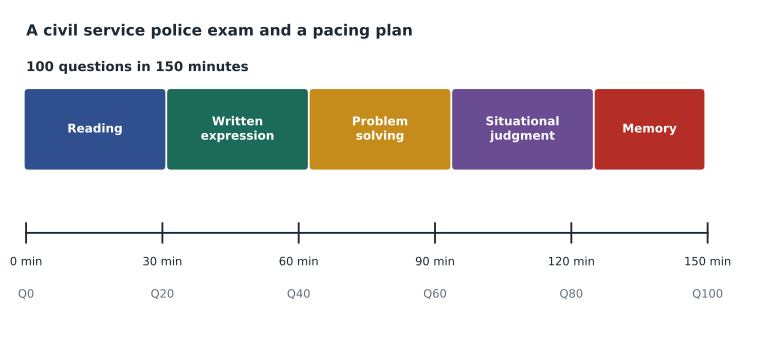
On a Saturday morning in mid-October, Amara Okafor sits in a high school gymnasium in Port Ardent with about two hundred and thirty other candidates for the city's civil service police examination. She has registered with the civil service commission, brought two pieces of identification and a pencil, and spent three weeks practicing. The test has a hundred multiple-choice questions on reading comprehension, written expression, problem-solving, situational judgment and memory, in two and a half hours. Three weeks later the commission posts the results: Amara scored 88 and is fourteenth on the eligibility list. 'It was not hard,' she tells the class. 'It was long. You had to stay sharp for the whole thing.'
Desjardins uses Amara's experience to open a lesson about the written and aptitude tests that come early in almost every police hiring process. They are rarely the hardest part, but they are where many applicants are lost, often because they did not prepare or did not read the instructions.
What the tests are for
Police work involves a great deal of reading and writing: statutes, policies, warrants, reports, notes, disclosure, court briefs. Officers must also make decisions quickly from incomplete information, remember details accurately, and judge how to deal with people. The written and aptitude tests are designed to predict whether an applicant can cope with the reading and writing of training and the job, and whether they show sound judgment in typical situations. They are not tests of police knowledge, which recruits learn in training. Most questions can be answered by any careful reader with good judgment.
In Ohio, many city departments use a competitive civil service examination for entry-level police officers. The commission or a testing company it hires designs or selects the test, which usually covers reading comprehension, written expression, problem-solving, situational judgment and sometimes memory and observation. Candidates who pass are ranked by score, with extra credit added where the rules allow, for example for veterans. Departments then call candidates in rank order, often under a rule that lets them choose among the top few names. Agencies that do not use civil service exams often use a commercial entry-level test with similar content. Separately, every Ohio cadet must later pass the state certification examination at the end of the basic academy.
Pacing
Many applicants who do badly on timed tests know the answers but run out of time. Pacing means knowing, before you start, how long you can spend on each question and checking your progress at fixed points. A simple pacing plan divides the time into blocks and sets a target number of questions for each block.
| Test | Time per question | Checkpoints: aim to have finished |
|---|---|---|
| 74 questions in 35 minutes | about 28 seconds | question 18 at 8.75 minutes; 37 at 17.5; 56 at 26.25; 74 at 35 |
| 100 questions in 150 minutes | about 90 seconds | question 20 at 30 minutes; 40 at 60; 60 at 90; 80 at 120; 100 at 150 |
Worked problem
Building a pacing plan
A test has 74 questions in 35 minutes. Set four checkpoints.
Show solution
- Time per question: 35 × 60 ÷ 74 = 2,100 ÷ 74 ≈ 28 seconds.
- Divide the time into four equal blocks: 35 ÷ 4 = 8.75 minutes each.
- At each checkpoint, the target is that fraction of the questions: 74 × 1/4 = 18.5, 74 × 2/4 = 37 and 74 × 3/4 = 55.5, rounded to 18, 37 and 56.
- Write the checkpoints on the scrap paper before starting, so checking progress takes a glance.
Answer: About 28 seconds a question, with targets of question 18 at about 9 minutes, 37 at 17.5 minutes, 56 at about 26 minutes and 74 at 35.
For the shorter test, the plan allows about twenty-eight seconds a question; for the longer one, about ninety seconds. Desjardins points out that not every question takes the same time. Vocabulary and grammar questions are often quick, while problem-solving questions take longer. A good strategy is to answer quickly the questions you are sure of, make a best guess on the ones you are not, mark them if the format allows, and come back if time remains. On most civil service tests, there is no penalty for guessing, so a guess is better than a blank, but always check the instructions.
The main question types
Boyce shows the class several sample items written in the style of police entry tests. None are from a real exam; real items are protected and applicants agree not to share them. She walks through each type and how to approach it.
Reading comprehension items give a passage, often a policy or a description of an incident, and ask questions about it. The key is to answer from the passage, not from what you think you know about policing. A typical trap is an answer that is true in real life but not stated in the passage.
Language items test spelling, vocabulary, grammar and punctuation. They reward people who read widely and write carefully. Applicants who have relied on spell-checkers for years may be surprised by how much they have lost. The written expression section often asks candidates to choose the clearest or most correct version of a sentence, as it would appear in a police report.
Problem-solving items give a short scenario and ask what to conclude or do. Some are logic problems, such as working out which of several people was where at a certain time from a set of statements. Others involve simple arithmetic in a practical setting, such as working out a speed, a distance or a total from a list.
Situational judgment items describe a realistic situation and ask what the best response would be, or rank several responses. These are where applicants' values show. The best answer usually reflects honesty, safety, respect for people, following policy, and escalating to a supervisor when something is beyond your authority. The worst answers usually involve ignoring misconduct, taking shortcuts with the truth, or using more authority than the situation needs.
Memory and observation items, used on some tests, show a picture or a short written description for a set time, then remove it and ask questions about the details. Practice helps: describe scenes to yourself in a fixed order, such as people, vehicles, locations, times and actions.
| Type | What it tests | Common trap | Strategy |
|---|---|---|---|
| Reading comprehension | Understanding written material | Answering from outside knowledge | Find the answer in the passage |
| Language | Spelling, grammar, punctuation, vocabulary | Relying on how words sound | Read widely; practice without spell-check |
| Problem-solving | Logic and simple arithmetic in context | Rushing the setup | Write down what is known before calculating |
| Situational judgment | Values and judgment | Choosing the most forceful option | Prefer honesty, safety, respect and proper escalation |
| Memory and observation | Recall of details | Trying to memorize everything at once | Use a fixed order: people, vehicles, places, times, actions |
The personality assessment
Personality assessments ask hundreds of short questions about how you usually think, feel and behave. There are no right answers in the ordinary sense, and there is no point studying for them. Their purpose is to help the service, and later a psychologist, understand how the applicant is likely to behave on the job. Most include scales designed to detect when an applicant is trying to present themselves as unrealistically perfect. 'If you answer that you have never told a lie, never been angry and never broken a rule,' Boyce says, 'the test will flag you. Nobody is like that, and the people who say they are worry us more than the ones who admit to being human.' The best preparation is rest, honesty and answering each question as it applies to you, not as you think a police officer should answer.
Preparing for written tests
Boyce gives the students a four-week preparation plan. In the first week, take a full practice test under timed conditions to find your weak areas. In the second and third weeks, work on those areas for twenty to thirty minutes a day: vocabulary and grammar exercises, logic puzzles, reading policy documents and summarizing them in a paragraph, and timed sets of practice items. In the fourth week, take another full practice test, review every error, and rest well before the real test. 'Most people need practice with the format and the clock more than with the content,' she says.
Reading habits matter more than any course. Applicants who read newspapers, long articles and books every day do better on reading and language items than those who read only short posts. Priya, who spent years reading fraud reports, finds the reading items easy but the vocabulary items harder than she expected. She starts keeping a list of unfamiliar words from articles and looking them up. Marco, who has not written an essay since high school, practices by writing a one-paragraph summary of a news story every evening and asking his partner to mark the errors.
Test day
On the day, practical details matter. Know where the test is and how long it takes to get there, and arrive early. Bring the identification and materials the instructions list, and nothing that is banned, such as phones. Eat beforehand. Listen to the instructions even if you think you know them, because formats change. If something goes wrong, such as illness or a family emergency, contact the testing organization before the test if you can; most allow rescheduling for documented reasons. Applicants with a disability that affects test-taking, such as a learning disability, can usually request accommodation, such as extra time, but must apply in advance with documentation.
After the test, resist the urge to discuss specific questions online. Testing organizations ask applicants to keep the content confidential, and sharing it can lead to disqualification. 'Talk about how you prepared,' Boyce says. 'Do not talk about what was on it.'
Writing samples
Some services and many training academies also assess writing directly. Recruits may be asked to watch a short video or read a scenario and write a report, which is marked for accuracy, completeness, organization, grammar and clarity. Desjardins points out that this is exactly the skill the earlier courses on investigation and evidence emphasized. A report that is clear, chronological, factual and specific is a better predictor of a good officer than almost any other piece of writing. He reminds the students to write in the first person, in plain language, to separate what they saw from what they were told, and to avoid opinion words such as 'suspicious' unless they explain the facts behind them.
Marco asks whether it is worth paying for commercial preparation courses. Boyce says that some are useful for practice and structure, but that applicants should be wary of any course that claims to have real test questions or guarantees a pass. Free resources, including the practice material published by testing bodies and services, a library card, and steady reading and writing practice, are enough for most people. 'The test is designed to measure skills you build over years,' she says. 'Four weeks of good practice helps with the format. It will not replace the years.'
Desjardins adds that the written tests are also a preview of training. Recruits read and write constantly at the academy, and those who struggled on the entry tests often struggle with the examinations in training. 'Treat the preparation as an investment in your first year,' he says. 'If reading and writing are hard for you now, get help now. Every college has a writing center, and using it is a sign of good sense.'
Worked problem
Working a problem-solving item
A practice item says: 'Four people were at a house party: Ash, Blake, Cam and Dee. Ash left before Blake. Cam left after Dee. Blake left before Dee. Who left last?' How should an applicant work it?
Show solution
- Write down what is known as short relations: Ash before Blake; Dee before Cam; Blake before Dee.
- Chain the relations that share a person: Ash before Blake, and Blake before Dee, gives Ash, Blake, Dee.
- Add the remaining relation: Dee before Cam gives Ash, Blake, Dee, Cam.
- Check each original statement against the order to make sure none is broken.
- Answer the question asked: who left last.
Answer: Cam left last. Writing the relations down takes twenty seconds and prevents the most common mistake, which is answering from the first statement alone.
Common mistakes
MistakeWritten tests measure police knowledge.
InsteadThey measure reading, writing, reasoning and judgment; police knowledge is taught in training.
MistakeYou can study for the personality assessment.
InsteadAnswer honestly; the assessments are built to detect impression management.
MistakeLeaving hard questions blank is safer.
InsteadUnless the instructions say otherwise, a best guess is better than a blank.
MistakePacing is only for slow readers.
InsteadEveryone benefits from a plan with checkpoints on a timed test.
Summary and key terms
- Written and aptitude tests predict whether applicants can handle the reading, writing and judgment the job requires.
- Many Ohio cities use a ranked civil service examination; agencies without civil service often use a commercial entry-level test.
- Pacing plans with checkpoints prevent running out of time.
- Common item types are reading comprehension, language, problem-solving, situational judgment and memory.
- Personality assessments should be answered honestly; attempts to look perfect are detected.
- Civil service commission
- The body that runs competitive examinations and eligibility lists for city jobs.
- Rule of three
- A common civil service rule letting the employer choose among the top few names on a list.
- Pacing plan
- A schedule of how many questions to finish by fixed times during a test.
- Situational judgment item
- A question that describes a realistic situation and asks for the best response.
- Impression management
- Answering to look better than you are, which personality tests are designed to detect.
Practice problems
Work each problem on paper first, then reveal the answer to check.
How long per question does the 100-question, 150-minute test allow?
Show answer
About ninety seconds.
What is the common trap in reading comprehension items?
Show answer
Answering from outside knowledge rather than the passage.
What does the personality assessment flag about applicants who claim never to have lied?
Show answer
That they may be trying to look unrealistically perfect.
In the party problem, who left first?
Show answer
Ash.
Lesson quiz · 5 questions
Score 60% or more to complete this lesson.
Create a free account to save your progress, take quizzes and earn a certificate.