
LES-215 · Lesson 3 of 12 · 20 min
Getting ready: minimum requirements and personal readiness
▶ Video coming soon A video version of this lesson is on the way.
Boyce begins the third class by putting a stack of real, anonymized applications on the table, about thirty of them, each with a yellow sticky note. 'These were all screened out last year before anyone met the applicant,' she says. 'Read the notes.' The students pass them around. 'No first aid certificate.' 'License suspended in the last year.' 'Did not disclose a prior application to another service.' 'Answered no to the drug question; social media showed otherwise.' 'Missing education documents after two reminders.' 'Twelve demerit points.' Priya counts them: nineteen of the thirty were screened out for something the applicant could have fixed or avoided.
'Most people who fail this process do not fail because they are bad candidates,' Boyce says. 'They fail because they were not ready. This lesson is about being ready: meeting the minimum requirements, and knowing your own history well enough that nothing in it surprises us or you.'
The minimum requirements
In Ohio, the Peace Officer Training Commission sets the requirements for basic training and certification, and each agency adds its own hiring standards. Common requirements include United States citizenship, a high school diploma or GED, a valid driver's license with an acceptable driving record, no felony convictions, and an age requirement, usually 21 at the time of appointment. Federal law prohibits anyone convicted of a misdemeanor crime of domestic violence from possessing a firearm, which in practice disqualifies them from police work. Many departments also require vision and hearing standards and a current first aid and CPR certificate. Some require college credits, military service or work experience, and some offer extra credit on civil service examinations for veterans or residents.
| Requirement | Typical Ohio standard | Common reasons applicants fall short |
|---|---|---|
| Age | Usually 21 at appointment; some academies accept 18 or older | Applying before the minimum age |
| Citizenship | United States citizen | Status documents not ready |
| Education | High school diploma or GED | Transcripts not ordered in time |
| Driver's license | Valid license; agencies review driving history | Recent suspensions, too many points |
| First aid and CPR | Current certificate | Expired certificate |
| Vision and hearing | Agency medical standards | Untested conditions found late |
| Criminal record | No felony convictions; domestic violence misdemeanors disqualify | Undisclosed charges or convictions |
Character: what services mean by good character
Every police service looks for applicants of good character, and every applicant thinks they have it. Boyce explains what the phrase means in practice. Services want people who are honest, reliable, respectful, able to control their temper, financially responsible and able to follow rules they disagree with. They assess character by looking at behavior over time: how you have treated employers, landlords, partners, neighbors and the police; whether you pay your debts; how you drive; what you post online; and, above all, whether you tell the truth about all of it.
'Nobody has a perfect record,' she says. 'I have hired people who were arrested as teenagers, who went bankrupt after a divorce, who used drugs at university. What I do not hire is people who lie about it. The background investigator will find most things. If you told us first, it is a conversation. If we found it, it is the end of the process.'
Desjardins connects this to the ethics material in the first-year courses. A police officer's word is evidence. Officers testify under oath, swear to the truth of notes and affidavits, and are trusted to report their own mistakes. Under Brady and Giglio, prosecutors must disclose evidence that could impeach an officer's credibility, and an officer with a record of dishonesty may be placed on a list that makes them nearly useless as a witness. 'That is why honesty in the application is not just a test,' he says. 'It is the job.'
Your history: what to review before you apply
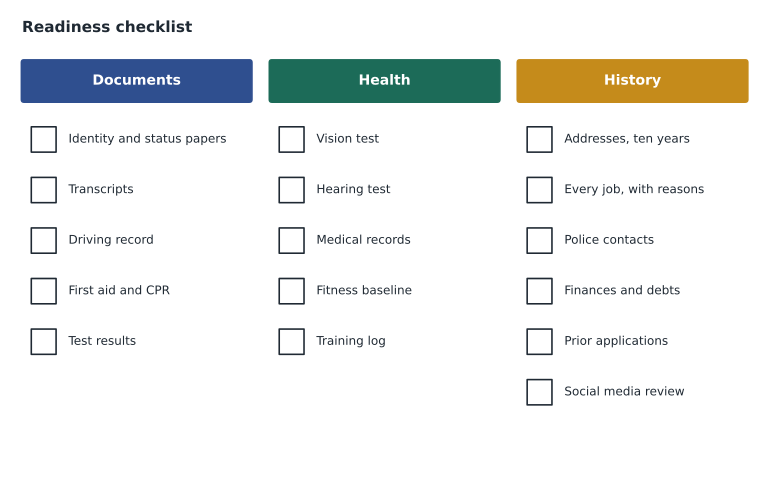
Before applying, Boyce asks each student to write out their own history as a background investigator would see it. The exercise takes hours, and it is the single most useful thing an applicant can do.
- Addresses for at least the last ten years, with dates and landlords.
- Every job, including part-time and casual work, with dates, supervisors and reasons for leaving.
- Education, with dates and any disciplinary matters.
- Every contact with police: charges, cautions, tickets, complaints made by you or about you, and times you were a witness or victim.
- Driving record, including suspensions and collisions.
- Finances: debts, collections, defaults, bankruptcies and how they were resolved.
- Drug use, including the substances, approximate dates and frequency. Services set their own rules on what is disqualifying and how long ago use must have ended.
- Prior applications to any police service or enforcement agency, and the outcome.
- Social media accounts and public posts, including old accounts.
Marco's list takes four pages. His military service helps: he has records, references and a security clearance history. Amara's is short but she finds one surprise. She had a collections notice for an unpaid phone bill from when she was eighteen. She pays it, gets a letter confirming it is closed and puts the letter in her file. Linh finds a public post from 2021, in which she had written an angry comment about police after her cousin Bao was stopped for the fourth time. She decides not to delete it. 'If they ask, I will explain it,' she says. 'It is true that I was angry. It is also why I want to be part of fixing it.' Boyce nods. 'That is a better answer than deleting it. Deleted posts have a way of turning up.'
| Event | Date | Months before the application |
|---|---|---|
| Driving suspension ended | March 2, 2025 | 22 |
| Last marijuana use (still asked about) | June 1, 2024 | 31 |
| Collections account closed | October 9, 2026 | 3 |
Each figure counts whole calendar months: from March 2025 to January 2027 is 12 × (2027 − 2025) + (1 − 3) = 24 − 2 = 22 months. If a service's rule were, say, 24 months since a driving suspension, this applicant would be two months short and would do better to wait or to explain the timing honestly than to apply hoping no one counts.
Desjardins stresses that the lookback periods vary by service and change over time, and the numbers in the example are for practice only. Cannabis remains illegal under federal law, and although Ohio legalized adult use in 2023, police employers may still treat recent or illegal drug use as disqualifying. The only safe approach is to read each service's published standards and answer every question truthfully.
Social media and your online life
Background investigators routinely review public social media. They look for threats, harassment, discriminatory or demeaning comments, posts about illegal activity, posts that show poor judgment with weapons or alcohol, and anything that would embarrass the service or undermine trust if it became public. Once hired, officers are bound by their service's social media policy, and posts can lead to discipline. Boyce recommends three steps: review every public account you have had, think about how each post would read on the front page of the local paper, and be ready to explain anything that might be misunderstood. Changing privacy settings is fine; lying about what you posted is not.
Building strengths before you apply
Readiness is not only about avoiding problems. Boyce tells the class that the strongest applications show a pattern of responsibility and service. Recruiters notice volunteer work that has lasted more than a few months, part-time jobs held through school, experience with people in difficult situations, second languages, military or cadet service, coaching, and work in health care, social services, security or corrections. 'We are hiring people who will spend their careers talking to strangers in crisis,' she says. 'Show me you have already done that somewhere.'
She suggests that students look at the gaps in their own experience and fill them deliberately. Amara, who has worked in retail since she was sixteen, signs up to volunteer at the youth drop-in center in Eastgate on Tuesday evenings. Jesse already coaches a youth hockey team at Nimkii Bay and helps run a land-based program for teenagers in the summer. Priya, who spent five years as a bank fraud analyst, has strong investigative experience but little contact with people in crisis, so she joins the volunteer crisis text line training. Marco's military service gives him leadership and discipline, and he adds a mental health first aid course. Linh's call-taking work is exactly the kind of experience recruiters value, whichever path she chooses.
Languages matter too. Port Ardent serves residents who speak Spanish, Arabic, Somali, Vietnamese and Anishinaabemowin, among other languages, and many departments pay attention to second-language skills in hiring. Priya speaks Punjabi, Linh speaks Vietnamese, and Amara speaks Yoruba. Boyce tells them to list every language and to be honest about their level of fluency.
Health issues to sort out early
Medical standards trip up applicants late in the process, when there is little time to fix anything. Boyce advises students to get the vision and hearing tests done before applying, not when asked. A vision problem may be correctable with glasses, contact lenses or laser surgery, but services often require a waiting period after surgery before testing. A hearing problem found early can be investigated by a specialist. Applicants with chronic conditions, such as asthma, diabetes or a past injury, should collect records showing how the condition is managed. 'A well-managed condition with good documentation is usually fine,' she says. 'A condition we discover in the medical with no records is a delay at best.'
Mental health is part of this. Many applicants worry that past counseling or treatment will disqualify them. Boyce says that seeking help for a problem and managing it is generally seen as a sign of good judgment, not a weakness, and that services assess current functioning rather than history alone. Human rights law also limits how services may treat applicants with disabilities, including mental health conditions. The important things are honesty and stability. 'What concerns a psychologist is not that you saw a counselor after your father died,' she says. 'It is if you hid it, or if you are struggling now and have not dealt with it.'
Money and stability
Finances are a common surprise. Investigators look at debts, defaults and spending because financial pressure is a known risk factor for corruption and because unpaid debts suggest unreliability. Boyce suggests that every applicant pull their own credit report before applying, deal with anything in collections, and be ready to explain any large debts. Student loans and a car payment are normal. Ignoring creditors is not. Priya, the former bank analyst, adds that investigators also look at gambling and at unexplained cash. 'If you won money or got a gift from family,' she says, 'have the paperwork.'
Desjardins ends the lesson by asking each student to list the three things in their own history they would least like to explain to a stranger. He does not collect the lists. 'Those are the three things you should be most ready to talk about,' he says. 'Practice saying them out loud, calmly and briefly, with what you learned. If you can do that with a friend, you can do it with an investigator.'
Worked problem
Disclosing a past charge
Priya was charged with shoplifting at seventeen. The charge was dealt with by diversion through the juvenile court; she completed community service and has no conviction. The application asks whether she has ever been charged with, arrested for or questioned about an offense. How should she answer?
Show solution
- Read the question exactly. It asks about charges and arrests, not only convictions, so the answer is yes.
- Give the date, the offense, the outcome and what she did to complete the sanction.
- Add a short, honest explanation of what she learned, without excuses.
- Do not assume a sealed or youth record cannot be seen. Services may have access to information an applicant thinks is private, and the question is about her answer, not the record.
- Gather any documents that confirm the outcome.
Answer: She answers yes, explains briefly and truthfully, and attaches what documents she has. A youth matter honestly disclosed and long resolved is far less damaging than one discovered.
Common mistakes
MistakeIf a record is sealed or a youth record, I do not have to mention it.
InsteadAnswer the question as asked; if it asks about charges or police contact, disclose, and let the service assess it.
MistakeGood character means a perfect record.
InsteadServices look at behavior over time and, above all, honesty about it.
MistakeDeleting old posts solves social media problems.
InsteadDeleted content can resurface; be ready to explain it instead.
MistakeMinimum requirements are the same everywhere.
InsteadEach service publishes its own standards on top of the legal minimums.
Summary and key terms
- Most applicants who are screened out early fail on preventable problems such as missing documents, expired certificates or driving records.
- Ohio's commission sets training and certification requirements, and each agency adds hiring standards such as age, citizenship and record.
- Good character is judged from behavior over time and especially from honesty about it.
- Applicants should write out their full history before applying, as a background investigator would.
- Social media is reviewed; explain rather than conceal.
- Brady list
- A list kept by prosecutors of officers whose credibility has been impeached.
- GED
- A high school equivalency credential.
- Good character
- Honesty, reliability, respect and self-control shown over time.
- Lookback period
- The time a service requires since an event, such as drug use or a suspension, before an applicant is considered.
- Driver's abstract
- An official record of a person's license history, suspensions and convictions.
Practice problems
Work each problem on paper first, then reveal the answer to check.
How many of Boyce's thirty applications were screened out for preventable reasons?
Show answer
Nineteen.
What did Amara do about the unpaid phone bill?
Show answer
She paid it, got written confirmation and kept it for her file.
Why did Linh decide not to delete her old post?
Show answer
Deleted posts can resurface, and an honest explanation is better.
Why is honesty in an application connected to the job itself?
Show answer
An officer's word is evidence; dishonesty can make them unusable as a witness.
Lesson quiz · 5 questions
Score 60% or more to complete this lesson.
Create a free account to save your progress, take quizzes and earn a certificate.