
LES-215 · Lesson 10 of 12 · 20 min
Training and certification: the academy, POST certification and field training
▶ Video coming soon A video version of this lesson is on the way.
Desjardins begins with a question for the class: when does a recruit become a police officer? Amara says when they are sworn in. Jesse says when they graduate from training. Marco says when they finish their probation. Priya says when they first make a decision alone that nobody can check. 'You are all right,' he says, 'which is the point. Becoming an officer is a process that takes a year or two after the offer. This lesson is about that process: the formal training, the certification, the field training that follows, and the probation that ends it.'
The path in Ohio
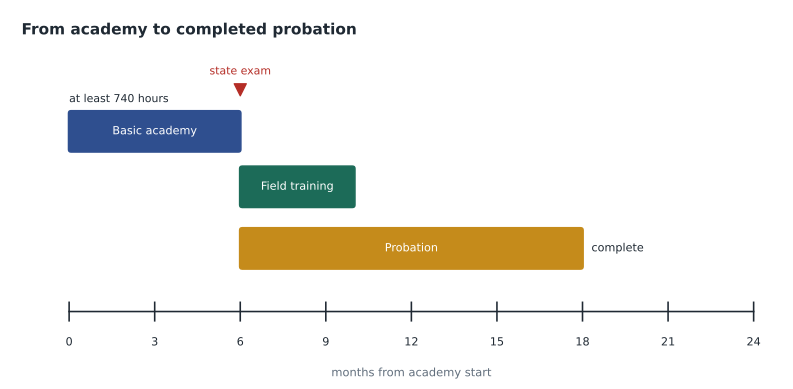
In Ohio, a person must complete a basic training academy approved by the Ohio Peace Officer Training Commission and pass the state certification examination before they can be commissioned by an agency. The basic curriculum requires at least 740 hours, and some academies require more. In closed-enrollment academies, recruits are hired by an agency first and attend as employees, often paid, sometimes with the agency covering all costs. In open-enrollment academies, often run by colleges, anyone who meets the entry requirements can enroll and pay tuition, and then seek a job after certification; financial aid or veterans' education benefits may help. The commission revised the curriculum after the Attorney General's task force: academies began teaching the revised curriculum on July 1, 2025, and it became mandatory on January 1, 2026. The revision added 44 hours of communication and mediation, 16 hours of training in critical decision-making and de-escalation, 8 hours on active threat response and the duty to render aid, and 4 hours on incident debriefs, while moving first aid and incident command training to online prerequisites and making speed measurement a post-graduation elective. Officers from other states or with qualifying federal experience can apply for a reciprocal certificate, which allows them to take the state examination without attending a full academy.
| Hours a week | Weeks |
|---|---|
| 40 | about 18.5 |
| 45 | about 16.4 |
| 50 | about 14.8 |
| Removed | Hours | Added | Hours |
|---|---|---|---|
| Blue Courage | 16 | Communication and mediation | 44 |
| First aid, CPR, AED | 8 | Decision-making and de-escalation | 16 |
| ICS/NIMS | 8 | Active threat and duty to render aid | 8 |
| Speed measuring | 40 | Incident debriefs | 4 |
| Total | 72 | Total | 72 |
Comparisons of training length should be made carefully. An hour of classroom instruction, an hour of scenario training and an hour of supervised field training are not the same thing, and a department with a long field training program after the academy may give a recruit more preparation in total than one with more academy hours. When students compare departments, Desjardins suggests asking three questions: how long the academy is, how much of it is practical, and how long the recruit works under a field training officer before patrolling alone.
A full-time academy of 740 hours at forty hours a week is about eighteen and a half weeks; many academies run longer because they exceed the minimum, and evening or part-time academies take much longer. The curriculum change replaced 72 hours of content with 72 hours of new content, so the minimum total did not change.
What training is like
Boyce describes training from the recruit's point of view. It is intense, structured and physically demanding. Days are long, with classroom learning, practical scenarios, physical training, driving and firearms. There are frequent tests, and recruits who fail examinations or practical assessments may be given a chance to remediate, but repeated failure can end their employment. Discipline matters: punctuality, uniform standards, respect for instructors and fellow recruits, and honesty about mistakes. In the academy, cadets must pass the written examinations, the practical skill assessments, the physical fitness graduation standard and finally the state certification examination.
Scenario training is the heart of modern police training. Recruits handle staged calls, a domestic dispute, a traffic stop, a person in crisis, with actors who respond to what the recruit does. Instructors then debrief the scenario, focusing on communication, decision-making, legality and safety. Desjardins notes that this is where everything in the program comes together: the law of arrest and search, the use-of-force framework, de-escalation, crisis response, and note-taking. 'You will be surprised how much of this program you will use in your first week of scenarios,' he says.
| Area | What recruits learn | Connection to this program |
|---|---|---|
| Law and police powers | Arrest, detention, search, use of force, charging | Law courses, arrest and search course |
| Communication and de-escalation | Tactical communication, crisis intervention, mediation | Community policing, mental health and crisis courses |
| Investigation and evidence | Scene management, interviewing, notes, disclosure | Investigation and evidence courses |
| Officer safety and use of force | Defensive tactics, firearms, control and restraint | Officer safety course |
| Driving | Emergency driving, pursuits policy, collision avoidance | Traffic and safety material |
| Wellness and ethics | Stress, resilience, professional standards | Ethics and wellness lessons throughout |
Field training and probation
Formal training is followed by supervised practice on the street. In many Ohio agencies, new officers complete a field training officer program after the academy. The common model divides training into phases, often with a different field training officer in each, and daily observation reports that score the trainee on standard categories such as officer safety, report writing, knowledge of law and relations with the public. The trainee gradually takes the lead until, in the final phase, the field training officer rides along mainly to observe. New officers usually remain on probation for six months to a year or more after the academy, during which they can be released without the protections that apply to permanent employees.
Boyce says that the coach or field training period is where many new officers learn the most and where some are lost. Common problems are poor report writing, unsafe habits, difficulty making decisions, and difficulty accepting feedback. 'In training, you were taught how,' she says. 'In the field, you learn when. Your coach is not your friend and not your enemy. Listen, ask questions, write things down and never hide a mistake.'
Preparing for training
Grant and Boyce give the students advice for the weeks before training starts. Arrive fit, ideally fitter than the hiring standard, because training is physically demanding and recruits who arrive at the minimum are more likely to be injured or to fail the graduation standards. Arrive rested. Settle family, finances and housing arrangements before training, because there will be little time during it. For a full-time academy, cadets should expect long days and homework, and some academies require recruits to live on site during the week. Review the basics from this program: the law of arrest, search and use of force, note-taking and report writing. Recruits who arrive able to write a clear report have a large advantage.
Desjardins adds something about attitude. Training environments are hierarchical and sometimes stressful by design. Recruits are expected to follow instructions, take criticism, and work as a team with people they did not choose. Most recruits find it rewarding; some find it hard. 'Be the recruit who helps the person struggling on the run, who admits when you got the scenario wrong, and who asks the question everyone else is afraid to ask,' he says. 'Your instructors are writing about you, and so are your classmates, whether they know it or not. Many of the people beside you will be your colleagues for thirty years.'
Lifelong training
Training does not end with probation. Officers complete regular requalification, such as annual use-of-force and firearms training, and mandatory training whenever laws, policies or equipment change. Many complete specialized courses for investigations, traffic, crisis intervention and other roles. In Ohio, the commission sets continuing professional training requirements that certified officers must complete each year to keep their certification active. Boyce tells the students that the officers who progress furthest are usually the ones who treat learning as part of the job, not an interruption to it.
What instructors look for
Boyce, who spent two years as an instructor before moving to recruiting, describes what instructors notice about recruits. They notice who arrives early and prepared, who helps classmates, who takes feedback without arguing and then changes what they do, and who tells the truth about a mistake in a scenario. They also notice recruits who talk over others, who try to look good rather than learn, and who treat role players and civilian staff with less respect than officers. 'Instructors write reports on every recruit,' she says. 'Those reports go back to the service and follow the recruit into their first posting. The coach officer will have read it before you meet.'
She also explains that failure in training is not always the end. Recruits who fail an examination or a practical assessment are usually given remedial training and another attempt. What ends careers in training is more often a pattern: repeated failures without improvement, dishonesty, or conduct problems. A recruit who struggles with the firearms qualification but practices every spare hour and passes on the second attempt has shown exactly the persistence the job needs.
Lateral and experienced officers
Not every new officer comes through the standard path. Experienced officers from other states or with qualifying federal experience can apply to the Ohio commission for a reciprocal certificate and then take the state examination without attending a full academy. Many Ohio agencies actively recruit lateral officers and may offer credit for prior service in pay or seniority. Desjardins mentions this because some of the students may start in one service and move to another later. 'Your first service is not necessarily your last,' he says. 'But the record you build there goes with you.'
Priya asks what happens to recruits who are injured during training. Boyce explains that services usually allow injured recruits to recover and rejoin a later intake, provided the injury heals and they can still meet the standards. A recruit who is injured but hides it, and then fails a practical assessment, is in a far worse position than one who reported the injury and was held back. 'Report injuries,' she says. 'Training instructors deal with them all the time. They do not deal well with being surprised.'
Desjardins closes the lesson by returning to his opening question. A recruit becomes an officer in law when sworn, in skill through training, in independence through coaching and probation, and in character through the decisions they make when nobody is checking. 'The first three happen to you,' he says. 'The last one you do yourself, every shift, for as long as you wear the badge.'
Costs and pay during training
Money during training is a practical worry for many students. Boyce explains that the arrangements differ widely. In closed-enrollment academies, recruits are hired first and usually paid during the academy, and the agency often covers the costs. In open-enrollment academies, cadets usually pay tuition, equipment and uniform costs themselves, although financial aid and veterans' education benefits may help, and some agencies reimburse costs when they hire an open-enrollment graduate. She suggests that every student find out exactly what their chosen route will cost and pay before they commit, and plan their finances for a period of long days and little flexibility.
Marco works out his family budget for the training period with his partner. Linh, who is not applying yet, realizes that her analyst path has a different cost: the certificate tuition and the risk of a gap between finishing it and finding a position. Both decide to keep their current jobs as long as possible, which Boyce says is exactly what she would advise.
Worked problem
Weighing two academy routes
Jesse could attend an open-enrollment college academy in the spring, paying tuition, or wait for the Nimkii Bay Tribal Police Department to hire him and send him to a closed-enrollment academy, with pay, in the fall. How should he compare the routes?
Show solution
- Compare costs: tuition and living costs for the open academy, against several months without academy pay while waiting for the closed one.
- Compare certainty: graduating from an open academy gives him certification but no job; the closed academy route depends on the department's hiring timeline.
- Ask the department whether it would hire him before the spring academy and sponsor him, or reimburse tuition if he certifies first.
- Consider family and community commitments during training, when evenings and weekends may be taken up.
- Talk to officers from each who completed training recently.
Answer: Jesse asks the department about sponsorship and learns that it will hire him in January and pay for the spring academy, which settles the question.
Common mistakes
MistakeGraduating from training makes you a fully independent officer.
InsteadCoach or field training and probation follow, usually for about a year.
MistakeTraining is mostly physical.
InsteadMuch of it is law, communication, investigation, report writing and scenarios.
MistakeProbation is a formality.
InsteadNew officers can be released during probation if they are not suitable.
MistakeHiding a mistake during field training protects you.
InsteadHidden mistakes destroy trust; disclosed mistakes become teaching points.
Summary and key terms
- Ohio requires an approved basic academy of at least 740 hours and the state certification exam before an agency can commission an officer.
- The Ohio curriculum revision, mandatory from January 1, 2026, added communication, de-escalation, active threat and debriefing content.
- Scenario training brings together law, communication, decision-making and safety.
- New officers complete a phased field training program and a probationary period.
- Accepting feedback and admitting mistakes are essential during field training.
- OPOTC
- Ohio Peace Officer Training Commission.
- Closed enrollment
- An academy open only to people already hired by an agency.
- Field training officer
- An experienced officer who trains and evaluates a new officer in the field.
- Recruit
- A person hired by a service who is in training.
- Scenario training
- Practice with staged calls and actors, followed by a debrief.
- Probation
- An initial period during which a new officer can be released if unsuitable.
Practice problems
Work each problem on paper first, then reveal the answer to check.
What did Desjardins mean by saying all the students were right about when someone becomes an officer?
Show answer
Becoming an officer is a process: swearing in, training, field training and probation.
What is the center of modern police training?
Show answer
Scenario training with actors and debriefs.
Name two common problems that end new officers' careers in field training.
Show answer
Any two of poor report writing, unsafe habits, difficulty making decisions, difficulty accepting feedback.
In the curriculum example, how many hours were removed and added in the Ohio revision?
Show answer
72 removed and 72 added.
Lesson quiz · 5 questions
Score 60% or more to complete this lesson.
Create a free account to save your progress, take quizzes and earn a certificate.