
LES-215 · Lesson 2 of 12 · 19 min
Careers beyond patrol: specialized units, civilian roles and related agencies
▶ Video coming soon A video version of this lesson is on the way.
Linh Tran has worked three evenings a week as a part-time call-taker in Port Ardent's communications center since the spring. She likes the work: calm voices on the worst nights, the pace, the sense that the first ninety seconds of a call can decide how it ends. She is less sure about patrol. 'I do not know if I want to carry a gun,' she tells Boyce after class. 'Is that a reason not to be in this program?'
'It is a reason to think hard about which job you want,' Boyce says. 'Not every career in public safety carries a gun, and not every career with a badge is patrol.' The next lesson, she says, is about everything else: the specialized units most officers hope to join one day, the civilian professionals who now do a large share of police work, and the related agencies that hire many graduates of programs like this one.
Specialized units: where patrol can lead
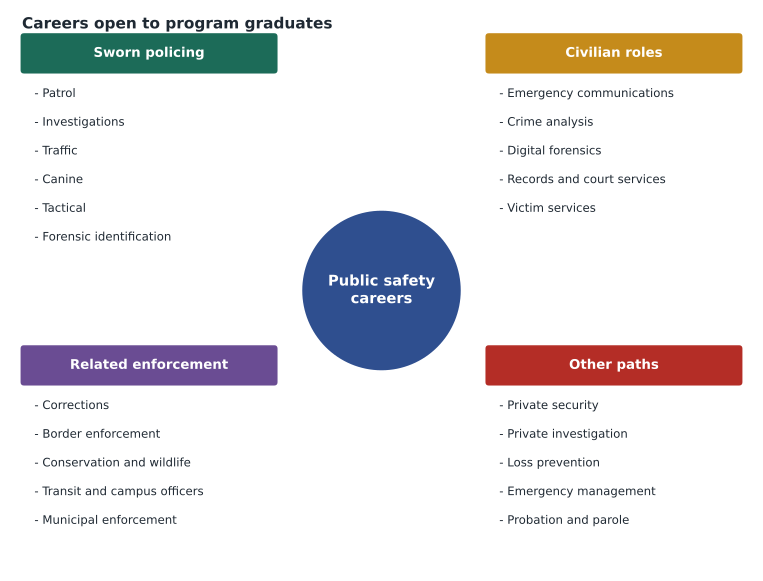
Almost every police officer starts in patrol. In most American departments, new officers serve a probationary period in patrol, and many units require several years of patrol experience before an officer can apply. Patrol is where officers learn to handle people, make decisions with incomplete information and write the reports that investigators and courts depend on. Specialized units then select officers who have shown the right skills and judgment.
| Unit | What the work involves | What selectors usually look for |
|---|---|---|
| Criminal investigations | Following up serious crimes, interviewing, warrants, case files for court | Strong report writing, interviewing skill, patience, court experience |
| Traffic and collision reconstruction | Enforcement, impaired driving, serious collision investigation | Interest in traffic law, mathematics and physics, attention to detail |
| Canine | Tracking, searching for people and evidence, detection | Fitness, reliability, willingness to care for a dog at home |
| Tactical or emergency response | High-risk warrants, barricaded persons, crisis situations | Fitness, composure, teamwork, firearms skill, negotiation support |
| Crisis negotiation | Talking with people in crisis or holding hostages | Listening, patience, empathy, calm under pressure |
| Forensic identification | Scene examination, photography, fingerprints, evidence recovery | Precision, science background, patience |
| Cybercrime and technological crime | Digital evidence, online offenses, device examination | Technical skill, continuous learning, careful documentation |
| Community and youth units | School resource work, neighborhood policing, outreach | Relationship building, problem-solving, communication |
Marco asks how officers get into canine work. Boyce explains that canine positions are rare: Port Ardent has four handlers and one opening every few years. Selection usually involves a written application, an interview, a fitness test, a home visit to check that the handler can house a dog, and a long training course. 'The officers who get these jobs are the ones who did patrol well for years,' she says. 'Excellent notes, good court testimony, no complaints they could not explain, and a reputation for showing up when someone needs backup.'
Civilian careers in policing
Police services employ large numbers of civilian staff. In many American departments, civilian staff make up a significant share of employees, and the share has grown. Civilians do work that once fell to sworn officers or did not exist: answering emergency calls and dispatching units, analyzing crime patterns, examining digital devices, managing evidence and records, running court services, supporting victims, and working in human resources, training, finance and information technology. These jobs are usually filled through ordinary public-sector hiring, with background checks but without the physical tests and academy training required of officers.
Linh's interest is crime analysis. Port Ardent's crime analyst, whom she has volunteered with since the community policing course, has a degree in geography and a certificate in data analysis. The work involves mapping incidents, finding patterns, writing bulletins for patrol and investigators, and evaluating whether strategies worked. 'Analysts are now part of how good services decide where to put their officers,' Desjardins says. 'You do not need a uniform to change what happens on the street.'
Emergency communications is another path. Call-takers and dispatchers receive emergency and non-emergency calls, decide what response is needed, send units and keep track of them. American agencies hire telecommunicators through their own processes or through regional dispatch centers, and many states require certification in emergency telecommunication. The work is shift-based, high-pressure and often hidden from public view, and turnover is high. Linh says the hardest call she has taken was a child calling about a parent who would not wake up. 'I kept her talking until the paramedics knocked,' she says. 'Then I took a ten-minute break and took the next call.'
Related agencies
Many graduates of police programs build careers in agencies that are not police services but do related enforcement work. Desjardins walks through the main ones and what makes each distinct.
Correctional officers work in county jails, often run by the sheriff, which hold people awaiting trial or serving short sentences, in state prisons, run in Ohio by the Department of Rehabilitation and Correction, and in federal prisons run by the Bureau of Prisons. The work centers on supervision, security and the safe daily operation of an institution, but increasingly also on de-escalation, mental health and preparing people for release. Some officers spend whole careers in corrections; others use it as a step toward policing, since the experience of managing people in confined, tense situations is valued by police recruiters.
Customs and Border Protection officers work at airports, land crossings and seaports, and Border Patrol agents work between ports of entry. Training takes place at federal academies, and new officers and agents can be assigned to locations far from home, often along the southern border at first. Marco reads the posting rule twice. 'That is the problem,' he says. 'Anywhere means anywhere.'
Ohio wildlife officers with the Department of Natural Resources enforce wildlife, natural resource and pollution laws on land and water, including Lake Erie. Applicants need associate-level coursework in a relevant field, must be 21 by the end of peace officer training, and must pass a background investigation, polygraph, psychological and physical exams, and fitness and swimming standards. Jesse, who grew up fishing and hunting near Nimkii Bay, is interested. 'I could do this at home,' he says.
Other related careers include campus and transit police, who are often fully sworn officers working for a university or transit authority; code enforcement officers employed by cities; and probation and parole officers, who usually need a degree in social work or criminal justice. Private security, loss prevention and private investigation also employ many program graduates, under provincial or state licensing.
Policing in tribal communities
Jesse's first choice is to police the community he grew up in. Sergeant Paul Keeshig of the Nimkii Bay Tribal Police Department, who spoke to the class in an earlier course, visits again and describes how a tribal department works. Its fourteen officers enforce tribal law under the authority of the tribal government. Some hold special law enforcement commissions from the Bureau of Indian Affairs that let them enforce certain federal laws, and the department has cross-deputization agreements with the county sheriff. Major crimes on tribal land are often investigated with the FBI under a memorandum of understanding. Many tribal officers train at the federal Indian Police Academy in Artesia, New Mexico, or at a state academy.
Keeshig is frank about the job. 'You will police your cousins, your teachers and the people you played hockey with,' he says. 'Some will expect favors. Some will expect you to be harder on them because you are one of them. The community will watch how you handle both. What you get in return is that you know the families, you speak the language of the place, and people will talk to you who would never talk to an outsider.' He tells Jesse that the service values officers who understand the community's history and its relationship with policing, including the reasons for mistrust, and who can work with Elders, the band council and community health workers.
Keeshig also mentions the practical side: small services have few officers, so shifts can be long and backup far away, and officers often do everything from traffic to sudden deaths. Training opportunities may require travel. 'It is not an easy posting,' he says. 'It is the most important one I know.'
Moving between careers
Boyce points out that careers in public safety are rarely straight lines. Many officers in Port Ardent started somewhere else. One of the current staff sergeants spent six years as a correctional officer before applying. A detective in the fraud unit was a bank investigator, like Priya. Two of the communicators became officers, and one officer left patrol after a serious injury and became the service's digital forensic examiner. Movement also runs the other way: experienced officers leave to become investigators for regulators, insurers, oversight bodies or private firms, or move into emergency management, like Maggie Kowal from the emergency management course.
The skills that transfer most readily are communication with people in difficult situations, careful documentation, knowledge of the law and the courts, and composure under pressure. Recruiters for every one of these careers ask about them. 'Whatever you do first,' Boyce says, 'do it well and leave on good terms. Your next employer will call your last one.'
Desjardins adds a point about education. Many related careers, such as probation and parole, analysis, digital forensics and federal enforcement, value or require a degree. Many Ohio universities accept associate degree credits in criminal justice toward a bachelor's degree, and some departments offer tuition assistance or extra pay for degrees. A graduate who starts in one career can build the credentials for another while working, which is how many of the people the students have met did it.
Private security and code enforcement
Private security is one of the largest employers of program graduates. In Ohio, private security officers and private investigators work for companies licensed by the state, and armed security officers need additional training and registration. Security work ranges from guarding buildings to loss prevention in retail, event security, hospital security and corporate investigations. It offers flexible hours and real experience with conflict and reporting, which is why many applicants use it while waiting for a police hiring process. Code enforcement officers enforce municipal rules on parking, property standards, noise and licensing, and often deal with the same neighborhood problems as police from a different angle.
Boyce closes the lesson with a suggestion. Before committing to any path, spend a day with someone who does the job. Most services and agencies will arrange a job shadow or a ride-along for serious applicants, and many related agencies, such as correctional centers and ports of entry, offer tours or information sessions. Linh has already spent a shift in the analyst's office; Jesse arranges a day with an Ontario conservation officer on the lake near Nimkii Bay; Marco visits the county jail with the program's corrections instructor. Each comes back with a clearer sense of what the work feels like on an ordinary day, which is the day that matters most.
Worked problem
Comparing two paths
Linh is choosing between applying as a police officer next year and continuing as a call-taker while she finishes a data analysis certificate to become a crime analyst. How should she compare them?
Show solution
- List the core tasks of each job and mark the ones she enjoys, tolerates or dislikes. Carrying a firearm and using force are core to the sworn job; neither is part of analysis.
- Compare the hiring process: the sworn path needs the written tests, physical test, background and academy; the analyst path needs the certificate, a portfolio of analysis work and a background check.
- Compare the schedules: patrol and communications are shift work; most analyst positions are weekday jobs.
- Compare openings: Port Ardent hires about forty officers a year but has two analyst positions, so an analyst career may mean applying to several services.
- Talk to people in both jobs, and keep the call-taker job while deciding.
Answer: Linh decides to finish the certificate, build an analysis portfolio and apply for analyst positions in the region, while keeping the sworn path open for later.
Common mistakes
MistakeSpecialized units hire directly from the street.
InsteadAlmost all specialized units select experienced patrol officers with strong records.
MistakeCivilian staff are support workers, not part of policing.
InsteadCivilians do core work such as emergency communications, analysis and digital forensics.
MistakeCorrections and border services are fallback careers.
InsteadThey are distinct professions with their own training and career paths, and many people choose them first.
MistakeConservation officers are not real law enforcement.
InsteadThey are armed peace officers who investigate, arrest and testify in court.
Summary and key terms
- New officers usually spend their first years in patrol before applying to specialized units.
- Specialized units select officers for the skills their work demands, and openings can be rare.
- Civilian professionals, including communicators, analysts and digital examiners, do a large share of police work.
- Corrections, border services, conservation enforcement, special constables, by-law or code enforcement, probation and private security are related careers.
- Each path has its own hiring process, training, schedule and posting rules.
- Telecommunicator
- An emergency call-taker or dispatcher.
- Border Patrol agent
- A federal officer who patrols between ports of entry.
- Specialized unit
- A unit such as investigations, traffic, canine or tactical that selects experienced officers.
- Communicator
- A civilian who takes emergency calls and dispatches units.
- Crime analyst
- A civilian who studies crime data to guide deployment and evaluate strategies.
Practice problems
Work each problem on paper first, then reveal the answer to check.
Why do specialized units prefer officers with years of patrol experience?
Show answer
Patrol develops judgment, people skills, report writing and court experience.
Which related career is posted anywhere in the country after training?
Show answer
Customs and Border Protection, among others.
What fitness requirement applies to applicants for conservation officer jobs?
Show answer
Fitness and swimming standards, as part of the hiring process.
What did Linh decide to do?
Show answer
Finish her analysis certificate and apply for analyst positions, keeping the sworn path open.
Lesson quiz · 5 questions
Score 60% or more to complete this lesson.
Create a free account to save your progress, take quizzes and earn a certificate.