
LES-215 · Lesson 4 of 12 · 19 min
The recruitment process: from application to offer
▶ Video coming soon A video version of this lesson is on the way.
Boyce draws a long horizontal line on the whiteboard and marks it with a dozen ticks. 'This is the process for a Port Ardent officer,' she says. 'On average it takes about eight months from the day an application arrives to the day a recruit enters the academy. Some take five months; some take more than a year. Every step is a gate. At every gate, some people leave.' She writes a number above the first tick, 1,100, and a number above the last, 40.
The students spend the class working out what happens at each gate and why. By the end, each of them has a timeline for their own application and a list of what they must do at each stage.
The stages
The details differ between agencies, but many Ohio city departments follow a civil service sequence. The applicant takes a competitive written examination given by the city's civil service commission, and those who pass are ranked on an eligibility list, with extra credit for veterans or residents where the rules allow. Candidates are then called in rank order for a physical fitness test, an oral board interview, a background investigation and, in many agencies, a polygraph examination. Because the Americans with Disabilities Act generally allows medical and psychological examinations only after a conditional offer of employment, the medical and psychological evaluations usually come after a conditional offer. Successful candidates are hired and sent to a basic academy approved by the Ohio Peace Officer Training Commission, unless they are already certified.
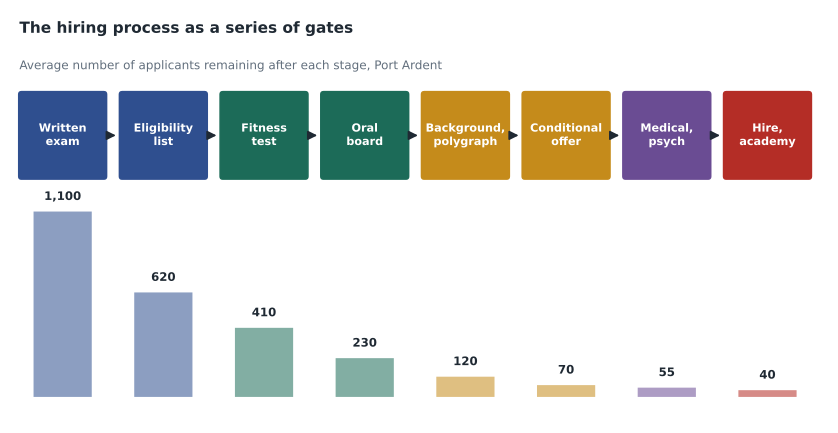
The numbers on Boyce's board are Port Ardent's averages for the last three years. They are not quotas. A strong year might produce sixty hires and a weak one twenty-five. But the shape is typical of police hiring everywhere: most applicants leave early, and many of those who leave do so for reasons they could have prevented.
| Stage | Remaining | Left at this gate | Share of those who reached it |
|---|---|---|---|
| Pre-screening | 1,100 | — | — |
| Application review | 620 | 480 | 0.44 |
| Physical test | 410 | 210 | 0.34 |
| Interviews | 230 | 180 | 0.44 |
| Background | 120 | 110 | 0.48 |
| Psychological | 70 | 50 | 0.42 |
| Medical | 55 | 15 | 0.21 |
| Offer | 40 | 15 | 0.27 |
Overall, 40 of 1,100 applicants are hired: 1,100 ÷ 40 = 27.5, or roughly 1 hire for every 28 applicants. The share column is the number who left divided by the number who reached the gate, so 480 ÷ 1,100 ≈ 0.44 at application review. The background investigation has the highest share, but application review loses the most people.
Jesse notices that the largest single drop is at application review: almost half of the people who reach it leave there. Boyce confirms that most of those are applicants who do not meet the minimum requirements or whose files are incomplete, the problems covered in the last lesson. The next big drops come at the physical test, the interviews and the background investigation. 'If you arrive at review with a complete file, at the physical test already trained, at the interview prepared and at the background with nothing hidden,' she says, 'your odds are very different from the averages on this board.'
What each stage is testing
Each stage tests something different, and it helps to understand the purpose of each one. The written and aptitude tests measure whether the applicant can read, reason and write well enough to cope with training and the job's paperwork. The physical test measures whether the applicant can perform the physical demands of the job safely, such as running, climbing, pushing, pulling and dragging. The interviews assess the competencies the service has identified as essential, such as communication, problem-solving, self-control, teamwork and respect for diversity, mostly by asking about past behavior. The background investigation tests the truth of everything the applicant has said and looks for patterns that predict misconduct. The psychological assessment looks for conditions or traits that would make the job unsafe for the applicant or the public. The medical examination checks vision, hearing and general health against the service's standards.
| Stage | What it measures | How to prepare |
|---|---|---|
| Written and aptitude tests | Reading, reasoning, problem-solving, writing | Practice tests, timed reading, attention to instructions |
| Physical test | Ability to perform physical job tasks safely | Months of progressive training aimed at the test |
| Interviews | Essential competencies, shown through past behavior | Prepared examples, practice with feedback |
| Background investigation | Honesty, reliability, judgment over time | A complete, truthful history; references briefed |
| Psychological assessment | Stability and suitability for the job's pressures | Honest answers, rest, no attempts to manage impressions |
| Medical examination | Vision, hearing and health standards | Early specialist tests; treatment of fixable issues |
Fairness, accommodation and diversity in hiring
Police hiring must comply with human rights law. Under Title VII of the Civil Rights Act of 1964, employers may not discriminate on the basis of race, color, religion, sex or national origin, and a test that has a disparate impact on a protected group must be shown to be job-related and consistent with business necessity. The Americans with Disabilities Act requires reasonable accommodation for qualified applicants with disabilities and limits when medical examinations may be given. The Civil Rights Act of 1991 prohibits adjusting test scores or using different cutoff scores on the basis of race, color, religion, sex or national origin. These rules shape every stage of the process, from the design of written tests to the standards on the physical test.
Desjardins reminds the class of the community policing course: services that reflect the communities they serve tend to be trusted more by them. Many American departments track the demographics of their applicants and hires, recruit at colleges and community events, and offer practice sessions for the physical and written tests. These programs do not lower standards. They help people who would meet the standards find out about the job and prepare for it.
Managing the process
Because the process is long and slow, applicants need to manage it actively. Boyce gives practical advice. Keep a file with copies of everything you submit and every message you receive. Answer requests quickly. Tell the service if you move, change jobs, or are charged with anything, even something minor. Keep training: many applicants lose fitness during the months of waiting. Keep working: a stable job during the process is itself evidence of reliability. And be patient. 'If you hear nothing for six weeks, that usually means your file is with an investigator, not that you have been forgotten,' she says. 'A polite email after a month is fine. Calling every week is not.'
Marco asks what happens if he is not successful. Boyce explains that most services allow applicants to reapply after a waiting period, often a year, and that unsuccessful applicants can usually ask for feedback on the stages they did not pass. A civil service eligibility list usually remains in force for a set period, often one or two years, after which the examination is given again. 'Many of the officers in this building did not get in on the first try,' she says. 'I did not. What matters is what you do with the feedback.'
The applicant's file
Boyce shows the class what a well-organized applicant file looks like. It is a binder or a folder on a laptop, divided into sections: identity and status documents, education, license and driving abstract, first aid and medical results, the civil service exam results, fitness log, employment history, references, volunteer work, the written personal history, and a log of every contact with the service. Each item is dated. 'When the investigator calls and asks for a document,' Boyce says, 'the applicant with this binder sends it the same day. The applicant without it takes three weeks, and that delay goes in the file too.'
She also explains how to choose references. Services usually ask for several, often including a current or recent supervisor and people who have known the applicant for years. They should be people who have seen the applicant under pressure and will speak honestly. Family members are usually not accepted. Applicants should ask permission before listing anyone, explain what the process involves, and warn them that an investigator may call and ask detailed questions, including about weaknesses. 'The worst reference is the one who is surprised by the call,' Boyce says.
Finally, she reminds them that the process is a two-way assessment. Applicants are also learning about the service: how it treats people, how organized it is, and whether its values match their own. Marco notes how quickly Port Ardent answered his questions about shift schedules and family leave. Priya notices that the highway patrol's recruiters were candid about postings. Those impressions are part of the decision too.
Common mistakes at each stage
Over the course, Boyce collects a list of mistakes she sees often, stage by stage. At application review: missing documents, unsigned forms, inconsistent dates between the application and the résumé, and references who were never contacted. At the physical test: arriving untrained, arriving injured or exhausted from training too hard the day before, and not knowing the test format. At the interview: memorized answers that do not answer the question, examples with no personal action in them, and criticizing former employers. At the background investigation: omissions, minimizing, and asking friends to describe things differently from how they happened. At the psychological assessment: trying to appear perfect, which the tests are designed to detect. At the medical: discovering a problem for the first time.
She also lists mistakes that can end a process at any stage: being charged with an offense and not reporting it, posting about the process or the service online, being rude to support staff, and accepting a job with another service without telling Port Ardent. 'The receptionist at the front desk has ended more applications than I have,' she says. 'Everyone in this building is part of the assessment.'
Desjardins asks the students to pick the two mistakes they are most likely to make. Marco picks overtraining before the physical test. Priya picks giving answers that sound rehearsed. Linh picks underselling herself in the interview. Jesse picks not following up. Amara picks talking too fast. They write the answers on cards and keep them in their files.
Boyce also talks about timing. Hiring usually follows the service's budget and its training schedule, so most services run one or two large intakes a year, and applications that arrive just after a cutoff may wait months for the next round. She recommends that applicants ask each service when its next intake closes, plan their preparation backward from that date, and allow time for delays at every stage. 'The process always takes longer than you think,' she says. 'Plan for that and it will not upset you.'
Jesse asks whether applying to a small service is different. Boyce says that the stages are usually the same, but a small service may run them less often and with fewer staff, so the timeline can be longer and the contact more personal. In a small service, the chief may sit on the interview panel and may know the applicant's family. That makes honesty and courtesy even more important.
Worked problem
Planning an application timeline
Amara wants to enter the academy in late 2027. Working backward with Port Ardent's average of about eight months, when should she apply, and what must she finish first?
Show solution
- Count back eight months from late 2027: she should apply by early 2027, and earlier allows for delays.
- Before applying, she needs every document from the checklist, a current first aid certificate, specialist vision and hearing tests, and a complete written history.
- She needs to pass the city's civil service examination, which Port Ardent gives twice a year, so she should take the spring sitting.
- She should be trained for the physical test before applying, not after, since it comes early.
- She should keep working and volunteering through the whole process.
Answer: Amara sets an application date of February 2027, schedules her medical tests for December, and starts a sixteen-week training plan aimed at the physical test.
Common mistakes
MistakeMost applicants fail because they are not good enough.
InsteadMany fail on preventable problems at the earliest stages.
MistakeThe process takes a few weeks.
InsteadMost police hiring processes take several months to a year.
MistakeSilence from the service means rejection.
InsteadBackground investigations are slow; a polite follow-up after a month is reasonable.
MistakeNot being hired the first time ends the possibility.
InsteadMost services allow reapplication after a waiting period, and feedback can guide improvement.
Summary and key terms
- Police hiring is a series of gates, and most applicants leave at the earliest ones.
- Many Ohio city departments start with a civil service examination and an eligibility list.
- Each stage measures something different: reasoning, physical ability, competencies, honesty, psychological suitability and health.
- Human rights law requires job-related standards and accommodation.
- Applicants should manage the process actively: keep records, respond quickly, report changes and keep training.
- Eligibility list
- A ranked list of candidates who passed a civil service examination.
- Conditional offer
- An offer of employment that depends on passing medical and psychological evaluations.
- Attrition
- The loss of applicants at each stage of a selection process.
- Competency
- A skill or behavior, such as self-control or teamwork, that a service has identified as essential.
- Accommodation
- Changes an employer must make so a qualified person can compete or work, short of undue hardship.
Practice problems
Work each problem on paper first, then reveal the answer to check.
At which stage does Port Ardent lose the most applicants?
Show answer
Application review, from 1,100 to 620.
What does the background investigation mainly test?
Show answer
The truth of what the applicant has said, and patterns that predict misconduct.
Why should an applicant keep training during the process?
Show answer
Fitness can drop during months of waiting, and some services retest.
What should you do if you are charged with something during the process?
Show answer
Tell the service promptly.
Lesson quiz · 5 questions
Score 60% or more to complete this lesson.
Create a free account to save your progress, take quizzes and earn a certificate.