
IRW-320 · Lesson 11 of 12 · 21 min
Finishes and protection
▶ Video coming soon A video version of this lesson is on the way.
On Friday morning, November 13, Lionel handed Shay a can of zinc-rich paint, a wire brush, a small roller and a roll of masking tape, and sent him around the canopy with a flashlight. The canopy outriggers were hot-dip galvanized, and the week's bolting, rigging and handling had left a dozen small scrapes and two bare patches where the slings had chafed. The painting contractor would paint the canopy in the spring, but the galvanizing underneath had to be whole, or rust would start under the paint. "The finish is part of the steel," Lionel said. "If we damage it, we fix it, and we fix it the way the spec says, not the way that's handy."
This lesson explains the finishes used on misc and ornamental metals, hot-dip galvanizing and how to repair it, paint and powder coat, stainless steel and its care, the problem of dissimilar metals, and how finished work is protected and turned over.
Why finishes matter
Most misc steel is carbon steel, which rusts when water and oxygen reach it. Inside a heated building, a shop primer and a coat of paint may be enough for decades. Outside, in a wall cavity, in a parking garage with road salt, or anywhere water collects, steel needs much more protection. The specification sets the finish for each item, and the shop drawings repeat it. The misc crew's job is to install the item without damaging the finish, to repair any damage by the approved method, and to protect the finish until the building is turned over.
| Finish | Where it is used | Installer's main concern |
|---|---|---|
| Shop primer | Interior steel to be painted later | Keep it clean; touch up bolting and welds with primer |
| Hot-dip galvanizing | Exterior and wet locations: lintels, canopies, rails, bollards | Do not grind or burn it; repair damage by an approved method |
| Duplex (galvanized and painted) | Exposed exterior steel where color matters | Repair both layers; keep surfaces clean for paint |
| Powder coat | Railings and ornamental items in a color | Avoid scratches; field touch-up is visible, so protect it well |
| Stainless steel | Ornamental railings, handrails, exposed fittings | Keep it free of carbon steel contamination; use stainless tools |
| Anodized aluminum | Storefront, soffits, trim (often by others) | Avoid contact with wet steel and concrete; protect from scratches |
Hot-dip galvanizing
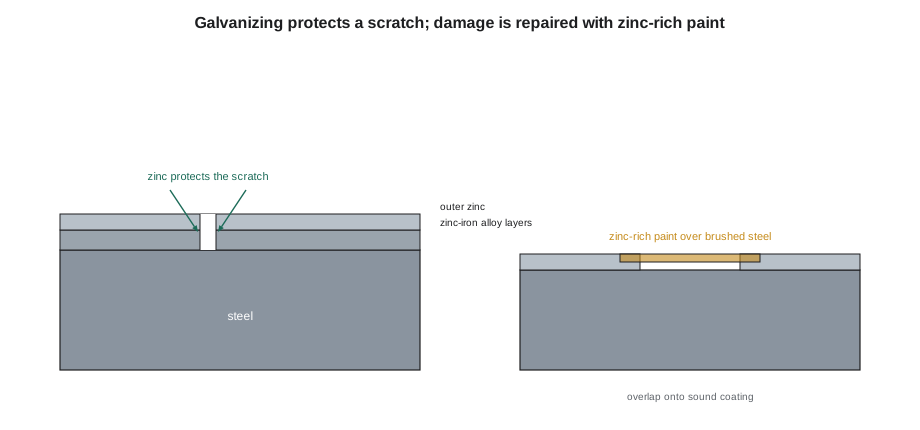
Hot-dip galvanizing coats steel with zinc by dipping the fabricated piece into a bath of molten zinc at about 840 °F. The zinc bonds with the steel, forming layers of zinc-iron alloy under a layer of pure zinc. It protects in two ways: as a barrier that keeps water away from the steel, and sacrificially, because zinc corrodes in preference to steel, so a small scratch through the coating is protected by the zinc around it.
Galvanizing of fabricated steel is specified to ASTM A123, which sets the coating thickness by the steel's thickness. For structural shapes and plates 1/4 in thick and over, common in misc steel, the required average coating grade is 100, about 3.9 mils; thinner material gets thinner coatings, and the table in the standard gives the exact grade.
Galvanized pieces need design details that the installer will see: vent and drain holes in tubes and closed shapes, so that molten zinc can flow in and out and trapped air cannot explode, and sometimes distortion of thin pieces from the heat. Vent holes are left open unless the drawing says to plug them; they let water drain out of hollow sections in service. Galvanized surfaces are also slippery to some paints, which is why duplex systems use a special surface preparation.
- Do not weld galvanized steel without the precautions the welding procedure requires; welding burns off the zinc and produces zinc oxide fumes that cause metal fume fever.
- Do not grind galvanizing to make a piece fit; if a galvanized piece does not fit, report it.
- Do not use galvanized pieces as a ground return for welding, and do not drag them on concrete.
- Lift galvanized pieces with nylon slings or padded chains, and land them on wood dunnage.
Repairing galvanizing
Damage to galvanizing from handling, bolting or field welding is repaired by one of the methods in ASTM A780, which the galvanizing standards refer to: zinc-rich paint, zinc-based solder or sprayed zinc metallizing. Zinc-rich paint is the usual method on site. The standard and the paint maker set the surface preparation, the thickness and the limits on the size of the repair; very large bare areas may need the piece to be regalvanized.
- Clean the damaged area of dirt, oil and loose material, and wire-brush or abrade it to bright metal, slightly beyond the damage.
- Apply the zinc-rich paint the specification names, in the thickness it requires, measured with a wet-film gauge or by coverage.
- Let it dry as the maker says before the area is handled or overcoated.
- Record the repair: location, area, product and date.
Worked problem
Paint for the canopy touch-up
Shay measured the bare and scraped areas on the canopy and the railings delivered so far: about 26 ft² in total, mostly small spots. The zinc-rich paint is 60 in 100 solids by volume, and the specification requires a dry film of 3.9 mils. What is the paint's theoretical coverage at that thickness, and how much paint does the touch-up need, before waste?
Show solution
- Theoretical coverage (ft² per gallon) = 1,604 × volume solids (as a fraction) ÷ dry film (mils) = 1,604 × 0.60 ÷ 3.9 ≈ 247 ft²/gal.
- Paint needed = 26 ÷ 247 ≈ 0.105 gal, about 13.5 fl oz.
Answer: About 13.5 fl oz before waste. Small brush and roller work wastes a lot of paint, so a quart can was about right. The formula gives the coverage of a perfect film; in practice, Lionel told Shay, plan on half of it for touch-up.
The two chafed patches were each the size of a hand. Shay wire-brushed them to bright steel, masked around them and applied two coats with a small roller, checking the first with the wet-film gauge from Lionel's kit. Lionel photographed each repair with a tape beside it for the repair log.
Paint and powder coat
Interior misc steel is usually shop primed and painted on site by the painting contractor. The misc crew's job is to keep the primer clean and to touch up bolted connections, field welds and damaged spots with the same primer, so that the painter has a sound base. Field welds must be cleaned of slag and spatter before priming, because paint does not bond to slag.
Powder coat is a dry paint powder applied electrostatically in the shop and baked into a hard, even finish. It is common on colored railings, gates and ornamental items. It is tough, but a scratch shows, and field touch-up with liquid paint never quite matches. So powder-coated items are protected with film or wrapping until the end of the job, handled with gloves, and installed with care at fasteners, where wrenches and drills slip. Field welding on powder-coated items is avoided; where it cannot be, the detail is designed so the weld is hidden or the item is coated after.
Stainless steel
Stainless steel resists corrosion because of a thin, invisible film of chromium oxide on its surface, which forms naturally in air and heals itself when scratched. It is used for handrails, ornamental railings, glass guard fittings and fasteners in exposed or wet locations. The two common grades are 304, for general use, and 316, which contains molybdenum and resists chlorides better, for coastal, pool and de-icing salt exposure.
Stainless steel's main enemy on site is contamination with ordinary carbon steel. A grinding disc or wire brush that has been used on carbon steel leaves tiny steel particles on the stainless surface, which rust within days and look like the stainless itself is rusting. Steel filings from cutting nearby carbon steel do the same. So stainless work has its own rules.
- Use stainless steel brushes and discs, and keep them only for stainless.
- Store and handle stainless away from carbon steel, on wood or plastic, not on steel racks.
- Protect installed stainless from sparks and filings when carbon steel is cut or ground nearby.
- Clean field welds on stainless as the specification says, which may include pickling or passivation to restore the oxide film.
- Use stainless fasteners in stainless work, to avoid both contamination and galvanic corrosion.
Rhea told Shay about a stainless lobby handrail at Larkmont Tower in 2025 that had turned orange with spots two weeks after installation. A plumber had cut steel pipe on the floor above, and the filings had fallen through a gap onto the rail. It took two days of cleaning with a passivating paste to bring it back. Since then, Rhea wrapped every stainless rail in film the day it was installed.
Dissimilar metals
When two different metals touch in the presence of water, the less noble one corrodes faster, as if the pair were a battery. This is galvanic corrosion. The farther apart the metals are in the galvanic series, and the larger the noble metal's area compared with the other's, the worse it is. Common problem pairs on buildings are aluminum against carbon steel or copper, galvanized steel against copper, and carbon steel fasteners in stainless or aluminum.
- Separate aluminum from steel with an isolating tape, gasket or coating, as the detail shows; aluminum storefront and soffits often sit on steel framing.
- Use fasteners of the same metal as the parts, or of a more noble metal in small area, such as stainless screws in aluminum, which is usually acceptable; never the reverse, such as carbon steel screws in stainless.
- Keep aluminum out of contact with wet concrete and mortar, which are alkaline and attack it.
- Do not let copper or copper-bearing water run onto galvanized steel or aluminum.
At Ashcroft, Sunbridge's aluminum soffit and storefront would sit against Crossbeam's galvanized steel at the canopy and the tube frames, and the details showed an isolating tape at every contact. Lionel added a note to the turnover list for Mina: the steel surfaces were ready, and the isolation was Sunbridge's to install with their aluminum.
Protection and turnover
Finished misc and ornamental work is installed long before the building is finished, and other trades work around it for months. Railings are leaned on, stairs carry every trade and their materials, canopies are walked on by roofers and stainless is splashed with plaster. Protection keeps the work in the condition it was installed in until the owner takes it over.
- Wrap railings and handrails with film or padding, and stainless and powder coat with a protective film rated for the time and the sunlight it will see.
- Cover stair nosings and treads with protective boards or nosing guards once the pans are filled.
- Put corner guards on exposed corners of finished items in corridors and lobbies.
- Post signs on finished items that must not be used as anchor points, ladders or hoisting points.
- Remove protection at the end, clean the work as the specification requires, and walk it with the general contractor for deficiencies.
Turnover is the formal handing over of the work. Lionel's crew would walk each area with Priscilla Hahn when the building was close to complete, with the shop drawings and the specification, and list any deficiencies: a scratched rail, a missing cap, a loose post. Each deficiency would be fixed and signed off. The repair log from that Friday, with its photographs, would be part of the record handed over with the building.
Powder coat and paint repairs that will be seen
Repairs to finishes that people will see are harder than repairs to galvanizing hidden under paint. A field touch-up of powder coat with liquid paint never matches perfectly in gloss or color, and a repaired stainless surface may look different from the mill finish around it. The specification usually says how visible repairs are handled: small chips touched up with the coating maker's repair paint, larger damage by replacing the piece or recoating it in the shop. Before touching up anything that will be seen, Lionel asked the general contractor, who asked the architect, because an owner may accept a small invisible repair and reject a visible one.
Cleaning finished metals
Cleaning is part of the turnover. Galvanized steel is cleaned of dirt and concrete splash with water and a soft brush, never with acid, which attacks zinc. Stainless steel is cleaned with mild detergent and water, or with a stainless cleaner, wiping along the grain of a brushed finish. Powder coat and anodized aluminum are cleaned with mild detergent and a soft cloth. Abrasive pads, steel wool and strong solvents damage most finishes, and the wrong cleaner can void the finish warranty. The specification and the finish maker's care instructions say what to use, and the crew follows them, because a finish that survives the whole construction job can still be ruined in the last week by a careless cleaner.
Common mistakes
MistakeGrinding galvanizing to make a piece fit.
InsteadReport the misfit; repair any damage by an approved ASTM A780 method.
MistakeWelding galvanized steel without precautions.
InsteadFollow the welding procedure for galvanized steel and control the zinc fumes.
MistakeUsing a carbon steel wire brush on stainless.
InsteadUse stainless brushes and discs kept only for stainless.
MistakeFastening aluminum directly to steel.
InsteadIsolate it with tape, gaskets or coatings as the detail shows.
MistakeLeaving finished rails unprotected while other trades work.
InsteadWrap them the day they are installed and keep the protection until turnover.
Summary and key terms
- The specification sets the finish for each item; the installer protects it and repairs damage by the approved method.
- Hot-dip galvanizing protects steel as a barrier and sacrificially; its thickness is set by ASTM A123.
- Damaged galvanizing is repaired with zinc-rich paint, zinc solder or metallizing under ASTM A780.
- Powder coat and stainless steel show every scratch and stain, so they are protected from the day they are installed.
- Carbon steel contamination makes stainless steel rust; dissimilar metals in contact with water corrode faster.
- Protection, cleaning and a deficiency walk complete the work at turnover.
- Hot-dip galvanizing
- Coating steel with zinc by dipping it in molten zinc.
- Zinc-rich paint
- A paint with a high zinc content used to repair galvanizing.
- Duplex system
- Galvanizing with a paint system over it.
- Passivation
- Treating stainless steel to restore its protective oxide film.
- Galvanic corrosion
- Faster corrosion of one metal when it touches a more noble metal in water.
- Turnover
- The formal handing over of finished work to the owner or general contractor.
Practice problems
Work each problem on paper first, then reveal the answer to check.
A paint is 50 in 100 solids. What is its coverage at 5 mils?
Show answer
1,604 × 0.50 ÷ 5 ≈ 160 ft²/gal.
At 160 ft²/gal, how much paint covers 20 ft²?
Show answer
0.125 gal, about 16 fl oz, before waste.
Why are vent holes left in galvanized tubes?
Show answer
So zinc can flow in and out during galvanizing and water can drain in service.
Which stainless grade resists chlorides better?
Show answer
316.
What is placed between aluminum and steel?
Show answer
An isolating tape, gasket or coating.
Lesson quiz · 5 questions
Score 60% or more to complete this lesson.
Create a free account to save your progress, take quizzes and earn a certificate.