
IRW-310 · Lesson 6 of 12 · 23 min
Heavy industrial and plant structures
▶ Video coming soon A video version of this lesson is on the way.
In the summer of 2024, two years before Shay started, Crossbeam spent eleven weeks inside Vandor Metals, a steel service and processing plant on the south side of Columbus. The job was a new bay on the end of an old mill building, with a 40-ton overhead crane on runway girders, and a pipe rack carrying steam, air and cooling water across the yard. "Industrial work is a different trade inside the trade," Carla told the November 6 group. "The steel is heavier, the tolerances on the crane runway are tighter than anything in a building, and you're working inside somebody's plant, with their trucks, their hazards and their schedule. The plant doesn't stop because the ironworkers showed up."
This lesson covers heavy industrial structures: mill buildings and crane runways, pipe racks, equipment supports and platforms, working in operating plants, shutdown work, and the special tolerances and safety rules that come with them.
What makes industrial steel different
- The steel is heavier. Columns carrying crane runways, deep girders and thick base plates mean bigger picks and bigger anchor rods than in a building.
- Loads move. Overhead cranes, conveyors and machinery put repeated and dynamic loads on the steel, so fatigue matters, and connections and welds are often more demanding.
- Tolerances can be tighter. A crane runway out of line by a few millimeters wears out wheels and rails and can derail a crane.
- The site is an operating plant, with its own traffic, process hazards, permits and rules, and the work often has to fit into a shutdown.
- The steel is often exposed to heat, corrosion, chemicals or vibration, which affects coatings, bolting and inspection.
Mill buildings and crane runways
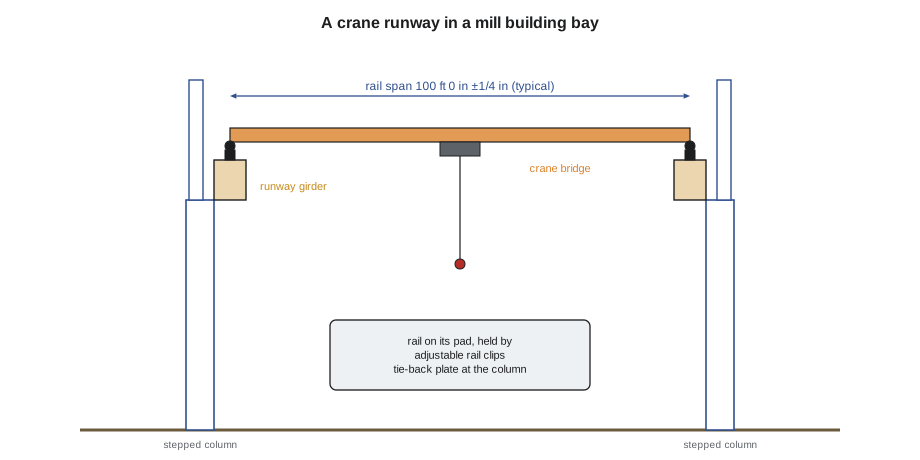
A mill building is a tall single-story structure with overhead cranes running the length of each bay. Its columns are often stepped or laced, with a lower, heavier part carrying the crane runway girder on a bracket or a crane column, and an upper, lighter part carrying the roof. The runway girders span from column to column along each side of the bay, and the crane rail is clipped to the top of the girders. The crane bridge runs on wheels along the two rails, and its trolley and hoist move across the bridge.
Vandor's new bay was 100 ft wide and 160 ft long, with columns at 40 ft along each side, so four runway girder spans each side, eight girders in all. Each girder was a welded plate girder 40 ft long weighing about 9,200 lb, and the rails were fastened to them with adjustable rail clips. The bay's roof trusses were lighter than Ravensworth's, but the columns were the heaviest pieces Crossbeam had set that year.
Runway tolerances
Crane runways have their own tolerances, which come from the crane maker, the engineer and industry guides, and they are usually tighter than building tolerances. The important ones are the rail span, the distance between the centers of the two rails; the straightness of each rail along its length; the difference in elevation between the two rails; and the rail joints, which must be tight and level so that the wheels do not hammer them.
Vandor's specification, following the crane maker and typical industry practice such as AISC Design Guide 7, set the rail span at 100 ft 0 in ±1/4 in, with each rail straight within about 1/4 in over 20 ft, and the two rails at the same elevation within a similar limit. These are typical values; the job's specification governs every runway.
Because these tolerances are tight, runway girders are set, aligned and surveyed before the rails go on, and the rails are aligned again with the adjustable clips. The girder-to-column connections are often designed with slotted holes or shims for adjustment, and bolts are tightened only after alignment. Tie-back plates at the top of the girder, which hold it to the column, may have slotted holes so the girder can rotate a little as the crane passes; the drawings show how they are installed.
Worked problem
Checking the rail span
The surveyor measured Vandor's rail span at five column lines: 100 ft 0 1/16 in, 99 ft 11 15/16 in, 100 ft 0 5/16 in, 99 ft 11 5/8 in and 100 ft 0 1/16 in. The tolerance is 100 ft 0 in ±1/4 in. Which readings are out?
Show solution
- Deviations: +1/16, −1/16, +5/16, −3/8 and +1/16 in.
- Limits: −1/4 to +1/4 in.
- The third (+5/16 in) and fourth (−3/8 in) are out of tolerance.
Answer: Two lines out. Both were next to each other, which suggested one girder pair set out of line rather than a column problem. The crew loosened the girder connections at those lines, moved the girders with a come-along against the column using the slotted holes, rechecked the span, and only then tightened. The rails were set after the girders were within tolerance.
The survey was repeated after the rails were clipped, and again after the crane maker's first load test, when the crane ran the length of the bay with its rated load.
Pipe racks
A pipe rack is a long steel structure of frames, called bents, carrying pipes, cable trays and sometimes walkways across a plant. The bents are usually spaced at regular intervals and connected by longitudinal struts and bracing. Racks may be one tier or several, and they are often built in an operating plant, over roads and between live equipment.
Worked problem
Counting pipe rack bents
Vandor's new pipe rack was 200 ft long with bents at 20 ft. How many bents were there?
Show solution
- Spaces = 200 ÷ 20 = 10.
- Bents = spaces + 1 = 11.
Answer: Eleven bents. The extra one is the most common counting mistake in racks and in any row of supports: count the spaces, then add one for the end.
Pipe racks are often erected in pre-assembled sections. At Vandor, each pair of bents was assembled on the ground with its struts and bracing into a module and lifted as one piece, which reduced the work at height and the time spent next to live pipes. Racks are also designed to take thermal movement of the pipes: some bents have guides and anchors for the pipes, and the drawings show which bents are anchors.
Equipment supports and platforms
Industrial steel includes supports for tanks, vessels, conveyors, fans and machinery, and access platforms, stairs and ladders. Equipment supports often have tight tolerances for elevation and level, because the equipment is set on them later by millwrights, and anchor bolt and base plate details may be heavier than in buildings. Platforms and grating are installed with the clips and fasteners the drawings show, and every opening is protected while the grating is incomplete. Grating that is set but not clipped is one of the commonest hazards in plants: it can slide or tip under a foot.
Working in an operating plant
Inside an operating plant, the ironworker is a guest, and the plant's rules apply on top of the construction rules. At Vandor, every Crossbeam worker attended the plant's orientation, wore its specified protective equipment and followed its permit system.
- Work permits for every task in a live area, issued by the plant each shift.
- Hot work permits, fire watches and gas testing for cutting and welding near flammables or in confined areas.
- Lockout of plant equipment, such as cranes, conveyors and machinery, that could move into the work; the ironworkers apply their own locks as well as the plant's.
- Traffic plans for forklifts, trucks and plant mobile equipment, with spotters for the crane.
- Overhead hazards from live cranes in neighboring bays: work near a runway in service needs the crane locked out or stops and warning devices agreed with the plant.
- Process hazards such as hot metal, steam, compressed gases, dust and noise.
At Vandor, the old bay's overhead crane ran beside the new bay for most of the job. The plant agreed to lock it out and park it at the far end whenever Crossbeam worked at the end wall, and a mechanical stop was clamped to its rails as a second barrier. The lockout was checked by Carla and the plant's crane supervisor every morning.
Shutdowns
Some industrial work can only be done when the plant stops: tying new steel into old, replacing a runway, or working over a process line. Shutdowns are short, expensive and planned to the hour, often with crews working around the clock. Everything that can be done before the shutdown is done: steel prefabricated, modules assembled, rigging tested, lift plans approved, anchors drilled. During the shutdown, the crew works long shifts, and fatigue becomes one of the hazards the plan must manage. Vandor's two-week August shutdown was used to tie the new runway into the old bay's end frame and to set the last pipe rack module over the main plant road, which was closed for one night.
Heavier anchor rods, base plates and grout
Heavy industrial columns sit on large base plates with big anchor rods, often 1-1/2 to 2 in in diameter or more, sometimes with shear lugs under the base plate set into a pocket in the foundation. They are usually set on shims or leveling nuts and grouted later with a non-shrink grout. The column's stability during erection depends on the anchor rods and the leveling nuts or shims until the grout is placed and has gained strength, and the erection engineer may limit the load on columns until then. Anchor rods that are bent, cut short or in the wrong place are reported to the engineer, not fixed by heating, bending or welding in the field.
Coatings and corrosion
Plant steel may be galvanized, painted with high-performance coatings, or fireproofed, depending on the environment. Damaged coatings are touched up with the specified product. Galvanized steel is welded only with fume control, and the weld area is repaired with zinc-rich paint. Bolts in corrosive areas may be galvanized or stainless, and they must not be mixed with plain bolts.
Erecting stepped and laced columns
Industrial columns are often stepped, with a heavy crane leg and a lighter roof leg, or laced, with two shafts joined by lacing bars. They are heavy for their length and their center of gravity may be off the centerline, so they are rigged with care: the pick point and any lifting lug are designed for them, and a tailing crane or a second line may be needed to raise them from the horizontal without dragging the base. Once set, they sit on their anchor rods and leveling nuts or shims, are plumbed and guyed or braced as the procedure shows, and wait for the runway girders and roof steel that will tie them together.
At Vandor, the eight runway columns weighed about 15,000 lb each, and each was lifted with a main crane at the top and a smaller crane tailing the base off the truck, so the base never touched the ground while the column rotated upright. The tailing crane then released the base, and the main crane set the column.
Grating, handrail and platforms in plants
Industrial jobs end with a great deal of light steel: platforms, stairs, ladders, handrails, grating and toe plates. It is easy to treat this work as an afterthought, but in a plant it is the steel people use every day. Grating must be clipped with the right number of clips per panel, handrail posts bolted or welded as the drawings show, and toe plates fitted so that nothing can roll off a platform onto a person below. Openings left for pipes or equipment are covered or guarded until the equipment arrives. A platform is not finished until its handrail, toe plate and gate are complete, and the plant's operators will be on it the day the job ends.
Hand-over in an operating plant
When the steel is finished, the plant takes it over. The erector walks the work with the plant's representative, closes the permits, removes locks, confirms that every temporary item has been removed or handed over with instructions, and leaves the records the plant needs: as-built changes, bolt and weld records, and any coating repairs. At Vandor, the hand-over walk took a whole morning and found two missing grating clips and a handrail gate that swung the wrong way.
Bolting in vibrating structures
Steel that carries cranes, conveyors or machinery is shaken thousands of times a day, and bolts that would be fine in a building can loosen. Runway and equipment connections are often pretensioned or slip-critical, and some use lock nuts, double nuts or tack welds where the drawings call for them. The erector installs exactly what is shown; replacing a pretensioned bolt with a snug-tight one, or leaving a lock nut off, can lead to a connection working loose years later.
Common mistakes
MistakeSetting crane rails before the runway girders are aligned.
InsteadAlign and survey the girders first, then set and align the rails.
MistakeTightening slotted runway connections before alignment.
InsteadAlign the girders, then tighten as the drawings show.
MistakeCounting spaces instead of supports.
InsteadBents or supports = spaces + 1.
MistakeWorking near a live plant crane without a lockout.
InsteadLock out the plant crane and add mechanical stops as agreed with the plant.
MistakeLeaving grating unclipped.
InsteadClip grating as soon as it is set and protect openings until it is.
Summary and key terms
- Industrial steel is heavier, carries moving and repeated loads, and is erected in operating plants.
- Mill buildings carry overhead cranes on runway girders supported on stepped or crane columns.
- Runway tolerances for rail span, straightness and elevation are tighter than building tolerances and are set by the specification.
- Pipe racks are erected in bents and modules; supports equal spaces plus one.
- Plant permits, lockout, traffic and process hazards apply on top of construction rules; shutdown work is planned to the hour.
- Heavy anchor rods and base plates carry the columns until grout is placed; anchor problems go to the engineer.
- Mill building
- A tall single-story industrial building with overhead cranes.
- Runway girder
- A girder carrying an overhead crane rail along a bay.
- Rail span
- The distance between the centers of the two crane rails.
- Pipe rack
- A steel structure carrying pipes and cable trays across a plant.
- Bent
- One cross-frame of a pipe rack or similar structure.
- Shutdown
- A planned stop of a plant's operation so that work can be done.
- Shear lug
- A plate under a base plate that transfers horizontal force into the foundation.
Practice problems
Work each problem on paper first, then reveal the answer to check.
A rack is 160 ft long with bents at 20 ft. How many bents?
Show answer
160 ÷ 20 = 8 spaces, 9 bents.
A rail span reads 100 ft 0 3/16 in. Is it within ±1/4 in?
Show answer
Yes, +3/16 in.
Six runway girders weigh 9,200 lb each. What is the total?
Show answer
55,200 lb.
What must happen before the rails are set?
Show answer
The girders must be aligned and surveyed.
Who decides on a fix for a misplaced anchor rod?
Show answer
The engineer.
Lesson quiz · 5 questions
Score 60% or more to complete this lesson.
Create a free account to save your progress, take quizzes and earn a certificate.