
IRW-310 · Lesson 3 of 12 · 24 min
Column splices and field welding
▶ Video coming soon A video version of this lesson is on the way.
Carla held up a photograph from Larkmont: Marco standing on a float beside a column splice at level 5, one hand on the splice plate, the other holding a drift pin. "Every two floors, the building is joined to itself," she said. "If the splice is wrong, everything above it is wrong. And on the end walls, where the moment frames are, the beams are welded to the columns in the field, which means we bring welders up to two hundred feet and ask them to make welds as good as a shop would."
This lesson covers column splices on multi-story buildings, where they go and why, bolted and welded splices, field welding of beam-to-column connections, the qualifications and procedures for field welding, preheat and weather, inspection and testing of field welds, and the safety of welding at height.
Why columns are spliced
A column cannot be shipped or lifted in one length for a tall building, so it is made in tiers, usually two or three stories long, and joined end to end at splices. Splicing also lets the fabricator reduce the column size as the loads get smaller higher up, so a heavy section at the base becomes a lighter one above. A splice must carry the column's load, keep the column straight and plumb, and resist the bending and tension that wind and earthquake loads can put into it.
Splices are normally placed a little above a floor, commonly about 4 ft above the finished floor level, where the column is stiffened by the floor beams below and where the connectors can reach the splice standing on the floor. The location also suits the perimeter safety cable, which runs at about that height between columns on the floor's edge.
OSHA 1926.756(e) requires perimeter columns to extend at least 48 in above the finished floor, unless constructibility does not allow it, so that perimeter safety cables can be attached; splices placed about 4 ft above the floor suit this. The splice location and its details are on the erection drawings, and the connectors must not move a splice or change its bolts without the engineer's approval.
Bolted column splices
Most building column splices are bolted. The upper column sits on the lower one, often with the ends milled so that they bear evenly on each other, and plates on the flanges and sometimes the web hold them together. Where the upper column is smaller, filler plates make up the difference in flange thickness, or a butt plate between the two columns carries the load across.
- Flange splice plates on each side carry tension and keep the flanges in line.
- Web plates, where used, keep the webs in line and carry shear.
- Erection aids, such as a lug with holes or a small angle, let the connectors hang the upper column on the lower one and pin it while the bolts go in.
- The ends of the columns bear on each other; the bolts are not meant to carry the full column load, but they must be complete before the column is loaded much beyond the erection stage.
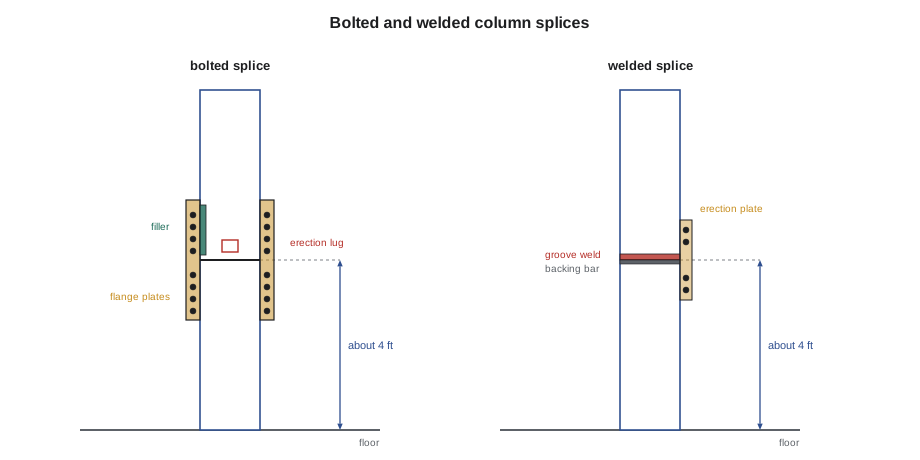
Setting a column on a splice is a connector's job, done with care. The upper column comes in on the crane, its foot is guided onto the lower column's top, the erection holes are drifted into line and pinned, and the minimum bolts go in before the load is released from the crane. At Larkmont each splice had two flange plates on each flange side, with eight bolts per plate on each side of the joint and six bolts in the web plate.
Worked problem
Counting the bolts in a splice
A Larkmont column splice has a flange plate on each of the two flanges, with 8 bolts in each plate on each side of the joint, and a web plate with 6 bolts in total. How many bolts are in one splice, and how many in the 24 splices at one level?
Show solution
- Flange bolts = 2 plates × 8 bolts × 2 sides of the joint = 32.
- Web bolts = 6.
- Total per splice = 32 + 6 = 38.
- At one level = 38 × 24 = 912 bolts.
Answer: Thirty-eight bolts a splice and more than 900 at each splice level. The bolt-up crew's bins were packed for each splice level, with the bolts for each column in its own labeled bag, so nobody had to count at the top.
Welded column splices
Heavy columns, especially in moment frames and in buildings designed for earthquakes, may have welded splices. The upper column end is beveled, a complete-joint-penetration groove weld joins the flanges and often the web, and erection plates bolted to both columns hold the upper column in place until the weld is finished. The erection plates are temporary and are removed or left as the drawings say.
A welded splice takes much longer than a bolted one: the joint must be fitted up, preheated if the procedure requires it, welded in several passes, allowed to cool and then tested. While it is being welded, the column above is held by its erection plates and the guying or bracing the erection engineer has designed, and the crane may be needed to hold the upper column for the first part of the work on some jobs. Larkmont's columns were all bolted, but its moment-frame beams were field welded.
Field-welded beam-to-column connections
In a moment frame, the beam is connected to the column so that the joint can carry bending, which is what lets the frame resist sideways loads without braces. The most common field-welded moment connection has a bolted shear tab or web plate to hang the beam during erection and carry its shear, and complete-joint-penetration groove welds joining the beam's top and bottom flanges to the column flange. The bottom flange is welded from above through access holes cut in the beam web, with a backing bar under the weld.
At Larkmont, each end wall had a moment frame of four columns and beams at every floor, 24 moment connections in all, and each connection had two flange welds. The erection sequence called for the beams to be bolted at the web, plumbed, and then welded before the deck was laid on that floor.
Worked problem
Planning the welding
Larkmont had 24 field-welded moment connections, each with a top and a bottom flange weld. Crossbeam's welding foreman, Ruben Ostergaard, allowed about 3 hours of welder time for each flange weld, including fit-up checks, preheat, welding and cleaning. With two welders working 8-hour days, how many days of welding was that?
Show solution
- Flange welds = 24 connections × 2 = 48.
- The 24 connections already count each beam end separately, as the weld map does.
- Welder time = 48 welds × 3 h = 144 h.
- Days = 144 ÷ (2 welders × 8 h) = 9 days.
Answer: About nine days of welding with two welders. Ruben planned twelve to allow for wind and rain stops, because field welding is one of the first things weather stops. The welding was scheduled floor by floor, two floors behind the connectors, so that the deck crew never waited for it.
Who may weld in the field
In the United States, structural steel welding follows AWS D1.1, the Structural Welding Code – Steel, and for buildings designed for earthquakes also AWS D1.8. Welders must be qualified to the welding procedure specifications the job uses, by testing to D1.1 or by the job's requirements, and their qualification must be current. Inspection is done by a welding inspector, often an AWS Certified Welding Inspector, working for the owner's testing agency or for the erector. Crossbeam's qualified welders, such as Ruben's crew, weld structural connections, and an apprentice may tack or weld only as the procedures and their qualification allow.
Every field weld follows a written welding procedure specification, which gives the process, the electrode or wire, the joint preparation, the position, the number of passes, the current and voltage, and the preheat and interpass temperatures. Field welding of structural steel is usually done with flux-cored arc welding or shielded metal arc welding, because they tolerate wind better than gas-shielded processes, but even they need a windbreak.
Preheat and weather
Thick steel draws heat away from a weld so fast that the weld and the steel beside it can cool too quickly and crack, especially in cold weather. Preheat warms the steel around the joint before welding, and the procedure sets a minimum preheat temperature that rises with the thickness of the steel. The welder checks it with temperature-indicating crayons or a contact thermometer at a distance from the joint the code sets, and keeps the steel between the minimum preheat and a maximum interpass temperature during welding.
Larkmont's heaviest moment-frame column flanges were about 1-1/2 in thick, and their welding procedure called for a minimum preheat of 150 °F. No welding was done on wet or frosted steel, or when the steel was below the procedure's lowest temperature, without heating it first. Wind breaks of fire-resistant tarps were set up around each joint, and the welding stopped if the wind blew through them.
Preheat is usually applied with propane torches. On a tower, every propane cylinder on the steel is a hazard: it must be secured upright, protected from damage and falling, kept away from openings and removed at the end of the shift. Crossbeam's plan at Larkmont allowed propane only on floors with deck and only in a rack with a chain.
Inspection and testing
Field welds are inspected visually by the welder as they go and by an inspector when they are finished, for size, profile, undercut, cracks and porosity. Complete-joint-penetration welds in moment frames are usually also tested by ultrasonic testing, which can find flaws inside the weld. The engineer's specification says which welds are tested, how many and by whom. A weld that fails is repaired by the procedure and tested again.
At Larkmont, the owner's testing agency, Thackeray Testing and Inspection, tested every moment-frame flange weld by ultrasound. Two of the 48 welds showed lack of fusion at the bottom flange, a known risk because the bottom flange weld is made through the access hole, from above, with the welder reaching in at an awkward angle. Both were gouged out, rewelded and passed on retest. Ruben changed the sequence after that, so that the bottom flange welds were always done in the morning when the welders were fresh.
Welding at height
- Welders on the steel are tied off like everyone else, with lanyards and lifelines that resist heat and sparks, or with fall arrest anchored away from the weld.
- Welding platforms or floats are designed for the welder, the equipment and the windbreak, and are inspected before use.
- Hot work rules apply: sparks and slag fall a long way, so the area below is protected or cleared, combustibles are covered, and a fire watch stays after welding as the program requires.
- Welding leads are run so that they do not lie across sharp edges or hang over the side, and the ground clamp is fastened close to the weld so that current does not travel through bearings, bolts or the crane.
- Welding fumes from primed or galvanized steel are controlled by working upwind or with respiratory protection.
Arc flash and ultraviolet light from welding can burn the eyes of people nearby, not only the welder. On a crowded floor, welding screens and warnings keep other trades from looking at the arc.
Coordination with the erection sequence
Welded connections change the erection plan. A frame that will be stable only when its welds are complete must be held by its bolted erection connections, guys or bracing until then, and the erection engineer decides how far erection may go above unwelded frames. At Larkmont, the procedure allowed erection to continue no more than two tiers above the highest level with all moment-frame welds complete and tested. The welding foreman's progress was marked on the trailer board next to the steel, so that Carla could see the limit coming.
Bolting a splice in the right order
The bolts of a column splice are tightened in a planned order so that the plates are drawn tight against the flanges without trapping a gap. The usual practice is to bring all bolts snug, starting from the bolts nearest the joint and working outward, then pretension them, if the drawings call for it, in the same pattern. Filler plates must be the thickness and grade shown; a filler made up on site from scraps changes the joint. Nate's crew at Larkmont marked each finished splice with paint, initialed and dated, so the inspector could see at a glance which splices were complete.
A splice is also a survey point. The upper column's plumbness depends on how squarely its end bears on the lower one, and a column that sits on a burr, a weld spatter or a piece of debris will lean. Connectors wipe the bearing surfaces clean before the upper column lands, and the surveyor checks the column after the splice bolts are snug and before they are tight.
Common mistakes
MistakeMoving a column splice to suit the crew.
InsteadBuild splices where the drawings show them; changes need the engineer.
MistakeReleasing an upper column from the crane before the minimum splice bolts are in.
InsteadPin and bolt the splice as the procedure requires before releasing the load.
MistakeWelding with an unqualified welder or without the procedure.
InsteadUse qualified welders working to the written procedure.
MistakeSkipping preheat on a cold morning.
InsteadMeasure and maintain the procedure's preheat and interpass temperatures.
MistakeLeaving propane cylinders loose on the steel.
InsteadSecure cylinders upright in racks on decked floors and remove them at the end of the shift.
Summary and key terms
- Columns are spliced every two or three stories, commonly about 4 ft above the floor.
- Bolted splices use flange and web plates with fillers or butt plates; columns usually bear end to end.
- Welded splices and field-welded moment connections use complete-joint-penetration groove welds and take much longer than bolting.
- Field welding follows AWS D1.1, with welders qualified to the job's procedures.
- Preheat rises with steel thickness; weather, wind and moisture are controlled, and propane is managed carefully on the steel.
- Welds are inspected and often ultrasonically tested, and the erection sequence limits how far erection runs above unwelded frames.
- Column splice
- A joint where two lengths of column are connected end to end.
- Filler plate
- A plate that makes up the difference in thickness between two column sections at a splice.
- Butt plate
- A plate between the ends of two columns of different sizes at a splice.
- Complete-joint-penetration weld
- A groove weld that fuses the full thickness of the joint.
- Moment connection
- A beam-to-column connection that carries bending as well as shear.
- Preheat
- Heating the steel around a joint before welding to slow cooling and prevent cracks.
- Ultrasonic testing
- A test that uses sound waves to find flaws inside a weld.
Practice problems
Work each problem on paper first, then reveal the answer to check.
A splice has two flange plates with 6 bolts each side and a web plate of 4 bolts. How many bolts?
Show answer
2 × 6 × 2 + 4 = 28 bolts.
There are 16 moment connections with two flange welds each at 3 hours a weld. How many welder-hours?
Show answer
16 × 2 × 3 = 96 hours.
With two welders on 8-hour days, how many days is 96 welder-hours?
Show answer
96 ÷ 16 = 6 days.
Why is the bottom flange weld harder than the top?
Show answer
It is made from above through the web access hole, reaching in at an awkward angle.
What process do field welders commonly use in wind?
Show answer
Flux-cored or shielded metal arc welding, with windbreaks.
Lesson quiz · 5 questions
Score 60% or more to complete this lesson.
Create a free account to save your progress, take quizzes and earn a certificate.