
IRW-310 · Lesson 11 of 12 · 21 min
Dismantling and demolition of steel
▶ Video coming soon A video version of this lesson is on the way.
Before Vandor's new bay could go up in 2024, something old had to come down. A conveyor gallery built in 1958, a long enclosed steel truss that had once carried coal and later scrap across the yard, stood on two steel towers exactly where the new bay's end wall would go. "Taking steel down is not erecting it backwards," Carla told the group on November 13. "When you erect, you know what every piece weighs, where it goes and what holds it. When you dismantle, you're guessing about all three until you prove otherwise. Old steel lies."
This lesson covers dismantling and demolition of steel structures: why it is more dangerous than erection, the survey and engineering that come first, hazardous materials, estimating weights, the sequence and methods of removal, cutting safely, and the rules that apply.
Why dismantling is dangerous
- Unknown weights: drawings may be missing or wrong, members may have been added, and old structures carry dust, scale, product build-up, water or ice inside them.
- Unknown load paths: decades of alterations can mean a member that looks like bracing is holding something up, or a connection that looks sound is rusted through.
- Stored energy: members in tension or compression can spring when cut; cables, springs and counterweights may be under load.
- Hazardous materials: old paint may contain lead, insulation may contain asbestos, and process residues may be toxic or flammable.
- Live surroundings: the structure is often in an operating plant or next to occupied buildings, with live services nearby.
Every one of these is a reason the work is planned by an engineer and supervised closely, and why the crew treats every cut as a decision.
The engineering survey
OSHA's demolition standard, Subpart T, begins with 1926.850(a): before demolition starts, a competent person must make an engineering survey of the structure to determine the condition of the framing, floors and walls and the possibility of unplanned collapse, including adjacent structures where workers may be exposed, and the employer must have written evidence of the survey. Utilities must be shut off, capped or controlled, with the utility notified, under 1926.850(c), and hazardous substances in pipes and equipment are tested and purged.
For the conveyor gallery, Vandor hired an engineer, and Odette wrote the dismantling procedure with her. The survey found that the gallery's original drawings matched most of the structure, but two diagonal members at the east tower had been replaced in the 1980s with lighter angles, and one bottom-chord connection was corroded to about half its section. The gallery also held a layer of compacted dust and scale along its floor, about 2 in deep in places.
Hazardous materials
Old steel is often painted with lead-based paint, and cutting or grinding it produces lead fumes and dust. Insulation, gaskets and coatings may contain asbestos, as INS-230 covers in detail for insulators. Before any cutting, these materials are identified by testing, and the hazardous material work is done by qualified contractors following the regulations; the ironworkers cut only where the paint has been stripped back or with the controls the hazard assessment sets, such as local exhaust, respirators and hygiene facilities.
At Vandor, the gallery's paint tested positive for lead. The cutting lines were stripped back by an abatement contractor before Crossbeam cut, the burners wore respirators as the assessment required, and blood lead testing was offered to the crew, under OSHA's lead in construction standard, 1926.62.
Estimating weights
Every piece taken down must have a weight before it is rigged. The engineer estimates weights from the drawings or field measurements, using the steel shapes and their weights per length, plus connection material, and then adds an allowance for unknowns: paint, rust, dust, product build-up, and members that are heavier than they look. Pieces with uncertain weight are critical lifts under Crossbeam's rules. Where possible, the crane's load indicator is watched as the load is taken up slowly, and the lift stops if the weight is higher than expected.
Worked problem
Weight of a gallery segment
The engineer estimated the whole 160 ft gallery, with its walkway and roof sheeting, at 69,500 lb from the drawings and field measurements. It was to come down in three equal segments of about 53 ft, with a 10 in 100 allowance for unknowns. The crane's chart gave 33,500 lb at the radius needed. What was the planned weight of each segment, and what share of the chart?
Show solution
- Weight per segment from the drawings = 69,500 ÷ 3 ≈ 23,167 lb.
- With 10 in 100 allowance = 23,167 × 1.10 ≈ 25,483 lb.
- Share of chart = 25,483 ÷ 33,500 ≈ 0.76, or 76 in 100.
Answer: About 25,500 lb a segment, 76 in 100 of the chart. Before any cutting, the dust and scale were vacuumed out of the gallery, because at 2 in deep along the floor it could easily have added more than the allowance. The first segment was weighed on the crane as it was taken up, and it came in close to the estimate.
Sequence and methods
Dismantling is planned in reverse of how the structure was built and in the order that keeps what remains stable. The common rule is to remove the parts that carry nothing first, then work from the top down and from the outside in, keeping the bracing and the members that hold the rest until last. Each segment is rigged and taken on the crane before the last cuts that free it, so that it never stands on its own or drops. The procedure shows the cuts for each segment, the order of cuts, the rigging, and what temporary supports or shores hold the remaining structure.
- Strip: remove roofing, sheeting, walkways, pipes, cables and anything loose, which reduces weight and wind area.
- Rig: attach the crane to the segment at designed pick points and take a little load.
- Cut: make the cuts in the order shown, with the crane holding the load, leaving the final cuts for last.
- Lift and land: take the segment away to a laydown area for cutting up on the ground.
- Check: look at what remains for movement, cracks or unexpected load before the next segment.
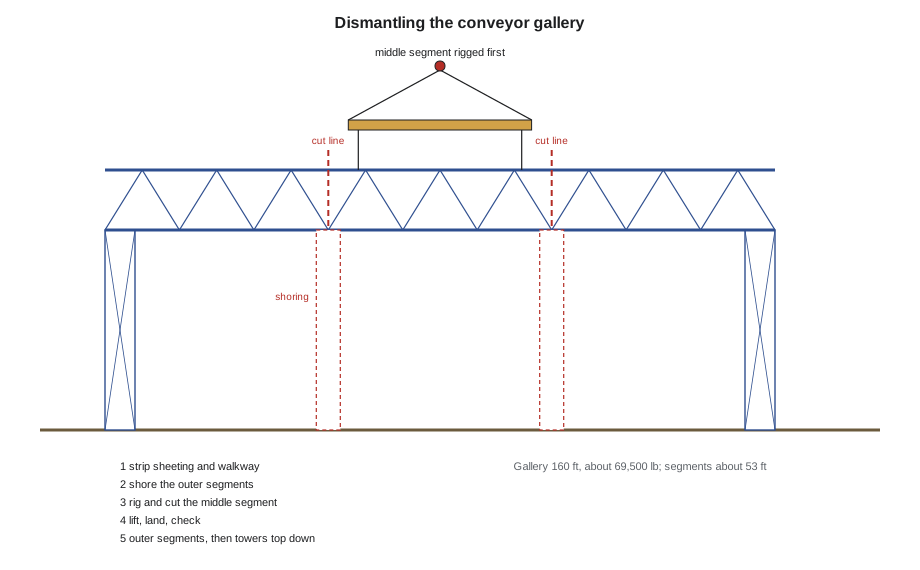
The gallery came down in September 2024, over three days during Vandor's quieter weekend shifts. The middle segment came out first, after shoring frames were set under the ends of the two outer segments; the outer segments followed, then the towers, top down. The corroded connection was strapped with a temporary bolted plate before any work near it, as the procedure required.
Cutting safely
Most steel dismantling is done with oxy-fuel torches, sometimes with plasma cutters or shears on an excavator for low work. Cutting is hot work, and in an old structure with dust, oil and grease the fire risk is high.
- Hot work permits, fire extinguishers, a fire watch during and after cutting, and protection of combustibles below and around the cut.
- Cutting from a stable position, never on the piece being freed, with fall protection anchored to the part that stays.
- Knowing what the member is doing before cutting it: a member in tension may spring apart, one in compression may jump or bind, and a cut can shift load to another member.
- Hoses and cylinders kept away from the cut and the fall zone, with flashback arrestors and cylinders secured upright.
- Fumes controlled, especially from coated steel.
The last cut on a segment is the most dangerous moment: the crane takes the full load, the piece may swing, and anything left attached will tear. The burner stands clear of the swing, the crane holds a light pull, and the signaler watches the segment, not the torch.
Demolition by machine
Some steel structures are pulled down or cut up by machines such as excavators with shears, rather than taken apart piece by piece. OSHA 1926.859 covers mechanical demolition: no workers are allowed in the area affected except those needed, steel members are cut free before walls are pulled over, and a competent person inspects continuously so that nobody works where weakened structure is a hazard.
Ironworkers are often called in where precision matters: cutting a structure free from one that will stay, removing pieces for reuse, or dismantling something that cannot be allowed to fall, as at Vandor, where the gallery stood over a live plant road and the old mill building.
Reuse and records
Steel taken down carefully can be reused or sold as scrap, but only after its condition and grade are known. Pieces for reuse are marked, inspected and not used in a new structure without the engineer's approval. The dismantling record, with weights, photographs and any surprises, is kept, because it often becomes the only record of what the old structure really was.
Stored energy and surprises
Old structures can hold energy that is invisible until a cut releases it. A beam that has sagged and been propped may be carrying more load than its drawings show. A tension rod or a cable may be holding a wall upright. A conveyor's counterweight, a spring in a take-up, or a piece of equipment still bolted to the steel can add weight or swing when freed. Before each cut, the crew and the foreperson ask what the member is doing, what will happen when it is cut, and where the cut ends will go. When in doubt, a member is clamped, chained or supported on both sides of the cut so that it cannot move when the steel parts.
At Vandor, the gallery's old take-up frame still held a concrete counterweight of about 2,600 lb inside the east tower. It was not on any drawing. It was found during the survey, rigged separately and lowered to the ground before any cutting on that tower, and it was added to the weight estimates.
Protecting what stays
Dismantling usually happens next to something that must stay: the rest of a building, a neighboring structure, live services or plant equipment. The procedure shows how the work avoids damaging them: where cuts are made so that a piece cannot fall onto what stays, what protection, such as plywood, steel plates or mats, is placed over equipment and roofs, how the crane's load path avoids them, and what temporary supports hold up anything that loses a support when the old steel goes. At Vandor, the old mill building's end wall had been partly supported by the gallery's west tower; a new temporary post went in beside the wall before the tower came down, and stayed until the new bay's steel took over.
Cutting up on the ground
Pieces brought down are cut up on the ground into sizes for scrap or reuse. Ground cutting is safer than cutting in the air, which is why the procedure brings large segments down whole when the crane can take them. The pieces are set on solid blocking so they cannot roll, cut in an area away from the plant's traffic with the same hot work and fume controls as in the air, and moved by crane or forklift, not by hand. The scrap is weighed when it leaves the site, which gives the final check on the weight estimates.
Lessons from the gallery
The gallery's weights came in within the allowance, but the dust and the unlisted counterweight would have used most of it if they had not been found. Crossbeam's dismantling checklist now includes cleaning out build-up, searching for counterweights, take-ups and equipment, and checking every connection marked as corroded in the survey before any cut near it.
Communication on a dismantling crew
Because so much is uncertain, a dismantling crew talks more than an erection crew. Before each segment, the foreperson walks the crew through the cuts, the rigging, where everyone stands and what will happen when the piece comes free. During the cuts, the burner calls each cut as it is made, and the signaler tells the crane operator what the load indicator should be showing. If anything unexpected happens, such as a creak, a shift, a heavier reading or smoke where there should be none, anyone may call a stop, and everyone does.
Common mistakes
MistakeTrusting old drawings for weights and load paths.
InsteadSurvey the structure, estimate weights with an allowance, and treat uncertain weights as critical lifts.
MistakeCutting a segment free before the crane holds it.
InsteadRig and take a light load on the crane before the final cuts.
MistakeCutting painted steel without knowing what the paint is.
InsteadTest for lead and asbestos first and use the controls the assessment requires.
MistakeStanding on the piece being freed.
InsteadCut from the part that stays, tied off to it.
MistakeRemoving bracing early to make cutting easier.
InsteadKeep the members that hold the rest until the procedure says they may go.
Summary and key terms
- Dismantling is more dangerous than erection because weights, load paths, stored energy and materials are uncertain.
- OSHA 1926.850(a) requires a competent person's engineering survey, in writing, before demolition.
- Weights are estimated from shapes and measurements with an allowance; uncertain weights are critical lifts and are checked as the load is taken up.
- Removal goes from non-load-carrying parts to the top and outside, keeping bracing until last; each segment is rigged before its final cuts.
- Cutting is hot work with fire, fume and spring-back hazards; the burner works from the part that stays.
- Machine demolition and reuse of old steel follow their own planning and approval.
- Dismantling
- Taking a structure apart piece by piece, usually in reverse of erection.
- Engineering survey
- An examination of an existing structure's condition and stability before demolition.
- Load path
- The route by which loads travel through members to the supports.
- Allowance
- An extra amount added to an estimated weight for unknowns.
- Spring-back
- Sudden movement of a member released from tension or compression when cut.
- Fire watch
- A person who watches for fire during and after hot work.
Practice problems
Work each problem on paper first, then reveal the answer to check.
A structure is estimated at 40,000 lb and comes down in two equal pieces with a 10 in 100 allowance. What is each piece?
Show answer
20,000 × 1.10 = 22,000 lb.
The chart gives 26,500 lb. What share is each piece?
Show answer
22,000 ÷ 26,500 ≈ 83 in 100.
In what order are parts usually removed?
Show answer
Non-load-carrying parts first, then top down and outside in, bracing last.
What must happen before the final cut on a segment?
Show answer
The crane is rigged and holds a light load.
Under OSHA 1926.850(a), who makes the engineering survey?
Show answer
A competent person, before demolition starts.
Lesson quiz · 5 questions
Score 60% or more to complete this lesson.
Create a free account to save your progress, take quizzes and earn a certificate.