
IRW-310 · Lesson 10 of 12 · 23 min
Weather, wind and night work
▶ Video coming soon A video version of this lesson is on the way.
Larkmont lost eleven working days to weather in 2025: seven to wind, two to thunderstorms, one to freezing rain and one to a heat warning that turned the day into an early start and an early finish. Carla's 2025 diary had a line for each. On November 13 she read out the one from May 21: "Ground wind fine. Level 9, gusts 55. Stopped connecting 10:40. Ewan stopped the crane at 11:15. Crew on bolt-up below level 8 till 2:00." She looked up. "Down on the street it was a nice spring day. People walking by thought we were taking a break."
This lesson covers weather on high and heavy steel jobs: how wind changes with height and affects people, loads and cranes, the limits that stop work, lightning, rain, ice, cold and heat, and the planning, lighting and fatigue rules for work at night.
Wind and height
Wind is slowed by the ground, buildings and trees, so it is usually stronger the higher you go. A wind that feels mild on the street can be strong at the top of a tower, and gusts there can be much stronger than the average. That is why wind on a tower job is measured where the work is: by the anemometer on the crane's jib or tower head, and by a hand-held anemometer on the top floor. A forecast or a reading at the ground is only a warning.
Engineers use rules of thumb for how wind speed grows with height. One common rule, for open country, says the speed grows with the height raised to a small power, about 1/7 or 0.14. It is only an estimate, and city buildings make wind gusty and unpredictable, but it shows why the top of a building is windier.
Worked problem
Estimating wind at the top floor
A ground station at 33 ft above the ground shows 24 mph. Using the 0.14 power rule, roughly what wind would you expect at 200 ft, the top of Larkmont's frame?
Show solution
- \[v_{200} = v_{33} \times (\tfrac{200}{33})^{0.14}\]
- (200 ÷ 33)^0.14 ≈ 1.287.
- v at 200 ft ≈ 24 × 1.287 ≈ 31 mph.
Answer: Roughly 31 mph, right at Crossbeam's 30 mph gust limit for connecting, before any gusts are counted. A ground reading of 24 mph can mean a stop at the top. The estimate does not replace the anemometer, which is what the crew actually goes by.
What wind does
- People: wind pushes workers off balance, especially when they are carrying sheets or standing on narrow steel. Gusts are the danger, more than steady wind.
- Loads: wind pushes on the load hanging from the crane, which swings and rotates it. Large flat loads such as deck bundles, wall panels, trusses and formwork catch the most wind and become uncontrollable first.
- Cranes: wind on the jib, the mast and the load adds to the forces the crane carries. Every crane has a maker's in-service wind limit; above it, the crane must stop.
- The partly built frame: wind on an unbraced frame, on stacks of material or on deck that is not fastened can move or overturn steel, which is why the erection procedure has its own design wind and what to do beyond it.
- Loose material: deck sheets, plywood, tarps and anything not tied down can blow off the building.
Wind limits
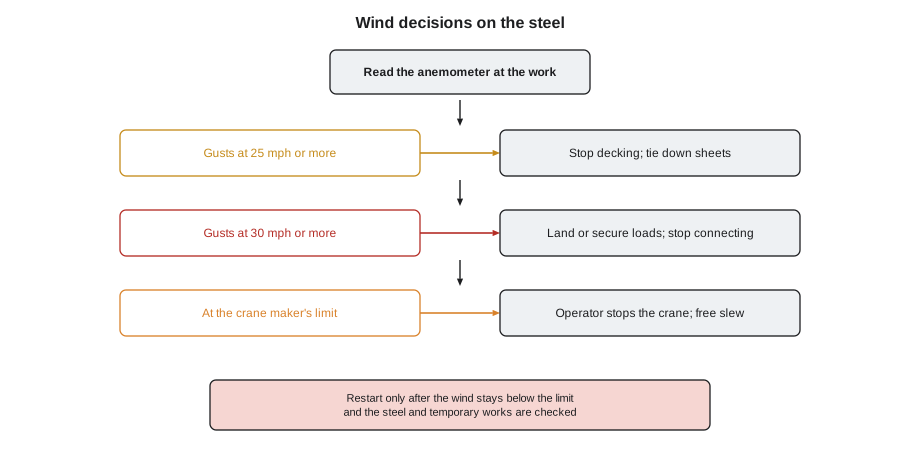
OSHA's crane standard requires that cranes be operated within the maker's limits, and the competent person must decide whether wind makes it unsafe to operate. Crossbeam's company rules, which IRW-110 introduced, set the limits for its crews: connecting stops when gusts reach 30 mph, and decking stops at 25 mph, because deck sheets act like sails. For tower cranes, the maker's in-service limit is commonly about 45 mph at the jib, but the lift plan can set a lower limit for large or light loads, and Crossbeam's connecting limit is reached long before the crane's.
| Activity | Stop at gusts of |
|---|---|
| Laying and spreading deck | 25 mph |
| Connecting and setting steel | 30 mph |
| Large flat loads on the crane | Lift plan limit, often lower |
| Tower crane in service | Maker's limit, commonly about 45 mph |
| Crane climbing or erection | Maker's climbing limit, much lower |
When a stop is called, the crew lands or secures the load first, never leaves a piece hanging, ties down loose deck and sheets, and moves to work below or away from the edge, such as bolting on lower floors, as Carla's gang did on May 21. Work does not restart until the wind has dropped below the limit for a period, and the foreperson has looked at the steel and temporary works for anything that moved.
Lightning
A steel frame and a tower crane are the tallest things around, and lightning is a real risk. The rule most crews use is that when thunder is heard or lightning is seen, work on the steel and the crane stops and the crew comes down to a safe place inside a finished part of the building or in vehicles, not under the crane, near the mast or on an open floor. Work resumes about 30 minutes after the last thunder or lightning. Weather radar and lightning alerts on phones give earlier warning; the foreperson checks them on stormy days. At Larkmont, two afternoons in July were lost to storms, and both times the crew was off the steel before the first strike near the site.
Rain, ice, snow and frost
Rain makes steel slippery, and a primed or painted surface is worse than bare steel. Light rain alone may not stop work, but the foreperson watches for slippery steel, poor visibility and loose footing on deck. Freezing rain and frost stop work on the steel until it is clear, because ice on beams or deck gives no grip at all. Snow is cleared from deck and steel before work, and never pushed off the edge onto people below. In cold weather, welding preheat and electrode handling follow the procedures in lesson 3, and bolts and their lubricant may behave differently, which is why pre-installation verification is done in the conditions of the work. At Linwood on Friday, November 13, frost on the deck delayed the morning start until it had melted.
Cold and heat
Cold stress, including frostbite and hypothermia, is a risk on open steel in winter, especially in wind. Crews dress in layers, take warm-up breaks, and watch each other for the signs, such as shivering, confusion and white patches on the skin. Gloves must still allow a safe grip on tools and steel. Heat stress in summer is just as serious: workers drink water often, take shaded breaks, and get used to the heat gradually at the start of a hot spell, and the work may be started earlier in the day.
OSHA has been developing a federal heat illness rule, but until a final rule applies, employers are expected under the general duty clause and state programs to protect workers from heat, and many follow OSHA's water, rest and shade guidance. Larkmont's heat advisory day in June 2025 ran from 6:00 a.m. to 1:00 p.m. with extra breaks and water on every floor.
Night work
Some steel work happens at night: a bridge girder during a rail possession or a highway closure, a shutdown in a plant running around the clock, or deliveries and picks on a downtown street that can be closed only at night. Night work brings its own hazards: darkness, glare, fatigue and other drivers who are tired or not paying attention.
- Lighting: work areas, access routes and the load path are lit evenly, without glare in the operator's or signaler's eyes. Light towers are set where they cannot be hit or blow over.
- Visibility: everyone wears high-visibility clothing with retroreflective material, and the crane's load and hook block may be lit.
- Signaling: radio is used for every lift, and hand signals are used only where the operator can clearly see the signaler in good light.
- Fatigue: crews coming onto a night shift need rest beforehand; long shifts after a day's work are avoided, and the plan sets maximum hours.
- Emergency: rescue and first aid plans must work at night too, including how the ambulance finds the site.
OSHA 1926.56 sets minimum illumination while work is in progress, from 3 foot-candles for outdoor construction areas and walkways to 5 foot-candles for general construction area lighting and 10 for shops. These are minimums; connecting and rigging at night need much more light at the work. For the 2023 footbridge, Crossbeam's plan set well-lit work areas at the abutments, light towers aimed away from the train engineers' line of sight, and portable lights at the cross-frames.
Worked problem
Converting light levels
Light is measured in lux in Canada and in foot-candles in the United States. One foot-candle is about 10.76 lux. A lighting plan asks for at least 10 foot-candles on the walkways and 50 foot-candles at the connection points. What are those in lux?
Show solution
- 10 × 10.76 ≈ 108 lux.
- 50 × 10.76 ≈ 538 lux.
Answer: About 108 lux on the walkways and 540 at the connections. A light meter on the phone is not accurate enough to prove a level, but it is good enough to find the dark corners that need another light.
Planning for weather
Weather cannot be controlled, but it can be planned for. The site-specific plan lists the limits; the foreperson checks the forecast every evening and morning; heavy and critical lifts are scheduled for calm windows; work below the top floors is kept ready for the days the top is too windy; and loose materials are tied down at the end of every shift whatever the forecast says. On a tower, the end-of-shift tie-down is as important as anything done during the day, because the strongest winds often come at night.
Visibility, fog and smoke
Fog, heavy rain, snow and smoke from fires can make it impossible for the operator to see the load or the signaler to see the operator. On a tower, the operator usually cannot see the load below the top floor anyway and depends on radio, but in fog the signaler may also lose sight of the load as it travels. When visibility drops so far that the signaler cannot see the load along its whole path, lifting stops. The same applies to dust and glare from a low sun, which can blind an operator looking toward the work at certain times of day; the picking sequence can sometimes be arranged around it.
Securing the site at the end of the day
Every shift on a tower ends with the same routine, whatever the weather is doing: loads off the hook and the crane left in free slew, loose deck sheets fastened or banded, bolt bags and small parts in their bins and the bins secured, tarps tied or removed, welding leads and hoses coiled and secured, and gang boxes closed. Partial bundles of deck on the frame are banded and tied to the steel. Wind at night is common, and anything left loose at the top of a building can be over the street by morning. At Larkmont, the last person off each floor signed a card on the trailer wall to say the floor was secure.
Forecasts and planning
The foreperson's evening check of the forecast decides the next day's plan. A windy forecast moves critical lifts, deck work and connecting at the top to another day, and puts bolting, welding below the top and detail work at the front of the list. A storm forecast means checking that the temporary works are tight and that nothing on the frame can blow loose. A cold forecast means having heaters ready for preheat and making sure the frost will be off the steel before the crew goes up. None of this replaces the anemometer on the day, but it means the crew is rarely surprised.
Sun, glare and long days
Summer days at the top of a tower are long, bright and hot. The steel itself heats in the sun and can burn bare skin; gloves and long sleeves are worn even in heat. Glare off primed steel and white deck tires the eyes, and safety glasses with tinted or anti-glare lenses help. The early start that avoids the afternoon heat also means the crew reaches the end of its day tired, which is when slips and mistakes happen. Carla's rule in July and August was no new critical lifts after 1:00 p.m.
Common mistakes
MistakeGoing by the ground wind or the forecast alone.
InsteadMeasure wind at the work with the crane anemometer and a hand-held meter.
MistakeStopping with a piece still on the hook.
InsteadLand or secure every load before stopping.
MistakeSheltering under the crane or on open steel in a thunderstorm.
InsteadCome down to a finished, safe area and wait 30 minutes after the last thunder.
MistakeWorking on frosted or icy steel.
InsteadWait until it is clear; ice gives no grip.
MistakeTreating night work as day work in the dark.
InsteadPlan lighting, visibility, signaling, fatigue and emergency response for the night.
Summary and key terms
- Wind is stronger and gustier at height; measure it at the work.
- Wind affects people, loads, cranes, partly built frames and loose material; large flat loads are the first to become uncontrollable.
- Crossbeam stops decking at 25 mph and connecting at 30 mph gusts; cranes follow the maker's limits and the lift plan.
- Lightning stops work on the steel and crane until about 30 minutes after the last thunder.
- Rain, ice, frost, snow, cold and heat each have their own controls.
- Night work needs a plan for lighting, visibility, radio signaling, fatigue and emergencies.
- Anemometer
- An instrument that measures wind speed.
- Gust
- A short burst of wind stronger than the average speed.
- In-service wind limit
- The highest wind in which the crane maker allows the crane to operate.
- Heat stress
- Illness caused when the body cannot shed heat fast enough.
- Foot-candle
- A unit of light on a surface, about 10.76 lux.
- Lux
- The metric unit of light on a surface.
Practice problems
Work each problem on paper first, then reveal the answer to check.
A ground reading is 19 mph at 33 ft. Using the 0.14 rule, estimate the wind at 165 ft.
Show answer
5^0.14 ≈ 1.25, so about 24 mph.
Gusts at the work reach 28 mph. What stops under Crossbeam's rules?
Show answer
Decking stops; connecting can continue below 30 mph with care.
When may work resume after a thunderstorm?
Show answer
About 30 minutes after the last thunder or lightning.
What is OSHA's minimum for general construction area lighting?
Show answer
5 foot-candles.
What is done before stopping for wind?
Show answer
Land or secure loads and tie down loose material.
Lesson quiz · 5 questions
Score 60% or more to complete this lesson.
Create a free account to save your progress, take quizzes and earn a certificate.