
IRW-230 · Lesson 7 of 12 · 23 min
Openings, edges and fall protection on deck
▶ Video coming soon A video version of this lesson is on the way.
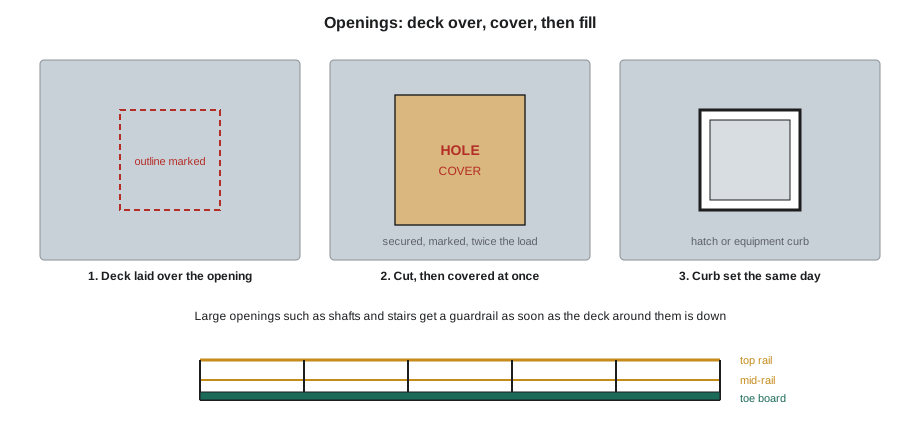
The roof hatch at the Linwood Fire Station was a hole about 3 ft square in the roof framing, framed with small angles between two beams, right beside the stair. When Ilona's crew decked the Linwood roof from Monday, November 9 to Friday, November 13, they laid the deck straight across it. On the morning of Thursday, November 12, the roofer's carpenter arrived with the hatch curb, and only then did Ilona mark out the opening on the deck, cut it with a saw, and stand back while the curb was set and fastened in the same hour. "A hole in a roof is the easiest way to fall through a building," she said at the last deck night two days earlier. "The best hole is the one that isn't cut yet."
Falls are the leading cause of death in the ironworking trade, and deck work puts workers at open edges all day: the building perimeter, the leading edge where new sheets are being laid, the edges of openings for stairs, shafts and equipment, and the gaps around columns. This lesson covers how openings in deck are handled, the requirements for covers, protection at edges and around columns, and the fall protection systems decking crews use, including the controlled decking zone allowed in the United States and why Crossbeam does not use it.
Deck over openings first
The safest way to handle a hole in a floor or roof is to deck over it and cut it out only when whatever fills it, the curb, the equipment, the stair or the shaft wall, is ready to go in. Until then the deck is a continuous surface, and nobody can fall through. Where the framing for a small opening sits below the top of the beams, the steel can often be turned down or the opening framed so that the deck runs straight across.
OSHA 1926.754(e)(2) requires framed openings to have their structural members turned down to allow continuous decking where design and constructibility allow, requires decking over holes and openings, with workers protected by guardrails or other systems under 1926.760(a)(1) where an opening is too large to deck over, such as an elevator shaft or stairwell, and allows holes to be cut only immediately before they are permanently filled with equipment or structure that meets the cover requirements, or immediately covered.
Covers
Where a hole must be open before it is filled, it is covered. A cover is not a sheet of plywood thrown over a hole. It must be strong enough for everything that may be on it at once, fixed so that it cannot slide or blow away, big enough to overlap the opening on all sides, and marked so that nobody lifts it without knowing what is underneath.
OSHA 1926.754(e)(3) requires covers for roof and floor openings to support, without failure, twice the weight of the workers, equipment and materials that may be imposed on them at any one time; to be secured against accidental displacement by wind, equipment or workers; and to be painted with high-visibility paint or marked with the word HOLE or COVER. Smoke domes and skylights are not covers unless they meet the strength requirement.
Worked problem
Sizing a cover
A roof drain opening is 3 ft by 3 ft. Crossbeam's covers lap at least 6 in past every edge. What size is the cover, and if two workers of 250 lb and 100 lb of material may be on it at once, what load must it support without failure?
Show solution
- Cover size = 3 ft + 2 × 6 in = 4 ft each way.
- Load that may be on it = 2 × 250 + 100 = 600 lb.
- Required strength = 2 × 600 = 1,200 lb without failure.
Answer: A 4 ft square cover that supports at least 1,200 lb. Crossbeam uses 3/4 in plywood with cleats underneath so it cannot slide, screwed to the deck, and spray-painted with the word HOLE in high-visibility paint.
Gaps around columns
Deck rarely fits tightly around columns. The gap where the deck stops at a column flange may be large enough for a foot, a tool or a bolt bag to go through, and objects falling through gaps strike workers below. These gaps are closed with wire mesh, plywood or sheet metal fixed to the deck, strong enough to stop a fall and to stop objects falling through, before the deck crew moves on.
OSHA 1926.754(e)(4) requires wire mesh, exterior plywood or equivalent to be installed around columns where planks or deck do not fit tightly, strong enough to provide fall protection for workers and prevent objects from falling through.
Perimeter protection
As soon as a floor is decked, its open perimeter is protected. On steel frames, the usual method is perimeter cables, wire rope strung between the columns at guardrail height, with a mid-rail, installed as soon as the deck at that level is down.
OSHA 1926.760(a)(2) requires perimeter safety cables on multi-story structures at the final interior and exterior perimeters of the floors as soon as the metal decking has been installed, and 1926.760(d) requires them to meet the guardrail criteria of 1926.502.
Fall protection for decking crews
The decking crew works where the perimeter is not yet protected and at the leading edge of the deck. Crossbeam protects them with personal fall arrest: full-body harnesses and self-retracting lifelines anchored to horizontal lifelines on the beams or girders, or to beam clamps behind the work. Because the leading edge is a sharp steel edge and the anchor is often at foot level, the lifelines used there must be rated for leading-edge use (Class 2 or leading-edge SRLs, as IRW-110 covered), and the fall clearance below the deck must be checked.
- The horizontal lifeline or anchor line is installed by the raising gang or the deck crew before decking starts, to the engineer's or manufacturer's design.
- Every worker on the deck is tied off at all times where there is no guardrail, under Crossbeam's 100 in 100 tie-off rule above 6 ft.
- Workers do not stand on unfastened sheets to spread the next ones, and they do not reach out over the leading edge to guide a bundle.
- Temporary roof anchors screwed or welded to the deck are used only if they are rated, installed as their maker requires and approved for the deck thickness and fastening.
The controlled decking zone
OSHA 1926.760(c) allows a controlled decking zone (CDZ) in an area more than 15 ft and up to 30 ft above a lower level where metal decking is initially being installed and forms the leading edge. In a CDZ, workers at the leading edge must still be protected from falls of more than two stories or 30 ft, whichever is less; access is limited to workers engaged in leading-edge work; the boundaries are designated and clearly marked with control lines or the equivalent; the zone may not be more than 90 ft wide and 90 ft deep from any leading edge; workers must have CDZ training under 1926.761; unsecured decking may not exceed 3,000 sq ft; safety deck attachments, at least two per panel, are made from the leading edge back to the control line; and final deck attachments and shear connectors may not be installed in the CDZ. Crossbeam does not use controlled decking zones: its decking crews are always tied off.
Worked problem
Unsecured deck in a zone
If Crossbeam did use a CDZ, how many 40 ft sheets with a 36 in cover could be spread but not finally fastened inside it before reaching the 3,000 sq ft limit?
Show solution
- Area of one sheet = 40 × 3 = 120 sq ft.
- Sheets = 3,000 ÷ 120 = 25.
Answer: 25 sheets. Crossbeam's crews instead fasten every sheet as it is laid and tie off, so the limit never comes into play on its jobs.
Protecting the people below
Deck work drops things: banding, screws, cut-offs, studs and ferrules, tools. The areas below active deck work are controlled, with barricades and signs, and nobody works directly below the deck crew. Tools are tethered where practical, small parts are kept in buckets and bags, and cut-offs are collected as they are made. At openings, toe boards on guardrails and covers that stop objects as well as feet do the same job.
Rescue
A worker who falls at a leading edge and is held by an SRL is left hanging beside or below the deck. As IRW-110 covered, suspension in a harness becomes dangerous within minutes, and every decking job has a rescue plan before work starts, usually a boom lift that can reach every part of the deck edge, or a rescue system on the lifeline. Crossbeam's target is to reach a suspended worker within six minutes.
Edges that change during the day
Deck edges move. The leading edge advances with every sheet, an opening appears when a hole is cut, and an edge that was protected in the morning may be open in the afternoon when a guardrail is moved to land a bundle. The foreperson walks the deck at the start of each shift and after every change, and the crew treats any new edge as unprotected until guarded. On Linwood, Ilona's crew moved a section of perimeter cable twice during the week to let the crane land bundles at the east wall, and each time the cable was replaced before the crew stepped back to that edge.
Fall clearance at the leading edge
A worker who falls over the leading edge on a self-retracting lifeline anchored at foot level falls farther than one anchored overhead. The line must pay out from the anchor to the edge before it starts to arrest, the worker swings below the edge, and the lifeline's deceleration distance and the harness stretch add to the drop. Leading-edge SRLs state the clearance they need below the deck edge for a given setback from the anchor, and the deck crew checks that there is that much clear space below, free of beams, equipment or a lower floor. On a single-story warehouse roof with a high clear height, clearance is rarely a problem; on a multi-story building with floors about 14 ft apart, it can be.
Swing is the other leading-edge hazard. A worker who falls at a point well to the side of the anchor swings like a pendulum along the edge and can strike a column or a beam. Anchors are kept roughly in line with the work, and the deck crew moves its anchors or uses a horizontal lifeline so that no worker works far to the side of the anchor point.
Guardrails around large openings
Elevator shafts, stairwells and large equipment openings are too big to deck over. They are protected with guardrails as soon as the deck around them is laid, with a top rail, a mid-rail and a toe board to stop material being kicked into the opening. When a trade must work at the opening, such as an elevator installer or the stair erector, a section of guardrail may be removed only under a written plan, with the workers protected by fall arrest and the area controlled, and the guardrail is replaced as soon as the work stops.
Materials near edges
Material stacked close to an open edge can fall, and a worker reaching for it can follow it. Crossbeam keeps bundles, tools and stacked material back from all open edges and openings by at least the distance its erection plan sets, never stacks material against perimeter cables or guardrails, and secures anything light enough to blow off. Deck banding, cut-offs and empty boxes are cleared from the deck as the crew works.
Weather and edges
Wind, rain, frost and snow make edges more dangerous. Wet or frosted deck is slippery, wind can push a worker off balance at an edge, and snow hides openings and the edges of covers. Crossbeam's wind limits for decking apply to edge work, and in winter the deck is cleared of snow and checked for covers and openings before anyone works on it. On the morning of Friday, November 13, at Linwood, a hard frost had left the roof deck slick, and Ilona's crew waited until the sun had melted it before going back to the east edge to finish the perimeter welds.
Training
Every worker on a deck crew is trained for the work. On both sides of the border, Crossbeam's deck workers complete its fall protection training and the leading-edge SRL and anchor training for the equipment they use, and its competent person inspects the fall protection equipment and the horizontal lifelines before use. New workers, like Shay on his first days with the deck crew at Ashcroft, work beside an experienced hand who checks their tie-off and their footing at the edge until the foreperson is satisfied.
Common mistakes
MistakeCutting openings in the deck as soon as it is laid.
InsteadDeck over openings and cut them only when they are about to be filled, or cover them at once.
MistakeLaying loose plywood over a hole.
InsteadUse a cover strong enough, fastened down and marked.
MistakeLeaving gaps around columns.
InsteadClose them with mesh, plywood or sheet metal strong enough to stop a fall and falling objects.
MistakeWorking at the leading edge tied to a non-rated anchor or SRL.
InsteadUse leading-edge-rated SRLs on approved anchors and check clearance.
MistakeAssuming a guardrail is still there.
InsteadWalk the edges after every change and treat new edges as unprotected.
Summary and key terms
- Openings are decked over and cut out only when they are about to be filled, or covered at once.
- Covers under OSHA support twice the intended load, are secured and are marked HOLE or COVER.
- Gaps around columns are closed, and perimeters are protected as soon as the deck is down.
- Decking crews use fall arrest with leading-edge-rated SRLs and are tied off at all times.
- OSHA allows CDZs between 15 and 30 ft with strict limits; Crossbeam does not use them.
- Areas below deck work are controlled, and a rescue plan is in place before work starts.
- Opening cover
- A secured, marked cover strong enough for the loads on an opening.
- Perimeter cable
- Wire rope strung at guardrail height around an open floor edge.
- Leading edge
- The advancing edge of new deck.
- Controlled decking zone
- A US federal provision allowing limited leading-edge decking without conventional fall protection.
- Horizontal lifeline
- An engineered line between anchors to which workers tie off.
- Toe board
- A low barrier at the bottom of a guardrail that stops objects falling off an edge.
Practice problems
Work each problem on paper first, then reveal the answer to check.
An opening is 2 ft by 2 ft and the cover laps 6 in past each edge. What size is the cover?
Show answer
3 ft square.
Three workers of 220 lb and 150 lb of tools may be on a cover. What must it support?
Show answer
2 × (660 + 150) = 1,620 lb.
What marking does OSHA require on a cover?
Show answer
High-visibility paint or the word HOLE or COVER.
What is the largest CDZ allowed?
Show answer
90 ft wide and 90 ft deep from any leading edge.
What may not be done inside a CDZ?
Show answer
Final deck attachments and installation of shear connectors.
Lesson quiz · 5 questions
Score 60% or more to complete this lesson.
Create a free account to save your progress, take quizzes and earn a certificate.