
IRW-230 · Lesson 4 of 12 · 22 min
Landing and spreading deck bundles
▶ Video coming soon A video version of this lesson is on the way.
On the morning of Tuesday, October 13, Shay climbed to the third floor of the Ashcroft Medical Building with Ilona's deck crew for the first time. The beams of the third floor had been bolted up and inspected, the perimeter cables were on, and Dwayne Mercer's crane was waiting at the north side with the first deck bundle hooked on. Before the bundle left the ground, Ilona walked Shay to the column at grid C-3 and pointed to a pair of paint marks on the top flanges of two beams. "That's where it lands," she said. "Not a meter this way or that. The layout says bundle 3-07 goes over these two beams, right beside the column, with the ribs running east-west. If we land it anywhere else, we'll be dragging sheets uphill all morning, or we'll overload a beam."
Landing and spreading deck is the moment the steel frame becomes a working floor. It is fast work, done at height on unfinished edges, and the bundles are heavy point loads on members that may not yet have their full strength. This lesson covers planning where bundles land, the rules for landing them on beams and joists, unbanding and spreading the sheets, laps and alignment, and securing the deck at the end of the day and against wind.
Planning the bundle placement
The deck supplier packs and tags bundles to match the deck layout drawing, usually one bundle for each area or bay, with the sheets in the bundle running the way they will be laid. The erector marks the landing spot for each bundle on the layout, close to where the sheets will be spread and close to a support: over a beam near a column, or across joists near their bearings. The plan considers the crane's reach and capacity, the order in which bays will be decked, the access for workers, and the strength of the members the bundles land on.
- Bundles are landed only on members that are attached, bolted or welded as the erection plan requires, and, for joists, bridged.
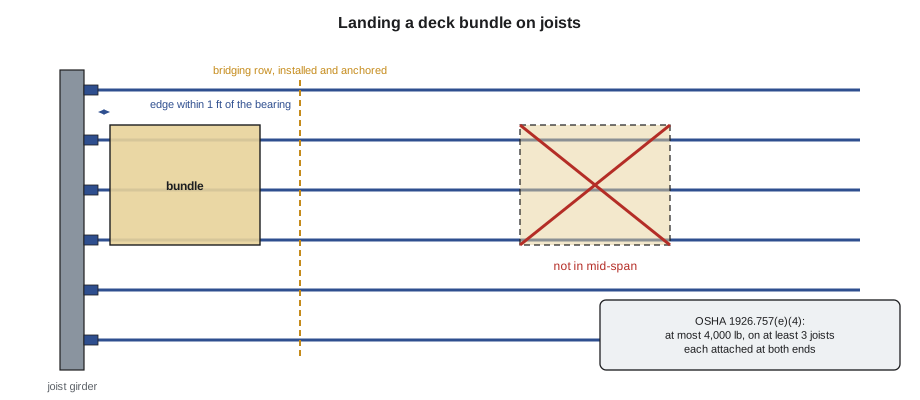
- Bundles are landed so their weight is shared by enough members, close to supports, never in the middle of a span when the plan says near the bearing.
- Bundles are landed with their banding still on, and with the ribs running the right way, so that the sheets can be spread without turning them.
- Bundles are landed where they can be unbanded without the sheets sliding off the supports.
The rules for landing bundles
OSHA 1926.754(e)(1) sets rules for hoisting, landing and placing deck bundles. Bundle packaging and strapping may not be used for hoisting unless specifically designed for that purpose. Loose items such as dunnage and flashing placed on top of bundles must be secured to the bundles. Bundles must be landed on framing members with enough support that they can be unbanded without dislodging them. Bundles on joists must be landed under 1926.757(e)(4): before all joist bearing ends are attached, a deck bundle may be landed only if a qualified person has determined the structure can support the load and documented it in a site-specific erection plan, the bundle rests on at least three joists that are each attached at both ends, at least one row of bridging is installed and anchored, the bundle weighs no more than 4,000 lb, and its edge is within 1 ft of the bearing surface of the joist end. Crossbeam follows these rules on all its US jobs.
Worked problem
How heavy is a bundle?
An Airpark bundle was first packed with 30 sheets of wide-rib deck, each 40 ft long with a cover width of 36 in, at 1.6 psf. Does it meet the 4,000 lb limit for bundles on joists, and how many sheets may a bundle hold?
Show solution
- Area of one sheet = 40 × 3 = 120 ft².
- Weight of one sheet = 120 × 1.6 = 192 lb.
- Bundle of 30 = 30 × 192 = 5,760 lb, more than 4,000 lb.
- Largest bundle = 4,000 ÷ 192 ≈ 20.8, so 20 sheets.
- Bundle of 20 = 20 × 192 = 3,840 lb, under 4,000 lb with room for the banding and dunnage.
Answer: No. A 30-sheet bundle would weigh 5,760 lb, so Ilona had the supplier repack the joist-bay bundles at 20 sheets each, 3,840 lb, and mark the weight on every tag.
Landing the bundle
The bundle is lifted with the supplier's lifting slings or a pair of chokers set at the marked lift points, never by its banding unless the banding is designed for lifting. Two tag lines control it. The deck crew stands clear while it lands, then guides it the last few centimeters onto dunnage, short lengths of timber laid across the beams or joists to spread the load and leave room to get hands and slings out from under it. The crane holds it until the crew is sure it is sitting square on its supports, and only then does the hook come off.
Wind matters more with deck than with any other steel. A bundle is a large flat surface, and a single loose sheet is a sail. Crossbeam's rule, the same on both sides of the border, is to stop landing and spreading deck when gusts reach 25 mph, and to stop earlier if the foreperson judges the conditions unsafe.
Unbanding
Bundles are unbanded only when the crew is ready to spread them, and only after the bundle is sitting securely on enough supports. Steel banding is under tension and springs when it is cut, so it is cut with proper cutters, with the worker standing to the side, and the cut ends are bent down or collected at once. Banding left lying on a deck is a tripping hazard and a cutting hazard, and it blows off roofs in wind. Ilona's crew carried a bucket for banding, and the last job of each bundle was to put its banding in the bucket.
Spreading the sheets
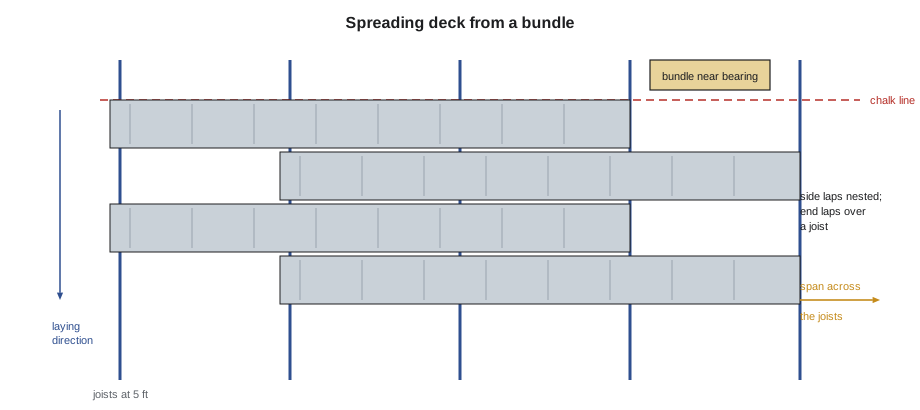
Spreading deck means sliding the sheets off the bundle one at a time and laying them in place across the supports. The crew works from the bundle outward, laying each sheet against the edge of the last one, with its side lap nested over the previous sheet's edge, and its ends landing on supports.
- The first sheet is laid to a line. The deck layout gives the starting edge, and the crew snaps a chalk line or uses a stringline so that the first sheet is straight; every sheet after it follows it.
- The ribs are kept in module. Deck ribs must line up with the layout so that openings, edges and the next area of deck fall where they should. A crew that lets each sheet creep a few millimeters ends up a whole rib off by the end of the bay.
- End laps fall over supports. Where one sheet ends and the next begins, the ends lap over a joist or beam by at least the minimum the deck standard and layout require, commonly about 2 in, or are butted on the support as the layout shows. An end lap in mid-span has nothing under it.
- Each sheet bears on its supports by at least the minimum shown on the layout.
- Sheets are fastened as they go. Lesson 5 covers fastening; the rule here is that sheets are not left loose behind the crew.
Securing deck as it is laid
OSHA 1926.754(e)(5) requires metal decking to be laid tightly and immediately secured upon placement, except in a controlled decking zone under 1926.760(c), and requires panels to be placed so they are fully supported by structural members during initial placement. Crossbeam does not use controlled decking zones (lesson 7), so on its jobs every sheet is fastened as it is laid.
At the end of each shift, and whenever wind or weather require it, any deck that is not fully fastened is secured, and open bundles are rebanded or tied down. Ilona's crew never left a partly spread bundle overnight: they either finished spreading it or strapped it back down to the steel.
Moving bundles on the deck
Once a floor is decked, bundles for the next area are sometimes landed on the finished deck. Deck is designed for its final loads, not for concentrated bundles dropped on it. Bundles on finished deck are landed over beams or joists, on dunnage, never in the middle of a span, and the layout or the supplier's instructions give any limits. Workers do not stack material on deck except where the plan allows, and they keep material away from open edges.
A day at Ashcroft
On October 13, the crew landed six bundles on the third floor and spread four of them. On October 14, the fifth bundle was the one Ilona stopped because its tag showed the wrong gauge (lesson 3). On October 15, the crew finished spreading the floor and fastening the sheets to the beams, and the next day Femi Ogunleye began marking the beams for shear studs. Shay's notes for the three days filled two pages of his notebook. The line he underlined twice was Ilona's: "Land it where the drawing says, unband it where it can't slide, and fasten it before you walk away from it."
Working near open edges
Spreading deck means working at the leading edge, the edge of the deck that moves forward as each sheet is laid, and often at the building perimeter too. Lesson 7 covers fall protection on deck in detail. For landing and spreading, the main points are that every worker on the deck is protected from falling at the leading edge and at the perimeter, that the bundle is never unbanded or spread by someone standing on the unfastened sheets, and that tag lines and slings are handled from behind the leading edge, never by reaching out over it.
Bundles on a sloped roof
Many roofs are built with a slope for drainage, usually small but enough that a loose sheet or an unbanded bundle can slide. On sloped steel, bundles are landed with their long direction across the slope where possible, chocked with dunnage on the downhill side, and unbanded only after the crew has a plan for each sheet. Sheets are spread from the low side upward when the layout allows, so that each new sheet is held by the one below it until it is fastened.
Cutting deck
Not every sheet is laid full length. Sheets are cut to fit at the ends of bays, around columns and at openings, and lengthwise along a rib to fill the last space in a bay. Deck is cut with a circular saw fitted with an abrasive or metal-cutting blade, a nibbler or shears; a cutting torch is not used on deck, because it burns the coating and leaves a ragged edge, and on a roof it creates a fire hazard. Cutting throws hot chips and sharp slivers, so the cutter wears eye and face protection and gloves, the cut edges are handled carefully, and offcuts are collected at once rather than left on the deck where they slip underfoot or blow off.
Where a sheet is cut around a column, the gap left around the column is covered (lesson 7). Where a sheet is cut lengthwise to fill a bay, the cut edge must still land on the side lap of the sheet beside it, or be supported as the layout shows; a cut edge hanging free between ribs is a trip and a weak spot.
Moving sheets by hand
A 1-1/2 in deck sheet 40 ft long weighs about 190 lb, and it is long, flexible and has sharp edges. Sheets are carried by two workers, one at each end, or slid along the deck, never carried by one worker alone on a windy day. Gloves with cut resistance are worn for all deck handling. Workers watch their footing on the ribs; deck is slippery with dew, frost and rain, and the ribs give an uneven surface that is easy to twist an ankle on.
Planning the order of decking
The order in which areas are decked depends on the crane, the steel sequence and the other trades. On a multi-story building, each floor is decked as soon as its steel is bolted and inspected, so that the deck becomes a working platform and fall protection for the floor below, and in many places the rules require a decked floor within a set number of floors below the erection work. On a single-story roof like Airpark's, the deck follows the joists bay by bay, so that each bay of joists is braced by its deck as soon as possible. In both cases, the deck crew starts where the crane can reach and works away from it, so that bundles are never landed over newly laid deck that workers are fastening.
Communication with the crane
Deck bundles are routine lifts, but they are not trivial ones. The bundle's weight, from its tag, is told to the crane operator before each lift, and the signal person or radio operator directs each landing. When the bundle is close to its landing spot, the crew on the deck takes over guiding it with the tag lines while the signal person controls the crane. At Ashcroft, Dwayne kept a list of bundle weights from the tags taped in his cab, and each bundle was called by number on the radio before it left the ground.
Common mistakes
MistakeLifting a bundle by its banding.
InsteadLift with the supplier's slings or chokers at the lift points unless the banding is designed for lifting.
MistakeLanding a bundle in mid-span of unbridged joists.
InsteadLand on joists attached at both ends, bridged, within the distance of the bearing the rules allow.
MistakeUnbanding a bundle that is not fully supported.
InsteadUnband only when the bundle is secure and the crew is ready to spread.
MistakeLetting end laps fall between supports.
InsteadLand every end lap over a support with the minimum lap.
MistakeLeaving loose sheets at the end of the shift.
InsteadFasten or secure all deck and reband open bundles before leaving.
Summary and key terms
- Bundle landing spots are planned on the deck layout, close to supports and where the sheets will be spread.
- OSHA limits bundles on joists landed early to 4,000 lb, on at least three joists attached at both ends, with one row of bridging anchored, within 1 ft of the bearing, under a qualified person's plan.
- Bundles are lifted with proper slings, landed on dunnage and unbanded only when secure.
- Sheets are laid to a line, kept in module, end-lapped over supports and fastened as they go.
- Deck work stops at gusts of 25 mph under Crossbeam's rule, and deck is secured at the end of every shift.
- Bundle
- A banded stack of deck sheets packed and tagged for one area.
- Dunnage
- Timber blocking under a load to spread its weight and leave room for slings.
- Unbanding
- Cutting the bands on a bundle so its sheets can be spread.
- Spreading
- Sliding sheets off a bundle and laying them in place.
- Module
- The regular rib spacing that sheets must keep in line with.
- End lap
- The overlap of two sheet ends over a support.
- Side lap
- The overlap of the edges of two side-by-side sheets.
- Leading edge
- The edge of the deck that moves forward as sheets are laid.
Practice problems
Work each problem on paper first, then reveal the answer to check.
A bundle holds 18 sheets 35 ft long, 36 in cover, at 1.6 psf. What does it weigh?
Show answer
18 × 35 × 3 × 1.6 = 3,024 lb.
Under OSHA, how many joists must a deck bundle landed early rest on?
Show answer
At least three, each attached at both ends.
How close to the bearing must its edge be?
Show answer
Within 1 ft of the bearing surface of the joist end.
May bundle strapping be used to hoist the bundle?
Show answer
Only if it is specifically designed for that purpose.
Gusts reach 28 mph. What happens to decking?
Show answer
It stops under Crossbeam's rule, and loose deck is secured.
Lesson quiz · 5 questions
Score 60% or more to complete this lesson.
Create a free account to save your progress, take quizzes and earn a certificate.