
INS-410 · Lesson 9 of 12 · 20 min
Insulation standards and guides
▶ Video coming soon A video version of this lesson is on the way.
Raj's office has a shelf that Priya called "the library": a binder of ASTM standards, the MICA plates book, the NIA and NAIMA guides, a copy of the energy standards that apply to the commercial jobs, and a few manufacturers' handbooks with heat loss tables. "You don't need to memorize any of it," Raj said. "You need to know which book answers which question, and to read it properly when it matters."
This lesson surveys the standards and guides behind insulation calculations: the ASTM test methods and practices that define how heat loss and surface temperature are measured and calculated, the energy codes and standards that set minimum thicknesses, and the industry guides that describe good installation. It works the thickness adjustment formula that the energy standards use when an insulation's conductivity differs from the table's assumption.
ASTM standards for calculations and properties
INS-120 introduced the ASTM material standards, such as C547 for mineral fiber pipe insulation and C552 for cellular glass, which define products. A second group of ASTM documents defines how properties are measured and how heat transfer is calculated:
| Standard | What it covers | Why insulators use it |
|---|---|---|
| ASTM C680 | Practice for estimating heat gain or loss and surface temperatures of insulated flat, cylindrical and spherical systems by computer programs | Sets the method behind 3E Plus and most heat loss software; the basis of reliable calculations |
| ASTM C335 | Test method for steady-state heat transfer properties of pipe insulation | How pipe insulation conductivity at each mean temperature is measured |
| ASTM C177 and C518 | Test methods for the conductivity of flat specimens (guarded hot plate and heat flow meter) | How board and blanket conductivity is measured |
| ASTM C585 | Practice for inner and outer diameters of pipe insulation | Real sizes of pipe and tubing insulation, needed for the radii in calculations, as INS-130 explained |
| ASTM C1055 and C1057 | Burn thresholds and skin contact temperature | Personnel protection limits, as lesson 4 described |
| ASTM C1136 | Flexible, low-permeance vapor retarders | Jacket permeance for cold work, as INS-320 described |
ASTM C680 matters most for this course. It does not tell you what thickness to use; it describes how a program should calculate heat flow and surface temperature through the layers of an insulated system, including the iteration of lesson 2 and the variation of conductivity with temperature, and it gives the equations for surface coefficients. A calculation "done to C680" is one that follows that practice, usually through software. Hand calculations like those in this course use simplified surface coefficients and a single conductivity, and are good to within a few in 100 of a C680 program for most cases.
A data sheet's conductivity is meaningful only with its test method and mean temperature. A pipe insulation data sheet usually lists conductivity tested to ASTM C335 at several mean temperatures; a board data sheet lists values to C177 or C518. Comparing a pipe value with a board value, or values at different mean temperatures, compares different things.
Energy codes and standards
Energy codes set minimum insulation for building services, mainly heating and cooling piping, service water heating and ductwork. They do not usually cover industrial process piping, which is insulated to the owner's standards and to economic thickness. The codes that apply depend on the jurisdiction:
- Ohio. Ohio's commercial energy code is based on the 2021 International Energy Conservation Code (IECC), which allows ASHRAE 90.1-2019 as an alternative compliance path, in force since March 1, 2024, as INS-130 noted. Other states adopt other editions of the IECC and 90.1.
- ASHRAE 90.1. The energy standard for buildings except low-rise residential. Its mechanical section has tables of minimum pipe insulation thickness by fluid temperature range and pipe size, and minimum duct insulation by location and climate zone.
- IECC. The International Energy Conservation Code, whose commercial chapter has its own piping insulation table, similar in structure to 90.1.
The pipe insulation tables in these documents have the same structure. They give a minimum thickness for each fluid temperature range and pipe size, for an insulation whose conductivity lies in a stated range at a stated mean rating temperature. When the product's conductivity is outside that range, the thickness must be adjusted.
The thickness adjustment formula
ASHRAE 90.1 and the codes based on it give a formula for the thickness T of an insulation whose conductivity K differs from the upper value k of the table's range:
where r is the actual outside radius of the pipe, t is the thickness from the table, K is the product's conductivity at the table's mean rating temperature and k is the upper value of the table's conductivity range. The formula comes from requiring the same heat loss through the insulation, using the cylindrical resistance of lesson 2: it finds the thickness of the new material with the same ln(r₂ ÷ r₁) ÷ k.
Worked problem
Adjusting for a higher conductivity
Suppose a code table requires t = 2 in on a 6 in hot water line (outside radius 3.3125 in) for insulation with a conductivity no higher than k = 0.32 Btu·in/h·ft²·°F at the table's mean rating temperature. A proposed product has K = 0.35 at that temperature. These are SAMPLE values for practice, not the code's. What thickness is required?
Show solution
- 1 + t ÷ r = 1 + 2 ÷ 3.3125 = 1.6038.
- K ÷ k = 0.35 ÷ 0.32 = 1.0938.
- 1.6038^1.0938 = e^(1.0938 × ln 1.6038) = e^(1.0938 × 0.4724) = e^0.5167 = 1.6765.
- T = 3.3125 × (1.6765 − 1) = 3.3125 × 0.6765 = 2.24 in.
- Round up to the next standard thickness: 2 ½ in.
Answer: The higher-conductivity product needs 2.24 in, so 2 ½ in in practice, a full size thicker than the table.
The formula also works the other way. A product with a lower conductivity, K = 0.28, needs only T = 1.70 in by the formula, but since the next standard size up is 2 in, there is no saving in practice. Rounding to available sizes often removes the benefit of a slightly better product.
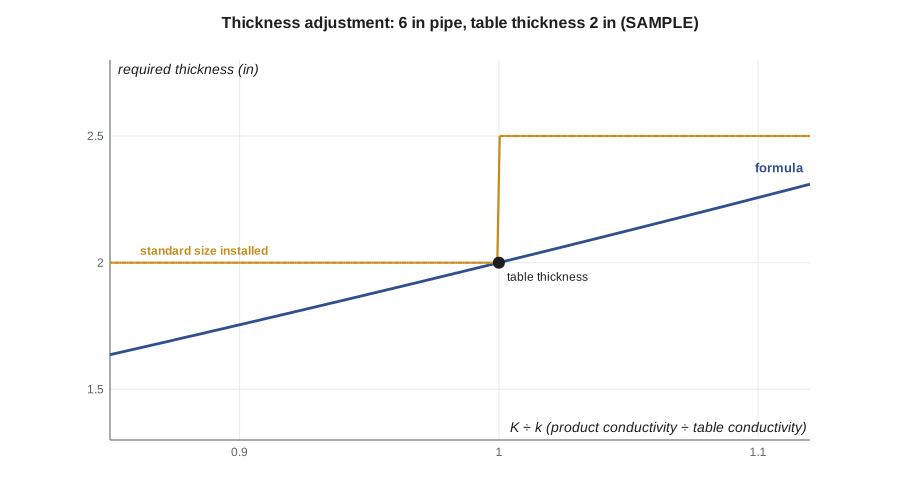
Two cautions. First, K must be the product's conductivity at the table's mean rating temperature, not at the pipe's operating mean temperature, so the data sheet value must be read or interpolated at the right temperature. Second, the formula applies to the energy requirement only; if personnel protection, condensation or the specification needs more, the larger thickness governs.
Industry guides
Codes say how much insulation; guides describe how to install it well. The ones insulators meet most are:
- NIA and NAIMA guidance. The National Insulation Association publishes guidance, training and the Insulation Outlook magazine; NAIMA publishes 3E Plus and technical guides on fiber glass and mineral wool.
- MICA National Commercial and Industrial Insulation Standards. The Midwest Insulation Contractors Association's book of detailed installation plates, showing how each kind of fitting, support and finish is to be insulated; specifications often call for work "in accordance with MICA" plates.
- The ASHRAE Handbook. The Fundamentals volume has a chapter on insulation for mechanical systems, with design data and methods.
- Manufacturers' handbooks and data sheets, with conductivity curves, heat loss tables and installation instructions for their products; the data sheet governs the product's limits.
Raj's rule for the library: a guide shows good practice, the specification and code say what is required, and the data sheet says what the product can do. When they disagree, ask, as lesson 8 explained.
Checking a design against the energy code, step by step
On a building project, the engineer is responsible for meeting the energy code, but the insulator who proposes a substitute or questions a thickness must be able to follow the check. The steps are the same in any code based on ASHRAE 90.1:
- Find the system's category: heating or hot water, steam, domestic hot water, chilled water or refrigerant, and its design fluid temperature range.
- Find the pipe size column for the actual nominal pipe size.
- Read the minimum thickness from the table and note the conductivity range and mean rating temperature in its heading.
- Check the product: read its conductivity at the table's mean rating temperature from the data sheet, interpolating between listed values if necessary.
- Adjust if needed with the formula in this lesson, and round up to a standard size.
- Compare with the specification: the specified thickness must be at least the code minimum; if it is not, raise an RFI.
Interpolation is simple when a data sheet lists conductivity at two mean temperatures that bracket the one needed. If a product lists 0.29 Btu·in/h·ft²·°F at 150 °F and 0.33 at 250 °F, its value at 200 °F is halfway between, 0.31. A value read at the wrong temperature is one of the most common reasons a substitution is rejected.
Editions and adoption
Codes refer to particular editions of standards, and a province or state may adopt an edition years after it is published. The edition that applies is the one the local code adopted, as of the date of the permit, not the newest one. That is why, for example, Ohio's code refers to the 2019 edition of ASHRAE 90.1 as its alternative path, while newer editions exist. Specifications sometimes call for a newer edition than the code; then the specification sets a higher bar, and both must be met.
Fire performance standards
Insulation calculations are about heat flow, but specifications and codes also limit how insulation behaves in a fire. Materials in buildings, and especially in air plenums and exposed areas, must meet flame spread and smoke developed limits, commonly 25 and 50, tested to ASTM E84 (UL 723), as INS-310 noted for duct coverings. Firestop systems at penetrations are tested and listed as INS-330 described. When a substitute is proposed for thermal reasons, its fire ratings must be checked too, together with those of its jacket and adhesives.
Guides in daily work
Guides earn their place on the shelf when a detail is not covered by the specification. When Priya asked how the new condensate tunnel insulation should be finished at the five flange pairs in lesson 12, Raj opened the MICA plates to the page for removable flange covers and the tunnel's wet conditions, and used it as the basis for the detail in his proposal. A guide does not make a detail mandatory, but a detail drawn from a recognized guide is easy for an owner to accept and easy for a crew to build.
Standards for jackets and accessories
Calculations depend on the insulation, but the system's life depends on its jackets and accessories, which have their own standards. Metal jackets are covered by ASTM C1729 for aluminum and C1767 for stainless steel, as INS-220 described; vapor retarder jackets by C1136; and mastics, coatings, adhesives and sealants by standards and manufacturer data that state their permeance, temperature range and fire performance. A specification that names a standard for each component lets the reviewer check a submittal quickly. One that names only the insulation leaves the jacket and accessories to the contractor, and the contractor should then choose products that meet the same standards, and say so in the submittal.
Why the details matter to calculations
Calculations assume insulation that is complete, dry and of the stated thickness everywhere. In service, heat escapes at the places a calculation ignores: joints that open, supports without inserts, fittings left bare, compressed insulation under bands and terminations at flanges. Studies of real systems routinely find installed heat losses higher than calculated ones because of these details. The installation guides exist to close that gap, and that is why the best calculation in the world is only as good as the crew that installs it.
When an inspector, owner or engineer asks which standard a piece of work follows, the answer should be specific: the specification section and its edition, the code and its edition, and the guide plate or manufacturer instruction used for the detail. Vague answers such as "industry standard" invite argument; specific ones end it.
Common mistakes
MistakeUsing a conductivity at the wrong mean temperature in the adjustment formula.
InsteadUse K at the table's mean rating temperature.
MistakeUsing the nominal pipe size as r.
InsteadUse the actual outside radius of the pipe.
MistakeInstalling the formula's exact thickness.
InsteadRound up to the next standard thickness that is made.
MistakeApplying building energy code tables to industrial process piping.
InsteadProcess piping follows the owner's standards and economic thickness; check the code's scope.
MistakeComparing a pipe-insulation conductivity with a board conductivity.
InsteadCompare values from the same kind of test at the same mean temperature.
Summary and key terms
- ASTM C680 defines how heat loss and surface temperature are calculated; C335, C177 and C518 define how conductivity is measured; C585 gives real insulation sizes.
- Energy codes set minimum thicknesses for building services; Ohio uses the 2021 IECC with an ASHRAE 90.1-2019 path.
- Code tables give thicknesses for a conductivity range at a mean rating temperature; T = r[(1 + t/r)^(K/k) − 1] adjusts for other conductivities.
- A product with K = 0.35 against k = 0.32 needs about 10 in 100 more thickness, a full standard size on a 6 in line.
- MICA, NIA, NAIMA, the ASHRAE Handbook and manufacturers' guides describe good installation; specifications and codes set the requirements.
- ASTM C680
- The standard practice for calculating heat gain or loss and surface temperatures of insulated systems.
- Mean rating temperature
- The mean temperature at which an energy code table states the conductivity range for its thicknesses.
- Thickness adjustment formula
- The energy standards' formula for the thickness of an insulation whose conductivity differs from the table's.
- Energy code
- A code that sets minimum energy efficiency requirements for buildings, including insulation of services.
- MICA plates
- Detailed installation drawings in the MICA insulation standards book.
- Best practices guide
- An industry guide describing good design and installation of mechanical insulation.
Practice problems
Work each problem on paper first, then reveal the answer to check.
What does ASTM C680 describe?
Show answer
How to calculate heat gain or loss and surface temperatures of insulated systems by computer programs.
Which ASTM standard gives the real inner and outer diameters of pipe insulation?
Show answer
ASTM C585.
A table requires 1 ½ in. The formula gives 1.7 in for a substitute. What is installed?
Show answer
The next standard size, 2 in.
At what temperature must K be taken in the adjustment formula?
Show answer
The table's mean rating temperature.
Do building energy codes usually set the thickness of industrial process steam lines?
Show answer
No; process piping follows the owner's standards and economic thickness.
Lesson quiz · 5 questions
Score 60% or more to complete this lesson.
Create a free account to save your progress, take quizzes and earn a certificate.