
INS-410 · Lesson 11 of 12 · 23 min
Energy audits of mechanical systems
▶ Video coming soon A video version of this lesson is on the way.
Thea Okerlund arrived at Kellerton at seven in the morning on Tuesday, September 15, 2026, with an infrared camera, a contact thermometer, a roll of black electrical tape, a laser distance meter and a clipboard. Kellerton's corporate office had asked every plant for a steam system assessment that year, and Anika Varga had hired Thea's firm, Harrowgate Energy Advisors, to do it. Raj Sandhu joined them for the afternoon, because Anika wanted the insulation items checked by someone who would have to price them. "An audit is only as good as its list," Thea told him. "If I miss a bare valve, it never gets fixed. If I count one twice, nobody believes the rest."
This lesson describes how an energy audit of mechanical insulation is done: the levels of audit, how infrared thermography finds problems and where it misleads, how a survey inventory turns observations into heat losses with equivalent lengths, how wet and damaged insulation are estimated, and what a good audit report contains. Its worked examples come from Thea's survey of the Kellerton boiler house and condensate tunnel.
Levels of audit
Energy audits are usually described by levels. ASHRAE Standard 211, the standard for commercial building energy audits, defines three, and industrial auditors use similar steps:
| Level | What it involves | Typical result |
|---|---|---|
| Level 1: walk-through | A short site visit and review of energy bills | A list of obvious measures with rough savings |
| Level 2: energy survey and analysis | Detailed survey, measurements and calculations of each measure | Savings, costs and paybacks for each measure, good enough to budget |
| Level 3: detailed analysis of capital projects | Engineering study, often with monitoring, for large investments | Investment-grade estimates for capital decisions |
Thea's assessment was a Level 2 survey of the steam system: boilers, distribution, steam traps, condensate return and insulation. The insulation part is the one an insulator contributes to, and the one this lesson covers. Steam traps, leaks and boiler tuning belong to other trades, but an insulator on an audit should note anything obvious, such as a blowing trap or a leaking valve stem, because they affect the savings and the safety of the insulation work.
Infrared thermography
An infrared (IR) camera measures the infrared radiation coming from a surface and displays it as an image of apparent temperature. On insulated systems it shows at a glance where heat escapes: bare pipe, missing fittings, gaps at joints and supports, and wet insulation, which conducts heat and shows as a warm band. It is the fastest way to find problems over a large plant, and many audits are built around it.
IR cameras are easily misread, because what they measure depends on the surface:
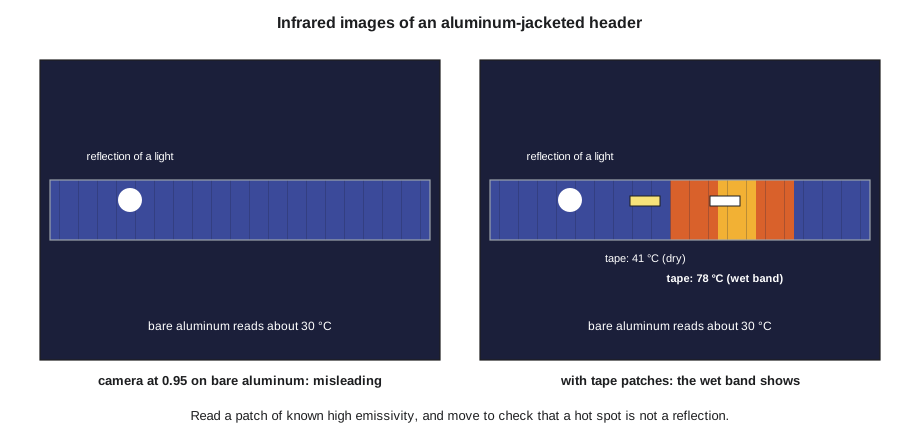
- Emissivity. The camera assumes an emissivity, the infrared equivalent of the emittance in lesson 2. Bare oxidized steel, paint, PVC and fabric are about 0.9 and read well. Aluminum and stainless jackets are low, about 0.1 to 0.3, and a camera set for 0.95 reads them far too cold, because most of what it sees is reflected radiation from the surroundings.
- Reflections. Shiny surfaces reflect warm objects nearby, such as lights, people and other pipes, and the reflections look like hot spots. Move and look again: a reflection moves, a hot spot does not.
- Conditions. Readings are best with the system at steady operating temperature, out of direct sun, with little wind and a large difference between the surface and the air, typically at least 18 °F.
Thea's standard practice on aluminum jackets was the one many auditors use: stick a short piece of black electrical tape on the jacket, which has a known high emissivity, wait for it to reach the jacket temperature, and read the tape instead of the bare metal. On one section of the boiler house header she found an apparent temperature of about 86 °F on the bare aluminum but 172 °F on the tape. Tape on the dry header a few meters away read about 106 °F, close to what a calculation for dry insulation gives. The tape readings were the real ones, and they showed a section of header running far warmer than its dry insulation should.
IR finds problems; it does not measure heat loss directly. The losses in an audit are calculated, as in lesson 2, from the pipe size, temperature and condition, with the IR images as evidence of where the problems are.
The survey inventory
The heart of an insulation audit is the inventory: a list of every bare or damaged item, with its location, size, temperature, length or count, and condition. Fittings are converted into equivalent lengths of bare pipe, as INS-210 explained: an 6 in gate valve has about 4 ft of bare pipe's surface, and a flange pair about 1 ft, as typical survey values. The inventory then gives a bare loss for each item and a total for the area.
Thea's inventory for the boiler house found the same 23 bare fittings that Lou Brisebois, Marcel and Devon listed on November 6 in INS-210, with a bare loss of about 51,800 Btu/h. A second area, the condensate tunnel under the old process building, was new to Coldstream.
Worked problem
Inventory of the condensate tunnel
The tunnel holds 138 ft of 3 in condensate return (outside diameter 3.500 in) at about 203 °F, in air at about 68 °F, with its insulation torn off years ago, and four bare flange pairs. The bare loss of 3 in steel at these conditions, with an emittance of 0.8, is about 300 Btu/h·ft. Using 1 ft per flange pair, find the bare loss and its annual cost at 7,550 hours and 13.75 dollars per MMBtu.
Show solution
- Equivalent length: 138 + 4 × 1 = 142 ft.
- Bare loss: 299.8 × 142 = 42,570 Btu/h.
- Energy: 42,570 × 7,550 ÷ 10⁶ = 321.4 MMBtu a year.
- Cost: 321.4 × 13.75 = 4,419 dollars a year.
Answer: The tunnel line wastes about 4,420 dollars a year bare. Condensate is cooler than steam, so its loss per foot is about a quarter of a steam line's, but a long bare run still adds up.
Equivalent lengths and bare-pipe losses are approximations, good to about 10 to 20 in 100, which is enough to rank items and decide what to fix. Where a decision hangs on a single item, it is worth a more careful calculation.
Damaged and wet insulation
Bare surfaces are easy to count; damaged insulation is harder, because some of it still works. Auditors use three approaches, in rising order of effort:
- Treat it as bare if the insulation is missing, crushed flat or hanging loose.
- Use a factor for insulation that is in place but wet or degraded, based on the auditor's judgment of its condition and the surface temperature measured with IR or a contact thermometer. Wet mineral wool or glass fiber can lose several times its dry heat loss.
- Back-calculate from a measured surface temperature: with the surface temperature known, the surface coefficient of lesson 2 gives the heat flow directly, without knowing the insulation's condition.
On the boiler house header, Thea found 49 ft of the 8 in main with a warm band and stained jacket below a roof drain leak, the problem Bernie warns about in INS-120. Dry, its 3 in of mineral wool would lose about 79.8 Btu/h·ft at the boiler house conditions. From the taped surface readings, Thea estimated the wet section was losing about four times that, 320 Btu/h·ft. The saving from replacing it would be about (319.2 − 79.8) × 49 = 11,730 Btu/h, worth about 1,220 dollars a year, and the roof drain had to be fixed first or the new insulation would be wet within a season.
A wet section is also a corrosion risk, as INS-310 and INS-320 explained, and its true cost is often the pipe, not the heat. Audits should flag wet insulation for inspection even where the energy saving alone would not justify the work.
The audit report
Thea's report, dated Wednesday, October 14, followed the usual form of a Level 2 audit. For insulation it contained:
- A summary of all measures, their savings, costs and paybacks, ranked.
- The inventory, with each item's location, photograph, IR image where useful, size, temperature, length or equivalent length, and condition.
- The method and inputs: operating hours, fuel price, efficiency, bare-loss source, insulated-loss source and emission factors, stated so that anyone can check them.
- Recommendations, including the thickness and system for each repair, and any non-energy reasons, such as personnel protection, inspection access or corrosion.
- Budget costs, with a note that they need contractor pricing, which is where Coldstream came in.
Raj's part, the subject of lesson 12, was to turn the insulation recommendations into a priced proposal with savings he could stand behind. Before he started, he and Priya checked every insulation line in the report against the plant, the drawings and their own calculations. They agreed with all but two: the fitting count, which matched Coldstream's own survey of November 6, and the tunnel's flange count, where Thea had counted four flange pairs but the tunnel had five, one hidden behind a support. Raj used five in his proposal, and told Thea.
Planning the survey
An insulation survey takes people into the hottest, highest and tightest parts of a plant, so it is planned like any other work there. Before Thea's visit, Anika arranged a plant orientation, a list of areas with their hazards, and an escort from maintenance. The condensate tunnel needed a confined space assessment, because it has one entrance and poor ventilation; Kellerton treats it as a space requiring an entry permit, atmospheric testing and an attendant, so Thea surveyed it only with a maintenance attendant and a gas monitor. Boiler house platforms meant fall protection and care around live steam, and the engine room required the ammonia awareness that INS-320 described. None of this is unusual. The survey is work in a plant, and the plant's rules apply.
Measuring sizes and lengths
An auditor seldom has drawings that match the plant, so sizes and lengths are measured on site. Lengths are taken with a tape or a laser distance meter, and counts of fittings are written down item by item, not estimated. Pipe size can be found from the circumference, as INS-130 taught: wrap a tape around the bare pipe or jacket and divide by π.
Worked problem
Identifying the tunnel pipe size
Thea's tape around the bare tunnel pipe read 11.0 in. What size is it?
Show solution
- Outside diameter: 11.0 ÷ π = 3.50 in.
- 3 in steel pipe has an outside diameter of 3.500 in, so the line is 3 in.
Answer: The line is 3 in, the size used in the inventory.
On insulated pipe, the same method gives the outside diameter of the jacket, from which the insulation thickness can be estimated if the pipe size is known. For each item, Thea also recorded the temperature: a contact thermometer on bare metal, the plant's gauges and steam tables for steam lines, and the operators' knowledge for lines that vary.
Photos and tags
Every item on an audit inventory has a photograph and, where useful, an infrared image, taken with a reference such as a tag or a tape in view so the item can be found again. Thea numbered her items in the same series Kellerton uses for its covers, so that her list, Coldstream's survey, the cover tags from INS-340 and the plant's maintenance records could all be matched. When Raj compared her list with Coldstream's November 6 count, the matching numbers made the comparison a matter of minutes.
A survey also records what is good. Thea's inventory noted the sections of header, receiver and rack that were sound and dry, with a sample of IR images, so that a later survey could compare them and see whether the insulation was aging. An audit that lists only problems gives no baseline for the next one.
Finally, an audit list goes stale. Insulation is removed for repairs every week in a working plant, and a list that was right in September may be wrong by spring. Thea's report recommended that Kellerton keep its list in the maintenance system, update it after every job that disturbs insulation, and repeat the survey every two or three years, a practice INS-310 recommended for insulation inspection programs.
Common mistakes
MistakeReading a shiny jacket with the camera set for high emissivity.
InsteadUse a tape or paint patch of known emissivity and read the patch.
MistakeMistaking a reflection for a hot spot.
InsteadMove and look again; reflections move with the viewpoint.
MistakeTreating IR images as heat loss measurements.
InsteadUse IR to find problems and calculate the losses from size, temperature and condition.
MistakeCounting fittings twice, once as fittings and again in the pipe length.
InsteadMeasure pipe lengths between fittings, or subtract fitting lengths, and add equivalent lengths once.
MistakeReplacing wet insulation without fixing the source of water.
InsteadFind and fix the leak first, and flag wet sections for corrosion inspection.
Summary and key terms
- Energy audits are done at levels from walk-through to detailed analysis; ASHRAE Standard 211 defines three levels for buildings.
- Infrared cameras find bare, damaged and wet insulation quickly, but shiny jackets need tape or paint patches and reflections must be ruled out.
- The survey inventory lists every item with size, temperature, length and condition; fittings become equivalent lengths of bare pipe.
- Wet or damaged insulation is treated as bare, given a factor or back-calculated from surface temperature.
- A good audit report states its inputs and methods so that every number can be checked.
- Energy audit
- A survey and analysis of where a facility uses and loses energy, and what it would save to improve.
- Infrared thermography
- Imaging of surface temperatures by the infrared radiation surfaces give off.
- Emissivity
- The infrared emittance of a surface, set in an IR camera to read temperature correctly.
- Survey inventory
- An item-by-item list of bare and damaged insulation found in an audit.
- Equivalent length
- The length of bare pipe with the same heat loss as a fitting.
- Back-calculation
- Finding heat loss from a measured surface temperature and the surface coefficient.
Practice problems
Work each problem on paper first, then reveal the answer to check.
Why does an IR camera read a bare aluminum jacket too cold?
Show answer
Aluminum has a low emissivity, so the camera sees mostly reflected radiation; at a high emissivity setting it reads too low.
How can an auditor get a true reading on an aluminum jacket?
Show answer
Read a patch of black tape or paint of known high emissivity.
What is the equivalent length of four flange pairs at 1 ft each?
Show answer
4 ft.
What must be done before replacing the wet header insulation?
Show answer
Fix the roof drain leak that wet it.
Which ASHRAE standard defines levels of building energy audit?
Show answer
ASHRAE Standard 211.
Lesson quiz · 5 questions
Score 60% or more to complete this lesson.
Create a free account to save your progress, take quizzes and earn a certificate.