
INS-410 · Lesson 2 of 12 · 24 min
Heat loss from bare and insulated pipe
▶ Video coming soon A video version of this lesson is on the way.
The first item in Thea Okerlund's audit was not a valve or a fitting but a reminder: the 4 in steam line in the Kellerton boiler house that INS-120 described, 65 ft 4 in of it left bare after a valve job in 2025 and found during the outage. INS-120 had used a round figure for its bare heat loss, about 1,020 Btu/h per foot, and INS-210's survey table gave 1,080 Btu/h·ft for the same size. "Which one is right?" Priya asked. Raj smiled. "Both, near enough. Let's work it out ourselves and see why they differ."
This lesson shows how heat leaves a bare pipe and an insulated pipe, using the idea of thermal resistance. It works the bare 4 in line from first principles, then the same line with 3 in of mineral wool, including the step that confuses most people: finding the surface temperature, which the answer depends on, by iteration.
Heat flow as current through resistances
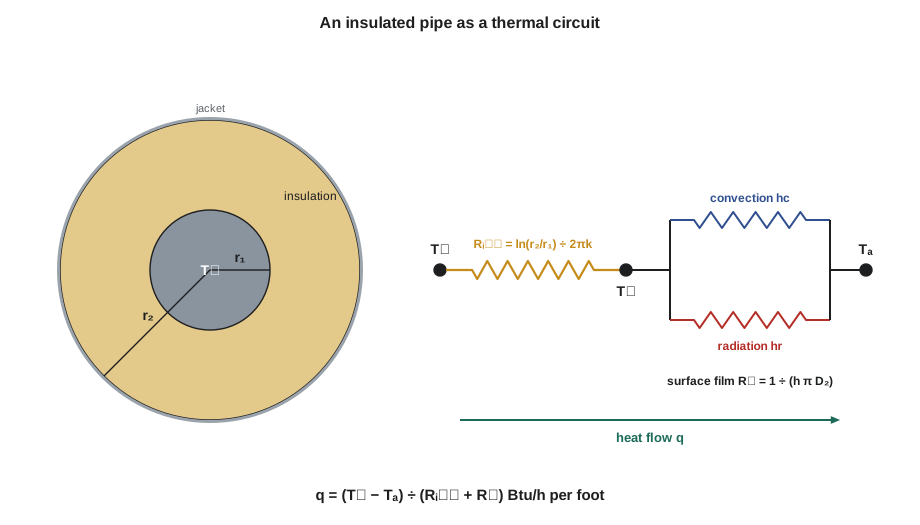
Heat flows from hot to cold through anything in its way, and each layer in its path resists the flow. The idea is the same as an electric circuit: the temperature difference drives the heat flow, as voltage drives current, and the resistances in series add up. For a pipe the heat passes through:
- The pipe wall. Steel conducts heat so well that its resistance is tiny and is always ignored.
- The insulation. Almost all the resistance of an insulated pipe is here.
- The jacket. Metal and thin plastic jackets add almost no resistance and are ignored.
- The surface film. Heat leaves the outer surface by convection to the air and radiation to the surroundings. Together they are described by a surface coefficient h, and the film acts as one more resistance.
With these resistances in series, the heat loss per unit length of pipe is:
where q is in Btu/h per foot of pipe, Tₚ is the pipe temperature, Tₐ the ambient air temperature, and the two resistances are per foot of pipe, in h·ft·°F/Btu.
The resistance of cylindrical insulation
On a flat wall, the resistance of a layer is simply its thickness divided by its conductivity. A pipe is different, because the area the heat passes through grows from the inside of the insulation to the outside. The resistance of a cylindrical layer, per unit length, is:
where r₁ is the inside radius of the insulation (the pipe's outside radius), r₂ is the outside radius of the insulation, ln is the natural logarithm and k is the conductivity at the mean temperature. Two consequences matter for insulators:
- Doubling the thickness does not double the resistance. Because the logarithm grows slowly, each extra inch adds less than the one before. This is why economic thickness, in lesson 3, comes to a sensible limit.
- Small pipes need less thickness for the same heat loss per area, but lose more per area for the same thickness, because their surface grows faster as insulation is added.
For several layers, such as two materials on a hot line, the resistances add: one ln term for each layer, each with its own radii and conductivity.
The surface coefficient
The surface coefficient h combines convection and radiation from the outer surface. Exact values come from engineering correlations that ASTM C680 and the calculation programs use; for hand calculations in still indoor air, two simple formulas are good enough:
Here hc is the natural convection coefficient for a horizontal cylinder, ΔT is the difference between the surface and the air, D is the outside diameter of the surface, hr is the radiation coefficient, ε is the surface emittance and the temperatures in the radiation formula are absolute. The total is h = hc + hr, and the surface film resistance per unit length is:
Emittance describes how readily a surface gives off radiant heat, from 0 for a perfect mirror to 1 for a perfect radiator. Typical values used in calculations are:
| Surface | Typical emittance |
|---|---|
| New, bright aluminum jacket | 0.03 to 0.10 |
| Weathered or embossed aluminum | 0.10 to 0.20 |
| Stainless steel jacket, new | about 0.15 to 0.30 |
| Galvanized steel, new to weathered | 0.10 to 0.30 |
| PVC jacket, painted surfaces, mastic, canvas, fabric | 0.85 to 0.95 |
| Oxidized steel pipe | 0.70 to 0.90 |
Wind matters too. Outdoors, even a gentle breeze can raise the convection coefficient several times. The programs handle wind with forced convection formulas; for hand work, outdoor calculations often use a single larger coefficient, as INS-120 did when it used about 1.76 Btu/h·ft²·°F for the outdoor kettle line.
Bare pipe, worked by hand
Worked problem
The bare boiler house line
A 4 in steel pipe (outside diameter 4.500 in, 0.375 ft) carries steam at 366 °F in still air at 50 °F, the condition used in INS-210's survey table. The oxidized steel has an emittance of 0.71. Estimate its heat loss per foot.
Show solution
- Temperature difference: ΔT = 366 − 50 = 316 °F.
- Convection: hc = 0.27 × (316 ÷ 0.375)^0.25 = 0.27 × 842.7^0.25 = 0.27 × 5.388 = 1.455 Btu/h·ft²·°F.
- Absolute temperatures: Tₛ = 825.67 °R, Tₐ = 509.67 °R; Tₛ⁴ − Tₐ⁴ = 46.48 × 10¹⁰ − 6.75 × 10¹⁰ = 39.73 × 10¹⁰ °R⁴.
- Radiation: hr = 0.71 × 0.1714 × 10⁻⁸ × 39.73 × 10¹⁰ ÷ 316 = 483.5 ÷ 316 = 1.530 Btu/h·ft²·°F.
- Total: h = 1.455 + 1.530 = 2.985 Btu/h·ft²·°F.
- Surface per foot: π × 0.375 = 1.178 ft².
- Heat loss: q = 2.985 × 1.178 × 316 = 1,111 Btu/h·ft.
Answer: About 1,110 Btu/h·ft. Radiation and convection are about equal on a bare steam pipe, which is why emittance matters so much.
The answer sits close to the 1,080 Btu/h·ft of INS-210's table and a little above INS-120's round 1,020 Btu/h·ft. The spread comes almost entirely from emittance: the same calculation gives about 1,023 Btu/h·ft with an emittance of 0.6 and 1,223 Btu/h·ft with 0.85. A bare pipe's emittance depends on rust, scale and paint, so a range of about 10 in 100 between sources is normal. For an audit, any of them is good enough; for a design, use the program with the best data available.
Insulated pipe and the surface temperature problem
With insulation on, the heat loss depends on the surface coefficient h, h depends on the surface temperature, and the surface temperature depends on the heat loss. The calculation goes round in a circle. The way out is iteration: guess the surface temperature, calculate h and the heat loss, use the heat loss to calculate a new surface temperature, and repeat until the guess and the result agree. The surface temperature comes from the drop across the surface film:
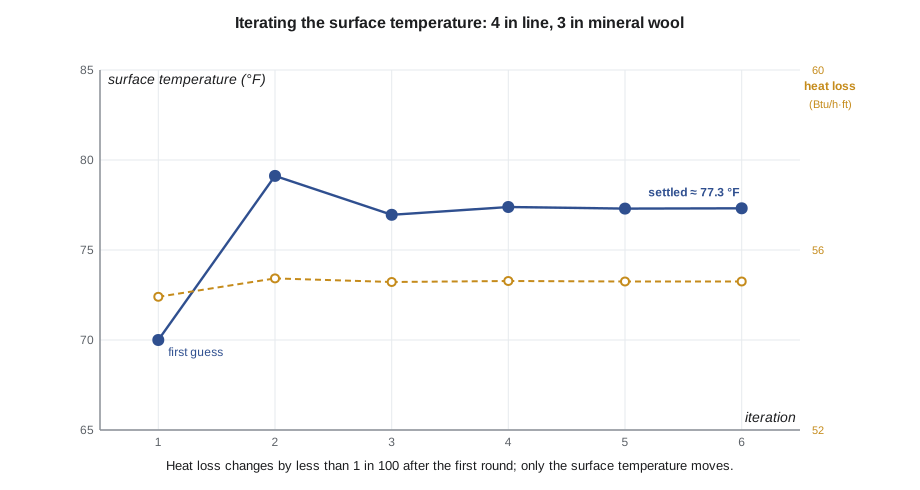
Because almost all the resistance is in the insulation, the heat loss hardly changes between iterations, and the answer settles in three or four rounds.
Worked problem
The same line with 3 in of mineral wool
The 4 in line is insulated with 3 in of mineral wool, k = 0.31 Btu·in/h·ft²·°F at its mean temperature, with a new aluminum jacket of emittance 0.10. The air is still, at 50 °F. Find the heat loss and the surface temperature.
Show solution
- Radii: r₁ = 2.25 in, r₂ = 2.25 + 3 = 5.25 in; outside diameter D₂ = 0.875 ft.
- Insulation resistance: ln(5.25 ÷ 2.25) = ln 2.333 = 0.8473; Rᵢₙₛ = 0.8473 ÷ (2π × 0.31 ÷ 12) = 5.220 h·ft·°F/Btu.
- Iteration 1: guess Tₛ = 70 °F; h = 0.687 Btu/h·ft²·°F; Rₛ = 1 ÷ (0.687 × π × 0.875) = 0.530; q = 316 ÷ (5.220 + 0.530) = 55.0 Btu/h·ft; new Tₛ = 50 + 55.0 × 0.530 = 79.1 °F.
- Iteration 2: Tₛ = 79.1 °F; h = 0.747; q = 55.4 Btu/h·ft; new Tₛ = 77.0 °F.
- Iteration 3: Tₛ = 77.0 °F; h = 0.734; q = 55.3 Btu/h·ft; new Tₛ = 77.4 °F.
- Iteration 4: Tₛ = 77.4 °F; h = 0.737; Rₛ = 0.494; q = 316 ÷ (5.220 + 0.494) = 55.3 Btu/h·ft; new Tₛ = 77.3 °F. Settled.
Answer: About 55.3 Btu/h·ft with a jacket temperature of 77 °F, about one twentieth of the bare loss. The insulation carries 5.220 ÷ 5.714 = 91 in 100 of the total resistance.
INS-120 used 61 Btu/h·ft for this case, a little higher than the hand result. INS-120's figure came from a simpler calculation with a surface coefficient typical of a dull jacket, while this example uses a bright aluminum jacket, which radiates less, runs warmer and slightly reduces the loss. Both figures are reasonable; the point is that the jacket choice changes the surface temperature far more than it changes the heat loss. Lesson 4 returns to this, because for personnel protection the surface temperature is the answer that matters.
A shortcut and a check
Two quick checks catch most mistakes in insulated pipe calculations:
- Ignore the film. The heat loss through the insulation alone, q = (Tₚ − Tₐ) ÷ Rᵢₙₛ, is always a little higher than the true answer. For the example it is 316 ÷ 5.220 = 60.5 Btu/h·ft. If a detailed answer comes out higher than this, something is wrong.
- Check the surface temperature. It must lie between the ambient and the pipe temperature, and for a well-insulated hot pipe it is usually within 20 to 50 °F of ambient. A surface temperature near the pipe temperature means the thickness or the radius was entered wrongly.
For flat surfaces such as ducts, tanks and breeching, the same method applies with simpler resistances: thickness divided by conductivity for each layer, and 1 ÷ h for the film, all per unit area. INS-310 used these for equipment, and lesson 4 uses them for a hot duct.
How much the jacket and wind matter
The surface film is a small share of the resistance of an insulated pipe, so changes to it change the heat loss only a little, while they change the surface temperature a lot. Repeating the 4 in example with different surfaces shows the pattern:
| Surface condition | Heat loss (Btu/h·ft) | Surface temperature (°F) |
|---|---|---|
| Aluminum jacket, ε = 0.1, still air | 55.3 | 77.3 |
| Painted or PVC jacket, ε = 0.9, still air | 57.7 | 65.0 |
| Fixed coefficient of 1.76 Btu/h·ft²·°F (light breeze) | 58.2 | 62.0 |
| Fixed coefficient of 4.4 Btu/h·ft²·°F (windy, outdoors) | 59.6 | 54.9 |
From still air with an aluminum jacket to a windy outdoor exposure, the heat loss rises by less than 10 in 100, but the surface temperature falls by more than half its rise above ambient. For heat loss, the surface assumption hardly matters on a well-insulated line; for surface temperature, it is the whole answer. Bare pipe is the opposite: there the film is the only resistance, and wind can nearly double the loss of a bare outdoor steam line.
Two layers on a pipe
Very hot pipe is often insulated with two materials, for example calcium silicate against the pipe and mineral wool outside. The resistances add, one logarithm for each layer:
Worked problem
A two-layer superheated steam line
A superheated steam line in a power plant, 6 in (r₁ = 3.3125 in), runs at 752 °F in air at 77 °F. It has 2 in of calcium silicate, typical k₁ = 0.45 Btu·in/h·ft²·°F, under 2 in of mineral wool, typical k₂ = 0.35, with an aluminum jacket. Find the heat loss and the interface temperature.
Show solution
- Radii: r₂ = 5.3125 in, r₃ = 7.3125 in.
- R₁ = ln(5.3125 ÷ 3.3125) ÷ (2π × 0.45 ÷ 12) = 0.4724 ÷ 0.2356 = 2.005 h·ft·°F/Btu.
- R₂ = ln(7.3125 ÷ 5.3125) ÷ (2π × 0.35 ÷ 12) = 0.3195 ÷ 0.1833 = 1.744 h·ft·°F/Btu.
- Surface film after iteration: Rₛ = 0.320 h·ft·°F/Btu, jacket at about 130 °F.
- q = 675 ÷ (2.005 + 1.744 + 0.320) = 675 ÷ 4.069 = 165.9 Btu/h·ft.
- Interface: 752 − 165.9 × 2.005 = 419 °F.
Answer: About 166 Btu/h·ft, with the mineral wool seeing about 419 °F at its hot face, well within its rating. The inner layer takes the heat; the outer layer carries the insulation value more cheaply.
Common mistakes
MistakeUsing the flat-wall formula for pipe insulation.
InsteadUse ln(r₂ ÷ r₁) ÷ (2πk) for cylindrical layers.
MistakeUsing diameters instead of radii, or the thickness instead of the outer radius, in the logarithm.
InsteadThe ratio is outer radius over inner radius; with diameters the ratio is the same, but never use the thickness in place of r₂.
MistakeUsing Celsius or Fahrenheit temperatures in the radiation formula.
InsteadUse kelvins or degrees Rankine for the fourth powers.
MistakeStopping after one iteration with a poor guess.
InsteadRepeat until the surface temperature stops changing by more than a fraction of a degree.
MistakeTreating a bare-pipe table value as exact.
InsteadBare losses vary about 10 in 100 with emittance and air movement; use them for surveys, not designs.
Summary and key terms
- Heat flows through the insulation and the surface film in series: q = (Tₚ − Tₐ) ÷ (Rᵢₙₛ + Rₛ).
- The resistance of cylindrical insulation is ln(r₂ ÷ r₁) ÷ (2πk), so extra thickness adds less and less resistance.
- The surface coefficient h is convection plus radiation; radiation depends strongly on emittance and is about half the loss of a bare steam pipe.
- Insulated calculations need iteration because h depends on the surface temperature, but they settle in a few rounds.
- A bare 4 in line at 366 °F loses about 1,110 Btu/h·ft in still air; with 3 in of mineral wool and aluminum jacket, about 55 Btu/h·ft.
- Thermal resistance
- Opposition to heat flow; for layers in series the resistances add.
- Surface coefficient
- The combined convection and radiation heat transfer coefficient at a surface, h = hc + hr.
- Surface film resistance
- The resistance to heat flow between a surface and the air, 1 ÷ (h × area).
- Emittance
- A measure of how readily a surface gives off radiant heat, from 0 to 1.
- Iteration
- Solving a problem by repeating a calculation with an improved guess until the answer stops changing.
- Natural logarithm
- The logarithm to base e, written ln, used in the resistance of a cylindrical layer.
- Convection
- Heat transfer by moving air or fluid at a surface.
- Radiation
- Heat transfer by infrared radiation between a surface and its surroundings.
Practice problems
Work each problem on paper first, then reveal the answer to check.
Which layer of an insulated pipe has the largest thermal resistance?
Show answer
The insulation.
For the same insulation, which jacket gives the higher surface temperature, aluminum or PVC?
Show answer
Aluminum, because its low emittance gives off heat less readily.
What is ln(r₂ ÷ r₁) for r₁ = 2.25 in and r₂ = 5.25 in?
Show answer
ln 2.333 = 0.847.
Why does the heat loss hardly change between iterations?
Show answer
Because the insulation resistance dominates and does not depend on the surface temperature.
A detailed calculation gives a heat loss higher than the insulation-only loss. What does that mean?
Show answer
There is a mistake, because the film resistance can only reduce the heat loss.
Lesson quiz · 5 questions
Score 60% or more to complete this lesson.
Create a free account to save your progress, take quizzes and earn a certificate.