
INS-330 · Lesson 9 of 12 · 25 min
Fireproofing structural steel
▶ Video coming soon A video version of this lesson is on the way.
On Tuesday, October 20, 2026, in the middle of the Level 2 firestopping, Rhoda found three beams in the corridor ceiling where the gray, cotton-candy-like spray on the steel had been scraped off in patches. Harcourt's crew had hung new pipe from beam clamps the week before and had knocked the fireproofing off to fit the clamps. The fireproofing had been sprayed in the summer by Bayliss Fireproofing, the specialty applicator on the job, which had already left the site. Rhoda called Bayliss's foreperson, got the product name and the repair instructions by email, and patched the three beams that afternoon with the same product. "Nobody walks past bare steel on a rated floor," she told Nico. "Not us, not the pipefitters, not the inspector."
Fire-resistive coatings on structural steel are usually called fireproofing, although they do not make steel proof against fire; they slow the rate at which it heats. Spraying new fireproofing is normally specialist work, but repairing it, inspecting it and working around it is part of every firestopper's job, and the insulator's trade includes fireproofing. This lesson explains why steel needs protection, the main kinds of protection, how ratings and thicknesses are set, how fireproofing is applied, repaired and inspected, and how to avoid damaging it.
Why steel needs protection
Steel does not burn, but it loses strength as it heats. At around 1,020 °F structural steel has lost roughly half of its strength at room temperature, and unprotected steel members in a fully developed fire can reach that temperature in well under half an hour. A floor beam or column that loses half its strength while still carrying its load can sag, buckle or collapse. Steel also expands as it heats, pushing on the structure around it.
Fire tests of steel beams and columns therefore measure the steel temperature, as well as whether the member holds its load. The test standards set limits on the average and the maximum temperature of the steel; for columns, for example, the average limit is about 1,000 °F. The job of fireproofing is to keep the steel below those limits for the rated time.
Concrete floors and masonry walls need no added protection, because they are rated by their thickness. Steel in a rated floor or roof, and steel columns supporting rated floors, usually do, unless they are protected by a rated ceiling below or encased in rated construction.
Kinds of fire-resistive protection
- Sprayed fire-resistive materials (SFRM). Lightweight cementitious or fibrous mixtures sprayed onto beams, columns and the underside of steel decks to a set thickness. They are the most common protection in concealed spaces such as ceiling plenums, because they are cheap and quick. Cementitious SFRM is a gypsum or cement-based mix with lightweight aggregate; fibrous SFRM uses mineral fiber with a binder.
- Intumescent coatings. Paint-like coatings, applied by spray, brush or roller in several coats, that swell into an insulating char when heated. They are thin and can be given a decorative finish, so they are used on exposed steel in lobbies and atria. Mastic or thick-film intumescents are used on industrial steel exposed to hydrocarbon fires, such as in refineries.
- Board and encasement. Gypsum board, calcium silicate board or concrete built around the steel. Columns in finished spaces are often boxed in with layers of gypsum board.
- Rated ceilings. In some floor and roof designs, a rated ceiling of special gypsum board or tile protects the steel above it, so the steel itself has no coating.
Each method is part of a listed design that gives the rating, the steel sizes it covers and the thickness or number of layers required. The designer chooses the design; the applicator installs it; the inspector checks it.
Ratings and thicknesses
In the US, the fire-resistance ratings of steel assemblies are determined by testing to ASTM E119 or UL 263, or by the calculation methods in IBC Section 722, and most projects use UL listed designs, which have letter prefixes by type, such as D-series designs for floor and roof assemblies with steel decks, N-series for beams and X-series for columns.
The thickness of SFRM needed depends on four things:
- The rating. A two-hour beam needs more than a one-hour beam.
- The size of the steel. Heavier, thicker steel members heat more slowly than light ones, because they have more mass to heat for each unit of surface exposed to fire. Designs express this as a ratio of weight to heated perimeter, often written W/D, and allow less coating on heavier members, within limits.
- Restrained or unrestrained. Members held at their ends by the surrounding structure behave better in fire than members free to expand, and some designs give different thicknesses for each. The designer decides which applies.
- The product. Each listed product has its own thickness tables in the design.
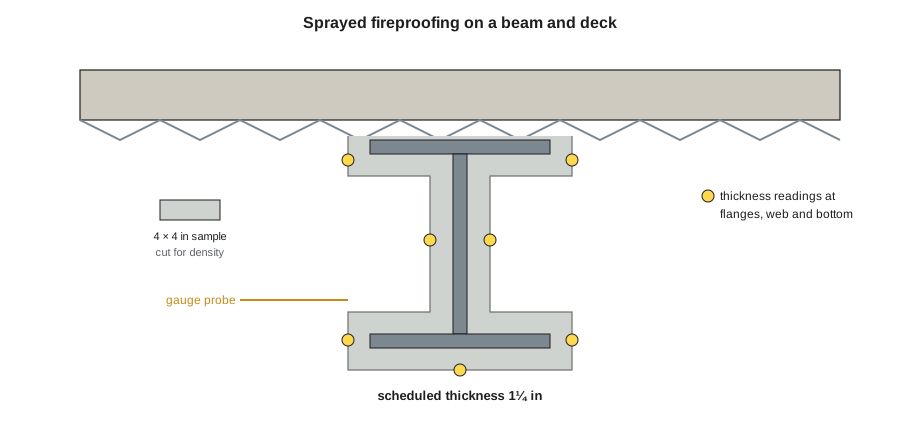
The required thicknesses are shown on the structural or architectural drawings or in a fireproofing schedule. On Mountview Level 2, the corridor beams were scheduled for 1¼ in of cementitious SFRM for their 2-hour rating, and the deck underside for less.
Applying SFRM
SFRM is applied by specialty crews with mixers and pumps or with dry-feed spray machines. A good application depends on preparation and conditions:
- Clean steel. Free of oil, grease, loose mill scale, dirt and anything that stops bond. Most SFRM goes on bare or primed steel; painted steel needs the paint to be compatible and sometimes a bond test or a bonding agent.
- Temperature and ventilation. A minimum air and steel temperature, often about 40 °F, before, during and for a period after application, and enough ventilation to let it dry. In winter, temporary heat may be needed.
- Thickness and density. Applied in one or more passes to the scheduled thickness, measured as the crew works, at the density the design requires.
- Sequence. After steel erection and deck installation, and before pipes, ducts, conduit and hangers go in, so that nothing blocks the spray or is attached through it later. Where hangers must be attached first, the design or the applicator says how to fireproof around them.
- Protection. Finished fireproofing is soft and easily damaged. It must not be disturbed while curing, and other trades must be warned.
Intumescent coatings
Intumescent coatings are applied more like paint, in measured coats over a compatible primer, sometimes with a topcoat for appearance or weather. Their thickness is measured as dry film thickness with a magnetic or electronic gauge on the steel, and each coat has a minimum drying time before the next. The required thickness is usually much smaller than SFRM, measured in fractions of a millimeter to a few millimeters, so small differences matter. Intumescent coatings must not be painted over with products the maker has not approved, because some paints stop them expanding.
Repairing damaged fireproofing
Fireproofing is damaged constantly during construction: by hanger installers, electricians, sprinkler fitters, ductwork, lifts and ladders. Damage is also common later, during renovations. Repairs must restore the design thickness and density with a compatible product, following the manufacturer's repair instructions.
- Identify the product. Repairs use the same product, or one the manufacturer says is compatible, applied to the same design. Ask the applicator or check the submittal.
- Prepare the area. Remove loose and damaged material back to well-bonded fireproofing, clean the steel, and apply any bonding agent the instructions call for at the edges and on bare steel.
- Apply to thickness. By hand trowel or small sprayer, building up in layers if needed, to at least the scheduled thickness, blending into the sound material around.
- Hangers and clamps. Where an item is fastened to fireproofed steel, the fireproofing must be restored around the attachment, and in some designs the hanger rod itself must be coated for a set distance.
- Record it. Note the location, the product and batch, and the thickness, and have the inspector check it before it is covered.
Worked problem
How much patching material for the corridor beams?
The damaged areas on the three Level 2 beams add up to about 17.2 ft², scheduled at 1¼ in of SFRM with a minimum density of 15 lb/ft³. The patching product comes in 50 lb bags. Allowing 25 in 100 for waste, overbuild and blending, how much material is needed?
Show solution
- Volume = 17.2 × 1.25 ÷ 12 = 1.79 ft³.
- Dry mass at the minimum density = 1.79 × 15 = 26.9 lb.
- With 25 in 100: 26.9 × 1.25 = 33.6 lb.
- One 50 lb bag is enough.
Answer: One bag. Rhoda mixed half a bag at a time so that it would not set before she had used it.
Inspecting fireproofing
SFRM is inspected for thickness, density and bond. Thickness is measured with a probe-type gauge pushed through the coating to the steel at a pattern of points on beams, columns and decks, following ASTM E605; density is found by cutting out a sample of known size and weighing it after drying; and bond strength is tested by gluing a cap to the surface and pulling it off, following ASTM E736. The IBC requires special inspection of SFRM and of mastic and intumescent coatings, with set numbers of thickness readings per area of floor and per member, density tests and bond tests, and minimum bond strengths.
A common rule in specifications is that the average of the readings in an area must be at least the required thickness, and no single reading may be more than a small amount under it, often ¼ in. The project's own rule is the one that governs.
Worked problem
Does the patched beam pass the thickness check?
Vera Sheffer, the special inspector, took eight thickness readings on the patched beam on October 21: 1.31, 1.19, 1.31, 1.38, 1.13, 1.31, 1.25 and 1.38 in. The required thickness is 1.25 in. The specification requires the average to be at least the required thickness and no reading to be more than ¼ in under it. Does it pass?
Show solution
- Sum = 1.31 + 1.19 + 1.31 + 1.38 + 1.13 + 1.31 + 1.25 + 1.38 = 10.26 in.
- Average = 10.26 ÷ 8 = 1.28 in, which is at least 1.25 in.
- Lowest reading = 1.13 in. The lowest allowed is 1.25 − 0.25 = 1.00 in, so 1.13 in is acceptable.
Answer: It passes on both counts.
Worked problem
Checking the density
Vera cut a 4 × 4 in sample through the full 1¼ in thickness of the original fireproofing on one beam, dried it and weighed it: 0.18 lb. The minimum density is 15 lb/ft³ (1 ft³ = 1,728 in³). Does it pass?
Show solution
- Volume = 4 × 4 × 1.25 = 20 in³ = 20 ÷ 1,728 = 0.01157 ft³.
- Density = 0.18 ÷ 0.01157 = 15.6 lb/ft³.
- 15.6 is at least 15, so it passes.
Answer: It passes.
Working around fireproofing
Most damage to fireproofing comes from trades who do not think of it as part of the fire protection. Rhoda's crew follows, and teaches, a few habits:
- Do not scrape, chip or hang from fireproofed steel without a plan for repair. Beam clamps and hangers on fireproofed steel need the fireproofing restored around them.
- Do not insulate or wrap over damaged fireproofing. Report it first; once covered, it is invisible.
- Protect it during work. Ladders, scissor lifts and material carts gouge fireproofing on columns.
- Report bare steel. Any bare steel on a rated floor or roof is a deficiency until someone who knows the design says otherwise.
- Do not paint over it or spray other coatings on it without approval.
At Mountview, after the October 20 repairs, the general contractor added a rule to the site orientation: no attachment to fireproofed steel without a fireproofing repair ticket, and Bayliss returned for a final walk before the ceilings closed.
Health and safety
SFRM work produces dust and, for some products, contains crystalline silica or mineral fibers. Older fireproofing, sprayed before the early 1980s, may contain asbestos: in an existing building, fireproofing must never be disturbed until the owner's hazardous materials survey says what it is, as INS-230 explained. Patching uses wet mixes that are alkaline and irritating to skin and eyes, so gloves, eye protection and long sleeves are needed, and respirators where the safety data sheet and the exposure assessment call for them. Overhead work means ladders, scaffolds or lifts, and dropped material.
Common mistakes
MistakeCalling fireproofing fireproof and treating it as permanent.
InsteadTreat it as a fragile, rated coating that must be kept at design thickness.
MistakeScraping fireproofing off to fit a clamp and leaving it.
InsteadRestore the fireproofing around every attachment to the design thickness.
MistakePatching with any product that is handy.
InsteadUse the same or a compatible product and follow the manufacturer's repair instructions.
MistakeInsulating over bare or damaged steel.
InsteadReport it and have it repaired and inspected before covering it.
MistakeDisturbing old fireproofing in an existing building without checking.
InsteadCheck the hazardous materials survey before touching it; older fireproofing may contain asbestos.
Summary and key terms
- Steel loses about half its strength near 1,020 °F; fireproofing slows heating to keep steel below test limits for the rated time.
- Protection methods are SFRM, intumescent and mastic coatings, board and encasement, and rated ceilings, each part of a listed design.
- SFRM thickness depends on the rating, the steel size (W/D), restraint and the product, and is shown in a schedule.
- Application needs clean steel, temperature and ventilation control, the scheduled thickness and density, and protection from damage.
- Repairs use the same or a compatible product to the design thickness, following the maker's instructions, and are inspected before covering.
- SFRM is inspected for thickness, density and bond; specifications commonly require the average at least the requirement and no reading much under it.
- Fireproofing
- A coating or covering that slows the heating of structural steel in a fire.
- SFRM
- Sprayed fire-resistive material, a lightweight cementitious or fibrous coating sprayed onto steel.
- Intumescent coating
- A paint-like coating that swells into an insulating char when heated.
- Dry film thickness
- The thickness of a cured coating, measured on the steel with a gauge.
- W/D ratio
- A measure of a steel member's weight per unit heated perimeter, used to adjust protection thickness.
- Restrained rating
- A rating for a member held at its ends by the surrounding structure.
- Bond strength
- The force needed to pull a coating off its substrate, tested with a glued cap.
- Fireproofing schedule
- A table on the drawings giving the protection and thickness required for each member.
Practice problems
Work each problem on paper first, then reveal the answer to check.
Why does a heavier steel beam need less SFRM than a lighter one for the same rating?
Show answer
It has more mass per unit of heated surface, so it heats more slowly.
Readings of 1.31, 1.13, 1.19 and 1.38 in are taken where 1.25 in is required, with a ¼ in tolerance. Do they pass?
Show answer
Average = 5.01 ÷ 4 = 1.25 in, at least 1.25; lowest 1.13 is above 1.00. Yes.
A 4 × 4 × 1 in sample weighs 0.13 lb. What is its density?
Show answer
Volume 16 in³ = 0.00926 ft³; 0.13 ÷ 0.00926 = 14.0 lb/ft³.
Why must a painted beam be checked before SFRM is applied?
Show answer
The paint may not be compatible or may stop the SFRM bonding; a bond test or bonding agent may be needed.
What must be checked before touching old fireproofing in an existing building?
Show answer
The hazardous materials survey, because older fireproofing may contain asbestos.
Lesson quiz · 5 questions
Score 60% or more to complete this lesson.
Create a free account to save your progress, take quizzes and earn a certificate.