
INS-330 · Lesson 7 of 12 · 23 min
Firestop materials: sealants, wraps and collars
▶ Video coming soon A video version of this lesson is on the way.
For the Saturday session on October 24, 2026, Rhoda moved the class out to the shop yard. Mei Zhou had written a hot-work permit for a fenced corner of the yard, with a fire extinguisher, a fire watch and a steel table well away from anything that could burn. On the table Rhoda laid out a short piece of plastic drain pipe with an intumescent wrap around it, a disc of firestop sealant cured on a steel plate, a scrap of mineral wool and a lump of firestop mortar. She played a propane torch over each in turn. The mineral wool glowed and stayed put. The mortar darkened and cracked a little. The sealant charred into a firm black crust. And the wrap swelled like bread rising, until it had puffed out to several times its thickness and squeezed the softened pipe flat.
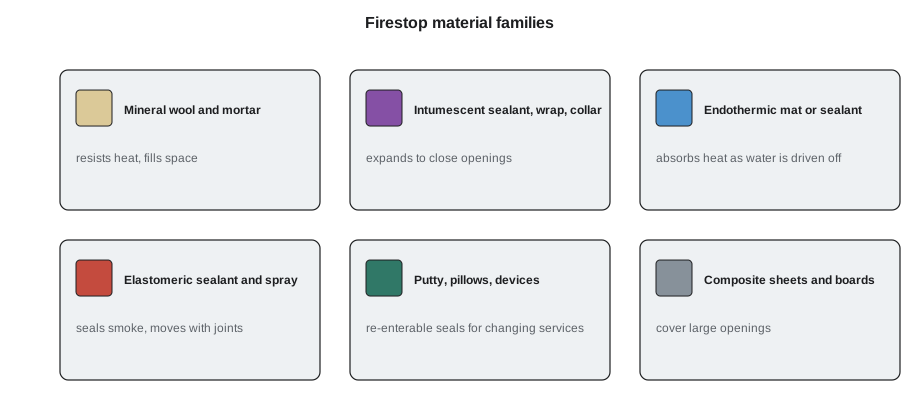
Every firestop system is built from a few families of materials, each of which does one or two jobs in a fire. This lesson describes them, what they do, how they fail, and how they are stored and handled on the job. The point is not to choose materials, which the listing does, but to understand why the listing asks for each one, so that the installer can tell when something is wrong.
How firestop materials work
Firestop materials work in four main ways, and many products combine more than one.
- Resisting heat. Noncombustible materials such as mineral wool, ceramic and mineral fibers and cementitious mortars do not burn and keep their shape at fire temperatures. They fill space and slow heat.
- Expanding. Intumescent materials swell when heated, often to many times their original volume, forming a firm char that fills gaps and closes openings left by melting plastic pipe or burning cable jackets.
- Absorbing heat. Endothermic materials contain chemically bound water that is driven off when heated, absorbing heat as it goes and cooling the item behind them. Some wraps and mats work this way.
- Sealing. Elastomeric materials, such as latex and silicone sealants and sprays, stay flexible, bond to surfaces and block smoke and air at normal and moderately raised temperatures, and they move with joints.
Sealants
Firestop sealants are the most common product on any job: thick pastes, applied from cartridges, sausages or pails, that cure into a solid or rubbery seal. They come in several types:
- Water-based (latex or acrylic) sealants. Easy to apply and clean up, paintable, and used for most metal pipe and many joint systems. Many are intumescent. They must not freeze in storage, and they shrink a little as they dry.
- Silicone sealants. Flexible over a wide range of temperatures, good for movement and for wet areas and outdoor use. Some are self-leveling and are poured into floor openings.
- Intumescent sealants. Sealants with an expanding ingredient, used for small plastic pipes, cable bundles and insulated pipes.
- Endothermic sealants. Less common, used where an item must be kept cool.
The listing names the exact sealant. Two sealants from the same maker may both be red, both come in the same cartridge, and both be called firestop sealant, but they are not interchangeable. Nor are sealants from different makers, even in a joint between two systems; a system is tested with one maker's products.
Wraps, collars and other intumescent devices
For plastic pipe and some insulated pipe, the intumescent material comes as a device rather than a paste.
- Wrap strips are soft, flexible strips of intumescent material, usually with a foil or film face, wrapped around a pipe or its insulation a set number of layers, held with tape or wire, and pushed into the opening a set distance. Sealant goes over or around them as the listing says.
- Collars are steel housings with an intumescent liner, sized for a pipe, wrapped around it on the fire side and fastened to the floor or wall with anchors. They are used where the opening is large or the pipe is big.
- Cast-in devices are sleeves with built-in intumescent rings, set on the deck or in the formwork before the concrete is poured, so that the pipe passes through a device that is already a firestop.
- Plugs and grommets are intumescent inserts for small openings or for re-enterable cable pathways.
Intumescent devices are sized to the pipe. A collar for a 4 in plastic pipe is not a collar for a 6 in one, and the number of wrap layers depends on the pipe size and material. Intumescent material starts to expand at moderate temperatures, typically somewhere around 350 to 400 °F depending on the product, so it is activated early in a fire, before the pipe has completely gone.
Worked problem
How many penetrations from one roll of wrap strip?
Four 4 in PVC condensate drains on Level 2 (outside diameter 4.5 in) need a wrap strip system. The listing calls for three layers of a 3/16 in thick strip, butted at each layer. The strip comes in 25 ft rolls. How long a strip does each pipe need, and how many pipes can one roll do?
Show solution
- Each layer wraps at its mean diameter: the first at 4.5 + 0.1875 = 4.6875 in, the second at 4.5 + 0.5625 = 5.0625 in, the third at 4.5 + 0.9375 = 5.4375 in.
- Lengths: π × 4.6875 = 14.73 in; π × 5.0625 = 15.90 in; π × 5.4375 = 17.08 in.
- Total per pipe = 14.73 + 15.90 + 17.08 = 47.71 in.
- Pipes per roll = 300 ÷ 47.71 = 6.29, so 6 pipes.
Answer: About 47¾ in per pipe; one roll does six, so one roll covers the four drains with some left over.
Mineral wool and other forming materials
Mineral wool, made from melted rock or slag spun into fibers, is the backbone of most packing, joint and perimeter systems. It is noncombustible, survives temperatures well above the standard fire curve's two-hour point, and when compressed it holds itself in place and holds up the sealant. Listings usually set its density, the mass per unit volume of the batt or board as made, and its compression, how much it is squashed when installed.
Not all fibrous insulation is mineral wool. Glass fiber softens and melts at much lower temperatures and is not a substitute for mineral wool packing unless the listing names it, which is rare. Ceramic fiber and other high-temperature fibers appear in some systems, and their dust is handled as INS-230 described. Backer rod, the foam rope used behind ordinary caulking, is not a firestop forming material unless the listing names it; most foam backer rod burns.
Mortars, boards and composite sheets
Large openings and openings with many items are often sealed with heavier materials:
- Firestop mortar. A lightweight cementitious mix poured or trowelled into the opening around the items. It is strong enough to walk on in floors, but it is rigid, so it cracks if items move, and it is hard to remove when services change. Floors may need forming boards underneath while it sets.
- Boards. Mineral fiber boards coated with an elastomeric or intumescent coating, cut to fit around items and sealed at the edges. They are lighter and easier to modify than mortar.
- Composite sheets. Steel sheets with an intumescent layer bonded on, cut to cover an opening and screwed to the floor or wall, with sealant around the items. Common for large mechanical openings.
Re-enterable products
Some openings will be changed many times: cable trays into data rooms, for example, where new cables are pulled every month. For these, re-enterable products let a trade add or remove items without destroying the firestop.
- Putty and putty pads: soft intumescent putty that can be shaped by hand, pressed around cables or onto the backs of electrical boxes. It can be pulled out and pressed back.
- Pillows or bags: intumescent pillows stacked tightly into an opening around cables or a tray.
- Firestop devices or pathways: manufactured sleeves with built-in intumescent seals, through which cables are pulled. Some are self-sealing at any fill.
Re-enterable does not mean temporary. A pillow pulled out to pass a new cable must be put back as listed, and the record updated. In hospitals, data and medical gas services change so often that the owner's maintenance staff need training in exactly this.
Sprays and coatings
Elastomeric sprays are thick coatings sprayed or brushed onto joint packing, perimeter safing and some penetrations. They are applied to a wet thickness given in the listing, and they shrink as they dry. Some coatings are used to coat mineral wool boards or cable bundles. Sprays need the right equipment, protection of nearby surfaces from overspray, and care with ventilation in enclosed spaces.
Compatibility and the plastics problem
Some firestop products can damage the items they seal. The best-known case is CPVC pipe, used for sprinklers and hot and cold water, which can crack when it comes into contact with certain chemicals, including some plasticizers and solvents found in sealants, wrap facings and even pipe lubricants. CPVC makers publish lists of products tested as compatible, and firestop makers state compatibility on their data sheets. Rhoda's rule for plastic pipe is to check compatibility as well as the listing.
Other compatibility issues include sealants that do not bond to certain plastics or coatings, and silicone overspray, which prevents paints and other sealants from sticking later. Where an insulated pipe passes through a firestop, the firestop products must be compatible with the jacket and vapor retarder of the insulation too.
Storage, shelf life and handling
Firestop products are chemicals, and they spoil if stored badly.
- Temperature. Water-based sealants and sprays are ruined by freezing. Most products also have a maximum storage temperature; a sealed truck in summer can exceed it. Coldstream keeps firestop stock in the heated part of the shop and moves it to site in a heated job box in cold weather.
- Shelf life. Each product has a shelf life from its date of manufacture, printed as a date or a batch code. Out-of-date products may not cure properly, and they are not the product that was tested.
- Installation conditions. Data sheets give the range of air and surface temperatures for installation, and the time needed to skin over and to cure before the seal can be disturbed, covered or inspected.
- Health and safety. Read the safety data sheet for each product. Some contain solvents, some release irritating vapor when cut or heated, and fiber products need dust control. Use gloves and eye protection, ventilate enclosed spaces and dispose of waste as the safety data sheet says.
Worked problem
Can this sealant still be used?
On October 13, 2026, Nico found a part case of sealant at the back of the job box. The cartridges were stamped with a manufacture date of August 2024, and the data sheet gives a shelf life of 24 months from manufacture when stored between 40 and 86 °F. Can he use it?
Show solution
- From August 2024 to August 2026 is 24 months, the end of the shelf life.
- October 2026 is two months later, so the cartridges are 26 months old.
- 26 months is more than 24, so they are out of date, whatever they look like inside.
Answer: No. The case went back to the shop to be disposed of, and Rhoda added a date check to the job box stock list.
Rhoda's crew stocks only what it will use in a few weeks, rotates the oldest stock to the front, and records batch numbers in the daily log. If a firestop is ever questioned, the batch can be traced.
Never mix systems
A tested system uses one maker's products, in one combination. Mixing products, such as one maker's collar with another maker's sealant around it, or packing a joint with mineral wool and capping it with a sealant that the listing does not name, produces an untested combination, even if each product is listed somewhere. It also makes the job impossible to inspect, because there is no listing to compare it with.
On a job with more than one firestop contractor, as Mountview was before November, the systems on adjacent floors may use different makers' products. That is acceptable as long as each penetration is one system. Where two contractors' work meets in one opening, the opening must be sealed with one system by one of them.
Common mistakes
MistakeUsing any firestop sealant that is the right color.
InsteadUse the exact product named in the listing.
MistakePacking with glass fiber or foam backer rod instead of mineral wool.
InsteadUse the forming material the listing names, usually mineral wool of a stated density.
MistakeLetting water-based sealant freeze in a cold truck or trailer.
InsteadStore and transport products within their temperature limits, and discard frozen material.
MistakeUsing sealant on CPVC pipe without checking compatibility.
InsteadCheck the pipe maker's compatibility list and the firestop maker's data sheet.
MistakeCombining one maker's collar with another maker's sealant.
InsteadBuild each firestop from one tested system's products.
Summary and key terms
- Firestop materials resist heat, expand, absorb heat or seal; many products combine these.
- Sealants are water-based, silicone, intumescent or endothermic; the listing names the exact product.
- Wraps, collars, cast-in devices and plugs carry intumescent material sized to the pipe; it activates early in a fire.
- Mineral wool of the listed density and compression is the forming material of most systems; glass fiber and foam backer rod are not substitutes.
- Mortars, boards and composite sheets seal large openings; putty, pillows and devices make re-enterable seals.
- Check compatibility, especially with CPVC; store products within temperature limits and shelf life, and follow the safety data sheet.
- Never mix products from different systems in one firestop.
- Intumescent material
- A material that swells to many times its volume when heated, forming a char that closes openings.
- Endothermic material
- A material that absorbs heat by releasing chemically bound water when heated.
- Elastomeric sealant
- A flexible sealant that bonds to surfaces, blocks smoke and moves with joints.
- Firestop mortar
- A lightweight cementitious material used to seal large openings.
- Composite sheet
- A steel sheet with a bonded intumescent layer, screwed over a large opening.
- Re-enterable product
- A firestop product, such as putty or pillows, that allows items to be added or removed and the seal restored.
- Shelf life
- The time from manufacture during which a product may be used, if stored as directed.
- Compatibility
- Whether a firestop product can be used against a material, such as CPVC pipe, without damaging it.
Practice problems
Work each problem on paper first, then reveal the answer to check.
What is the difference between an intumescent and an endothermic material?
Show answer
An intumescent material expands to fill space; an endothermic one absorbs heat by releasing bound water.
A wrap needs three layers of a 3/16 in strip on a 2.375 in pipe. What is the length of the first layer?
Show answer
π × (2.375 + 0.1875) = π × 2.5625 = 8.05 in.
Why is mortar a poor choice for an opening where cables will be added often?
Show answer
It is rigid and hard to remove; a re-enterable product is better.
A sealant made in March 2025 has an 18-month shelf life. When does it expire?
Show answer
September 2026.
Why should silicone overspray be kept off nearby surfaces?
Show answer
It prevents paints and other sealants from bonding later.
Lesson quiz · 5 questions
Score 60% or more to complete this lesson.
Create a free account to save your progress, take quizzes and earn a certificate.