
INS-330 · Lesson 5 of 12 · 23 min
Through-penetration firestops
▶ Video coming soon A video version of this lesson is on the way.
Rhoda's crew started on the Mountview Hospital addition on Monday, September 28, 2026, on Level 1, where Harcourt Mechanical had finished its piping and pressure tests under the Level 2 slab. The penetration list for the floor ran to four pages. Rhoda and Nico worked from the ceiling space on a rolling scaffold and from the floor above, sealing insulated heating and chilled water lines, copper domestic water, cast iron drains and a few plastic condensate lines. On Thursday, October 1, Priya Lam joined them for a day to set the anchors for the plastic pipe collars, as INS-230 described.
This lesson covers the work of installing through-penetration firestops: preparing the opening, installing sleeves, packing and sealants, and the special methods for metal pipe, plastic pipe, insulated pipe, ducts and groups of items. Every step is controlled by the listing for the system being installed, so the details below are typical; the listing always has the final word.
Before starting: the opening and the item
A good firestop starts with a good opening. Ideally, the trade that makes the hole cores it round, close to the size the listing assumes, and places the item near the center. In practice, firestoppers find holes that are too big, too small, ragged, or with the item jammed against one side. Each of these is checked against the listing's annular space limits before any material goes in.
- Too big. If the annular space is more than the listing allows, another listed system with a bigger allowance may fit. If none does, the hole must be reduced, for example by the concrete trade grouting it smaller, or an engineering judgment is needed. Firestoppers do not "fill it with more caulk".
- Too small. If the item, or its insulation, is jammed tight, the listing may allow point contact; if it requires a minimum space all round, the opening must be enlarged or the insulation detail changed.
- Ragged or cracked. Broken edges are cleaned back to sound concrete. Cracked or damaged gypsum board around a wall opening is repaired by the drywall trade before firestopping.
- Off-center. Usually fine if the listing allows point contact; measure both the closest and farthest points.
The surfaces must be clean and dry. Sealants do not bond to dust, form oil, frost, standing water or loose paint. Rhoda's crew vacuums out each core and wipes the pipe. Sealant also has temperature limits for installation, usually given on the data sheet as a range of air and surface temperatures; in an unheated building in late fall, the crew checks the slab temperature with an infrared thermometer before starting.
Coring and drilling concrete and masonry release crystalline silica. INS-230 described the controls Coldstream uses: water-fed core drills, or hammer drills with a dust shroud connected to a HEPA vacuum, and respirators where the task calls for them. On October 1 at Mountview, Priya drilled 16 anchor holes that way for the collars on four plastic drain lines, and when one core had to be enlarged, Harcourt did it with a water-fed core drill.
Sleeves
Many penetrations pass through a sleeve, a short length of pipe or sheet metal cast into the concrete or set into the wall, rather than a cored hole. Sleeves let the pipefitters set the position of the pipe before the concrete is poured. If a sleeve is used, it is part of the system: the listing must allow it, and it states the sleeve material, minimum gauge or schedule, and how far it may project above or below the surface.
Plastic sleeves, which are sometimes used as cheap forms to leave holes in concrete, are a common problem. Most listings that allow sleeves call for steel, and a plastic sleeve left in place melts in a fire. Where a plastic form has been left in, the crew asks whether it can be removed or whether a listing covers it.
Packing and sealant: the most common system
The most common through-penetration system, for metal pipe and for many insulated pipes in concrete floors, has two parts: a packing material that fills the depth of the opening, and a sealant that closes the top. The listing sets both.
- Packing. Usually mineral wool, cut into strips and pushed into the annular space to a set depth, such as 4 in, and compressed to a set amount, often stated as compressed to half its original thickness. Packing gives the system body, holds the sealant at the right depth and adds fire resistance. In floors it is usually recessed from the top surface by the thickness of the sealant.
- Sealant. A listed firestop sealant, applied over the packing to a set thickness, such as ½ in, and tooled so that it is pressed against the item and the edge of the opening all around, with no voids. Sealants are usually water-based or silicone, and some are intumescent, swelling when heated.
- Which side. Floors are usually sealed from the top only, because the fire is below; walls are often sealed on both sides. The listing says which.
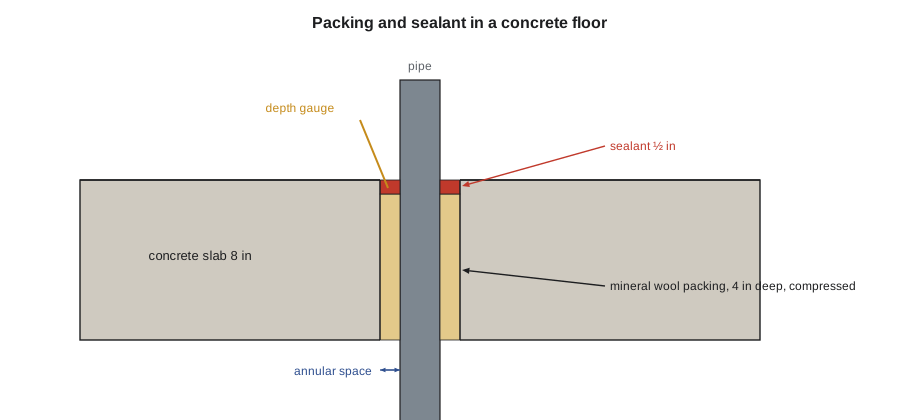
The sealant thickness is the dimension inspectors check most often. Rhoda's crew measures it during installation, by marking the depth of recess on a stick before packing, and afterwards with a thin wire depth gauge pushed through the wet sealant at several points. Too thin is a deficiency; much too thick wastes material and may not cure properly.
Worked problem
How much sealant for the Level 1 drain penetrations?
Level 1 has 24 penetrations of 4 in cast iron drain pipe (outside diameter about 4.5 in) through 6 in cores. The listing calls for ½ in of sealant over mineral wool packing. Allowing 10 in 100 extra for tooling and waste, how many 10.1 fl oz cartridges are needed? One fluid ounce is 1.805 in³.
Show solution
- Annular area = π ÷ 4 × (6² − 4.5²) = 0.7854 × (36 − 20.25) = 12.37 in².
- Sealant volume per penetration = 12.37 × 0.5 = 6.19 in³.
- With 10 in 100 extra: 6.19 × 1.10 = 6.80 in³.
- For 24 penetrations: 24 × 6.80 = 163.3 in³.
- One cartridge = 10.1 × 1.805 = 18.23 in³, so 163.3 ÷ 18.23 = 8.96, so 9 cartridges.
Answer: 9 cartridges; the crew took a case of 12 to cover any oversize cores.
Metal pipe and conduit
Steel, iron and copper pipe stay in place in a fire, so the firestop's job is to seal the annular space and, where a temperature rating is needed, to deal with the heat the metal carries through. Most metal pipe systems are packing and sealant, or sealant alone in small annular spaces. A few points matter:
- Pipe size and wall thickness. Larger, thinner-walled pipes and tubes, especially copper, are often limited to smaller sizes or have lower temperature ratings.
- Combustibles on the cool side. A hot pipe can char wood blocking or ignite insulation that is not part of the system just above the floor. The listing's temperature rating, and sometimes a wrap of mineral wool or the pipe covering itself, deals with this.
- Movement. Pipes expand and contract. Sealants that stay flexible cope with small movements; if the pipe moves a lot, as on a steam riser, the pipefitters' guides and anchors must hold it, and the firestop must not be used as a support.
Plastic pipe
Plastic pipe is the hardest common penetrant, because in a fire it softens, collapses and burns away, leaving an open hole. Systems for plastic pipe use intumescent materials, which expand many times their volume when heated and fill the space the pipe leaves.
- Collars. A steel housing lined with intumescent material, wrapped around the pipe on the fire side (the underside of a floor or both sides of a wall) and fastened to the assembly with anchors. When the pipe softens, the intumescent expands inward and crushes it closed.
- Wraps. Strips of intumescent material wrapped around the pipe a set number of layers and set into the opening, sometimes with a steel retaining collar, then sealed.
- Intumescent sealants. For small plastic pipes, an intumescent sealant applied to a set depth may be enough.
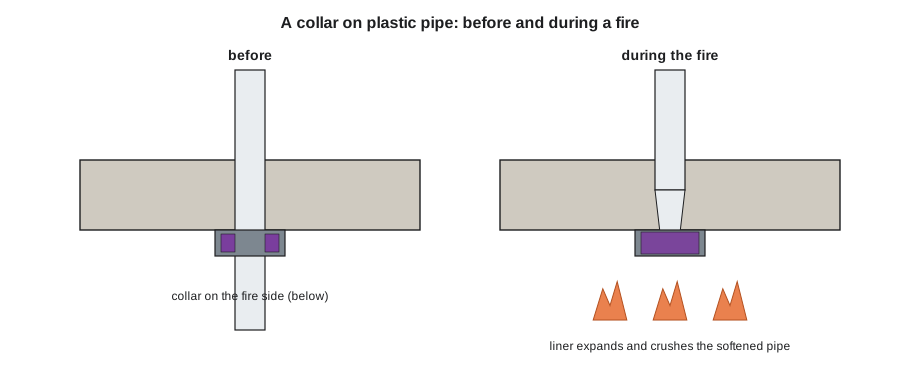
The pipe material, size and whether the piping system is open (vented, like drains) or closed (pressure piping) are critical, because an open pipe lets fire gases and air up the inside of the pipe. A collar listed for 4-inch PVC drain is not good for 4-inch ABS, or for 6-inch PVC. Collars must be fastened with the anchors and spacing the listing gives; a missing anchor lets the collar sag away from the slab in a fire.
Some US plastic pipe listings are limited to closed piping, some to particular wall types, and some to sizes well below what the drawings show. Rhoda's submittal for Mountview lists, for every plastic pipe system, the pipe materials, sizes and open or closed condition it covers.
Insulated pipe
Insulated pipe is Coldstream's own territory, and it is where an insulator's knowledge of both trades pays off. The insulation either passes through the firestop as part of the system, or it is stopped short of the opening and the bare pipe is firestopped, depending on what the listing allows.
- Continuous insulation. Many systems for glass fiber or mineral fiber pipe covering let the covering pass through the opening, with packing and sealant around the outside of the jacket. The covering type, density and thickness must be as listed, and the jacket must be intact.
- Foam plastic and elastomeric insulation. These melt or burn, so they are usually allowed only with an intumescent wrap around the insulation in the opening, or only up to a set thickness, or not at all. Some systems require the foam to stop short and be replaced through the opening with a listed mineral fiber section.
- Cold pipe. On chilled water and other cold lines, the firestop must not break the vapor retarder. Where the insulation is continuous, its jacket and vapor retarder run through the opening; where the listing requires a change of material at the opening, the crew seals vapor stops on each side so that the cold line does not condense inside the firestop. INS-320 explained why a break in the vapor retarder spreads.
- Hot pipe. On steam and high-temperature lines, the firestop materials must suit the surface temperature, which may be above the sealant's service limit. Mineral wool packing with a listed high-temperature sealant, or a sleeve detail, may be needed.
Coordination with the insulation crew matters. At Mountview, Rhoda gave Bernie Valois's crew a short list before they started on Level 2: insulate through the slab only where the submittal shows continuous covering, leave the covering short by a set distance where it shows a break, and never stuff off-cuts of foam into a core to "tidy it up".
Ducts and large openings
Ducts through rated walls usually have fire dampers, which are protected by the damper's own installation, as lesson 2 explained. Where a duct passes through a rated assembly without a damper, which codes allow in some cases, a tested duct system is used, typically steel retaining angles around the duct on both sides of the wall, mineral wool packing and sealant, with limits on the duct gauge and size.
Large openings with many items, such as a slot in a shaft floor with a dozen pipes and cables, are sealed with systems for groups of items: mortar, composite sheets of steel and intumescent material screwed over the opening, or boards and spray. These are complex and their listings strict about spacing between items. Rhoda's advice: spread the items into separate cores when the opening is planned, because a large mixed opening is expensive to seal and hard to inspect.
Walls compared with floors
Framed walls need extra care. The firestop must be tested in a wall of the same design: the same stud type, the same number and type of gypsum board layers on each side. The sealant usually goes into the full depth of the board layers on both sides of the wall, and the cavity between may be left empty or packed as the listing says. The opening is cut in the board, not torn, and the board around it must be screwed to framing or backed as the wall design requires.
Concrete and masonry walls are similar to floors, but are often sealed on both sides because fire could come from either side. Block walls with hollow cores need the cores around the opening filled or the listing must cover hollow units.
Labels and records as you go
Each finished firestop gets a label next to it, on the wall or on the underside or top of the slab where it will be seen: the system number, the product, the installer's company and the date, and often a space for the inspector. The crew also logs the location, the item, the system and a photo in the job record, and the penetration list is ticked off. Lesson 10 covers labeling and records in detail.
At the end of the first week on Level 1, Rhoda and Nico had sealed 118 of the 131 penetrations on the list. Of the rest, nine were waiting for Harcourt to finish moving pipes, two needed an engineering judgment for oversize cores, and two turned out to be on a line that the life safety plan showed as unrated: Rhoda asked in writing before leaving them.
Common mistakes
MistakeFilling an oversize opening with extra sealant.
InsteadUse a listed system that allows the larger annular space, have the opening reduced, or get an engineering judgment.
MistakeApplying sealant to a dusty, wet or frosted surface.
InsteadClean and dry the opening and check the temperature limits on the data sheet.
MistakeInstalling a plastic pipe collar without all the listed anchors.
InsteadFasten every collar with the anchors, sizes and spacing the listing gives.
MistakeLetting foam insulation pass through an opening the listing does not allow it through.
InsteadFollow the listing for the insulation at the opening, with wraps, breaks or changes of material as shown.
MistakeBreaking the vapor retarder on a cold line at the firestop.
InsteadKeep the vapor retarder continuous, or seal vapor stops on both sides of the opening.
Summary and key terms
- Check the opening and the item against the listing's annular space limits before starting; holes that are too big need a different system, repair or an engineering judgment.
- Surfaces must be clean, dry and within the sealant's temperature limits; drilling and coring need silica controls.
- Sleeves are part of the system; most listings require steel sleeves with set projections.
- Packing and sealant systems fill the opening with compressed mineral wool to a set depth and cap it with sealant of a set thickness, checked with a depth gauge.
- Plastic pipe needs intumescent collars, wraps or sealants matched to the pipe material, size and open or closed condition.
- Insulated pipe needs the covering type and thickness listed; foam insulations need special treatment, and cold lines must keep their vapor retarder.
- Ducts without dampers and large mixed openings need their own systems; framed walls need systems tested in the same wall design.
- Sleeve
- A short length of pipe or sheet metal set into a floor or wall through which a penetrating item passes.
- Packing material
- Material, such as compressed mineral wool, that fills the depth of an opening under the sealant.
- Sealant
- A listed firestop material applied to a set thickness to close an opening.
- Intumescent
- Describes a material that expands many times its volume when heated.
- Collar
- A steel housing lined with intumescent material, fastened around a plastic pipe at a rated assembly.
- Wrap strip
- A strip of intumescent material wrapped around a pipe or its insulation in a firestop system.
- Open piping
- A piping system, such as a vented drain, that is open to the air inside the pipe.
- Depth gauge
- A thin probe used to measure the thickness of installed sealant.
Practice problems
Work each problem on paper first, then reveal the answer to check.
A listing calls for 4 in of packing and ½ in of sealant in an 8 in slab. How far is the packing recessed from the top?
Show answer
½ in, the thickness of the sealant.
An NPS 2 steel pipe (2.375 in) is in a 4 in core. What sealant volume is needed for ½ in?
Show answer
π ÷ 4 × (4² − 2.375²) × 0.5 = 8.14 × 0.5 = 4.07 in³.
Why must a collar be on the underside of a floor?
Show answer
The fire comes from below, and the collar must close the opening as the pipe softens on the fire side.
What two things about a plastic pipe besides its size must match the listing?
Show answer
Its material and whether the piping system is open or closed.
Why must the vapor retarder stay continuous through a firestop on a chilled water line?
Show answer
A break lets moisture in, and it condenses inside the insulation and spreads along the pipe.
Lesson quiz · 5 questions
Score 60% or more to complete this lesson.
Create a free account to save your progress, take quizzes and earn a certificate.