
INS-330 · Lesson 3 of 12 · 24 min
Firestop testing: ASTM E814 and UL 1479
▶ Video coming soon A video version of this lesson is on the way.
The second Saturday session, on October 3, 2026, started with a video. On the training room screen, a furnace door the size of a garage door swung shut against a slab of concrete with a dozen pipes and cables passing through it, and a technician's voice counted down. Flames roared inside the furnace. On the cool side, the camera watched the firestops: the sealant around a copper pipe darkened, a red intumescent collar on a plastic pipe swelled and squeezed shut, and after an hour a man in a heavy coat walked up with a fire hose and blasted the hot slab with water. "Everything we install has been through that," Rhoda said. "If we change it, it hasn't."
This lesson explains how firestops are tested in the US under ASTM E814 and UL 1479, the two closely matching standards for fire tests of penetration firestop systems, and what the ratings in a listing mean. It also introduces the related standards for joints. Firestoppers who work in Canada meet a different standard, CAN/ULC-S115, with different rating letters; the lesson notes where they differ.
Why a standard test
A fire test is not a copy of a real fire. Real fires vary endlessly in fuel, ventilation and size. A standard fire test exposes every sample to the same conditions so that results can be compared: if two firestops are tested the same way and one lasts two hours and the other one hour, the first is better under those conditions. The building codes then use the standard test results as the measure of what is acceptable.
Standard tests work only if the test is repeatable and the thing tested is the thing built. That is why the details of the test matter to an installer. Every choice the test makes, the size of the opening, the depth of the sealant, the type of insulation on the pipe, whether the pipe end is open or capped, becomes a condition of the listing.
The furnace and the time-temperature curve
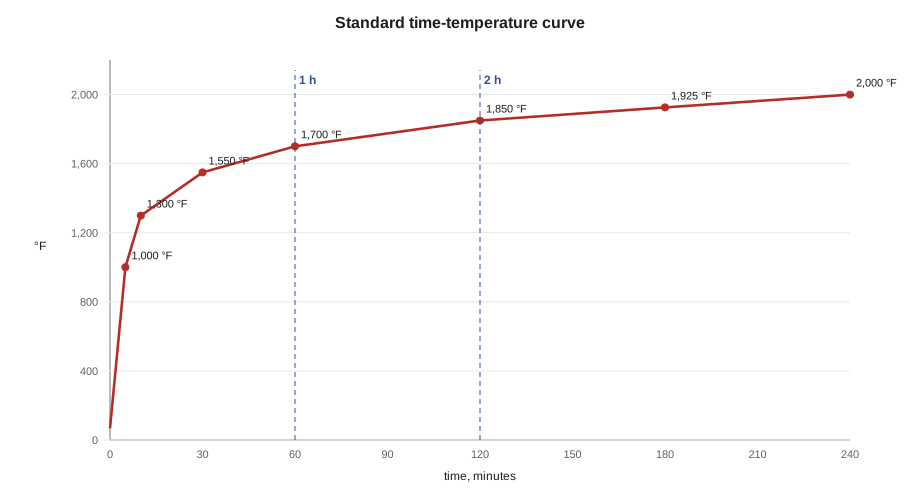
Firestop tests use the same furnace and the same standard time-temperature curve as the tests for walls and floors (ASTM E119 and UL 263). The sample, a section of floor or wall with the penetrations installed in it, is mounted on the furnace so that one face is exposed to the fire. Burners inside the furnace are controlled so that the average furnace temperature follows the curve: it climbs steeply in the first minutes and then more slowly for as long as the test runs.
| Time into the test | Furnace temperature on the standard curve |
|---|---|
| 5 minutes | 1,000 °F |
| 10 minutes | 1,300 °F |
| 30 minutes | 1,550 °F |
| 1 hour | 1,700 °F |
| 2 hours | 1,850 °F |
| 3 hours | 1,925 °F |
| 4 hours | 2,000 °F |
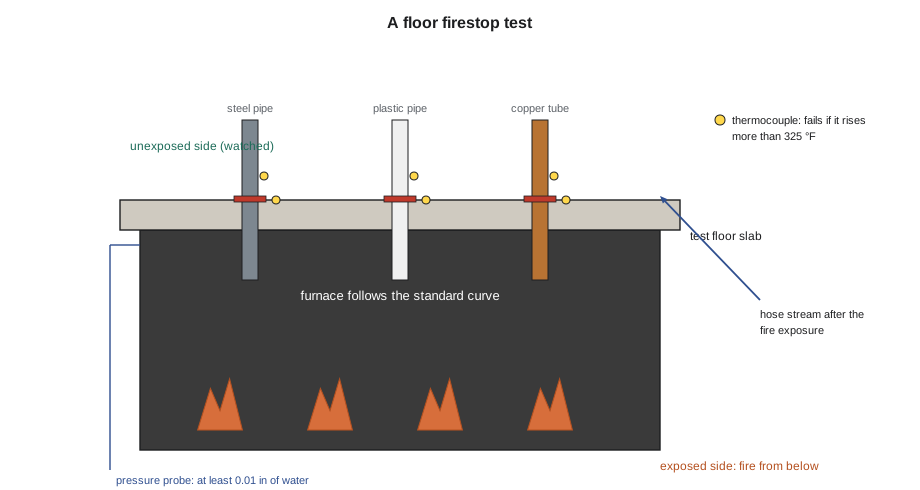
Floors are tested with fire from below, because a fire in the room under a floor attacks it from beneath. Walls are tested from one side; if a wall firestop is not the same on both sides, it is tested from each side, or from the weaker side, and the listing says which. The furnace is run at a slight positive pressure, pushing hot gas outward against the sample, so that any weakness shows up as flame or hot gas coming through.
The IBC requires penetration firestops to be tested with a positive pressure difference of at least 0.01 in of water (about 2.5 Pa) between the furnace and the cool side. Canadian requirements for some items, such as combustible piping, call for testing at a much higher 50 Pa (0.20 in of water). Products sold in both countries are often tested at both pressures, and a listing will say which.
What is measured
During the test, the laboratory watches and measures the unexposed side, the cool side away from the fire, for the three things that would let a fire spread:
- Flame passage. Any flame, or any hot gas that ignites a cotton pad held near a crack, on the unexposed side counts as failure.
- Temperature rise. Thermocouples, small temperature sensors, are fastened to the unexposed face of the firestop and to each penetrating item a short distance from the firestop. If any of them rises more than 325 °F above its starting temperature, the sample fails the temperature criterion. That limit is roughly where wood, paper and other common materials touching the item could start to char or ignite.
- Integrity under water. Right after the fire exposure, the hot sample is hit with a standard hose stream, as a firefighter's hose would hit it. Water must not pass through the firestop. The hose stream checks that the firestop has not turned to brittle ash that would fall out.
Penetrating items usually fail the temperature criterion before anything else, because metal pipe carries heat straight through. A small copper tube can easily pass 325 °F on the cool side long before the sealant around it lets any flame through. That is why many listings give a long flame rating and a much shorter temperature rating, and why insulation on the pipe often lengthens the temperature rating.
The ratings
ASTM E814 and UL 1479 give a listing up to four ratings, each in hours:
- F rating: the time the firestop prevents flame passage, with no flaming on the unexposed side, and it must also pass the hose stream test.
- T rating: the time the firestop meets the F criteria and also keeps the temperature rise on the unexposed side, including on the penetrating item, within 325 °F.
- L rating: an optional rating for air leakage through the firestop, in cfm per square foot of opening, measured at room temperature and at 400 °F. Smoke barriers need it.
- W rating: an optional rating for water leakage, which shows the firestop resists a column of standing water, as on a floor that may be flooded.
The IBC asks for the F rating in rated walls, F and T in rated floors, and L in smoke barriers. In the US system the hose stream is built into both the F and the T rating, so there is no separate H letter.
A listing states each rating separately and often gives different ratings for different conditions in the same system, such as a longer rating for smaller pipes, or a T rating that depends on the pipe size and material.
| Canada: CAN/ULC-S115 | US: ASTM E814 / UL 1479 | |
|---|---|---|
| Flame | F rating | F rating (includes hose stream) |
| Flame and temperature | FT rating | T rating (includes hose stream) |
| Hose stream | FH and FTH ratings | Part of F and T |
| Air leakage | L rating (optional) | L rating (UL 1479, optional; required in smoke barriers) |
| Water leakage | Not a standard S115 rating | W rating (UL 1479, optional) |
| Minimum furnace pressure | 2.5 Pa; 50 Pa where required | 0.01 in of water (about 2.5 Pa) |
Worked problem
Reading the temperature results
In a test of a copper pipe firestop, the thermocouple on the pipe 1 in above the slab started at 68 °F. The laboratory logged 330 °F at 60 minutes, 386 °F at 90 minutes and 405 °F at 95 minutes, when that thermocouple passed the limit. No flame came through until well after 2 hours, and the hose stream was passed. What are the temperature limit, the T rating and the F rating, if ratings are stated in half-hour steps?
Show solution
- Limit = starting temperature + 325 = 68 + 325 = 393 °F.
- 386 °F at 90 minutes is under the limit; 405 °F at 95 minutes is over it, so the temperature criterion was met for 90 minutes but not 95.
- In half-hour steps, the T rating is 1½ hours.
- Flame was stopped for more than 2 hours and the hose stream was passed, so the F rating is 2 hours.
Answer: Limit 393 °F; T 1½ hours; F 2 hours. The pipe, not the sealant, set the temperature rating.
Air and smoke leakage
Fire ratings measure what happens in a fire. Smoke is a separate problem, and it moves through gaps at temperatures far below what a fire test measures. The air leakage test puts the installed firestop in a chamber and measures how much air flows through it at a set pressure, first at room temperature and then at 400 °F, which represents the warm smoke that reaches a barrier early in a fire. The result is the L rating.
For penetrations, L ratings are given in cfm per square foot of opening; for joints, in cfm per linear foot. A lower number is better. The IBC limits penetrations in smoke barriers to an L rating of no more than 5.0 cfm per square foot of opening, measured at 0.30 in of water both at room temperature and hot, or a total leakage limit per 100 square feet of wall. Products with good L ratings are elastomeric sealants and sprays that stay flexible and bond to the penetrating item; dry mineral wool by itself leaks badly.
Worked problem
Converting the test pressures
A Canadian product sheet quotes a test at 50 Pa for plastic pipe. One inch of water is about 249 Pa. How does 50 Pa compare with the IBC minimum test pressure of 0.01 in of water?
Show solution
- 50 Pa ÷ 249 Pa per inch = 0.20 in of water.
- 0.01 in of water × 249 = 2.49 Pa.
- 0.20 ÷ 0.01 = 20, so the 50 Pa test pushes about twenty times as hard on the firestop.
Answer: 50 Pa is 0.20 in of water, twenty times the IBC minimum.
Joints and perimeters are tested differently
Linear joints, such as the gap at the top of a wall or between two floor slabs, are tested to ASTM E1966 or UL 2079, which add movement cycling before the fire test for joints that must move. The gap at the edge of a floor slab against a curtain wall, the perimeter, is tested to ASTM E2307, which uses a two-story test rig so that fire can attack the joint from the floor below and up the face of the curtain wall. Lesson 6 covers joints in detail.
From test to listing
A test by itself is a report on one sample on one day. Before a system can be used on a job, it is usually listed by a certification organization, such as UL Solutions, Intertek or another accredited laboratory. A listing means three things:
- The system passed the standard test with the ratings shown.
- The products are made the same way as those tested. The certifier inspects the factories and the products carry the certifier's mark.
- The installation is published. The listing describes every element of the tested system: the assembly, the opening, the penetrating items, the materials, their amounts and how they are installed, often with a drawing.
Listings for the US show the ASTM E814 or UL 1479 ratings. A system evaluated only to Canadian requirements uses different rating letters and must be checked against US requirements before use.
Lesson 4 shows how to read a listing.
When no tested system fits: engineering judgments
On real jobs, conditions appear that no tested system covers exactly: a pipe slightly bigger than any tested, an annular space too large, an unusual mix of items in one opening. The proper answer is not to improvise. The firestopper documents the condition and asks the firestop manufacturer for an engineering judgment, often called an EJ: a written, drawn recommendation by the manufacturer's technical staff, based on the results of similar tests, of how to seal that condition and what rating it can be expected to achieve.
An engineering judgment is not a listing. It is valid only for the job and the condition it was written for, and it must be accepted by the authority having jurisdiction, usually the building official, and often the designer. Industry guidelines, such as those published by the International Firestop Council, set out what a proper engineering judgment should contain: the actual project and condition, a drawing, the tested systems it is based on, the ratings expected, and the name of the person responsible. Coldstream keeps every EJ with the firestop records for the job.
Engineering judgments are a last resort. Rhoda's view is blunt: "The cheapest EJ is the one you don't need. Get Harcourt to core the right size hole and you can use a listed system."
What testing does not tell you
A listing is powerful, but it has limits that every installer should understand.
- It describes new work. The test sample was installed carefully by the manufacturer's technicians and tested soon after. Damage, dirt, missing material and changes made later are not covered.
- It covers only what was tested. Different pipe material, larger size, a different insulation, a thinner wall or floor, or a different product all take the installation outside the listing.
- It does not test every hazard. Most tests do not cover long-term building movement for penetrations, chemical exposure, vibration or repeated maintenance.
- The ratings are relative. A 2-hour rating does not mean the firestop will last exactly two hours in a real fire; it means it met the standard test for two hours.
These limits are why installation exactly as listed, inspection, labeling and maintenance matter as much as the test itself.
Common mistakes
MistakeReading a T rating as if it were an F rating, or the reverse.
InsteadRead each rating letter and check it against what the code and specification require.
MistakeAssuming a Canadian evaluation meets US requirements.
InsteadCheck that the listing was evaluated to the standard your jurisdiction requires.
MistakeTreating an engineering judgment like a listing for other jobs.
InsteadUse an EJ only for the job and condition it was written for, after it is accepted.
MistakeUsing dry mineral wool alone where smoke leakage matters.
InsteadUse the listed sealant or spray that gives the required air leakage rating.
MistakeChanging a tested detail because it seems equivalent.
InsteadInstall the system exactly as listed, or get an engineering judgment for the change.
Summary and key terms
- Firestops in the US are tested to ASTM E814 or UL 1479 on a furnace that follows the standard time-temperature curve, at a positive pressure of at least 0.01 in of water.
- The test watches the unexposed side for flame passage and for a temperature rise of more than 325 °F, then applies a hose stream.
- Listings carry F and T ratings, which include the hose stream, and may carry L and W ratings.
- Penetrating items, especially metal pipe, often limit the temperature rating; insulation can lengthen it.
- Joints and perimeters have their own test methods with movement cycling and, for perimeters, a two-story rig.
- A listing confirms the test, the product's manufacture and the installation details; an engineering judgment is a last resort for one condition on one job.
- Standard time-temperature curve
- The furnace temperature schedule used in fire-resistance and firestop tests.
- Unexposed side
- The side of a test sample away from the fire, where failures are watched for.
- F rating
- The time a firestop prevents flame passage and passes the hose stream test.
- T rating
- The time a firestop meets the F criteria and keeps the unexposed-side temperature rise within 325 °F.
- L rating
- The measured air leakage through a firestop, at room temperature and at 400 °F.
- W rating
- An optional rating showing a firestop resists water leakage under a standing head of water.
- Engineering judgment
- A manufacturer's written recommendation for a condition no tested system covers, valid only for that job once accepted.
- Listing
- A certifier's publication of a tested system and its ratings, backed by factory inspection of the products.
Practice problems
Work each problem on paper first, then reveal the answer to check.
Which side of a floor is exposed to the fire in a firestop test?
Show answer
The underside, because a fire in the room below attacks the floor from beneath.
A thermocouple starts at 72 °F. At what reading does it fail the temperature criterion?
Show answer
72 + 325 = 397 °F.
Is the hose stream part of the F rating under ASTM E814?
Show answer
Yes; the F and T ratings both include passing the hose stream test.
Why can a copper pipe have an F rating of 2 hours but a T rating of only 1 hour?
Show answer
The metal carries heat through the assembly and the pipe gets too hot on the cool side long before flame passes.
When may an engineering judgment be used?
Show answer
Only for the specific job and condition it was written for, after the authority having jurisdiction accepts it.
Lesson quiz · 5 questions
Score 60% or more to complete this lesson.
Create a free account to save your progress, take quizzes and earn a certificate.