
INS-320 · Lesson 9 of 12 · 25 min
Contraction joints and expansion
▶ Video coming soon A video version of this lesson is on the way.
On the arena job in July, Tessa had asked Marcel why he made her leave a gap in each layer of cellular glass near the elbows on the ammonia suction line, then stuff the gap with strips of mineral wool. "The pipe's going to get shorter," he had said, "and the insulation isn't going to get shorter by the same amount. If we don't decide where the difference goes, the line will decide for us, and it will pick the worst place." At the end of the October 26 session, he brought a straight 2 m length of NPS 2 copper tube, laid a steel rule along it and packed the tube with crushed ice and salt from the shop freezer. Within a few minutes the tube's end had crept back from the mark on the rule by more than a millimeter. "That's two meters of copper and forty degrees," he said. "Now picture thirty meters of steel at minus thirty-four."
Earlier lessons mentioned that cold materials shrink. This lesson explains how much pipes and insulation move as they cool and warm, why the difference between them opens joints and tears vapor retarders, and how insulators use contraction joints, flexible vapor retarders and careful details at elbows, supports and terminations to let the system move without breaking.
Everything moves with temperature
Almost every material gets longer as it warms and shorter as it cools. The amount is given by its coefficient of thermal expansion, often written with the Greek letter α (alpha): the change in length per unit length for each degree of temperature change. The change in length of a straight piece is:
where L is the length, α the coefficient and ΔT the temperature change. Coefficients are very small numbers, so they are usually given in millionths per degree.
| Material | Typical coefficient near room temperature | Comment |
|---|---|---|
| Carbon steel pipe | About 6.5 millionths per °F | Most refrigeration and brine piping |
| Stainless steel (300 series) | About 9 to 9.5 millionths per °F | Cryogenic and food plant piping |
| Copper | About 9.4 millionths per °F | Refrigerant lines in buildings |
| Aluminum jacket | About 13 millionths per °F | Jackets move with the air around them |
| Cellular glass | About 5 millionths per °F | Close to, and a little less than, steel |
| Rigid foam plastics (PIR, PUR) | Often 28 to 39 millionths per °F | Several times steel |
| PVC jacket | About 33 millionths per °F | Large movement outdoors |
Two things follow from the table. First, steel pipe moves a lot over a long run, even though the coefficient is small. Second, the insulation does not move by the same amount as the pipe. A foam insulation shrinks several times as much as steel for the same temperature drop; cellular glass shrinks a little less than steel. The outer layers of any insulation system also stay much warmer than the pipe, so they move less than the inner layers. That difference between pipe, inner layers and outer layers is what has to be managed.
How much does the pipe move?
Worked problem
Contraction of a suction line
A 100 ft straight run of carbon steel ammonia suction line is installed at 68 °F and runs at −30 °F. How much shorter does it become, and how much of that occurs in each 30 ft section?
Show solution
- ΔT = 68 − (−30) = 98 °F.
- ΔL = 1,200 in × 0.0000065 × 98 = 0.764 in, about 3/4 in.
- Per 30 ft section: 360 × 0.0000065 × 98 = 0.229 in, a little under 1/4 in.
Answer: About 3/4 in over 100 ft, or a little under 1/4 in in each 30 ft.
Pipefitters and engineers design the piping to take this movement with loops, offsets, anchors that hold the pipe at fixed points and guides that let it slide in a straight line between them. The insulator does not design that, but must know where the anchors and guides are and which way the pipe will move, because the insulation has to move with it, or let it move inside, at every support.
Worked problem
Contraction of a cryogenic line
A 65 ft stainless steel liquid nitrogen line is installed at room temperature and runs at −320 °F. Over that large range, stainless steel of this type shrinks by a total of about 0.28 in 100 of its length. How much shorter does the line get?
Show solution
- Length = 65 × 12 = 780 in.
- ΔL = 780 × 0.28 ÷ 100 = 2.18 in.
Answer: About 2 3/16 in, roughly three times the movement of the much longer suction line above.
The total-contraction figure is a typical published value for 300-series stainless steel between room temperature and liquid nitrogen temperature; at cryogenic temperatures the coefficient changes with temperature, so totals over the range are used instead of a single coefficient.
Why the difference matters
If the insulation simply rode on the pipe and moved with it, there would be no problem. But insulation is not rubber; rigid sections are fixed to each other by sealant, bonded to the pipe at vapor stops and held at supports, and each layer runs at a different temperature. When a cold system cools down, several things can happen:
- Foam inner layers shrink more than the pipe and pull apart at their butt joints, opening gaps through the insulation.
- The pipe shrinks inside cellular glass, which moves a little less, and drags on the inner layer at vapor stops and supports, shearing bonds or cracking sections.
- Outer layers barely move, because they stay near room temperature, so inner and outer layers slide against each other and against the vapor retarder.
- Vapor retarders tear where they bridge a joint that opens, and jackets buckle or open at laps where they meet a fixed point.
- On warm-up the process reverses. Shutdowns, defrost and cleaning warm the line; gaps that opened when cold close again, and anything that filled them, including ice, is crushed or pushes the insulation apart.
Worked problem
Differential movement of a foam inner layer
A cold line has three layers of PIR. Over a 30 ft section, the steel pipe shrinks 0.229 in (from 68 °F to −30 °F). The inner layer of insulation averages about −13 °F in service, a drop of 81 °F from installation, and has a coefficient of about 33 millionths per °F. How much does the inner layer shrink, and what gap would open if it were held rigidly at both ends of the section?
Show solution
- Inner layer shrinkage = 360 × 0.000033 × 81 = 0.96 in.
- Difference from the pipe = 0.96 − 0.229 = 0.73 in.
Answer: The inner layer shrinks almost 1 in, so a gap of nearly 3/4 in would open unless the system has contraction joints to take it.
That gap, open from the pipe to the next layer, is a highway for cold to reach the outer layers and for any moisture to reach the pipe. Spread across many small butt joints it may do little harm; concentrated at one place, such as next to a vapor stop or a support, it splits the system. Contraction joints decide where it goes.
Contraction joints
A contraction joint is a planned gap in an insulation layer, filled with a compressible packing, that lets the layer shrink and grow without opening uncontrolled cracks elsewhere. On cold systems they are built like this, though the specification governs the details:
- A gap in each layer. A gap, commonly about 1 in wide, is left between two sections in each layer at the joint location.
- Staggered between layers. The joints in different layers are offset along the pipe, so no gap runs straight through the system.
- Packed with compressible material. Each gap is packed with strips of glass fiber or mineral wool, or flexible foam, compressed when installed so that it expands to keep the gap filled as the layers shrink in service. Joint sealant is kept out of the packing, or the joint cannot move.
- Covered by a flexible vapor retarder. Over the outer layer's joint, the vapor retarder must stretch and fold without tearing: a fold or loop of flexible membrane, a band of flexible vapor retarder mastic with fabric laid with slack, or a sealed sleeve, as the system maker specifies.
- A slip joint in the jacket. The jacket over a contraction joint is lapped with a slip joint, sealed as the specification requires, so it can move without opening or buckling.
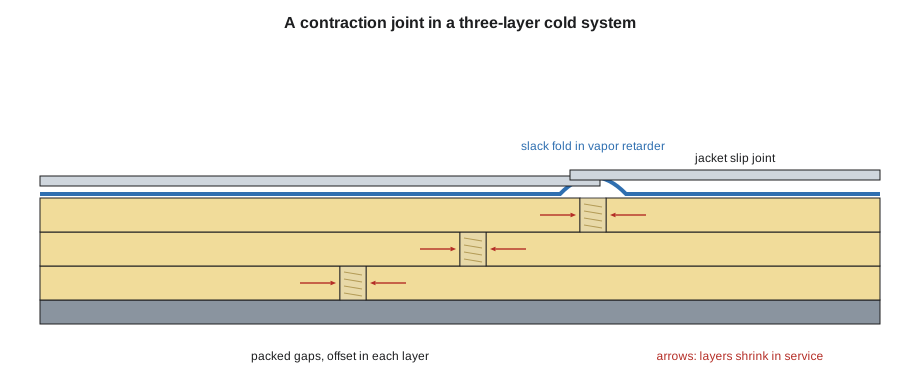
Where joints go is set by the specification and the system maker. Typical locations are:
- On long straight runs, at regular intervals, often in the range of about 20 to 30 ft on low-temperature and cryogenic systems.
- Near elbows and other changes of direction, where pipe movement is greatest and the elbow insulation would otherwise be pushed or pulled.
- Next to fixed points such as anchors, vessel nozzles and valves, where the insulation cannot move with the pipe.
- Never directly at a support, where the insert must stay whole, and never inside a vapor stop.
Systems with smaller temperature differences need fewer joints. On chilled water at 44 °F, many specifications call for none, because the movement is small and spread over many butt joints. On brine at 16 °F in cellular glass, which moves almost with the steel, the arena specification called for joints near each elbow and at about 30 ft on the long headers. On low-temperature foam systems and all cryogenic systems, they are essential.
Elbows, tees and fittings
Pipe movement at an elbow is not straight; as the two legs shrink, the elbow swings. Insulation fitted tightly around an elbow and bonded to the straight runs on both sides is pushed and twisted, and the vapor retarder at the elbow cracks. Good practice includes:
- Contraction joints in the straight insulation near each side of the elbow, so the elbow's insulation can move as a unit.
- Fitting covers built from mitered segments of the same material as the pipe insulation, with staggered joints in multi-layer work.
- A flexible vapor retarder, such as reinforced mastic with flexible fabric, over the whole fitting, carried well onto the pipe insulation on both sides.
- Clearance from walls, steel and other pipes, so the elbow can swing without its insulation being crushed.
Supports, anchors and vapor stops
At guides and sliding supports, the pipe moves past the support. Normally the load-bearing insert and its shield are fixed to the pipe and move with it, sliding on the support, so the shield must be long enough to stay on the support over the full movement and the support must let it slide. At anchors, the pipe does not move, and the insulation near an anchor is a natural place for a contraction joint. Lesson 10 covers supports in detail.
Vapor stops bond the insulation to the pipe. In service, the pipe pulls the inner layer at each stop as it shrinks. A vapor stop must therefore be built with a bond and sealant that can take that movement, and contraction joints are kept near, but not in, vapor stops, so the stop is not torn by the layer pulling away from it.
Installing at the right temperature
Contraction joints are designed on the assumption that the system is installed warm and then cooled. If insulation is installed on a line that is already cold, as when working on a live line, the joints will see the opposite movement the first time the line is warmed: the pipe will grow and the insulation layers, cold when fitted, will expand, closing the gaps. Packing in that case must be installed with room to compress, and the foreperson should check the specification or ask the engineer how joints are to be set on live work. Marcel's rule was to write the pipe temperature on the job record for every section installed on a live line, so that anyone looking at the system later would know how it had been set.
Common mistakes
MistakeBonding every layer of a long cold run solidly from end to end.
InsteadInstall contraction joints at the specified intervals, near elbows and next to fixed points.
MistakeLining up the contraction joints in all three layers.
InsteadStagger them so no gap runs straight through the system.
MistakeFilling a contraction joint with sealant.
InsteadPack it with compressible material; keep sealant out so the joint can move.
MistakeCovering a contraction joint with a tight vapor retarder and a fixed jacket lap.
InsteadUse a flexible retarder with slack and a slip joint in the jacket.
MistakePutting a contraction joint at a support or inside a vapor stop.
InsteadKeep joints near, but not at, supports and vapor stops.
Summary and key terms
- Materials change length by length × coefficient × temperature change.
- Long steel lines move many millimeters when cooled; cryogenic stainless lines move several times more.
- Foam insulation shrinks several times as much as steel; cellular glass a little less; outer layers move less than inner ones.
- Uncontrolled differential movement opens joints, shears bonds, tears vapor retarders and buckles jackets, and warm-up reverses it.
- Contraction joints are packed gaps in each layer, staggered between layers, covered by a flexible vapor retarder and a jacket slip joint.
- Joints go at intervals on long runs, near elbows and fixed points, and never at supports or inside vapor stops.
- Inserts and shields move with the pipe over guides; installation temperature on live lines must be recorded.
- Coefficient of thermal expansion
- The change in length per unit length for each degree of temperature change.
- Contraction joint
- A planned, packed gap in an insulation layer that lets it shrink and grow without cracking elsewhere.
- Differential movement
- The difference in movement between the pipe and its insulation, or between layers.
- Anchor
- A support that holds a pipe at a fixed point.
- Guide
- A support that lets a pipe slide along its length but not sideways.
- Slip joint
- A lapped jacket joint that lets the jacket move without opening.
- Expansion loop
- A U-shaped bend in a pipe that absorbs its change in length.
Practice problems
Work each problem on paper first, then reveal the answer to check.
A 40 ft steel line cools by 72 °F. With α = 6.5 millionths per °F, how much does it shorten?
Show answer
480 × 0.0000065 × 72 = 0.22 in.
Why are contraction joints staggered between layers?
Show answer
So no gap runs straight from the pipe to the outside.
Why is sealant kept out of the packing in a contraction joint?
Show answer
Sealant would bond the faces together and stop the joint from moving.
Which shrinks more for the same temperature drop: PIR or cellular glass?
Show answer
PIR, by several times.
Where should a contraction joint not be placed?
Show answer
At a support or inside a vapor stop.
Lesson quiz · 5 questions
Score 60% or more to complete this lesson.
Create a free account to save your progress, take quizzes and earn a certificate.