
INS-320 · Lesson 7 of 12 · 21 min
Low-temperature and freezer systems
▶ Video coming soon A video version of this lesson is on the way.
Kellerton Foods freezes most of what it makes. Its blast freezers pull prepared meals down to about −22 °F in a few hours with fans blowing air through the coils at high speed, and its cold storage rooms hold the frozen product at about the same temperature until the trucks come. The ammonia suction lines from those rooms run at about −30 °F. In 2024, before Devon joined the company, Marcel's crew re-insulated the suction and pumped liquid lines where they pass out of the cold storage room through its insulated wall into the dock corridor, the warmest and most humid space in the plant. The old insulation there had iced so badly that the panel wall around the pipes had frozen and buckled. "In a freezer the air is dry," Marcel told the apprentices at the November 9 session. "Outside the freezer the air is wet. The trouble is always where the pipe crosses from one to the other."
Lesson 6 covered refrigeration piping in general. This lesson covers the coldest common refrigeration service: freezers, blast freezers, cold storage and the lines that serve them, at about −13 to −49 °F. At these temperatures every rule of cold work becomes stricter: insulation must be thicker, layers must be staggered and sealed, penetrations need careful detailing, and even the work itself is harder, because people, tools and materials do not perform well in the cold.
Low-temperature spaces and their piping
A low-temperature refrigeration plant serves several kinds of space, each with its own conditions.
- Cold storage rooms hold frozen product at a steady low temperature. Their walls, ceilings and floors are built of insulated metal panels by a panel contractor, with a vapor barrier on the warm side, usually the outer skin of the panel.
- Blast freezers and spiral or tunnel freezers freeze product quickly, with very cold coils and high air speeds, and are defrosted often.
- Docks and corridors outside the freezers are cool but busy, with doors opening to the outside and to the freezers, so the air there can be humid, especially in summer.
- Engine rooms and pipe chases carry the main suction, liquid and hot gas lines from the plant to the rooms.
Inside a freezer, the air is cold and holds very little water, so a pipe inside the room at a temperature close to the room's own does not collect much frost. Many lines inside freezers are insulated mainly to limit heat gain, or not at all near the evaporator coils. The serious work is on the warm side: the lines in docks, corridors, pipe chases and engine rooms, where the air is warm and humid and the pipe is very cold, and at the points where lines pass through freezer walls and roofs.
Thickness in humid spaces
Lesson 2 showed how to check whether a surface stays above the dew point. On a low-temperature line in a humid space, that check often calls for much more insulation than an energy calculation would. Rearranging the same flat-surface method gives the insulation resistance needed for a chosen surface temperature.
Worked problem
How thick in the dock corridor?
A low-temperature suction line at −40 °F runs through a dock corridor designed for 77 °F and 80 in 100 RH, with a dew point of about 70.4 °F. The specification calls for the surface to stay at least 4 °F above the dew point. Using the flat-surface method with a surface film resistance of 0.709 h·ft²·°F/Btu, what insulation resistance is needed, and what thickness of PIR (k 0.17 Btu·in/h·ft²·°F) or cellular glass (k 0.27)? How does the answer change if the corridor were only at 60 in 100 RH (dew point 62.0 °F)?
Show solution
- Required surface temperature = 70.4 + 4 = 74.4 °F, so the drop across the surface film may be at most 77 − 74.4 = 2.6 °F out of a total of 77 − (−40) = 117 °F.
- The film's share of the total resistance must be 2.6 ÷ 117, so the total resistance must be at least 0.709 × 117 ÷ 2.6 = 31.9, and the insulation resistance at least 31.9 − 0.709 = 31.2 h·ft²·°F/Btu.
- PIR thickness = 31.2 × 0.17 = 5.3 in; cellular glass = 31.2 × 0.27 = 8.4 in.
- At 60 in 100 RH: surface ≥ 66.0 °F, allowed film drop 11.0 °F; total ≥ 0.709 × 117 ÷ 11.0 = 7.54; insulation ≥ 6.83; PIR = 6.83 × 0.17 = 1.16 in.
Answer: About 5.3 in of PIR or 8.4 in of cellular glass in the humid corridor, against only about 1.16 in of PIR if the corridor were kept at 60 in 100 RH.
The flat-surface method overstates the thickness needed on pipe, because a pipe's outer surface is larger than its inner one, and real designs use the cylinder method of INS-410 or a calculation program. But the comparison is the point: on a very cold line, the humidity of the space changes the thickness needed by a factor of three or four. That is why owners of food plants often dehumidify their docks, and why insulators must know the design conditions before quoting.
Multiple layers
Low-temperature insulation is almost always installed in two or more layers. The reasons are practical and thermal:
- Thick single pieces of rigid insulation are hard to make, handle and fit, and they crack.
- With layers, every joint in one layer is covered by solid material in the next, so no joint runs straight from the room to the pipe. Longitudinal joints are turned, for example by a quarter turn, and butt joints are staggered by at least the amount the specification gives, often half a section length.
- Each layer is thinner, so the temperature difference across it is smaller, and it shrinks and moves less.
- Inner layers can be fitted closely to the pipe and outer layers sized to fit the inner ones exactly.
On the coldest lines, the specification may call for sealant in the joints of every layer, or only the outer layer, and sometimes a vapor retarder between layers as well as outside. A common three-layer build for the dock corridor line above would be three layers of about 1 1/2 in of PIR, giving about 4 1/2 in, with all joints staggered, the outer layer's joints sealed, a vapor retarder jacket or mastic system outside, and a protective jacket over that. Each layer must be sized for the actual outside diameter of the layer beneath it; ordering the second layer for the pipe size instead of the first layer's outside diameter is a common and expensive mistake.
Through walls, roofs and floors
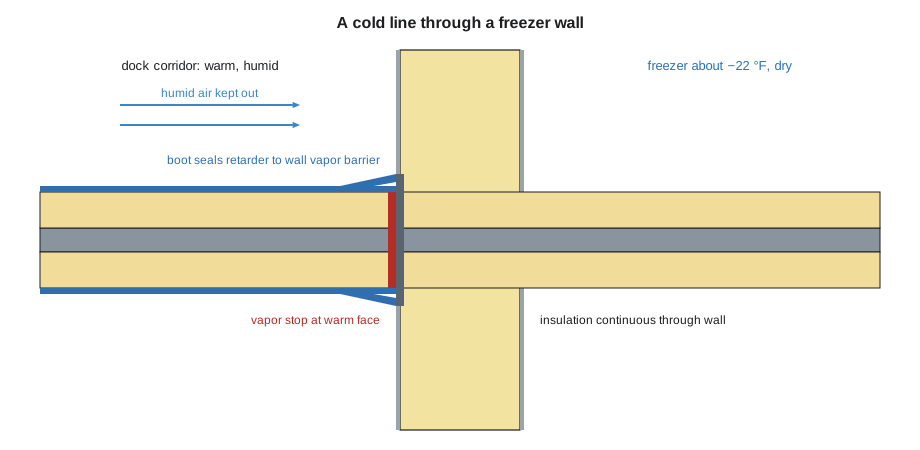
Where a cold line passes from a warm, humid space into a freezer, three things must happen at once.
- The vapor retarder must stay continuous on the warm side. The pipe insulation's vapor retarder is carried up to the wall and sealed to the wall's own vapor barrier, which on panel walls is the outer skin of the panel. A gap here lets humid air into the wall itself, where it freezes inside the panel joints.
- The opening must be sealed. The space between the insulated pipe and the wall opening is filled and sealed on the warm side, usually with a sealed sleeve or boot and sealant, so that air cannot flow through the wall alongside the pipe. The panel contractor's details for penetrations must be followed.
- The insulation must be continuous through the wall. The pipe insulation runs through the wall opening without a gap, so the pipe inside the wall is not bare. A vapor stop is placed at the warm face of the wall, sealing the insulation to the pipe.
The same rules apply where lines pass through roofs to rooftop condensers or evaporative condensers, where the roofing contractor seals the roof membrane around a curb or sleeve and the insulator seals the pipe insulation inside it.
Floors, drains and heat tracing
Low-temperature buildings have two other features that insulators meet even though they do not install them.
- Heated sub-floors. Under a freezer or cold store, the ground would slowly freeze and heave, cracking the floor. Freezer floors are built with insulation board, usually extruded polystyrene, under the slab, and a heating system under the insulation: glycol piping warmed by waste heat from the plant, ventilation pipes or electric cables. Ice-rink floors are built the same way, as lesson 12 describes.
- Drain lines and heat tracing. Evaporator coils in freezers collect frost that is melted during defrost, and the water drains away through drain lines. Inside the freezer, those lines would freeze, so they are fitted with heat tracing, an electric heating cable along the pipe, and insulated. The heat tracing is installed by electricians, and the insulator installs the insulation over it, sized to allow for the cable, without damaging the cable or its connections. INS-410 covers freeze protection and heat tracing in more detail.
Defrost and temperature swings
Low-temperature systems do not run at one temperature all the time. Evaporators defrost several times a day, and suction lines near them warm up during defrost and cool again after. Plants shut down rooms for cleaning, maintenance and repair. Each warm-up and cool-down moves the pipe, as lesson 9 explains, and melts any ice that has formed inside wet insulation, letting water run to low points before it freezes again. Insulation systems on low-temperature lines must therefore be built to tolerate movement and to keep water out even when the line is warm, which is another reason for closed-cell materials, sealed joints, flexible vapor retarders and vapor stops.
Working in the cold
Insulating inside and near freezers puts the crew in the cold, often for hours at a time. Ohio has no regulation written specifically for cold work, but the general duty clause of the federal OSH Act requires the hazard to be controlled, and industry guidance on cold stress sets out how. Common practice includes:
- Plan the work out of the cold where possible. Insulate lines inside freezers before the rooms are pulled down to temperature, or during shutdowns, and prefabricate sections in a warm space.
- Dress for it. Layers of clothing, insulated boots with good grip, insulated gloves or liners under work gloves, and head and face protection, with spares to replace anything that gets wet.
- Limit time in the cold. Work in shifts with warm-up breaks in a heated space, more often in colder rooms and at higher air speeds, such as in blast freezers.
- Watch each other. Use a buddy system and learn the signs of cold stress: shivering, numbness, clumsiness, confusion and pale or waxy skin. Severe shivering, slurred speech or confusion are signs of hypothermia and need immediate warming and help.
- Never touch very cold metal with bare skin. Moist skin can freeze to metal that is below freezing and tear when pulled away; at −30 °F a cold burn can happen in seconds.
- Know the way out. Freezer doors must open from the inside. Know where the inside release and the alarm button are before going in, and never wedge or lock a door in a way that could trap someone.
- Watch the floor and the light. Frost makes floors slippery, forklifts and pallet trucks move constantly, and safety glasses fog when moving from cold to warm.
Materials suffer too. Adhesives, sealants and mastics have minimum application temperatures and will not cure properly below them; keep them warm until used and follow the maker's instructions, which may require the surface or the room to be warmed. Elastomeric becomes stiff and harder to fit in the cold. Cellular glass is unaffected, but its sealants are not.
Common mistakes
MistakeSizing low-temperature insulation without knowing the humidity of the space.
InsteadGet the design conditions; humid docks and corridors may need three or four times the thickness.
MistakeOrdering every layer of a multi-layer system for the pipe size.
InsteadSize each layer for the outside diameter of the layer beneath it.
MistakeLeaving a gap in the insulation inside a freezer wall.
InsteadRun the insulation through the wall and seal the vapor retarder to the wall's vapor barrier on the warm side.
MistakeDamaging heat tracing when insulating a drain line.
InsteadCoordinate with the electrician, size the insulation for the cable and protect the cable and its connections.
MistakeWorking long stretches in a freezer without breaks or a buddy.
InsteadPlan warm-up breaks, work in pairs and know the inside door release.
Summary and key terms
- Low-temperature systems at about −25 to −45 °C serve freezers, blast freezers and cold storage; the hardest insulation work is on the warm, humid side.
- Humidity in docks and corridors can multiply the thickness needed to prevent condensation several times.
- Low-temperature insulation is installed in staggered layers, each sized to the layer beneath, with sealed joints and an excellent outer vapor retarder.
- At walls and roofs, the insulation runs through the opening, the opening is sealed, and the vapor retarder is sealed to the wall's vapor barrier on the warm side.
- Freezer floors have insulation and heating beneath them; evaporator drain lines are heat-traced and insulated.
- Defrost and shutdowns move the pipe and melt trapped ice, so systems must tolerate movement and stay sealed when warm.
- Cold work needs planning, warm clothing, limited exposure, a buddy system, care with cold metal and materials kept within their temperature limits.
- Blast freezer
- A freezer that freezes product quickly with very cold coils and high air speeds.
- Cold storage
- A room or building that holds frozen product at a steady low temperature.
- Insulated metal panel
- A factory-made wall or roof panel of foam insulation between metal skins, used to build cold rooms.
- Heated sub-floor
- A heating system under the insulation of a freezer or rink floor that stops the ground freezing and heaving.
- Heat tracing
- An electric heating cable run along a pipe to keep it from freezing.
- Defrost
- Melting the frost off evaporator coils, usually several times a day.
- Cold stress
- The harm the body suffers from working in cold conditions, including hypothermia and frostbite.
- Hypothermia
- A dangerous fall in body temperature caused by prolonged exposure to cold.
Practice problems
Work each problem on paper first, then reveal the answer to check.
Why does a pipe inside a freezer collect little frost?
Show answer
The freezer air is cold and holds very little water vapor, and the pipe is close to the room temperature.
A line needs an insulation resistance of 18 h·ft²·°F/Btu. What thickness of PIR at k 0.17 is that?
Show answer
18 × 0.17 = 3.06 in.
A second layer of insulation goes over a first layer with an outside diameter of 7 1/2 in. What size must the second layer be ordered for?
Show answer
For a 7 1/2 in outside diameter, not for the pipe size.
Where is the vapor stop placed on a line passing into a freezer?
Show answer
At the warm face of the wall, sealing the insulation to the pipe.
Name three signs of cold stress to watch for in a partner.
Show answer
Any three of shivering, numbness, clumsiness, confusion, slurred speech and pale or waxy skin.
Lesson quiz · 5 questions
Score 60% or more to complete this lesson.
Create a free account to save your progress, take quizzes and earn a certificate.