
INS-320 · Lesson 1 of 12 · 22 min
Why cold systems are different
▶ Video coming soon A video version of this lesson is on the way.
On Monday evening, September 21, 2026, Marcel Ouellet set a sealed glass jar of ice water on the table in the training room above the Coldstream shop and waited. Devon Marsh, Tessa Moreau, Priya Lam and two other apprentices watched the outside of the jar fog, then bead, then run with water onto the table. "That is every cold job you will ever do," Marcel said. "The air in this room is full of water you cannot see. Put anything cold in it and the water comes out. My job, and now yours, is to stop the water reaching the cold." Marcel had spent most of his career on refrigeration and cold work: the ammonia engine room at Kellerton Foods, chilled water in hospitals and towers, a summer of ice-rink plants, and, years earlier, an air separation plant where the piping ran colder than anything most insulators ever touch. Raj Sandhu had asked him to run a set of Monday evening sessions on cold work through the fall, and this course follows them.
INS-310 introduced cold equipment and the vapor retarder. INS-130 and INS-210 showed vapor stops on chilled water pipe and fittings. This course goes further: why cold systems fail, how to check against condensation, how water vapor moves, which materials and vapor retarders suit cold service, and how chilled water, refrigeration, freezer and cryogenic systems are insulated, supported and repaired. It ends with a case study from the summer of 2026: Coldstream's work in the refrigeration plant of a city ice arena.
Hot and cold: the direction of the problem
On a hot system, the insulator's main job is to keep heat in. Heat flows out from the pipe through the insulation to the room, and the insulation slows it. If the insulation gets a little wet, the heat drives the water back out and dries it. Small gaps cost some heat, but the system keeps working.
On a cold system, which is any system that runs below the temperature of the air around it, everything is reversed. Heat flows in from the room toward the pipe, so the insulation's job is to slow heat gain. And water vapor, which always moves from warm humid air toward colder, drier places, is pushed inward toward the cold surface all the time. This inward push is called the vapor drive. Nothing dries a cold system from the inside; any water that gets in stays, and more follows it.
That single difference explains almost every rule of cold work. On hot work, a gap is a heat leak. On cold work, a gap is a water leak, and water leaks get worse every day they are left.
What cold service covers
Cold service is not one temperature but a wide range. The table shows the main groups an insulator meets, from chilled water just below room temperature to cryogenic liquids colder than the air's own boiling point. The temperatures are typical values; each system's design sets its own.
| Service | Typical operating temperature | Where it is found |
|---|---|---|
| Chilled water | 39 to 55 °F | Building air conditioning, process cooling |
| Domestic cold water, storm drains | 41 to 59 °F | Buildings, to stop sweating |
| Glycol and brine | 23 to −4 °F | Ice rinks, food plants, process cooling |
| Medium-temperature refrigeration | 23 to 5 °F | Coolers, rink chillers, cold rooms |
| Low-temperature refrigeration | −13 to −49 °F | Freezers, blast freezers, cold storage |
| Carbon dioxide (low stage) | −22 to −58 °F | Supermarkets, newer rinks and plants |
| Cryogenic liquids | −238 °F and colder | Liquid nitrogen, oxygen, argon, natural gas |
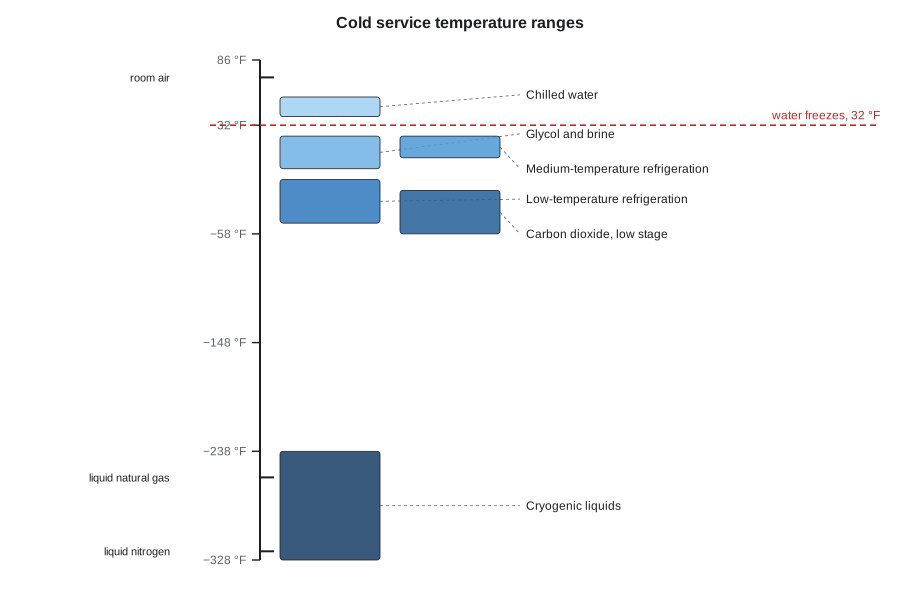
Two lines on that scale matter more than any other. The first is the dew point of the surrounding air: any surface colder than it collects water. The second is the freezing point of water: below it, water that gets into the insulation turns to ice. Chilled water systems sit between the two, so they collect liquid water. Brine, refrigeration and cryogenic systems sit below both, so they collect ice.
How a cold system fails
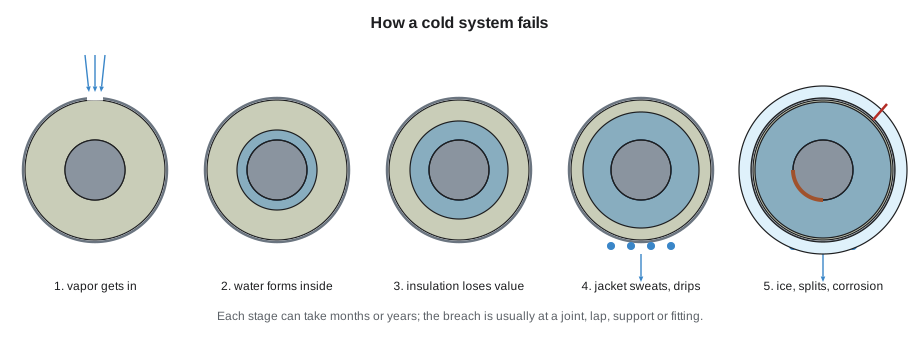
Cold insulation rarely fails all at once. It fails in a sequence that can take months or years, and an insulator who knows the sequence can read where a system is in it.
- Vapor gets in. A break in the vapor retarder, such as a split lap, an unsealed joint, a screw hole or a crushed spot at a hanger, lets humid air and water vapor reach the insulation.
- Water condenses inside. The vapor moves inward until it reaches a layer colder than its dew point, then condenses there. On systems below freezing, it freezes.
- The insulation loses its value. Water conducts heat many times better than still air, and ice better still. A wet or iced layer insulates poorly, so the outer layers get colder.
- The surface falls below the dew point. Now water condenses on the outside of the jacket as well, the jacket sweats or frosts, and more moisture is driven in.
- Damage spreads. Water runs along the pipe under the insulation, ice grows and splits the insulation and jacket, and the pipe corrodes. Drips fall on floors, ceilings, products and people.
The Kellerton Foods engine room shows the sequence well. Everyone at Coldstream knew of an NPS 4 ammonia suction line there, running at about −30 °F, that had grown a sleeve of ice at one hanger. During the plant outage in the first week of November, Marcel and Devon cut it out, as INS-110 described. Under the ice they found the end of the sequence: cellular glass cracked where the hanger clamped straight onto the pipe, the vapor retarder mastic split along the crack, and years of frozen moisture inside. The ice alone weighed about 520 lb over 16 ft of pipe. Nothing about it had happened quickly; the breach had probably been there since the day the line was insulated.
What the failures cost
Owners care about cold insulation because its failures are expensive in several ways at once.
- Energy. Every watt of heat that leaks into a cold system must be pumped back out by a compressor, and the colder the system, the more electricity each watt costs. A refrigeration plant at −30 °F typically uses roughly half a unit of electricity for each unit of heat it removes, often more.
- Capacity. Heat gain uses up refrigeration capacity the plant was bought to use on its product or building.
- Water damage and hygiene. Drips stain ceilings, ruin finishes, grow mold and, in food plants and hospitals, threaten hygiene. A food plant may have to stop a line if water drips over open product.
- Safety. Ice falls from overhead lines, water and ice on floors cause slips, and heavy ice loads strain hangers that were never designed for them.
- Corrosion. Steel kept wet under insulation corrodes. On refrigeration lines carrying ammonia, corrosion is not only a maintenance problem but a release risk, which is why plants inspect for it.
Worked problem
What does heat gain cost on a suction line?
The Kellerton suction line, NPS 4 (outside diameter 4.5 in), runs at −30 °F through an engine room at 77 °F. Its insulation is 2 in of cellular glass with a thermal conductivity of about 0.24 Btu·in/h·ft²·°F at its mean temperature. With a surface film coefficient of 1.41 Btu/h·ft²·°F, the heat gain works out to about 19.9 Btu/h per foot. How much heat enters a 131 ft run, and how much electricity does the plant use to remove it over a year, if the refrigeration system uses 1 kW of electricity for every 1.8 kW of heat it removes?
Show solution
- Heat gain on 131 ft = 19.9 × 131 = 2,606 Btu/h, which is 2,606 ÷ 3,412 = 0.764 kW.
- Electricity to remove it = 0.764 ÷ 1.8 = 0.424 kW.
- Over a year of continuous running: 0.424 × 8,760 h = 3,716 kWh.
- If the insulation were wet and its conductivity rose to about 0.70 Btu·in/h·ft²·°F, the gain would rise to about 52 Btu/h per foot, more than two and a half times as much.
Answer: About 3,700 kWh a year for 131 ft of sound insulation; wet insulation would multiply it by more than two and a half.
The ratio of 1.8 is a typical figure for a low-temperature ammonia plant; warmer systems such as chilled water do better, and very cold ones do worse. INS-410 shows how heat gain is calculated. The point here is that on a cold system, wet insulation costs twice: once in the heat it lets in, and again in the electricity to pump that heat back out.
Why cold work needs different habits
Because the vapor drive never stops, cold work needs habits that hot work can do without. Marcel wrote his list on the whiteboard that first evening, and Devon copied it into his notebook.
- Treat the vapor retarder as the system. The insulation slows heat; the vapor retarder keeps the insulation working. A beautiful job with one unsealed lap is a failed job.
- Nothing pierces the retarder. No screws, rivets or staples through it on cold work, and no pins that are not sealed over. Bands go outside.
- Seal what you install the same day. Never leave cold insulation open overnight. Humid air gets in, and the next layer goes on over wet material.
- Divide the system. Vapor stops at fittings, terminations and intervals keep one breach from spreading along the whole line.
- Insulate on dry surfaces only. Adhesives and sealants do not bond to wet or frosted metal, and water trapped under the insulation never leaves.
- Protect the finish. A punctured jacket or coating is a breach. Cold systems need jackets that stand up to ladders, carts and people.
- Watch the details. Hangers, supports, valves, flanges, instruments and the ends of insulation are where nearly all cold systems fail first.
Tessa asked whether all that was needed on a chilled water line that only runs at 44 °F. "More," Marcel said. "A freezer line full of ice tells you it has failed. A chilled water line full of water hides it until the ceiling tiles fall in."
Who does what on a cold system
On most cold jobs, the insulator works alongside other trades whose work affects the insulation. The refrigeration mechanic or pipefitter installs, tests and charges refrigeration systems; the pipefitter installs chilled water and brine piping and usually the hangers; the mechanical contractor or engineer sets the specification; and the owner's operators run the plant. An insulator must not start on a cold line until it has been pressure-tested and released, must coordinate hanger inserts with the pipefitters before the pipe is hung, and must never open, bend or stand on refrigeration piping or valves. In an ammonia plant, the plant's procedures for permits, alarms and emergencies apply to every contractor; lesson 6 covers them.
Reading a cold system on a walk-down
Before Marcel quotes or starts any cold job, he walks the system with the owner's operator and looks for the stage of failure each part has reached. He showed the apprentices how he records it, line by line, on the plant's drawing or a marked-up sketch.
- Dry and sound. The jacket is dry and at about room temperature to the hand, laps and vapor stops are intact, and nothing is crushed at the supports. Record it and move on.
- Early warning. The jacket feels noticeably colder in one area than elsewhere, there is a faint line of condensation along a lap or at a hanger on a humid day, or a seal has lifted. The insulation inside may still be dry; this is the cheapest time to repair.
- Active failure. The jacket sweats, beads or drips, or carries frost. Rust stains run from laps and bands. The insulation under that spot is wet or iced and must be cut out.
- Advanced failure. Ice has built up over the jacket, the jacket is split or bulged, bands have broken, or water runs out when the jacket is pressed. Expect wet insulation well beyond the visible damage and possible corrosion of the pipe, which the owner's inspector must see.
He also notes the conditions on the day: the room temperature and humidity, whether doors were open and whether the system was running at its normal temperature. A line that looks dry in a cool, dry week in March may sweat in a humid week in July, so a walk-down on a dry day shows less than one on a humid day. Lesson 11 returns to inspection tools, such as infrared cameras, and to the methods for cutting out and rebuilding wet sections.
Common mistakes
MistakeTreating cold insulation like hot insulation, with small gaps and unsealed laps.
InsteadSeal every joint, lap and penetration; on cold work a gap lets water in, and it stays.
MistakeScrewing or riveting the jacket on a cold line.
InsteadUse bands and sealed laps; nothing may pierce the vapor retarder.
MistakeLeaving insulation unsealed overnight.
InsteadInstall only what you can seal the same day.
MistakePatching over ice or wet insulation.
InsteadRemove wet and iced material back to sound, dry insulation and rebuild the system.
MistakeStarting before the line has been tested and released.
InsteadWait for the pressure test and the release from the trade that owns the piping.
Summary and key terms
- On a cold system, heat and water vapor both move inward, toward the cold surface.
- The vapor drive never stops, and nothing dries a cold system from inside, so any water that gets in stays and builds up.
- Cold service runs from chilled water just below room temperature to cryogenic liquids below −150 degrees Celsius.
- Cold systems fail in a sequence: breach, condensation or ice inside, loss of insulating value, surface sweating, then ice damage and corrosion.
- Failures cost energy, capacity, water damage, safety and corrosion; on a cold system wet insulation costs twice.
- Good cold work treats the vapor retarder as the system, pierces nothing, seals daily, divides the system with vapor stops and watches the details.
- Cold system
- A system that operates below the temperature of the surrounding air.
- Heat gain
- Heat flowing into a cold system from its surroundings.
- Vapor drive
- The movement of water vapor from warm, humid air toward a colder surface.
- Dew point
- The temperature at which the water vapor in air begins to condense.
- Vapor retarder
- A continuous layer on the warm side of cold insulation that slows the passage of water vapor.
- Vapor stop
- A sealed band that bonds the insulation and vapor retarder to the surface, dividing the system into sections.
- Refrigeration mechanic
- The trade that installs, tests, charges and services refrigeration systems.
Practice problems
Work each problem on paper first, then reveal the answer to check.
Which way does heat move on a cold system?
Show answer
Inward, from the room toward the cold pipe or equipment.
Why can a hot system tolerate a little wet insulation when a cold one cannot?
Show answer
Heat drives the water out of hot insulation; on cold work the vapor drive pushes more water in and nothing dries it.
A chilled water line runs at 44 °F. Will water that gets into its insulation freeze?
Show answer
No; it stays liquid, so the line sweats and drips rather than icing.
Heat gain on a cold line is 6,824 Btu/h, which is 2 kW. With 1 kW of electricity per 2 kW of heat removed, what electricity is used?
Show answer
2 ÷ 2 = 1 kW of electricity.
Name three details where cold systems usually fail first.
Show answer
Any three of hangers and supports, valves, flanges, instruments and the ends of insulation.
Lesson quiz · 5 questions
Score 60% or more to complete this lesson.
Create a free account to save your progress, take quizzes and earn a certificate.