
INS-320 · Lesson 3 of 12 · 23 min
Moisture migration and vapor drive
▶ Video coming soon A video version of this lesson is on the way.
At the start of the October 5 session, Marcel took two short lengths of NPS 2 steel pipe out of the shop freezer, each capped at both ends and filled with frozen brine. Both had been insulated the day before with 1 in of elastomeric sheet. On the first, every seam had been bonded across its full depth with adhesive. On the second, he had left one 4 in stretch of seam unbonded, the faces just touching. He stood them on the table under the lights. By the end of the two-hour session, the first was dry. The second had a white line of frost along the unbonded stretch, and a drop of water on the table under it. "Same material, same thickness, same room," he said. "One door left open. That is all it takes."
Lesson 2 explained the dew point and how to keep a cold system's outer surface dry. This lesson looks inside the insulation: how water vapor moves through materials and gaps, what decides how fast it moves, what the numbers on a vapor retarder's data sheet mean, and why a single open joint can let in more water in a day than a sound jacket lets in over a year.
Vapor pressure drives the flow
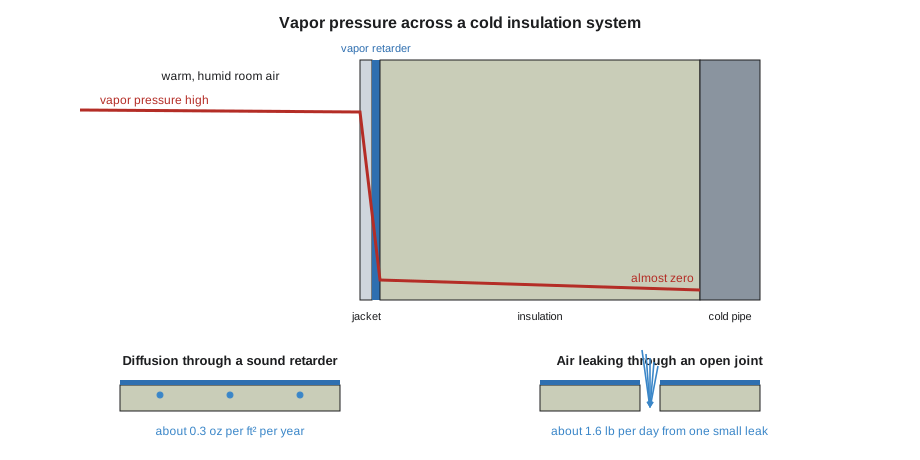
Water vapor moves from places where its vapor pressure is high to places where it is low, just as heat moves from hot to cold. Around a cold system, the vapor pressure is high in the room air and very low at the cold surface, because cold surfaces can only hold a little vapor: the saturation vapor pressure at −30 °F is about a hundredth of that at room temperature. The difference between the two, the vapor pressure difference, is what pushes vapor inward. The bigger the difference, the stronger the drive.
On a chilled water line, the difference is moderate. On a freezer or ammonia suction line, the vapor pressure at the pipe is almost zero, so the full vapor pressure of the room air pushes inward. And because the room's vapor pressure is highest in hot, humid weather, the drive is strongest in summer, which is when most cold systems show their failures.
Diffusion, air leakage and liquid water
Moisture reaches cold insulation in three main ways.
- Diffusion is water vapor moving through a material itself, molecule by molecule. Every material lets some vapor through; a good vapor retarder lets through very little.
- Air leakage is humid air flowing through gaps: open joints, unsealed laps, holes, cracks and the spaces around penetrations. Air moves in and out of these gaps as temperatures change and as pressures in the room change, and every cubic meter of air that reaches the cold surface leaves its water behind.
- Liquid water comes from outside: rain on outdoor lines, washdown hoses in food plants, leaks from above, water running along a pipe from a breach further up the line, or wet insulation installed straight from a pallet left out in the rain.
Diffusion is slow and steady and is controlled by choosing materials with low permeance. Air leakage and liquid water are sudden and large and are controlled by workmanship: sealed joints, bonded seams, laps facing the right way, vapor stops and a protective jacket. On real jobs, almost all cold insulation failures come from the second group.
Permeance and permeability
How easily vapor diffuses through a material is described by two related numbers.
- Permeance describes a particular layer at its actual thickness, such as a jacket, a coating or a sheet. It is the rate of vapor flow through a unit area of the layer for each unit of vapor pressure difference. In metric units it is given in nanograms per pascal-second-square-meter, ng/(Pa·s·m²). In US practice it is given in perms, where one perm is one grain of water per hour per square foot per inch of mercury of vapor pressure difference. One perm equals about 57.2 ng/(Pa·s·m²).
- Permeability is a property of the material itself, independent of thickness. It is permeance multiplied by thickness, so it is given in ng/(Pa·s·m) or, in US units, in perm-inches. A thicker layer of the same material has a lower permeance.
Both are measured by the test method ASTM E96, in which a sample is sealed over a dish holding either a drying agent (the dry cup method) or water (the wet cup method) in a controlled room, and the weight change over time gives the vapor flow. Results can differ between the two methods, so data sheets say which was used.
When several layers are in a row, as in an insulation system, their resistances to vapor flow add, just as thermal resistances do. The vapor resistance of a layer is one divided by its permeance. A system with a good vapor retarder has almost all of its resistance in that one layer, which is why the retarder, not the insulation behind it, controls diffusion.
| Layer or material | Typical permeance or permeability | Comment |
|---|---|---|
| Aluminum foil (unbroken) | Effectively zero | Foil laminates owe their low permeance to the foil |
| Vapor retarder jacket to ASTM C1136 Type I or II | 0.02 perm or less | Factory jackets on pipe and board |
| Cellular glass | Effectively zero | Glass cells do not pass vapor; joints must be sealed |
| Flexible elastomeric foam | About 0.10 perm-in or less | Closed cell; permeance falls as thickness rises |
| Polyisocyanurate foam | Several perm-in | Needs a separate vapor retarder on cold work |
| Glass fiber and mineral wool | Very high | Open fibers pass vapor freely; facing does all the work |
How much water gets in?
The rate of diffusion through a layer is its permeance times the vapor pressure difference across it. Over a year, even a small rate adds up.
Worked problem
Diffusion through a vapor retarder jacket
An ammonia suction line at −30 °F runs through an engine room at 81 °F and 70 in 100 RH. The room air's vapor pressure is about 0.745 inHg; at the cold pipe it is about 0.007 inHg. How much water diffuses through each square foot of jacket in a year if the jacket's permeance is 0.02 perm, and how much if the jacket had a permeance of 1 perm?
Show solution
- Vapor pressure difference = 0.745 − 0.007 = 0.738 inHg.
- With 0.02 perm: flow = 0.02 × 0.738 = 0.0148 grains per hour per ft².
- A year has 8,760 hours, so the yearly flow = 0.0148 × 8,760 = 129 grains per ft². With 7,000 grains to the pound, that is 0.018 lb, or about 0.3 oz per ft².
- With 1 perm: flow = 0.738 × 8,760 = 6,460 grains, or about 0.92 lb per ft² per year.
Answer: About 0.3 oz per ft² a year through a 0.02 perm jacket, against about 0.92 lb through a 1 perm layer.
On a cold line below freezing, all of that water stays in the insulation as ice. Even the good jacket lets in some, which is why low-temperature systems use closed-cell insulation that does not take up the small amount that diffuses, and why the very best retarders are rated at or near zero. But the jacket with fifty times the permeance would put kilograms of ice into every square meter of insulation each year, enough to ruin it in a season or two.
Worked problem
An open joint, by comparison
Suppose an unsealed joint lets about 1 cfm (cubic foot per minute) of room air reach the cold pipe, which is a very small leak. Room air at 81 °F and 70 in 100 RH holds about 0.0157 lb of water per lb of dry air; air at −30 °F can hold only about 0.00015 lb. Air weighs about 0.073 lb per cubic foot. How much water does the leak leave behind in a day?
Show solution
- Mass of air per day = 1 × 0.073 × 60 × 24 = 105 lb.
- Water left behind per lb of air = 0.0157 − 0.00015 = 0.0155 lb.
- Water per day = 105 × 0.0155 = 1.63 lb.
Answer: About 1.6 lb of water a day from one small leak: more than the sound jacket lets through over a whole year on about 90 ft² of surface.
That comparison is the most important lesson of cold work. The permeance of good vapor retarders matters, but the workmanship that keeps air out matters far more. A sealed system with a modest retarder outlasts a system with an excellent retarder and one open joint.
Where moisture goes once it is in
Water that enters cold insulation does not stay where it came in.
- It moves toward the cold. Vapor keeps moving inward until it reaches a layer below its dew point, so water and ice gather nearest the pipe, where they do the most harm to the insulation's value and sit against the steel.
- It runs downhill. Liquid water under insulation runs along the pipe to low points, supports and elbows. On vertical lines it collects at the bottom of the run or at the first fitting.
- It wicks. Fibrous insulation, cloth, paper facings and some cements draw water along by capillary action, spreading it far from the breach. Closed-cell materials do not wick.
- It freezes and grows. Below freezing, ice builds up in cracks and joints and pushes them open, letting in more air. The ice sleeve on the Kellerton line grew this way, year after year, from one cracked spot.
This is why cold systems are divided by vapor stops. A vapor stop bonds the insulation and its vapor retarder to the pipe in a sealed ring, so that water entering at one breach cannot travel along the line under the insulation. It confines the damage to one section, which can be cut out and replaced without disturbing the rest. Lesson 5 shows how vapor stops are built.
When the drive changes direction
On most cold systems the vapor drive is always inward. A few systems are different.
- Dual-temperature systems carry chilled water in summer and heating water in winter through the same piping. In summer the drive is inward; in winter it is outward. These systems need insulation that tolerates both, usually closed-cell material with a vapor retarder on the outside and no layers that would trap moisture in winter.
- Cycling and defrost. Refrigeration lines that warm up during defrost, shutdowns or cleaning can melt the ice inside wet insulation, letting water run to low points before it freezes again.
- Outdoor lines in winter. A chilled water line outdoors may sit colder than a summer room but warmer than the winter air; the drive can reverse with the seasons, which is one reason outdoor cold lines use closed-cell materials and well-sealed metal or PVC jackets.
When a system's drive can reverse, the specification should say so. If it does not, and the system carries both hot and cold service, ask the engineer before installing.
What this means on the job
Marcel summed up the session on the whiteboard. Seal every joint, lap and seam as if the room were at its most humid. Bond the seams of closed-cell materials across their full depth, not just at the face. Never leave a cold system open overnight. Keep insulation dry before it goes on; store it indoors or covered and off the ground. Fit vapor stops where the specification calls for them, and at every place where the system ends. Protect the vapor retarder with a jacket that will not be punctured. And when you find frost or sweating, look for the open door, not for a thicker wall.
Common mistakes
MistakeChoosing a better vapor retarder to make up for poor sealing.
InsteadSeal the joints and laps; air leakage through gaps brings in far more water than diffusion through any jacket.
MistakeLeaving a seam of closed-cell insulation touching but unbonded.
InsteadBond seams across their full depth with the maker's adhesive or sealant.
MistakeStoring insulation outdoors uncovered before a cold job.
InsteadKeep it dry, covered and off the ground; wet insulation installed on a cold line stays wet.
MistakeLeaving out vapor stops to save time.
InsteadFit them where specified; they keep one breach from spreading along the whole line.
MistakeUsing a fibrous material with an unsealed facing on a freezer line.
InsteadUse closed-cell materials and a sealed vapor retarder on systems below freezing.
Summary and key terms
- Water vapor moves from high to low vapor pressure; around cold systems the drive is inward and strongest in hot, humid weather.
- Moisture enters by diffusion through materials, by air leakage through gaps, and as liquid water from outside.
- Permeance describes a layer at its thickness; permeability describes the material; both are measured by ASTM E96.
- Even a good retarder lets in a little water each year; a poor one lets in kilograms per square meter.
- One small air leak can bring in more water in a day than a sound jacket does in a year, so workmanship matters most.
- Water inside moves toward the cold, runs downhill, wicks along fibrous materials and freezes; vapor stops confine it.
- Dual-temperature, cycling and outdoor systems may see the drive reverse; the system must tolerate both directions.
- Vapor pressure difference
- The difference in vapor pressure between two places, which drives water vapor from high to low.
- Diffusion
- The movement of water vapor through a material itself.
- Air leakage
- The flow of humid air through gaps, carrying water vapor with it.
- Permeance
- The rate of vapor flow through a layer of given thickness per unit area and unit vapor pressure difference.
- Perm
- The US unit of permeance: one grain per hour per square foot per inch of mercury.
- Permeability
- Permeance multiplied by thickness; a property of the material.
- Wicking
- The spreading of liquid water through a material by capillary action.
- Dual-temperature system
- A system that carries chilled water in one season and hot water in another through the same piping.
Practice problems
Work each problem on paper first, then reveal the answer to check.
A jacket's permeance is 0.02 perm. What is that in ng/(Pa·s·m²)?
Show answer
0.02 × 57.2 = 1.14 ng/(Pa·s·m²).
Two layers have vapor resistances of 0.8 and 0.05 (in the same units). Which controls diffusion?
Show answer
The layer with 0.8; resistances add and the larger one dominates.
Why does water collect nearest the pipe in cold insulation?
Show answer
Vapor keeps moving inward until it reaches a layer below its dew point, which is next to the cold pipe.
A 2 cfm air leak reaches a freezer line. Using 0.0155 lb of water per lb of air and 0.073 lb per cubic foot, how much water a day?
Show answer
2 × 0.073 × 1,440 = 210 lb of air a day; × 0.0155 = 3.3 lb of water.
Why are vapor stops fitted on long cold lines?
Show answer
To keep water that enters at one breach from traveling along the whole line.
Lesson quiz · 5 questions
Score 60% or more to complete this lesson.
Create a free account to save your progress, take quizzes and earn a certificate.