
INS-320 · Lesson 2 of 12 · 26 min
Dew point and condensation
▶ Video coming soon A video version of this lesson is on the way.
For the second Monday session, on September 28, Marcel brought a digital hygrometer, an infrared thermometer and a sling psychrometer, the old kind that is whirled on a handle. He sent Devon and Priya down to the shop floor and out into the yard to take readings, and wrote them on the whiteboard when they came back: shop 75 °F and 55 in 100 relative humidity; yard 66 °F and 80 in 100; the walk-in cooler where Tomasz kept adhesives 39 °F. "Now tell me," he said, "would a pipe at 50 °F sweat in the shop? In the yard? Nobody can tell me that by looking. You have to work out the dew point."
Lesson 1 showed that cold systems fail when water reaches the cold surface. This lesson explains where that water comes from: the water vapor carried by air, how much air can hold, what the dew point is and how to find it, and how to check whether an insulated surface will stay dry. INS-120 introduced heat flow and INS-310 showed a first condensation check on a cold tank. Here the method is made more complete and practical, so that an insulator can check a job on site. INS-410 covers the full design calculation of insulation thickness to prevent condensation.
Water vapor in air
Air is a mixture of gases, and one of them is water vapor: water in its gas form, invisible and always present. How much water vapor air can hold depends on its temperature. Warm air can hold much more than cold air; for every 18 °F or so of warming, the most water vapor air can hold roughly doubles.
The water vapor in air exerts its own share of the air's pressure, called its vapor pressure. The most it can exert at a given temperature, when the air holds all the water vapor it can, is the saturation vapor pressure. At 84 °F, for example, the saturation vapor pressure is about 1.18 inHg; at 32 °F it is about 0.18 inHg.
Relative humidity (RH) is the air's actual vapor pressure divided by the saturation vapor pressure at its temperature, expressed here as a number in 100. Air at 60 in 100 RH holds 60 in 100 of the water vapor it could hold at that temperature. Relative humidity depends on temperature: if a sample of air is warmed without adding water, its RH falls; if it is cooled, its RH rises.
Keep cooling a sample of air without removing any water, and its RH climbs until it reaches 100 in 100. The temperature at which that happens is the dew point. Cool the air any further and it cannot hold all its water vapor, so water condenses out as liquid droplets, or, below freezing, as frost. The dew point depends only on how much water vapor the air actually contains, not on the air's temperature. That is why it is the most useful single number for cold work: any surface colder than the dew point of the air touching it will collect water.
Measuring humidity on site
Insulators check humidity on site to see whether conditions are safe for installing cold insulation, and to understand why an existing system sweats.
- A digital hygrometer or thermo-hygrometer reads air temperature and RH directly, and many also show the dew point. They are quick and accurate enough for site work if they are calibrated and given a few minutes to settle when moved from a warm truck into a cold room.
- A sling psychrometer has two thermometers, one with its bulb in a wet wick. Whirled in the air, the wet bulb cools by evaporation, and the difference between the dry-bulb and wet-bulb readings, looked up in a chart, gives the RH. It needs no batteries and is still used as a check.
- An infrared thermometer reads surface temperature without contact. It must be set to the surface's emissivity, which for shiny metal jackets is very low; lesson 11 explains how to get accurate readings on jackets.
- A surface thermometer with a contact probe reads the pipe or jacket surface directly and is more reliable on shiny metal.
Measure where the work is, not at the door. The air near a cold pipe in a ceiling space or a trench can be much more humid than the air in the room below, and the air in a plant room with a hot compressor in it can be warmer and drier than outside, or more humid if doors are open on a summer day.
Finding the dew point
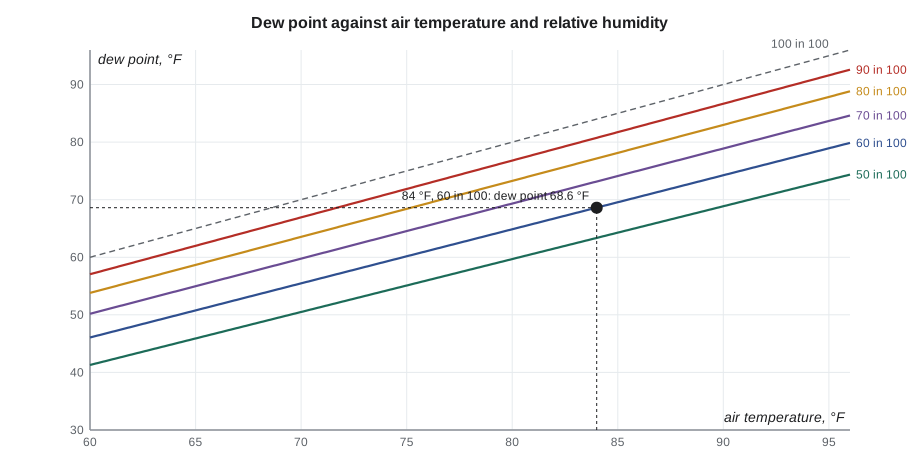
The dew point can be read from a chart or table, shown by a hygrometer, or worked out from the temperature and RH with a formula. The table gives dew points for common conditions. It is a sample worked out with the formula below; published psychrometric charts give the same values to within a few tenths of a degree.
| Air temperature | 50 in 100 RH | 60 in 100 RH | 70 in 100 RH | 80 in 100 RH | 90 in 100 RH |
|---|---|---|---|---|---|
| 70 °F | 50 °F | 55 °F | 60 °F | 64 °F | 67 °F |
| 75 °F | 55 °F | 60 °F | 65 °F | 68 °F | 72 °F |
| 80 °F | 60 °F | 65 °F | 69 °F | 73 °F | 77 °F |
| 85 °F | 64 °F | 70 °F | 74 °F | 78 °F | 82 °F |
| 90 °F | 69 °F | 74 °F | 79 °F | 83 °F | 87 °F |
| 95 °F | 73 °F | 79 °F | 84 °F | 88 °F | 92 °F |
Notice how fast the dew point climbs with humidity. At 86 °F, going from 50 to 90 in 100 RH moves the dew point up by about 18 °F. In very humid air, the dew point is only a degree or two below the air temperature, and almost any cold surface will sweat unless its insulation is thick and perfectly sealed.
The Magnus formula is a simple and accurate way to work out the dew point by calculator. With the air temperature T in degrees Celsius and the relative humidity RH as a number in 100, first find a helper number γ (gamma), then the dew point:
The constants 17.62 and 243.12 are the common values for water above freezing. In US units, convert the air temperature to Celsius first and convert the answer back to Fahrenheit.
Worked problem
The dew point in the rink plant room
On a July afternoon in 2026, Marcel measured the refrigeration plant room at the ice arena where Coldstream was working (lesson 12) at 84 °F and 60 in 100 RH. What was the dew point?
Show solution
- Convert: 84 °F = (84 − 32) × 5 ÷ 9 = 28.89 °C.
- γ = ln(0.60) + 17.62 × 28.89 ÷ (243.12 + 28.89) = −0.5108 + 509.04 ÷ 272.01 = −0.5108 + 1.8714 = 1.3606.
- Dew point = 243.12 × 1.3606 ÷ (17.62 − 1.3606) = 330.79 ÷ 16.259 = 20.34 °C.
- Convert back: 20.34 × 9 ÷ 5 + 32 = 68.6 °F. The table gives 70 °F at 85 °F and 60 in 100, so 68.6 °F is reasonable.
Answer: About 68.6 °F. Any surface in that room colder than about 69 °F would collect water.
Dew point and frost point
Below the freezing point of water, vapor that reaches a cold surface does not condense as liquid but deposits directly as frost. The temperature at which that begins is called the frost point. It is slightly higher than the dew point would be for the same air, because ice holds on to water molecules a little more strongly than liquid water does. For insulation work the difference is small, and the dew point is used for checks; what matters is that on a system below freezing, every bit of vapor that gets in stays as ice, which does not drain away and keeps growing.
Will the surface stay dry?
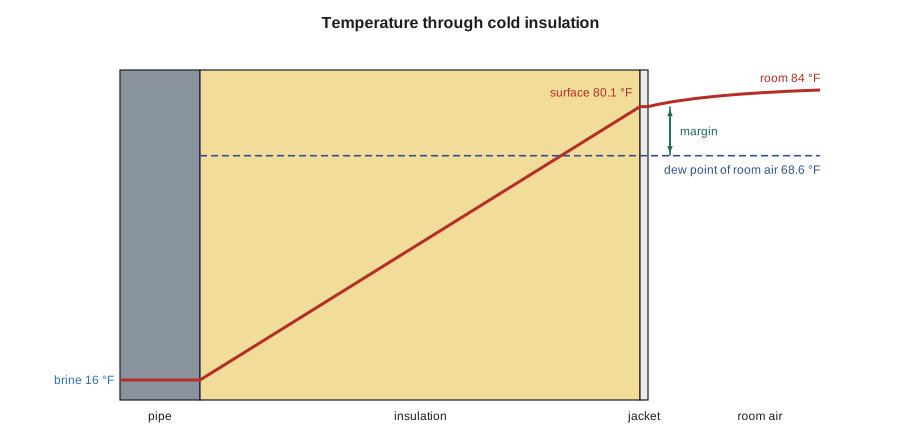
Insulation keeps a cold system's outer surface warm by slowing heat flow. Heat flows from the room through the thin layer of still air against the jacket, called the surface film, then through the insulation to the cold pipe. The surface film and the insulation are like two resistances in a row: most of the temperature drop happens across the insulation, and a small part across the surface film. The outer surface temperature is the room temperature minus that small drop. If the surface temperature is above the dew point, the surface stays dry; if it is below, water condenses on it no matter how well the vapor retarder is sealed.
Worked problem
Checking the brine header in the plant room
The new brine supply header in the same plant room carries calcium chloride brine at 16 °F. It is insulated with 2 in of polyisocyanurate (PIR) with a thermal conductivity of about 0.17 Btu·in/h·ft²·°F. Treat the wall as flat, as a simple check on the safe side, and use a surface film coefficient of 1.41 Btu/h·ft²·°F. Is the surface safe in the 84 °F, 60 in 100 room?
Show solution
- Insulation resistance = 2 ÷ 0.17 = 11.76 h·ft²·°F/Btu. Surface film resistance = 1 ÷ 1.41 = 0.709. Total = 12.47.
- Heat flow = (84 − 16) ÷ 12.47 = 68 ÷ 12.47 = 5.45 Btu/h per ft².
- Temperature drop across the film = 5.45 × 0.709 = 3.87 °F.
- Surface temperature = 84 − 3.87 = 80.1 °F. The dew point is 68.6 °F, so the margin is 11.5 °F.
Answer: The surface is about 80.1 °F, comfortably above the 68.6 °F dew point.
The margin is what protects a system on a worse day than the one you measured. If the plant room doors are open on a humid August afternoon, the RH may climb well above 60 in 100, and the dew point rises toward the surface temperature. A designer chooses thickness for the worst conditions the system will see, called the design conditions, not for an average day.
Worked problem
How humid can the room get before the header sweats?
The header's surface stays at about 80.1 °F when the room is at 84 °F. At what RH would the room's dew point reach 80.1 °F?
Show solution
- Convert: 80.1 °F = 26.72 °C; 84 °F = 28.89 °C.
- 17.62 × 26.72 ÷ 269.84 = 1.7449; 17.62 × 28.89 ÷ 272.01 = 1.8714.
- Difference = 1.7449 − 1.8714 = −0.1265; e^−0.1265 = 0.881.
- RH = 100 × 0.881 = 88 in 100.
Answer: The header would only start to sweat if the plant room reached about 88 in 100 RH at that temperature, which is unlikely in a ventilated plant room. In the arena's header trench, where the air is much more humid, the answer was different, as lesson 12 shows.
Design conditions and margins
Insulation for cold systems is sized for design conditions: the highest air temperature and humidity the space is expected to reach, set by the engineer from the building's use and climate data. A mechanical room with air conditioning may be designed for 75 °F and 50 in 100; an unconditioned plant room, a ceiling space with outdoor air or a food plant washdown area may be designed for much more humid air. Specifications often state the design conditions with the insulation schedule, and an insulator who finds the real conditions much worse than designed should report it before installing, not after the jacket starts to drip.
Common practice is to keep the outer surface at least a few degrees above the design dew point: a margin of 4 to 5 °F is typical, more where conditions vary or the insulation will age. The margin covers uncertainty in the conditions, small variations in thickness, compression at supports and the slow loss of insulating value as materials age. It does not cover a breach in the vapor retarder; no thickness of insulation keeps a system dry if humid air can get inside it.
Site checks before and during installation
Before installing cold insulation, check that the surface itself is dry and above the dew point of the air around it. A cold pipe that is running will be below the dew point, wet with condensation or white with frost, and adhesives and sealants will not bond to it. Ways round this include:
- Insulating before the system is put into service, which is best, and is why insulators want to know the start-up date.
- Asking the owner to shut down or warm the line, which is not always possible on a plant that cannot stop.
- Working on live lines in short sections, drying each section of pipe surface with clean rags and warm air just before it is insulated, and sealing that section before moving on, as Marcel and Devon did on the Kellerton suction line in November.
- Lowering the humidity around the work with portable dehumidifiers or dry air, used on large jobs in humid spaces.
Record the conditions on the job: air temperature, RH and dew point at the work, the surface temperature, and the time. On a cold job, those readings are part of the quality record, and they help explain later whether a problem came from the installation or from conditions the system was never designed for.
Common mistakes
MistakeJudging by eye whether a space is humid enough to cause sweating.
InsteadMeasure temperature and RH at the work and work out the dew point.
MistakeMeasuring humidity at the door of a plant room and assuming it applies in the trench or ceiling space.
InsteadMeasure where the cold system actually runs; local conditions can be much more humid.
MistakeThinking thicker insulation will cure a sweating jacket with an open lap.
InsteadFind and seal the breach; thickness only helps when the vapor retarder is continuous.
MistakeApplying adhesive or sealant to a surface below the dew point.
InsteadDry and warm the surface, or insulate before the system runs.
MistakeSizing for an average day.
InsteadUse the design conditions and keep a margin above the design dew point.
Summary and key terms
- Air always carries water vapor, and warm air can hold much more than cold air.
- Relative humidity is the vapor pressure in the air divided by the most it could hold at that temperature.
- The dew point is the temperature at which air becomes saturated and water condenses; any surface colder than the dew point collects water.
- The dew point can be read from a table or hygrometer, or worked out with the Magnus formula.
- The outer surface temperature of cold insulation is the room temperature minus the small drop across the surface film; it must stay above the dew point with a margin.
- Insulation is sized for design conditions, not average ones, and only works if the vapor retarder is continuous.
- Measure conditions at the work and record them; never install on a wet or frosted surface.
- Water vapor
- Water in its invisible gas form, always present in air.
- Vapor pressure
- The part of the air pressure exerted by its water vapor.
- Saturation vapor pressure
- The highest vapor pressure air can hold at a given temperature.
- Relative humidity
- The actual vapor pressure divided by the saturation vapor pressure at the same temperature.
- Dew point
- The temperature at which air becomes saturated and water begins to condense.
- Frost point
- The temperature below freezing at which water vapor begins to deposit as frost.
- Surface film
- The thin layer of still air against a surface that resists heat flow between the surface and the room.
- Design conditions
- The highest temperature and humidity a space is expected to reach, used to size insulation.
Practice problems
Work each problem on paper first, then reveal the answer to check.
Air at 75 °F has 70 in 100 RH. From the table, what is its dew point?
Show answer
About 65 °F.
Use the Magnus formula to find the dew point of air at 68 °F (20 °C) and 85 in 100 RH.
Show answer
γ = ln(0.85) + 17.62 × 20 ÷ 263.12 = 1.1768; dew point = 243.12 × 1.1768 ÷ 16.443 = 17.4 °C = 63.3 °F.
A chilled water pipe's jacket is at 71 °F in a room with a dew point of 70 °F. Is the margin enough?
Show answer
No; it is only 1 °F, well below the 4 to 5 °F typical margin.
Why does the dew point, not the RH, tell you whether a surface will sweat?
Show answer
The dew point depends only on how much water vapor the air holds; RH changes with temperature.
A plant cannot shut down a cold line. How can it still be insulated?
Show answer
In short sections, drying each section just before insulating it and sealing it the same day, or with dehumidified air around the work.
Lesson quiz · 5 questions
Score 60% or more to complete this lesson.
Create a free account to save your progress, take quizzes and earn a certificate.