
INS-320 · Lesson 5 of 12 · 23 min
Vapor retarders and sealing
▶ Video coming soon A video version of this lesson is on the way.
On October 26, Marcel handed out copies of one page of a specification: the vapor retarder section from the arena refrigeration job Coldstream had finished in July. He had underlined four phrases: "continuous and unbroken", "two coats with reinforcing fabric embedded", "minimum dry film thickness as stated by the manufacturer for the rated permeance" and "no fasteners shall penetrate the vapor retarder". Then he set a pail of vapor retarder mastic on the table, brushed a patch onto a piece of scrap board, and pressed a small toothed gauge into the wet coating. "The spec tells you what the system has to do," he said. "This tells you whether you did it. You cannot see a thin coat once it dries, but the water can find it."
Lesson 3 showed that a cold system's life depends on keeping water vapor and humid air out, and that workmanship matters more than the permeance of any one product. This lesson covers the vapor retarders themselves: the types used on cold work, the standards that rate them, how mastic systems are applied to the right thickness, how joints and laps are sealed, how vapor stops are built, and how the work is checked.
What a vapor retarder must be
A vapor retarder is the layer, or combination of layers, that slows water vapor to a very low rate on the warm side of cold insulation. Whatever form it takes, it must meet the same requirements, which INS-310 introduced for equipment:
- Low permeance, at the thickness installed, as the specification requires.
- Continuous, with every seam, lap, joint and end sealed, and carried across fittings, supports and terminations without a break.
- On the warm side, which on cold work is the outside of the insulation, under the protective jacket.
- Unpierced, by screws, rivets, staples, wire, pins or the tools of other trades.
- Durable, able to stay sealed through temperature changes, movement of the pipe and the years of service the owner expects.
- Protected, by a jacket or hard finish where it could be damaged.
A weather barrier or protective jacket is not a vapor retarder. Metal jacketing keeps rain and damage off the insulation, and its factory moisture barrier film protects the metal from corrosion, but its laps and seams are not airtight. A cold system needs its vapor retarder under the jacket, sealed in its own right.
Types of vapor retarder
Cold systems use one or more of these types, depending on the material, the service and the specification.
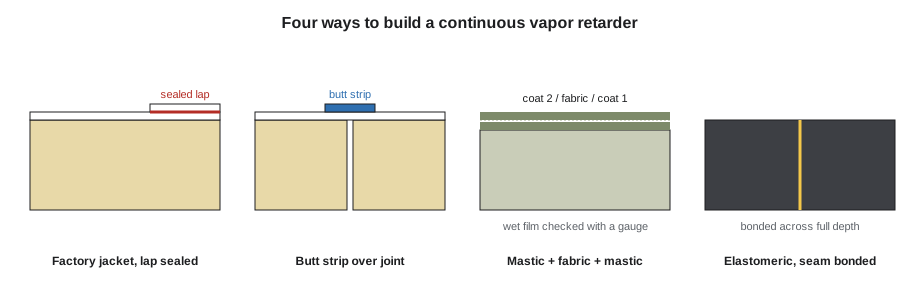
- Factory-applied jackets and facings. Laminates of foil, polymer film, kraft paper and scrim, applied to pipe insulation, board and duct wrap at the factory. The all-service jacket (ASJ) on glass fiber pipe insulation and the foil-scrim-kraft (FSK) facing on board are common examples. Polymer film jackets are also made for foam pipe sections on low-temperature and cryogenic lines.
- Tapes and sheet membranes. Self-adhesive foil, polymer and butyl-backed tapes and sheets used for butt strips, laps, fitting covers and repairs, and to carry the retarder across awkward details.
- Vapor retarder mastics and coatings. Thick liquid coatings, solvent-based or water-based, applied by brush, trowel or spray, usually in two coats with a reinforcing fabric of glass or polyester mesh embedded between them. They form a seamless membrane over cellular glass, foam and fitting insulation, and are rated for permeance at a stated dry film thickness.
- The insulation itself. A closed-cell material such as elastomeric foam, with every seam and butt joint bonded, can act as its own vapor retarder in many building applications, if the maker rates it so; for low-temperature service many makers call for an extra retarder.
ASTM C1136 covers flexible vapor retarders for insulation, such as jackets, facings and tapes, and sorts them into types by their properties. The types used on cold piping have a maximum permeance of 0.02 perm, which is about 1.15 ng/(Pa·s·m²) in metric units, or lower; some types allow 0.10 perm, and the lowest type is rated at zero. ASTM C755 is a practice for choosing vapor retarders for insulation, and ASTM C647 is a guide to the properties and tests of mastics and coatings for insulation. Specifications refer to these by name, and data sheets state which type or rating a product meets.
Mastic and coating systems
Mastic systems are used where a factory jacket cannot follow the shape, such as on cellular glass pipe and vessels, fittings, valves and irregular equipment, and where the specification calls for a seamless membrane. A typical system is applied like this, though the maker's instructions govern:
- Check that the insulation is dry, clean and sound, with every joint sealed and every gap filled. The mastic is a membrane, not a filler.
- Apply the first coat to the wet film thickness the maker gives for that coat, working it into the surface.
- While the first coat is wet, embed the reinforcing fabric, smoothing it with a brush or trowel so it is fully wetted with no wrinkles or air pockets. Lap the fabric edges by the amount the specification gives, commonly about 2 in.
- Let the first coat set as the maker requires, then apply the second coat to its wet film thickness so that the fabric is fully covered and no weave shows through.
- Allow the full cure time before jacketing, banding or handling, and protect the coating from rain, washdown and frost while it cures.
Two thicknesses are used to describe a coating. The wet film thickness (WFT) is the thickness as applied, which can be measured with a wet film gauge: a small plate with teeth of graded lengths that is pressed into the wet coating, the reading being the longest tooth that comes out wet. The dry film thickness (DFT) is what remains after the solvent or water evaporates, and is what gives the rated permeance. The two are related by the coating's volume solids, the share of its volume that remains as film:
A useful relationship gives the WFT from the coverage rate. In metric units, one liter spread over one square meter gives a wet film one millimeter thick. In US units, one gallon spread over one square foot gives a wet film 1,604 mils thick (a mil is a thousandth of an inch), so a coverage of one gallon per 40 square feet gives about 40 mils.
Worked problem
Mastic for the brine headers in the header trench
The arena's brine supply and return headers in the header trench are NPS 8 (outside diameter 8.625 in), each 85 ft long, insulated with two 1 1/2 in layers of cellular glass, 3 in in all. The specification calls for two coats of vapor retarder mastic, each applied at 1 gallon per 40 ft² wet, with fabric between. The mastic has 55 in 100 volume solids and comes in 5 gallon pails. Allow 10 in 100 for waste. What is the dry film thickness, how much mastic is needed, and how many pails?
Show solution
- Outside diameter of the insulation = 8.625 + 2 × 3 = 14.625 in = 1.219 ft.
- Surface area = π × 1.219 × (2 × 85) = 3.829 × 170 = 651 ft².
- Wet film per coat = 1,604 ÷ 40 = 40 mils; dry film per coat = 40 × 0.55 = 22 mils; two coats = 44 mils.
- Mastic = 651 × 2 coats ÷ 40 = 32.6 gallons; with waste, 32.6 × 1.10 = 35.8 gallons.
- Pails = 35.8 ÷ 5 = 7.16, so 8 pails.
Answer: A dry film of about 44 mils, using about 36 gallons of mastic, which is 8 pails, since a part pail cannot be ordered.
Those coverage and solids figures are a sample; every product has its own, and the specified rate is the one to use. The calculation also shows why the wet film gauge matters. If the crew spreads the mastic at twice the area per liter or gallon, each coat is half as thick, the rated permeance is lost, and the pails last longer, which is how a thin coat often first shows up: the job uses less mastic than the takeoff said it would.
Mastic do's and don'ts
- Use vapor retarder mastic, not breather mastic, on cold work. Breather mastics and weather coatings are made to let vapor out of hot insulation while keeping rain off; on a cold system they let vapor in.
- Respect the temperature limits. Most mastics have a minimum application temperature, often around 40 °F for the air and surface, and water-based products are ruined if they freeze in the pail or before they cure.
- Never coat over frost, condensation or wet insulation. The coating will not bond, and the water stays inside.
- Embed the fabric fully. Fabric left dry or wrinkled leaves channels and thin spots; no weave should show after the second coat.
- Carry the coating onto adjoining work. At the ends of a coated section, lap the coating onto the vapor retarder of the next section or down onto the pipe at a vapor stop, so the two are joined.
- Ventilate and control ignition with solvent-based products, especially in trenches, pits and plant rooms, as the safety data sheet requires.
Sealing joints, laps and seams
Most leaks are at joints, so each type of joint has its own sealing method.
- Cellular glass joints are sealed with the specified joint sealant, buttered onto the mating faces so the joint is filled through its depth, then pressed together. Depending on the specification, the inner layer may be sealed the same way or fitted dry; the outer layer always is.
- Factory jacket laps on pipe insulation, such as self-sealing laps, are pressed firmly closed with a sealing tool along their full length; on cold service many specifications also call for lap sealant or tape over the lap. Butt joints between sections are covered with the matching butt strip, centered on the joint and pressed down all round.
- Elastomeric seams and butt joints are bonded with the maker's adhesive applied to both faces, allowed to become tacky, then pressed together under slight compression across their full depth, as the frozen-pipe demonstration in lesson 3 showed.
- Fitting covers of PVC over cold insulation are sealed at their throat seams and at their ends onto the pipe jacket with the specified sealant or tape, and the insulation under them carries its own vapor retarder.
- Penetrations through the vapor retarder, such as instrument stems, thermowells, drain valves and hanger rods that pass close to the insulation, are sealed with mastic and fabric or a sealed boot, and the retarder is carried along the penetration for a distance.
Fasteners are the most common avoidable breach. Some specifications allow outward-clinching staples on the laps of jacketed fibrous insulation on chilled water only if every staple is then coated over with vapor retarder mastic; many forbid them, and on systems below freezing the specifications Coldstream works to forbid them entirely. Screws and rivets through the vapor retarder are never acceptable on cold work. Bands go over the jacket and do not pierce it.
Vapor stops
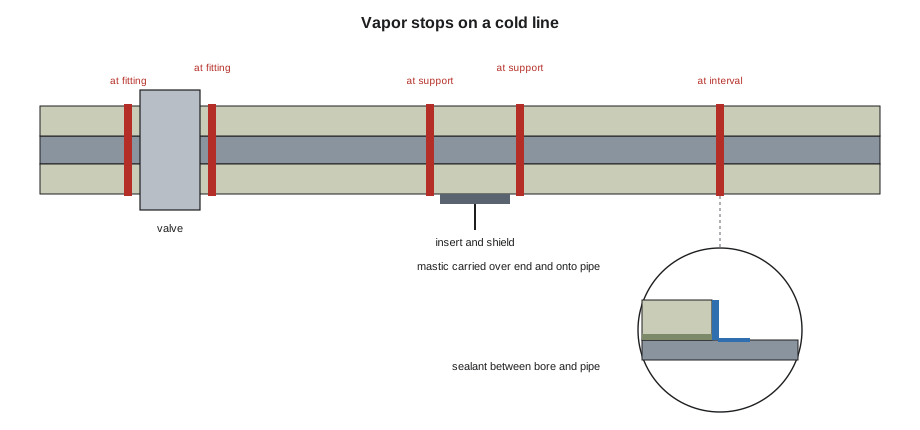
A vapor stop divides a cold insulation system into sealed sections, so that moisture entering through a breach in one section cannot travel along the pipe into the next (lesson 3). Vapor stops are placed:
- At every termination: the ends of the insulation at equipment, valves, flanges, unions, and where the insulation stops at walls or floors.
- At both sides of fittings, valves and flanges, so a removable or later-installed cover does not open the pipe insulation to the room.
- At supports, where the insert and shield break the run.
- On long straight runs, at the interval the specification gives. Intervals vary; on the Mountview chilled water mains, the schedule called for one about every 10 ft.
A vapor stop is built by sealing the insulation to the pipe in a ring. On cellular glass or foam, a band of sealant or vapor retarder mastic is applied to the pipe surface and to the bore and end of the insulation at the stop, the insulation is pressed into it, and the vapor retarder coating is carried over the end face and down onto the pipe for a short distance, often about 2 in. On jacketed sections, the end of the insulation is coated with mastic and the coating lapped onto the pipe. Where the insulation ends against equipment, the coating is carried onto the equipment surface. A vapor stop is only as good as the bond to the pipe, so the pipe surface there must be clean and dry.
Checking the work
Because a vapor retarder cannot be judged once the jacket is on, it is checked as it goes on.
- Measure wet film thickness with a gauge at intervals on every coated area, and record the readings.
- Compare mastic used with the takeoff; a large shortfall means thin coats.
- Inspect for pinholes, bare spots, dry fabric, wrinkles and unsealed fabric laps before the jacket goes on.
- Check every lap, butt strip and seam by eye and by hand; laps should be flat, fully pressed and sealed along their length.
- Check that vapor stops are at every place the specification and the drawings require.
- Hold the jacket until the foreperson or the owner's inspector has seen the vapor retarder, if the specification requires an inspection.
On the arena job, Bernie Valois insisted on seeing every coated section in the header trench before Tessa banded the PVC jacket over it, and the wet film readings went into the job file with the photographs. "Nobody will ever see that mastic again," Marcel told the apprentices. "The day you put the jacket on is the day you stop being able to fix it cheaply."
Common mistakes
MistakeTreating the metal or PVC jacket as the vapor retarder.
InsteadBuild a sealed vapor retarder under the jacket; the jacket only protects it.
MistakeUsing breather mastic on a cold system.
InsteadUse the specified vapor retarder mastic at the stated wet film thickness.
MistakeSpreading mastic thin to make the pails last.
InsteadApply each coat at the specified rate and check it with a wet film gauge.
MistakeLeaving fabric dry or wrinkled under the second coat.
InsteadEmbed it fully in the first coat and cover it completely with the second.
MistakeLeaving out vapor stops at supports and fittings.
InsteadSeal the insulation to the pipe at every termination, fitting and support, and at the specified intervals.
Summary and key terms
- A vapor retarder must be low in permeance, continuous, on the warm side, unpierced, durable and protected.
- Metal and PVC jackets protect the vapor retarder; they are not vapor retarders themselves.
- Factory jackets and facings, tapes and membranes, reinforced mastics and bonded closed-cell foam are the main types; ASTM C1136, C755 and C647 cover them.
- Mastic systems are applied in two coats with embedded fabric, at a stated wet film thickness; dry film thickness equals wet film thickness times volume solids.
- One liter per square meter gives a 1 mm wet film; one gallon per square foot gives 1,604 mils.
- Joints, laps, seams and penetrations each have their own sealing method; fasteners must not pierce the retarder.
- Vapor stops seal the insulation to the pipe at terminations, fittings, supports and intervals.
- Check the retarder as it goes on; once the jacket is on, it cannot be inspected.
- Vapor retarder mastic
- A thick coating applied with reinforcing fabric to form a seamless low-permeance membrane over cold insulation.
- Breather mastic
- A weather coating that lets vapor pass out of hot insulation; not for cold work.
- Reinforcing fabric
- Glass or polyester mesh embedded between coats of mastic to strengthen it.
- Wet film thickness
- The thickness of a coating as applied, measured with a wet film gauge.
- Dry film thickness
- The thickness of a coating after it cures, which gives its rated permeance.
- Volume solids
- The share of a coating's volume that remains as dry film.
- Butt strip
- A strip of jacket material or tape that seals the joint between two sections of pipe insulation.
- Weather barrier
- A jacket or coating that keeps rain and damage off insulation without necessarily stopping vapor.
Practice problems
Work each problem on paper first, then reveal the answer to check.
A mastic with 50 in 100 volume solids is applied at a wet film of 48 mils. What is the dry film thickness?
Show answer
48 × 0.50 = 24 mils.
What wet film thickness does a coverage of 1 gallon per 32 ft² give?
Show answer
1,604 ÷ 32 = 50 mils.
A vessel needs 194 ft² coated in two coats at 1 gallon per 40 ft² each, plus 10 in 100 waste. How many 5 gallon pails?
Show answer
194 × 2 ÷ 40 × 1.10 = 10.7 gallons; 10.7 ÷ 5 = 2.13, so 3 pails.
Why is the vapor retarder coating carried onto the pipe at a vapor stop?
Show answer
To seal the end of the insulation to the pipe so moisture cannot travel along under the insulation.
Why should a crew compare mastic used with the takeoff?
Show answer
Using much less than planned usually means the coats were applied too thin.
Lesson quiz · 5 questions
Score 60% or more to complete this lesson.
Create a free account to save your progress, take quizzes and earn a certificate.