
INS-230 · Lesson 4 of 12 · 21 min
OSHA and EPA asbestos rules
▶ Video coming soon A video version of this lesson is on the way.
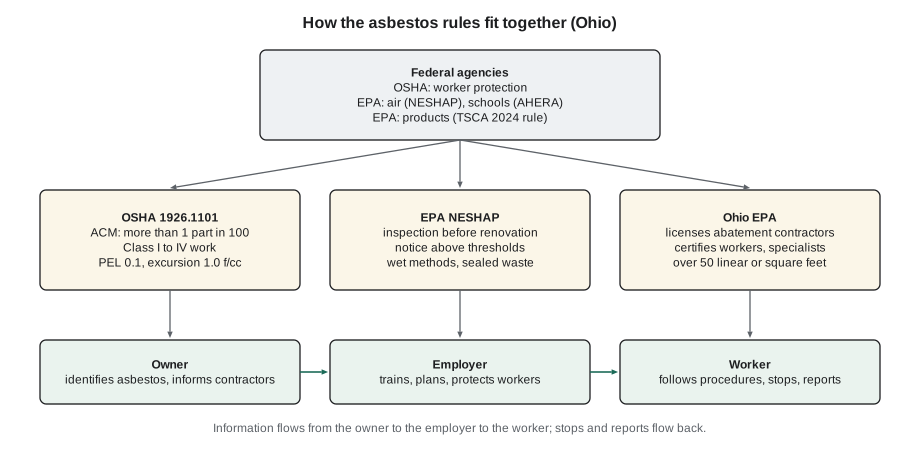
At the fourth session, on Wednesday, October 7, Mei put a single slide on the screen with four boxes: OSHA, EPA, Ohio EPA and the employer. "Every rule we follow about asbestos comes from one of these," she said. "OSHA protects workers. EPA protects the air and controls what can be sold. Ohio EPA licenses the people who remove it. And the employer, which is Coldstream, has to make sure none of you breathes it." This lesson sets out the main rules that govern asbestos for an insulator working in Ohio, what they require, and how they fit together.
You do not need to memorize section numbers. You do need to know which rules apply, what they expect of you and of the people around you, and where to look when a question comes up. Your safety coordinator and supervisor will have the current text.
Who makes the rules in the United States
In the United States, two federal agencies share most of the responsibility. The Occupational Safety and Health Administration (OSHA) sets rules to protect workers. Ohio has no state plan covering private employers, so federal OSHA standards apply directly to contractors such as Coldstream. The Environmental Protection Agency (EPA) controls air emissions during renovation and demolition, the handling of asbestos in schools, and, under the Toxic Substances Control Act (TSCA), whether asbestos products may be made and sold. States add their own requirements, and in Ohio the state EPA licenses asbestos abatement businesses and workers and administers the federal air rules.
OSHA has two asbestos standards. The construction standard, 29 CFR 1926.1101, covers demolition, removal, alteration, repair, maintenance, installation, cleanup and other construction work involving asbestos, which includes most insulation work in existing buildings and plants. The general industry standard, 29 CFR 1910.1001, covers other workplaces, such as plants where asbestos-containing equipment is operated. An insulator working on a renovation or a plant maintenance job is normally covered by the construction standard.
OSHA's construction asbestos standard
OSHA's construction standard is long and detailed. Its main elements are:
- Definitions. A material is asbestos-containing material (ACM) if it contains more than 1 part in 100 asbestos. Thermal system insulation and surfacing material in buildings constructed no later than 1980 are presumed asbestos-containing material (PACM) unless an inspection and analysis show otherwise.
- Classes of work. Asbestos construction work is divided into Class I, Class II, Class III and Class IV, from the highest-risk removal of thermal system insulation and surfacing material down to maintenance and custodial work that contacts but does not disturb asbestos (lesson 7).
- Owner's duties. Building and facility owners must determine the presence, location and quantity of ACM and PACM before work begins, and must tell employers and workers who will work in or near those areas. Owners must also post signs or labels and keep records (lesson 5).
- Exposure limits and assessment. The permissible exposure limit (PEL) is 0.1 fiber per cubic centimeter of air (f/cc) as an eight-hour time-weighted average, and the excursion limit is 1.0 f/cc averaged over 30 minutes. Employers must assess exposures and monitor them where required.
- Controls. The standard sets out regulated areas, wet methods, HEPA vacuums, prohibited practices such as dry sweeping and compressed air, enclosures for higher-risk work, protective clothing, respirators, hygiene facilities and waste handling.
- Competent person and training. Every asbestos job must have a competent person with the authority to correct problems, and training is required for each class of work, from a two-hour awareness course for Class IV to full accredited courses for Class I and II.
- Medical surveillance and records. Workers in certain classes of work, or exposed above the limits, must be offered medical examinations. Exposure records must be kept for 30 years and medical records for the duration of employment plus 30 years.
OSHA's rules also require employers on multi-employer sites to tell each other about asbestos work, so that an insulation crew is not working next to an unannounced removal. The general contractor or construction manager on a site has duties to coordinate.
EPA rules that matter
EPA's National Emission Standards for Hazardous Air Pollutants (NESHAP), in 40 CFR Part 61, Subpart M, protect the public during renovation and demolition. Before a renovation or demolition, the owner or operator must have the affected part of the facility thoroughly inspected for asbestos. If the amount of regulated asbestos-containing material to be disturbed reaches the thresholds, which for renovation are 260 linear feet on pipes, 160 square feet on other components or 35 cubic feet, EPA or the state agency must be notified, normally at least 10 working days in advance, and work practices such as keeping the material adequately wet and sealing waste in labeled leak-tight containers must be followed.
In Ohio, Ohio EPA and local air agencies administer the NESHAP rules through Ohio's own asbestos emission control rules. Ohio EPA also licenses asbestos hazard abatement contractors and certifies abatement specialists, workers and other professionals; a licensed contractor is required for abatement of more than 50 linear feet or 50 square feet of friable asbestos-containing material. The Asbestos Hazard Emergency Response Act (AHERA) requires public and private schools from kindergarten to grade 12 to have their buildings inspected by accredited inspectors, keep management plans, reinspect every three years and use accredited workers and supervisors for abatement.
Under TSCA, EPA issued a final rule in 2024 banning the ongoing uses of chrysotile asbestos, with phase-out periods for a few industrial uses such as some chlor-alkali equipment. In 2025 EPA said it would reconsider the rule, then reversed itself in July 2025 and let the court challenge go ahead; the federal appeals court heard argument in June 2026. EPA has also said it plans to propose a rule on legacy asbestos, the material already in buildings, by June 2027. These product rules do not change the worker protection rules above, but check the current status if you need it.
What the rules expect of you
The rules put most of the duties on owners, constructors and employers, but workers have duties too, and the rules only work if everyone does their part.
- Work in the way the training and procedures require, and use the protective equipment provided.
- Report hazards, including suspect material that is not on the survey, to your supervisor at once.
- Do not disturb material you are not trained and authorized to work on.
- Do not remove or defeat controls, signs, barriers or enclosures.
- Attend the training, fit testing and, where required, medical examinations.
Workers also have rights: to information about the hazards, to training in a language they understand, to see exposure records, to file a complaint with OSHA, and, in narrow circumstances, to refuse dangerous work. Lesson 6 explains how those rights relate to simply stopping work on suspect material.
Time-weighted averages
Exposure limits are written as time-weighted averages (TWAs). A TWA averages the concentration over a working day, weighting each concentration by the time it lasted. The formula is:
where each C is a concentration measured over a period of t hours. Any time not sampled counts as zero only if there was truly no exposure during it; otherwise it must be estimated or sampled. Consultants and safety coordinators do these calculations, but an insulator who understands them can read an air monitoring report and ask the right questions.
Worked problem
Checking a day's exposure against both limits
During a Class I glove bag removal by an abatement contractor near the Coldstream crew's work area, a consultant's personal air sampling on one abatement worker gave 0.05 f/cc for 2 hours, 0.15 f/cc for 3 hours and 0.02 f/cc for 3 hours. A separate 30-minute sample during the most intense part of the work gave 0.6 f/cc. Compare the results with the PEL of 0.1 f/cc and the excursion limit of 1.0 f/cc.
Show solution
- Add the products: 0.05 × 2 = 0.10; 0.15 × 3 = 0.45; 0.02 × 3 = 0.06.
- Total = 0.10 + 0.45 + 0.06 = 0.61 f/cc·h.
- TWA = 0.61 ÷ 8 = 0.076 f/cc, below the PEL of 0.1 f/cc.
- The 30-minute result of 0.6 f/cc is below the excursion limit of 1.0 f/cc.
- The three-hour period at 0.15 f/cc was above the PEL level, which shows why respirators were required during the removal.
Answer: The TWA was about 0.076 f/cc and the excursion sample 0.6 f/cc, both below their limits. The worker was protected by a respirator, which this class of work requires whatever the results turn out to be.
Air sampling for asbestos is normally analyzed by phase contrast microscopy, which counts all fibers of a certain size on a filter. It does not tell asbestos fibers from other fibers, so results can overstate asbestos exposure when other fibers are present. Where that matters, transmission electron microscopy can identify asbestos fibers specifically.
Inspections and enforcement
OSHA compliance officers inspect workplaces after complaints, referrals, incidents and under targeted programs that include asbestos and silica. They can review the owner's asbestos information, exposure assessments, training and respirator records, and interview workers. Violations lead to citations and penalties, and serious hazards must be corrected by set dates. On multi-employer sites, OSHA can cite the employer that created a hazard, the employer whose workers were exposed, the employer responsible for correcting it, and the controlling employer, such as a general contractor. Ohio EPA enforces its licensing and air rules separately, and can cite owners and contractors for working without a license, without notification or without required work practices.
Workers and their representatives can file complaints with OSHA, and can ask to accompany a compliance officer during an inspection. On union jobs, the safety committee or steward may review the owner's asbestos information and the contractors' procedures.
Where the rules can differ
Not every job falls under the construction standard. Work in shipyards and on vessels, such as Coldstream's occasional towboat and barge work, falls under OSHA's shipyard employment asbestos standard, 29 CFR 1915.1001, which is similar but not identical. Work in a plant where asbestos-containing equipment is operated may involve the general industry standard. Other states have their own state OSHA plans, licensing and notification rules, so a crew that travels for a job must learn the local version. Mei confirms which rules apply before each out-of-state or marine job.
What this means for a contractor's paperwork
For an insulation contractor, the rules translate into a set of documents that should be in place before work starts in any older building or plant:
- The owner's asbestos survey or inspection report for the work area, read and understood by the foreperson.
- A written procedure for what the crew will do if it finds suspect material, including who to call.
- Training records showing each worker's asbestos awareness training and any other hazardous materials training.
- Respirator program records: health screening, training and fit tests for each worker.
- Information from the abatement contractor about any asbestos work scheduled near the crew.
- Copies of clearance results for any area the crew will enter after abatement.
Raj Sandhu keeps a checklist of these documents for every Coldstream job in an older building. "If one of them is missing," he says, "we don't start until it isn't."
How the rules developed
The United States' asbestos rules grew out of decades of evidence and public pressure. OSHA's first asbestos standard, in the early 1970s, set a limit of 12 fibers per cubic centimeter, which was lowered in steps to 5, then 2, then 0.2 f/cc in 1986, and finally to today's 0.1 f/cc in 1994, when the current classes of construction work were introduced. EPA's NESHAP rules date from 1973, AHERA from 1986, and the 2024 TSCA rule is the latest step.
Each step lowered the limit as the evidence grew that even relatively low exposures cause disease. The long series of reductions is one reason why insulators who started work in the 1960s and 1970s were exposed at levels that today's rules would never permit.
Knowing this history helps explain the rules' structure. Each requirement, from the survey before work to the clearance after it, answers a way in which workers were harmed in the past: by not knowing asbestos was present, by working in uncontrolled dust, by carrying it home, or by returning to areas that had not been cleaned.
Common mistakes
MistakeThinking the ban means asbestos rules no longer apply to existing buildings.
InsteadThe product bans stop new use; the worker protection rules apply whenever existing asbestos may be disturbed.
MistakeTreating the limit as an amount you are allowed to breathe.
InsteadKeep exposure as low as possible; the limit is a legal maximum, not a safe level.
MistakeAssuming the owner's survey covers everything.
InsteadSurveys and lists can miss hidden material; report anything that does not match.
MistakeLeaving the rules to the abatement contractor.
InsteadEvery employer and worker on the site has duties, including stopping and reporting.
MistakeAveraging a high short-term result into a TWA and ignoring it.
InsteadHigh short periods matter; they show when protection is essential.
Summary and key terms
- OSHA protects workers through the construction asbestos standard, 1926.1101, and the general industry standard, 1910.1001.
- Under OSHA, ACM has more than 1 part in 100 asbestos; old thermal system insulation and surfacing are presumed ACM; the PEL is 0.1 f/cc and the excursion limit 1.0 f/cc over 30 minutes.
- Work is classed as Class I to IV, which sets the precautions, training and respirators; a competent person is required.
- Owners must identify ACM and PACM and inform employers and workers; EPA's NESHAP requires inspection, notification above thresholds and wet work practices.
- Ohio EPA licenses abatement contractors and certifies workers; AHERA governs asbestos in schools; the 2024 TSCA chrysotile rule bans remaining uses.
- Exposure limits are time-weighted averages; high short periods still matter.
- Permissible exposure limit (PEL)
- OSHA's legal limit: 0.1 f/cc for asbestos as an eight-hour TWA.
- Excursion limit
- OSHA's short-term limit for asbestos: 1.0 f/cc averaged over 30 minutes.
- Asbestos-containing material (ACM)
- Under OSHA, material with more than 1 part in 100 asbestos.
- Presumed asbestos-containing material (PACM)
- Thermal system insulation and surfacing material in buildings built no later than 1980, treated as ACM unless shown otherwise.
- NESHAP
- EPA's air emission rules for asbestos in renovation and demolition, 40 CFR Part 61, Subpart M.
- AHERA
- The federal law governing asbestos inspection and management in kindergarten to grade 12 schools.
- Time-weighted average (TWA)
- An average concentration over a working day, weighted by the time spent at each level.
Practice problems
Work each problem on paper first, then reveal the answer to check.
Which OSHA standard normally covers asbestos work on a renovation or plant maintenance job?
Show answer
The construction standard, 29 CFR 1926.1101.
What are OSHA's asbestos PEL and excursion limit?
Show answer
0.1 f/cc as an eight-hour TWA, and 1.0 f/cc over 30 minutes.
What is PACM?
Show answer
Thermal system insulation and surfacing material in buildings built no later than 1980, presumed to contain asbestos unless shown otherwise.
A worker's sampling shows 0.12 f/cc for 4 hours and 0.03 f/cc for 4 hours. What is the TWA?
Show answer
(0.48 + 0.12) ÷ 8 = 0.075 f/cc.
Above what amount of friable ACM does Ohio require a licensed abatement contractor?
Show answer
More than 50 linear feet or 50 square feet.
Lesson quiz · 5 questions
Score 60% or more to complete this lesson.
Create a free account to save your progress, take quizzes and earn a certificate.