
INS-230 · Lesson 9 of 12 · 21 min
Man-made mineral fibers
▶ Video coming soon A video version of this lesson is on the way.
On Wednesday, October 21, Mei set four new products on the training room table: a fiberglass pipe section with an all-service jacket, a slab of mineral wool board, a roll of white refractory ceramic fiber blanket and a roll of a newer high-temperature blanket labeled as a low-biopersistence fiber. These were safe to handle in class. She switched off the lights, shone a flashlight across the table and had Devon cut each one with a knife. Glittering specks drifted through the beam over the fiberglass and the mineral wool, and many more over the ceramic blanket. "These are the materials you work with every day," Mei said. "They are not asbestos, and they are far less dangerous than asbestos. But they are not nothing."
Man-made mineral fibers, often shortened to MMMF and also called synthetic vitreous fibers, replaced asbestos in most insulation. This lesson explains what they are, how they differ from asbestos, what health effects they have, the exposure limits that apply, and how to work with them comfortably and safely.
The main types
Man-made mineral fibers are made by melting glass, rock, slag or ceramic raw materials and spinning or blowing the melt into fibers. The main types used in insulation are:
- Glass wool (fiberglass): fibers of glass, used in pipe sections, duct wrap, duct board, batts and blankets, mostly for service up to a few hundred degrees.
- Rock wool and slag wool, together called mineral wool: fibers made from molten basalt and similar rock, or from blast furnace slag. Used in pipe sections, boards, blankets and loose fill for higher temperatures and for fire protection.
- Refractory ceramic fiber (RCF), also called aluminosilicate wool: fibers made from alumina and silica, used in blankets, boards, paper, rope and modules for furnaces, kilns, boilers, turbines and other very high-temperature work.
- Alkaline earth silicate (AES) wool: a newer high-temperature fiber made from calcium, magnesium and silica, designed to dissolve in the body much faster than RCF. Often used in place of RCF where its temperature limit allows.
- Continuous filament glass and special purpose glass fibers: textile glass used in cloths, tapes and jackets, and very fine glass microfibers used in some filters and specialty products.
Most insulators work every week with glass wool and mineral wool, and from time to time with RCF and AES on high-temperature equipment.
How these fibers differ from asbestos
Asbestos is hazardous mainly because of three properties: its fibers are extremely thin, they split lengthwise into ever finer fibrils, and they stay in the body for decades. Man-made mineral fibers differ on all three counts, though by different amounts for different types.
- Diameter. Most glass wool and mineral wool fibers are thicker than the asbestos fibers that cause disease, so a smaller share of them is respirable, able to reach the deepest part of the lung.
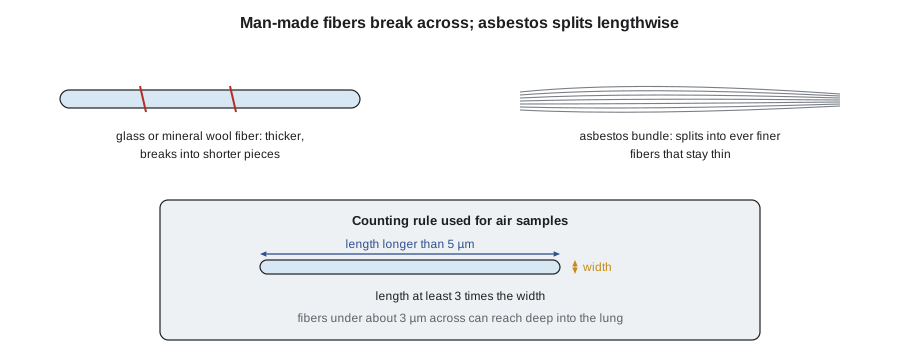
- Breaking. Man-made fibers are glassy, so they break across into shorter pieces rather than splitting lengthwise into thinner fibrils. Shorter fibers are cleared from the lung more easily.
- Biopersistence. Most glass, rock and slag wools dissolve in lung fluid over weeks to months, and AES wools faster still. RCF and some special purpose glass fibers last much longer. Biopersistence, how long a fiber survives in the lung, is now considered the key factor in a fiber's long-term hazard.
In air sampling, a fiber is counted if it is longer than 5 µm and at least three times as long as it is wide. Fibers with diameters below about 3 µm can reach the gas-exchange region of the lung. These definitions are the same as those used for asbestos counting, which is why ordinary fiber counts by phase contrast microscopy cannot tell a glass fiber from an asbestos fiber.
Health effects
For glass wool, rock wool and slag wool, the main effects are irritation:
- Skin: an itchy, prickly rash where fibers rub against the skin, especially at wrists, neck and waist. It is a mechanical irritation, not an allergy, and it clears when exposure stops.
- Eyes: redness and irritation from fibers and dust.
- Nose and throat: irritation, sneezing and coughing during dusty work.
After many years of study of manufacturing workers, the International Agency for Research on Cancer (IARC) concluded in 2001 that glass wool, rock wool, slag wool and continuous filament glass are not classifiable as to their carcinogenicity to humans (Group 3). That does not prove they are harmless, but it reflects the evidence that, as used today, they have not been shown to cause cancer in people.
RCF and certain special purpose glass fibers are different. IARC classifies them as possibly carcinogenic to humans (Group 2B), based on animal studies that found lung tumors and mesothelioma after long exposure. Studies of RCF manufacturing workers have found pleural plaques, a sign that these fibers reach the lining of the lung. RCF therefore needs more care than ordinary mineral wool, and many owners and contractors now prefer AES wool where its temperature limit allows.
Heat-aged high-temperature fibers
One further hazard applies to RCF and some other high-temperature insulations after long service at very high temperatures. Above roughly 1,830 °F, sustained for long periods, the glassy ceramic fibers can slowly crystallize (devitrify), and part of the material can turn into cristobalite, a form of crystalline silica. Removing heat-aged RCF from a furnace or kiln lining can therefore release both fibers and respirable crystalline silica. Treat after-service high-temperature insulation as a dual hazard: control the dust, use HEPA vacuums and wet methods, and wear the respirator the job requires.
Old high-temperature linings may also contain asbestos, especially in older equipment, so they are checked against the survey before any work begins, as with any other old insulation.
Exposure limits
Exposure limits for man-made fibers are usually given in fibers per cubic centimeter (f/cc), like asbestos, measured by the same counting rules.
- The American Conference of Governmental Industrial Hygienists (ACGIH), whose threshold limit values many jurisdictions and employers use, recommends 1 f/cc for glass wool, rock wool, slag wool and special purpose glass fibers, and 0.2 f/cc for RCF, as eight-hour time-weighted averages.
- The RCF manufacturers' product stewardship program, agreed with OSHA in 2002, sets a recommended exposure guideline of 0.5 f/cc for RCF and supports customers in keeping exposures low.
- OSHA has no specific limit for man-made mineral fibers; they fall under its general limits for nuisance dust, measured by weight. Coldstream, like many contractors, uses the ACGIH values as its own targets on every job.
Field research in Ontario, Canada, by IHSA, a construction safety association there, gives a useful picture of real exposures. In its samples, insulators installing pipe wrap averaged about 0.42 f/cc and those handling batts about 0.2 to 0.3 f/cc, below the 1 f/cc guideline on average, while blowing insulation and spraying fireproofing averaged about 0.66 to 0.68 f/cc. Of the RCF samples, 9 of 21 exceeded 0.2 f/cc. Ordinary installation is usually below the limits for glass and mineral wool; dusty tasks and RCF work need closer attention.
Worked problem
Comparing exposures with the guidelines
A consultant's samples on three tasks give: installing mineral wool pipe sections, 0.35 f/cc; cutting RCF blanket for a burner door, 0.28 f/cc; and removing heat-aged RCF from an old oven door, 0.62 f/cc. Compare each with the ACGIH value for its fiber type and, for the RCF tasks, with the stewardship program's guideline. If a half-mask respirator with an assigned protection factor of 10 is worn, what is the highest RCF concentration it is suitable for?
Show solution
- Mineral wool: 0.35 ÷ 1 = 0.35, about a third of the 1 f/cc value.
- Cutting RCF: 0.28 ÷ 0.2 = 1.4, so 1.4 times the ACGIH value but below the 0.5 f/cc guideline.
- Removing heat-aged RCF: 0.62 ÷ 0.2 = 3.1 times the ACGIH value, and above the 0.5 f/cc guideline. Cristobalite may also be present.
- Maximum use concentration = APF × limit = 10 × 0.2 = 2 f/cc for RCF.
- Both RCF tasks are below 2 f/cc, so a properly fitted half-mask with high-efficiency filters is suitable for the fibers; the removal task also needs silica precautions and better dust control.
Answer: The mineral wool task is well below its value; both RCF tasks exceed the ACGIH value, the removal also exceeds the 0.5 f/cc guideline, and both need respirators and dust control. A half-mask with APF 10 covers RCF up to about 2 f/cc.
Working comfortably and safely with man-made fibers
Most of what makes MMMF work safer also makes it more comfortable:
- Keep products in their packaging until you need them, and open them in the work area, not in a crowded corridor.
- Cut with a sharp knife or a saw designed for the material, not a high-speed power saw. Where power cutting is necessary, use dust extraction.
- Work with the cut edge and fibers pointing away from your face, and avoid shaking or throwing scraps.
- Clean up with a HEPA vacuum or by damp wiping; never use compressed air to blow fibers off clothing or surfaces.
- Wear loose, long-sleeved clothing buttoned at the wrists and neck, gloves and safety glasses. Disposable coveralls help on dusty work.
- Wear a respirator for dusty tasks such as blowing loose fill, spraying, cutting large quantities, working overhead in confined ceiling spaces, removing old insulation, and any RCF work. A disposable or half-mask particulate respirator is usually suitable for glass and mineral wool; RCF and heat-aged material may need more.
- Wash exposed skin with cool water and mild soap after work, without scrubbing hard, and wash work clothes separately from other laundry.
Walt applied the same thinking when Coldstream priced the Kellerton cogeneration exhaust duct in late October. The specification allowed RCF or AES blanket for the expansion joint pillows; Walt chose AES. "Same job, lower hazard, and the price difference is small," he said. "That's substitution, the second rung on Mei's ladder."
Labels and safety data sheets
Insulation products are covered by OSHA's Hazard Communication Standard, so manufacturers must provide labels and safety data sheets (SDSs) that describe the fiber type, the hazards, the exposure limits and the recommended precautions. Read the SDS for any product you have not used before, particularly high-temperature blankets and boards, and keep SDSs available at the job. Your employer must train you on the products you use.
Products made from RCF carry stronger warnings than glass or mineral wool, and their SDSs usually describe the cristobalite hazard of after-service material. If you are unsure which fiber a blanket or board is made of, check the label or SDS before cutting it.
Loose fill and vermiculite
Loose-fill insulation, blown or poured into walls, attics and cavities, is a special case. Modern loose fill is usually glass wool, mineral wool or cellulose, and blowing it is one of the dustiest insulation tasks, so it calls for a respirator, eye protection and covering clothing.
Older loose fill may be vermiculite: light, pebble-like granules, gray-brown or gold, that look a little like popcorn. Much of the vermiculite sold in North America for decades came from a mine in Libby, Montana, where the ore was contaminated with tremolite and other amphibole asbestos. Health and environmental agencies in both countries advise that vermiculite insulation should be assumed to contain asbestos unless it has been tested, and that it should not be disturbed. If you open a wall, ceiling or attic and find vermiculite, stop and report it.
Fiber products in the shop
Insulators also handle man-made fibers in the shop: cutting fitting covers from pipe sections, making removable blankets from glass or ceramic cloth and mineral wool, and fabricating board for equipment. The same controls apply, with some extra opportunities:
- Use band saws and cutting tables with dust extraction for rigid insulation, and keep the extraction serviced.
- Clean benches and floors with a HEPA vacuum at the end of each task, not a broom or compressed air.
- Store opened products in closed bins, not on open shelves where fibers can be knocked loose.
- Keep sewing and blanket-making areas separate from break areas.
Tomasz Nowicki's shop at Coldstream has a downdraft table for cutting fitting covers and blanket insulation. When it was installed in 2019, the shop's fiber counts during cutting dropped to about a third of what they had been.
Common mistakes
MistakeTreating fiberglass itch as an allergy to avoid the trade.
InsteadIt is a mechanical irritation that loose, covered clothing and good hygiene control.
MistakeBlowing fibers off clothing with compressed air.
InsteadUse a HEPA vacuum or remove the outer layer; compressed air drives fibers into the air and the skin.
MistakeHandling RCF the same way as ordinary mineral wool.
InsteadRCF has a lower exposure value and needs more dust control and respiratory protection.
MistakeRipping out old furnace linings without checking the survey.
InsteadOld high-temperature linings may contain asbestos, and heat-aged RCF may contain cristobalite.
MistakeCutting batts with a power saw for speed.
InsteadCut with a knife, or use extraction when power cutting is unavoidable.
Summary and key terms
- Man-made mineral fibers include glass wool, rock and slag wool, refractory ceramic fiber, alkaline earth silicate wool and textile glass.
- They are generally thicker than asbestos, break across rather than splitting, and most dissolve in the lung much faster; biopersistence is the key factor.
- Glass, rock and slag wools mainly cause skin, eye and airway irritation; IARC places them in Group 3.
- RCF and some special purpose glass fibers are possibly carcinogenic (Group 2B) and need more care; heat-aged RCF may contain cristobalite.
- Common guideline values are 1 f/cc for glass, rock and slag wool and 0.2 f/cc for RCF, with an industry RCF guideline of 0.5 f/cc.
- Cut with knives, avoid compressed air, use HEPA vacuums, wear covering clothing, eye protection and respirators for dusty tasks, and read the SDS.
- Man-made mineral fibers (MMMF)
- Fibers manufactured from melted glass, rock, slag or ceramic materials; also called synthetic vitreous fibers.
- Refractory ceramic fiber (RCF)
- A high-temperature aluminosilicate fiber that is more biopersistent than glass or mineral wool.
- Alkaline earth silicate (AES) wool
- A high-temperature fiber designed to dissolve quickly in the body.
- Biopersistence
- How long a fiber survives in the lung before it dissolves or is cleared.
- Devitrification
- The slow crystallization of glassy fibers at very high temperatures, which can form cristobalite.
- Threshold limit value (TLV)
- An exposure guideline published by the ACGIH.
- Respirable fiber
- A fiber thin enough to reach the deepest part of the lung, generally under about 3 µm in diameter.
Practice problems
Work each problem on paper first, then reveal the answer to check.
Name the four main types of man-made mineral fiber used in insulation.
Show answer
Glass wool, rock or slag wool (mineral wool), refractory ceramic fiber and alkaline earth silicate wool.
Why is biopersistence important?
Show answer
Fibers that dissolve or clear quickly have less time to cause long-term damage; it is considered the key factor in fiber hazard.
What extra hazard can heat-aged RCF present?
Show answer
Part of it may have turned into cristobalite, a form of crystalline silica.
A sample during RCF cutting shows 0.30 f/cc. How does it compare with the ACGIH value and the industry guideline?
Show answer
1.5 times the 0.2 f/cc ACGIH value, and below the 0.5 f/cc guideline.
Why should you not use compressed air to clean fibers off your clothes?
Show answer
It throws the fibers into the air and drives them into the skin; use a HEPA vacuum or remove the outer layer.
Lesson quiz · 5 questions
Score 60% or more to complete this lesson.
Create a free account to save your progress, take quizzes and earn a certificate.