
INS-230 · Lesson 10 of 12 · 21 min
Lead and other coatings
▶ Video coming soon A video version of this lesson is on the way.
On Monday, October 26, Wendell Ashby and Bernie walked through the Kellerton engine room with Lou Brisebois, the plant's maintenance manager, to look at an old hot water storage tank that the plant wanted reinsulated in the new year. The tank was about fifty years old, painted a dull gray over an orange primer that showed through at the scratches. Wendell's first thought was the usual one for a tank that size: weld insulation pins to the shell. Bernie's first question was about the paint. Lou checked the plant's hazardous materials survey on his tablet. The paint on the engine room tanks and structural steel had been tested by the plant's consultant in 2019: lead, at levels well above what the survey called lead-containing. "Then nobody's welding pins on that," Bernie said.
This lesson covers lead, the most common hazardous coating an insulator meets, and briefly some other old coatings and residues: polychlorinated biphenyls (PCBs), coal tar, chromates and mercury. As with asbestos, the aim is to recognize where these hazards are likely, understand how exposure happens, know the rules, and avoid creating the exposure in the first place.
Where insulators meet lead
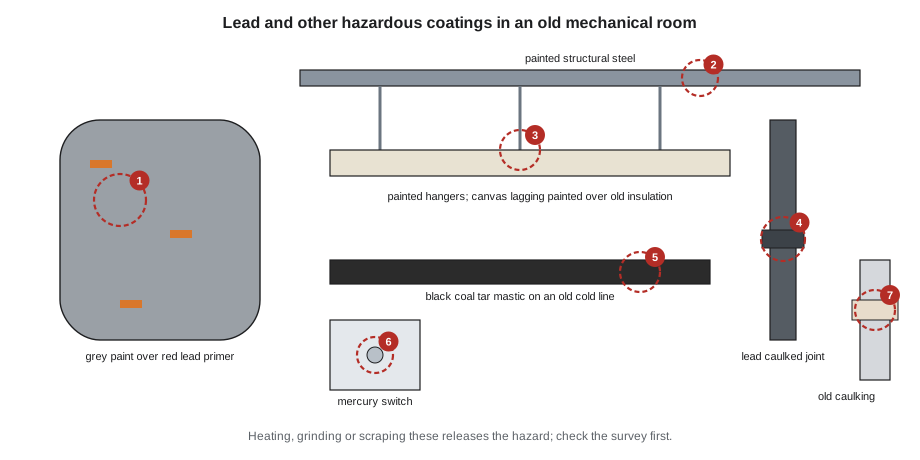
Lead was used in paints and primers for most of the twentieth century because it made them durable and helped prevent rust. Red lead primer, orange in color, was standard on structural steel and tanks for decades. Lead-based paints were used on pipes, hangers, equipment, railings and the canvas lagging over old pipe insulation. Lead is also found in:
- Old solder on copper pipe and fittings, and in the lead caulking of old cast iron drain joints.
- Lead sheet used for sound control in some older mechanical rooms and for radiation shielding in the walls and doors of hospital imaging rooms.
- Some old flashing, roof drains and gaskets.
- Dust and debris in old plants and buildings, where paint has flaked or been sanded over the years.
Intact lead paint is not a hazard to touch briefly. Lead enters the body when it is breathed as dust or fume, or swallowed as dust from hands, food, cigarettes and drinks. Insulation work can create both:
- Heating lead paint: welding pins, studs or clips onto painted steel, torch cutting painted hangers or supports, or using heat guns. Heat creates lead fume, the most hazardous form, which is fine enough to be breathed deep into the lungs.
- Mechanical disturbance: grinding, sanding, wire brushing or scraping painted surfaces to prepare them for adhesive pins or to remove old insulation clips; cutting or drilling painted steel.
- Handling debris: removing old painted lagging or jacket, or cleaning up paint chips and dust.
How lead harms the body
Lead is a poison that builds up in the body over time. Once absorbed, it travels in the blood and is stored in the bones, from which it can be released for years. It affects many systems:
- Nervous system: headaches, irritability, fatigue, poor concentration and memory problems; at high levels, damage to the nerves of the hands and feet.
- Kidneys and blood: kidney damage, anemia and high blood pressure.
- Digestive system: stomach pain, nausea and constipation.
- Reproduction: reduced fertility in men and women, and harm to an unborn child.
Children are especially vulnerable, because lead harms the developing brain at very low levels. Lead dust carried home on clothing, boots, tools and in vehicles has poisoned workers' children. Early symptoms of lead poisoning in adults are vague and easily mistaken for other illnesses, which is why blood lead testing is used to check exposed workers.
OSHA's lead standard for construction
OSHA's lead standard for construction, 29 CFR 1926.62, sets a permissible exposure limit of 50 micrograms of lead per cubic meter of air (50 µg/m³) as an eight-hour time-weighted average, and an action level of 30 µg/m³. When workers are exposed for more than eight hours in a day, the PEL is reduced: it becomes 400 divided by the number of hours worked.
Employers must assess exposures. For certain trigger tasks, such as manual scraping and sanding of lead paint, using heat guns, and torch cutting, burning and welding on lead-painted surfaces, the standard requires interim protection, including respirators, protective clothing, hygiene facilities and blood lead testing, until an exposure assessment shows exposures are below the PEL. Workers exposed at or above the action level for more than 30 days a year must be offered blood lead testing and medical examinations, and workers with high blood lead levels must be removed from exposure with their pay and benefits protected.
The standard also requires washing facilities, clean areas for eating, protective clothing that stays at work, HEPA vacuums or wet methods for clean-up rather than dry sweeping or compressed air, training and signs at work areas.
Worked problem
Checking a lead result on a long shift
At the Kellerton tank, three ways of attaching insulation were considered: (a) welding pins to the painted shell; (b) hand scraping paint off small spots so that adhesive pins could be glued on; (c) clamp-on support rings and banding that do not disturb the paint. A consultant's sample from similar hand scraping elsewhere in the plant, on a 10-hour shift, gave a time-weighted average of 36 µg/m³. What is the adjusted PEL for a 10-hour shift, and how does the result compare with it and with the action level? Which option avoids the lead hazard?
Show solution
- Adjusted PEL = 400 ÷ hours worked = 400 ÷ 10 = 40 µg/m³.
- 36 µg/m³ is below the adjusted PEL of 40 µg/m³, but above the action level of 30 µg/m³.
- Because the result is above the action level, the action level requirements, such as monitoring and medical surveillance for workers exposed more than 30 days a year, apply.
- (a) Welding on lead paint is a trigger task with high interim protection requirements because it creates fume.
- (c) does not disturb the paint at all, so it avoids the lead exposure entirely.
Answer: The adjusted PEL is 40 µg/m³; the 36 µg/m³ result is below it but above the action level. Option (c) avoids the lead hazard and was chosen.
Wendell's plan for the Kellerton tank, written up for a January 2027 job, uses clamp-on support rings and banding to hold the insulation, so that nobody needs to weld, grind or scrape the lead paint. Where a fastener must be attached to the shell, the plant will have the paint removed at those spots by trained workers first.
Working safely around lead
On jobs where lead paint is present, the most effective step is to avoid disturbing it, as Wendell did. Where disturbance cannot be avoided, the controls follow the same pattern as for the other hazards in this course:
- Find out first. Check the survey for lead in paints and coatings before cutting, welding, grinding or scraping any painted surface in an older building or plant. If there is no information, ask for testing.
- Choose low-dust, low-heat methods: mechanical cutting with hand tools or shears instead of torch cutting; clamps and bands instead of welded pins; chemical stripping or HEPA-extracted tools instead of open grinding.
- Have paint removed at hot work locations by trained workers before welding or cutting.
- Use HEPA vacuums and wet wiping for clean-up; never dry sweep or blow lead dust.
- Wear the respirator and protective clothing the task requires, and leave the clothing at work.
- Wash your hands and face before eating, drinking or smoking, and never eat, drink or smoke in the work area.
- Change out of work clothes and boots before going home, and keep work clothes separate from family laundry.
Other hazardous coatings and residues
Several other old materials deserve awareness. They are less common than lead or asbestos, but each can turn up on insulation work in older buildings and plants.
- Polychlorinated biphenyls (PCBs). PCBs were used from the 1930s to the late 1970s in electrical equipment and also in some paints, caulks, sealants, adhesives and coatings. Old caulking around penetrations and old coatings in mechanical rooms may contain them. PCBs are toxic and persistent, and EPA rules control their use, removal and disposal. If a survey lists PCBs, or you find old caulking or coatings that are not described, treat them as suspect and ask.
- Coal tar and pitch. Old vapor barrier mastics on cold lines, some old roofing and some pipe coatings were made from coal tar, which contains polycyclic aromatic hydrocarbons (PAHs), some of which cause cancer. They can irritate and burn the skin, especially in sunlight. Avoid heating or grinding them, wear gloves and long sleeves, and wash skin promptly.
- Chromate and cadmium coatings. Some old primers and platings contain chromium or cadmium compounds. Grinding, cutting or welding them can release hexavalent chromium or cadmium fume, both serious hazards. Check the survey before hot work on old coated metal.
- Mercury. Old thermostats, pressure switches, manometers, thermometers and some lamps contain mercury. If you must work around old controls and gauges, do not break them; report broken mercury devices so they can be cleaned up properly.
- Old mastics and adhesives. Some old duct sealants, vapor barrier mastics and adhesives contain asbestos as well. Treat them as suspect until the survey says otherwise.
The pattern is always the same: older material of unknown makeup is suspect, the survey is the first source of information, heating and grinding are the most hazardous ways to disturb it, and stopping to ask is always acceptable.
Testing for lead
Whether a coating contains lead is decided by testing, not by color or age, although age is a strong clue. The common methods are:
- X-ray fluorescence (XRF): a hand-held instrument that measures lead in paint without removing it. It gives quick results on site and is used by consultants for paint surveys.
- Paint chip analysis: a small sample of paint, through all layers, is removed and analyzed in a laboratory. It is more precise but disturbs the paint.
- Air and wipe sampling: used during and after lead work to measure exposure and check clean-up.
Spot test kits sold to the public can show the presence of lead but are not reliable enough to decide that a coating is lead-free for construction work. As with asbestos, the consultant chooses the method and takes the samples; the insulator reads the result and asks if anything is unclear.
Lead in hospitals
Hospitals contain a particular kind of lead that insulators sometimes meet: radiation shielding. The walls, floors, ceilings and doors of X-ray, CT and other imaging rooms may be lined with lead sheet or lead-lined drywall, and pipe and duct penetrations through those walls must be shielded too.
- Drilling or cutting through lead-lined walls creates lead dust and can break the shielding. It is done only with the hospital's approval, under its procedures.
- Any opening through a shielded wall must be restored with shielding as specified, usually checked by the hospital's radiation safety officer or a physicist.
- Lead sheet should be handled with gloves, and hands washed before eating or smoking.
At Mountview, two of the new mains passed near a shielded imaging room in the old south wing, but the route stayed outside the shielded walls, so no penetrations were needed.
Lead and other hazards together
Old coatings rarely come alone. A hanger with lead paint may support pipe with asbestos cement on its fittings; an old tank may have both lead primer and asbestos block under a newer finish. When a survey lists several hazards in one place, the controls must cover all of them, and the strictest requirement usually decides how the work is done. At Mountview, the lead-painted hangers on the abandoned line were removed by the asbestos abatement contractor inside the asbestos enclosure, cut with hand tools so that no lead fume was created, and disposed of with the asbestos waste.
Coldstream's own rule on older jobs is that no hot work, grinding or wire brushing is done on any painted surface until the survey or a test confirms whether the paint contains lead, and Mei's hot work permit form has a line for it. Where a lead trigger task cannot be avoided, the crew works under the interim protection the standard requires until an exposure assessment has been done, and Mei arranges blood lead testing before and after the work.
Common mistakes
MistakeWelding insulation pins onto old painted steel without checking the paint.
InsteadCheck the survey for lead first; heating lead paint creates lead fume.
MistakeTorch cutting old painted hangers in an enclosed room.
InsteadUse hand tools or shears, or have the paint removed first by trained workers.
MistakeEating lunch in the work area after scraping paint.
InsteadWash hands and face first and eat in a clean area.
MistakeWearing work boots and clothing home from a lead job.
InsteadChange before leaving; lead dust carried home harms children.
MistakeGrinding off an old black mastic to prepare a surface.
InsteadOld mastics may contain coal tar or asbestos; check the survey and avoid grinding.
Summary and key terms
- Lead was used in paints and primers for most of the twentieth century and is common on old steel, tanks, hangers, pipe and lagging.
- Lead enters the body by breathing dust or fume or swallowing dust; heating lead paint by welding or torch cutting creates the most hazardous exposure.
- Lead harms the nervous system, kidneys, blood, digestive and reproductive systems; children are especially vulnerable to take-home lead.
- OSHA's construction PEL is 50 µg/m³, reduced for shifts over eight hours, with an action level of 30 µg/m³ and interim protection for trigger tasks.
- Avoid disturbing lead paint where possible, choose low-dust and low-heat methods, use HEPA clean-up and good hygiene.
- PCBs, coal tar, chromates, cadmium, mercury and old mastics may also be present; treat unknown old coatings as suspect.
- Red lead primer
- An orange lead-based primer once standard on structural steel and tanks.
- Lead fume
- Very fine lead particles formed when lead or lead paint is heated, easily breathed deep into the lungs.
- Blood lead test
- A blood test that measures the amount of lead absorbed into the body.
- Take-home exposure
- Exposure of family members to a hazard carried home on clothing, tools or vehicles.
- Polychlorinated biphenyls (PCBs)
- Toxic, persistent chemicals once used in electrical equipment and some paints, caulks and coatings.
- Coal tar
- A black material made from coal, used in old mastics and coatings, that contains cancer-causing PAHs.
- Maximum use concentration
- The highest concentration for which a respirator is suitable: its assigned protection factor times the exposure limit.
Practice problems
Work each problem on paper first, then reveal the answer to check.
Why is welding insulation pins onto lead-painted steel especially hazardous?
Show answer
The heat creates lead fume, which is fine enough to be breathed deep into the lungs.
What are OSHA's construction lead PEL and action level?
Show answer
50 µg/m³ and 30 µg/m³ as eight-hour TWAs.
What is the adjusted lead PEL for a 12-hour shift?
Show answer
400 ÷ 12 = 33 µg/m³.
What is the maximum use concentration of an APF 50 respirator for lead?
Show answer
50 × 50 = 2,500 µg/m³.
Name two hazardous old coatings or residues other than lead.
Show answer
PCBs, coal tar, chromate or cadmium coatings, mercury, asbestos-containing mastics (any two).
Lesson quiz · 5 questions
Score 60% or more to complete this lesson.
Create a free account to save your progress, take quizzes and earn a certificate.