
INS-230 · Lesson 1 of 12 · 24 min
Why older insulation can be hazardous
▶ Video coming soon A video version of this lesson is on the way.
On Wednesday evening, September 16, 2026, Mei Zhou opened the first of her hazardous materials sessions in the training room above the Coldstream shop. Eleven people sat at the tables: Devon Marsh, Tessa Moreau, Priya Lam, three other apprentices, two new journeyworkers from another contractor, and Bernie Valois, who had asked to sit in. On the screen was a black-and-white photograph from the 1950s: a crew of insulators in a ship's engine room, sleeves rolled up, mixing a gray cement in a bucket with their bare hands. Nobody in the photograph wore a mask. "Most of the men in this picture were dead before they were sixty-five," Mei said. "Not from falls or burns. From the dust in that bucket."
This course is about the hazardous materials an insulator can meet in older buildings and plants: asbestos above all, but also crystalline silica, man-made mineral fibers, lead and other old coatings. It is an awareness course. It teaches you to recognize materials that may be hazardous, to understand how they harm people, to know the rules that protect you, and to stop and get help before you disturb something you are not trained and authorized to handle. It does not train you to remove asbestos. That work belongs to specially trained and certified workers, and later lessons explain who they are and how the rules decide who may do what.
This first lesson explains why older insulation needs special care, what hazards hide in older insulation systems, why insulators in particular have paid such a high price, and the basic attitude that protects you: treat old insulation as hazardous until someone qualified has shown that it is not.
A material that seemed perfect
For most of the twentieth century, asbestos looked like the ideal insulating material. It is a mineral that occurs as bundles of extremely fine fibers. It does not burn, it resists heat and many chemicals, it is strong, it can be spun into yarn and woven into cloth, and it mixes well with binders such as magnesium carbonate, calcium silicate, clay and Portland cement. It was also cheap and plentiful. From the late 1800s until the 1970s, insulators used it on almost everything hot: boilers, steam pipe, turbines, ovens, kilns, tanks, breeching and ship machinery.
Asbestos was used in insulation in several forms. Pipe was covered with molded sections made of magnesia or calcium silicate with asbestos fiber as a reinforcement, or with corrugated asbestos paper known as aircell. Fittings, valves and irregular shapes were finished with an insulating cement, often called mud, which an insulator mixed with water and trowelled on by hand. Boilers and tanks were covered with asbestos block and finished with cement. The finish over pipe and fittings was often a canvas or asbestos cloth lagging, painted or sealed. Gaskets, rope packing, tape and cloth on doors and expansion joints also contained asbestos. Lesson 2 covers these products and how to recognize the places where they are likely to be found.
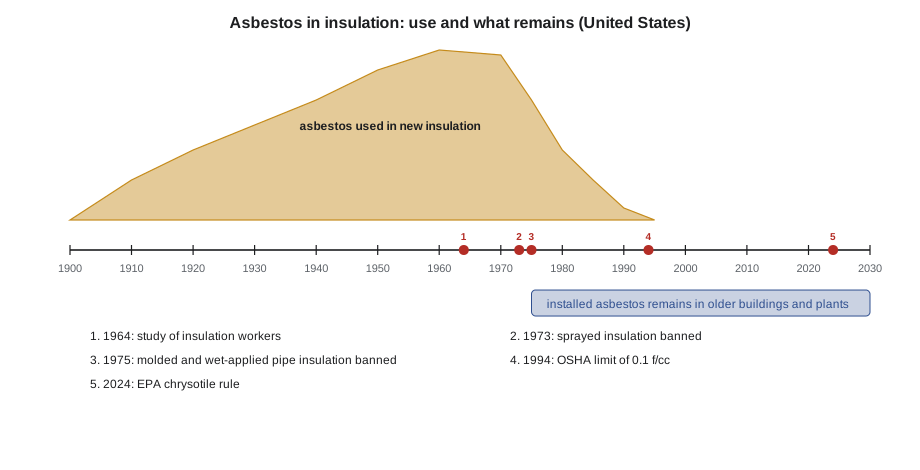
In the United States, asbestos use in insulation peaked in the 1960s and early 1970s. Federal air rules banned sprayed-on asbestos insulation in 1973 and molded and wet-applied asbestos pipe insulation in 1975, and later rules restricted other uses. A broad 1989 ban was largely overturned in court in 1991, so many asbestos products stayed legal for decades. In 2024 the Environmental Protection Agency (EPA) issued a rule banning the remaining uses of chrysotile asbestos, with phase-out periods for a few industrial uses. None of these rules require owners to remove asbestos that is already in place, so a great deal of it remains in buildings and plants built before the 1980s.
That is the key fact for an insulator today. You will not be asked to install asbestos. But maintenance, repair, renovation and demolition work all bring you into contact with insulation systems that were installed fifty or more years ago, and many of those systems contain asbestos, sometimes under newer insulation and jackets that hide it completely.
The hazards that hide in older insulation systems
Asbestos is the most serious hazard in older insulation, but it is not the only one. When you open up an old system, you may meet several hazards at once:
- Asbestos in pipe covering, block, cement, cloth, tape, gaskets and rope, and in the dust and debris that has fallen from damaged insulation over the years.
- Crystalline silica in some old cements and refractories, and in the concrete and masonry around the work. Drilling, coring, grinding or sweeping can make silica dust that scars the lungs (lesson 8).
- Man-made mineral fibers: glass wool, rock and slag wool and refractory ceramic fiber, which replaced asbestos in many uses. They are much less hazardous than asbestos, but they irritate skin, eyes and airways, and some high-temperature fibers need more care (lesson 9).
- Lead in old paints and primers on pipe, hangers, tanks and structural steel, and in some old coatings on canvas lagging. Cutting, grinding, heating or welding painted steel can release lead fume and dust (lesson 10).
- Other coatings and residues: some old mastics and caulks contain polychlorinated biphenyls (PCBs) or coal tar, some old equipment has mercury switches or gauges, and wet insulation can grow mold.
- Biological hazards in plant ceilings and pipe racks: bird and bat droppings can carry diseases when the dried material is disturbed.
None of these can be identified reliably by looking. Old insulation that looks white and chalky may be calcium silicate with or without asbestos. A gray cement on an elbow may be an asbestos cement or a modern mineral wool cement. Even an experienced insulator cannot tell asbestos from a substitute by eye, which is why the rules depend on surveys and laboratory analysis, and why a careful worker treats any old material as suspect until it has been tested.
Why insulators paid the highest price
Many trades worked with asbestos, but insulators were among the most heavily exposed. They cut, sawed and fitted asbestos pipe covering every day, mixed dry asbestos cement by hand, ripped out old insulation without protection, and worked in boiler rooms and ship holds full of dust. Their families were exposed as well, through dust carried home on work clothes.
In 1964, a physician named Irving Selikoff and his colleagues published a study of members of insulation workers' union locals in the New York and New Jersey area. It found far more deaths from lung cancer, from asbestosis and from mesothelioma, a cancer of the lining of the chest and abdomen, than would have been expected in men of the same ages. Later studies of insulation workers across the United States and Canada confirmed the pattern. The insulators' union worked with the researchers, and those studies became some of the strongest evidence behind the rules that protect workers today.
Bernie told the group about her uncle Gerard, an insulator who started in the trade in the early 1960s. "He was the one who got me into this work," she said. "He used to say the dust in the boiler rooms was so thick you could write your name on the pipe. He was diagnosed with mesothelioma in 2010 and died the next year, almost fifty years after his first job. Everything Mei is going to tell you about stopping work and calling for a survey, I learned the hard way, watching him."
The lesson for today's insulator is not that the trade is dangerous. It is that the danger is hidden, delayed and preventable. The diseases caused by asbestos appear decades after the exposure, so nobody feels sick on the day the damage is done. The only protection is to prevent the exposure in the first place.
How exposure happens
Asbestos harms people only when its fibers get into the air and are breathed in, or, less commonly, swallowed. A material that is intact, sealed and left alone releases very few fibers. The danger comes when it is disturbed: cut, broken, sanded, drilled, scraped, ripped off, crushed or swept up.
The rules use the word friable for material that can be crumbled, pulverized or reduced to powder by hand pressure when dry. Most old pipe covering, aircell, block and cement is friable, especially when it is old, dry or damaged. Friable material releases fibers easily. Non-friable materials, such as asbestos cement pipe or some vinyl products, hold their fibers more tightly, but they can still release fibers when they are broken, ground or cut with power tools.
Asbestos fibers are so small that you cannot see the ones that matter. A visible cloud of dust tells you that a great many fibers are in the air, but a clear-looking room can still contain a hazardous level. Fibers also settle on surfaces, on top of ceiling tiles, on beams and on old jackets, and they are stirred back into the air when someone moves the tiles or brushes the beam. That is why debris and dust near old insulation are treated with the same care as the insulation itself.
Exposure can also travel. Fibers on clothing, boots, tools and vehicles can expose people who were never near the work, including family members at home. Much of the hygiene in lesson 11 exists to stop that.
The basic attitude: suspect, stop, ask
Everything in this course rests on one attitude, which Bernie puts in plain words: "Old mud is guilty until the survey says it isn't." In practice it means:
- Before work starts, find out what the owner knows. Owners are required to identify hazardous materials and tell contractors about them. Read the report or survey for your work area, and ask questions if anything is unclear (lesson 5).
- Compare what you see with what the survey says. Surveys can be incomplete. Material hidden under newer insulation or behind walls and ceilings may never have been sampled.
- If you find something that may contain asbestos and is not clearly identified as safe, stop. Do not touch it, break it, sample it or clean it up. Keep others away and report it to your supervisor (lesson 6).
- Leave removal to the people trained, certified and equipped for it. Coldstream's rule is simple: our crews do not remove or disturb asbestos-containing material in any amount (lesson 7).
- Use the controls and protective equipment the job requires for the hazards you are cleared to work with, and keep your respirator fitted and maintained (lesson 11).
Mei summed it up for the group: "You are not expected to know whether that gray stuff is asbestos. You are expected to know that you don't know, and to stop before you find out the hard way."
Controls in the right order
Safety professionals rank controls from most effective to least effective. The order applies to every hazard in this course:
| Level | What it means | Example with old insulation |
|---|---|---|
| Elimination | Remove the hazard before the work | The owner has the asbestos removed by an abatement contractor before the insulators start |
| Substitution | Use a less hazardous material or method | Modern insulation replaces old; a low-dust method replaces a dusty one |
| Engineering controls | Change the equipment or workplace | Enclosures, wetting, local exhaust, tools with dust shrouds and HEPA vacuums |
| Administrative controls | Change how and when people work | Surveys, permits, training, signs, keeping people out of the area |
| Personal protective equipment | Protect the individual worker | Respirators, disposable coveralls, gloves, eye protection |
For asbestos, elimination is the normal approach on insulation work: the owner's abatement contractor removes the asbestos-containing material from the work area, the area passes air testing, and only then do the insulators begin. For silica and lead, engineering controls such as dust extraction and wet methods do most of the work. Respirators are essential, but they come last because they protect only the person wearing them, and only when they fit and are used correctly.
Worked problem
Reading the history of a pipe run
At Kellerton Foods, the steam header in the boiler house was installed in 1966. The plant's survey says the header was stripped and reinsulated with mineral wool in 2004, except for two valves and one flange pair, which kept their original asbestos cement until an abatement contractor removed them in October 2026. During the November outage, Devon found a tee covered with an old cement that did not appear on the survey. Work out which parts of the system should have been treated as suspect, and why.
Show solution
- The header dates from 1966, well within the period when asbestos insulation was normal, so any original material is suspect.
- The 2004 mineral wool is recorded as asbestos-free, but only the parts actually replaced can be trusted; the survey depends on what was opened and sampled.
- The valves and flange pair were known asbestos and were removed before the outage, so those locations are cleared only if clearance air testing was done (it was).
- The tee was not on the survey, its cement looked old and it was under a newer jacket, so it was an unknown original material: suspect until sampled.
- Laboratory analysis later showed chrysotile asbestos in the tee cement.
Answer: Everything original to 1966 that was not documented as replaced or tested should have been treated as suspect. The tee was such a part; stopping before disturbing it was correct.
The example shows why a survey is the beginning of the answer, not the end. A survey records what was found where samples were taken. Old systems were patched, extended and partly replaced many times, and pieces of the original insulation often survive in places nobody expected.
What the rest of this course covers
Lessons 2 and 3 describe asbestos itself: where it was used, what the products look like and how it harms the body. Lesson 4 sets out the laws that govern it, lesson 5 explains surveys, sampling and labels, lesson 6 covers stopping work, and lesson 7 explains who is allowed to remove asbestos. Lessons 8, 9 and 10 cover silica and other dusts, man-made mineral fibers, and lead and other coatings. Lesson 11 covers respirators, fit testing and hygiene, and lesson 12 follows a real renovation at Mountview Hospital, where a crew opened a ceiling and found something the survey had missed.
Common mistakes
MistakeAssuming that old insulation is safe because it looks like modern material.
InsteadAsbestos cannot be identified by eye; treat old material as suspect until a survey or laboratory result shows otherwise.
MistakeThinking that a clear-looking room is free of fibers.
InsteadThe fibers that matter are invisible; use the survey and air testing, not your eyes.
MistakeBelieving that asbestos is no longer a problem because it has been banned.
InsteadThe bans stop new use; they do not remove the asbestos already installed in older buildings and plants.
MistakeRelying on a respirator instead of on the survey and abatement.
InsteadRespirators are the last line of defense; the first is not disturbing asbestos at all.
MistakeCleaning up a little debris from old insulation to be helpful.
InsteadDebris and settled dust are as hazardous as the insulation; leave them for the abatement contractor.
Summary and key terms
- Asbestos was widely used in insulation from the late 1800s until the 1970s, and much of it remains in older buildings and plants.
- Old insulation systems can also contain silica, man-made fibers, lead and other hazardous coatings, and none of these can be identified by eye.
- Insulators were among the most heavily exposed workers, and studies of insulation workers showed high rates of lung cancer, asbestosis and mesothelioma.
- Asbestos harms people when fibers are released into the air by disturbance; friable materials release fibers easily, and settled dust can be stirred up again.
- The basic attitude is to suspect old material, stop before disturbing it, and ask for the survey and qualified help.
- Controls work best in order: elimination, substitution, engineering controls, administrative controls and, last, protective equipment.
- Asbestos
- A group of naturally occurring minerals that form bundles of fine, strong, heat-resistant fibers.
- Friable
- Able to be crumbled, pulverized or powdered by hand pressure when dry.
- Aircell
- Pipe covering made of corrugated asbestos paper, common in older buildings.
- Insulating cement (mud)
- A cement mixed with water and trowelled onto fittings and equipment; older types often contained asbestos.
- Mesothelioma
- A cancer of the lining of the chest or abdomen, strongly linked to asbestos exposure.
- Abatement
- The removal, enclosure or encapsulation of asbestos-containing material by trained and authorized workers.
- Hierarchy of controls
- The ranking of hazard controls from elimination, the most effective, to personal protective equipment, the least.
Practice problems
Work each problem on paper first, then reveal the answer to check.
Name four hazardous materials besides asbestos that an insulator may meet in an older system.
Show answer
Crystalline silica, man-made mineral fibers, lead in paints, PCBs or coal tar in old mastics, mercury, mold and droppings (any four).
Why can't an experienced insulator identify asbestos by looking at it?
Show answer
Asbestos and its substitutes look alike; only laboratory analysis of a sample can confirm whether asbestos is present.
What does friable mean, and why does it matter?
Show answer
Material that can be crumbled by hand pressure when dry; friable material releases fibers easily when disturbed.
What is the first-choice control for asbestos insulation that is in the way of the work?
Show answer
Elimination: have it removed by an abatement contractor before the insulation work starts.
Why are debris and settled dust near old insulation treated like the insulation itself?
Show answer
They may contain the same fibers, and moving or sweeping them puts the fibers back into the air.
Lesson quiz · 5 questions
Score 60% or more to complete this lesson.
Create a free account to save your progress, take quizzes and earn a certificate.