
INS-230 · Lesson 11 of 12 · 23 min
Respirators, fit testing and hygiene
▶ Video coming soon A video version of this lesson is on the way.
Saturday, October 17, was fit test day at the Coldstream shop. Mei had set up two stations in the training room: a qualitative test with a hood and a bitter-tasting test solution, and a quantitative test with a particle-counting instrument connected to a probed respirator. Devon went first. He failed the qualitative test in the first minute; he could taste the solution while turning his head. Mei looked at his chin. "When did you last shave?" Thursday, he admitted. He shaved in the washroom with a disposable razor, came back, and passed easily in a medium half-mask. Wendell Ashby, who wears a beard for religious reasons, was not fit tested for a tight-fitting mask at all. Mei had already issued him a loose-fitting powered air-purifying respirator with a hood, which seals at the neck and shoulders rather than against the face.
Respirators are the last line of defense in the hierarchy of controls, but on many insulation jobs they are essential. This lesson covers the main types of respirators, how protection factors are used to choose one, fit testing and seal checks, maintenance, and the hygiene practices that keep contamination off you and out of your home.
Types of respirators
Respirators fall into two families. Air-purifying respirators clean the air you breathe by passing it through filters or cartridges. Atmosphere-supplying respirators give you clean air from another source.
- Filtering facepiece respirators: disposable masks, such as the common N95, in which the mask itself is the filter. Light and convenient, but they must still fit and seal.
- Elastomeric half-mask respirators: a reusable rubber or silicone mask covering the nose and mouth, with replaceable filters or cartridges. The standard respirator for most insulators.
- Full-facepiece respirators: cover the whole face, give a better seal and protect the eyes as well.
- Powered air-purifying respirators (PAPRs): a battery-powered blower pushes air through filters to a tight-fitting mask or to a loose-fitting hood or helmet. They are easier to breathe through and, with a hood, can be worn with facial hair.
- Supplied-air respirators and self-contained breathing apparatus (SCBA): deliver air from a compressor, cylinders or an air line. Used for the highest-risk work, oxygen-deficient atmospheres and some abatement work.
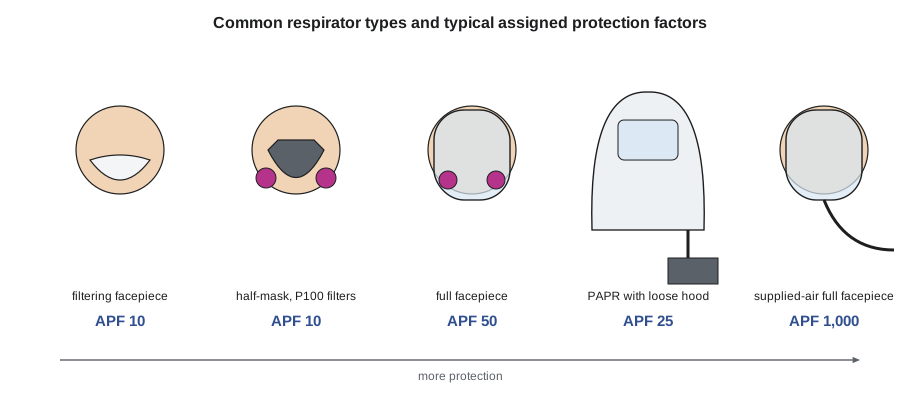
Particulate filters are rated by their efficiency and their resistance to oil. N filters are not resistant to oil, R filters are somewhat resistant, and P filters are strongly resistant. The number gives the minimum filtering efficiency: 95, 99 or 100 (meaning 99.97). P100 filters, colored magenta, are the usual choice for asbestos, silica, lead and fibers. Gas and vapor cartridges, such as those for organic vapors from solvents and adhesives, do not stop particles unless they are combination cartridges with a particulate filter.
Assigned protection factors
Each type of respirator has an assigned protection factor (APF): the level of protection it can be expected to provide, when it fits and is used correctly, as part of a proper respiratory protection program. An APF of 10 means the concentration inside the mask should be no more than a tenth of the concentration outside.
| Respirator type | Typical APF |
|---|---|
| Filtering facepiece or elastomeric half-mask, air-purifying | 10 |
| Full-facepiece, air-purifying | 50 |
| Powered air-purifying, loose-fitting hood or helmet | 25 |
| Powered air-purifying, tight-fitting half-mask | 50 |
| Powered air-purifying, tight-fitting full-facepiece | 1,000 |
| Supplied-air, pressure-demand, full-facepiece | 1,000 |
| Self-contained breathing apparatus, pressure-demand | 10,000 |
The maximum use concentration (MUC) of a respirator is its APF multiplied by the exposure limit. A respirator is suitable only if the expected concentration is below its MUC. Specific regulations, such as those for asbestos and lead, may require a particular class of respirator for a given task regardless of the calculation.
Worked problem
Choosing a respirator by protection factor
Mei is checking respirator choices for three tasks: (a) asbestos glove bag work by an abatement contractor near Coldstream's crew, with an expected concentration of 0.6 f/cc and a PEL of 0.1 f/cc; (b) grinding mortar with an expected 300 µg/m³ of respirable crystalline silica and a PEL of 50 µg/m³; (c) removing heat-aged RCF with an expected 0.62 f/cc and a target of 0.2 f/cc. What minimum APF does each need, and would a half-mask (APF 10) be suitable by the calculation?
Show solution
- Required APF = expected concentration ÷ limit.
- (a) 0.6 ÷ 0.1 = 6, so APF 10 would be suitable by the calculation; OSHA's asbestos standard sets further respirator requirements for each class of work.
- (b) 300 ÷ 50 = 6, so APF 10 by the calculation; Table 1 lists the controls and respirators for grinding tasks, which must also be followed.
- (c) 0.62 ÷ 0.2 = 3.1, so APF 10 by the calculation, with silica precautions as well.
Answer: Each task needs at least APF 6, 6 and 3.1 by the calculation, so a half-mask would be enough on numbers alone; the standard for the task can require more.
A respiratory protection program
A respirator protects you only as part of a program: the right respirator chosen for the hazard, fitted to your face, maintained, and worn by a trained person who is medically able to wear it. OSHA's respiratory protection standard, 29 CFR 1910.134, which applies to construction, requires employers to have a written program with a program administrator, to select respirators for the hazard, to provide a medical evaluation before a worker is fit tested or uses a respirator, to fit test, to train, and to clean, store, inspect and maintain respirators.
Coldstream's program is run by Mei. Every field worker has a medical questionnaire on file, is trained each year, is fit tested on the exact make, model and size of respirator they will use, and is issued their own respirator and filters.
Fit testing
A tight-fitting respirator protects only if it seals against your face. Faces differ, so the same model and size will not fit everyone. A fit test checks the seal on your face, with your respirator, while you move and talk.
- Qualitative fit tests use a test agent you can taste or smell, such as a bitter or sweet solution sprayed into a hood over your head. If you detect it during a series of exercises (breathing normally and deeply, turning and nodding the head, talking, bending), the respirator does not fit.
- Quantitative fit tests use an instrument that counts particles inside and outside the mask and calculates a fit factor: the outside concentration divided by the inside concentration. A half-mask usually needs a fit factor of at least 100, and a full facepiece at least 500 for quantitative tests.
OSHA requires fit testing before a respirator is first used, at least once a year after that, and whenever a change in the worker's face or the respirator could affect the fit, such as a significant change in weight, dental work, scarring or a different respirator model.
Facial hair that lies between the face and the sealing surface, such as stubble or a beard, prevents a tight-fitting respirator from sealing, and workers who have it cannot be fit tested in or wear a tight-fitting respirator. That is why Devon had to shave. Workers who keep a beard can use a loose-fitting hood or helmet PAPR, which does not depend on a face seal, where its protection factor is high enough for the task.
Worked problem
Reading a quantitative fit test
During Tessa's quantitative test, the instrument measured an average of 12,000 particles per cubic centimeter in the room air and 80 inside her half-mask during one exercise. What is the fit factor for that exercise, and is it a pass for a half-mask?
Show solution
- Fit factor = outside concentration ÷ inside concentration.
- Fit factor = 12,000 ÷ 80 = 150.
- A half-mask usually needs at least 100, so 150 passes for that exercise.
- The overall fit factor is calculated from all the exercises together, so one good exercise does not guarantee an overall pass.
Answer: The fit factor for that exercise is 150, a pass for a half-mask.
Seal checks every time
A fit test shows that a respirator can fit you. A user seal check shows that it does fit you, today, as you have put it on. Do one every time you put on a tight-fitting respirator.
- Negative pressure check: cover the filters with your palms (or a cover, if the model allows), breathe in gently and hold. The mask should pull in slightly and stay collapsed. If you feel air leaking in, adjust and try again.
- Positive pressure check: cover the exhalation valve and breathe out gently. The mask should bulge slightly without air escaping around the edges.
If you cannot get a good seal, do not enter the area. Readjust the straps, check that you have the right size, and if necessary get a different respirator.
Care and maintenance
- Inspect your respirator before each use: cracks, tears, distortion, missing or damaged valves, worn straps.
- Change particulate filters when breathing becomes noticeably harder, when they are damaged or wet, or on the schedule your program sets. Filters used in asbestos work are discarded as asbestos waste.
- Clean and disinfect reusable respirators after use, following the maker's instructions, and let them dry.
- Store them in a clean bag or container, away from dust, sunlight, heat and chemicals, in a way that does not distort the facepiece.
- Never share your respirator, and never modify it.
- Charge PAPR batteries and check the airflow before each use.
Hygiene and decontamination
Hygiene keeps contamination on the job. It protects you from swallowing dust, and it protects your family from dust carried home.
- Wear the protective clothing the job requires, such as disposable coveralls with hoods and boot covers, over your work clothes.
- Do not eat, drink, smoke, chew gum or apply cosmetics in the work area. Wash your hands and face before you do any of these.
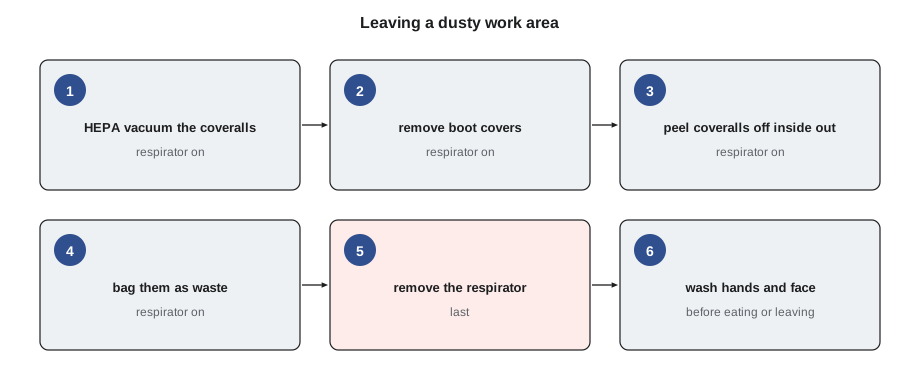
- When leaving a dusty work area, HEPA vacuum your outer clothing or remove it carefully, rolling it inside out, while still wearing your respirator. Remove the respirator last, then wash.
- Bag disposable clothing as waste at the job. Work clothes that may be contaminated stay at work and are laundered by the employer or a laundry that knows what they contain.
- Keep your vehicle clean: do not drive home in dusty clothes or boots, and keep tools and equipment that may be contaminated in sealed bags or boxes.
- Shower at the job when the work requires it, as it does for high-risk asbestos and lead work.
Mei ended the fit test day the way she ends every one: "Your respirator only works on the job. Your hygiene works for the people waiting at home."
Voluntary use and disposable masks
Sometimes a worker wants to wear a respirator for comfort on a task that does not require one, such as a disposable mask while handling dusty but harmless materials. OSHA allows voluntary use, but the employer must give the worker the information in the standard's appendix on voluntary use and make sure the respirator does not itself create a hazard; voluntary use of an elastomeric respirator also requires a medical evaluation and a cleaning program. Under Coldstream's program, any respirator worn on the job is chosen with Mei.
A disposable filtering facepiece is a real respirator only when it is an approved type, fits and seals, and is worn correctly. A loose paper dust mask or a cloth face covering is not a respirator and gives little protection against fine fibers or silica. At Mountview, the fitter who cut into the bulkhead was wearing a disposable mask that had never been fit tested; it may have helped a little, but nobody could count on it.
Respirators, heat and work
Respirators add breathing resistance and heat, especially in hot boiler rooms, enclosed ceiling spaces and plant outages in summer. A worker who is uncomfortable is tempted to lift the mask or break the seal, which defeats it. To make respirator use sustainable:
- Plan regular breaks in a clean area where the respirator can be removed safely.
- Drink water often, outside the work area.
- Consider a PAPR for long or hot tasks; the blower reduces breathing effort and cools the face.
- Change filters before breathing becomes difficult.
If you feel dizzy, short of breath or unwell while wearing a respirator, leave the area, remove the respirator in a clean area and tell your supervisor.
Common mistakes
MistakeWearing a tight-fitting respirator with stubble or a beard.
InsteadShave where the mask seals, or use a loose-fitting hood respirator suitable for the task.
MistakeUsing any respirator in the van because it is handy.
InsteadUse the make, model and size you were fit tested on.
MistakeSkipping the seal check because the respirator fitted last week.
InsteadDo a seal check every time you put it on.
MistakeTaking off the respirator before removing dusty coveralls.
InsteadRemove contaminated clothing first, then the respirator, then wash.
MistakeUsing an organic vapor cartridge for dust.
InsteadUse particulate filters, such as P100, for asbestos, silica, lead and fibers.
Summary and key terms
- Air-purifying respirators include filtering facepieces, half-masks, full facepieces and PAPRs; atmosphere-supplying respirators include supplied-air units and SCBA.
- P100 (magenta) filters are the usual choice for asbestos, silica, lead and fibers; vapor cartridges alone do not stop particles.
- Assigned protection factors range from 10 for half-masks to 1,000 or more for supplied-air and full-facepiece PAPRs; the maximum use concentration is APF times the limit.
- Employers run a respiratory protection program under 1910.134, with medical evaluation, training, annual fit testing and maintenance.
- Facial hair prevents a tight-fitting respirator from sealing; a seal check is needed every time a respirator is put on.
- Hygiene keeps contamination at work: no eating or smoking in the work area, careful removal of protective clothing, the respirator removed last, and no dusty clothes or tools taken home.
- Assigned protection factor (APF)
- The level of protection a respirator type is expected to provide when used correctly.
- Maximum use concentration (MUC)
- The highest concentration a respirator is suitable for: APF times the exposure limit.
- Fit test
- A test of how well a particular respirator seals on a particular person's face.
- Fit factor
- In a quantitative fit test, the outside concentration divided by the concentration inside the mask.
- User seal check
- A quick positive and negative pressure check done each time a tight-fitting respirator is put on.
- Powered air-purifying respirator (PAPR)
- A respirator in which a blower pushes air through filters to a mask, hood or helmet.
- P100 filter
- A particulate filter at least 99.97 in 100 efficient and strongly resistant to oil, colored magenta.
Practice problems
Work each problem on paper first, then reveal the answer to check.
What does an APF of 50 mean?
Show answer
The concentration inside the respirator should be no more than a fiftieth of the outside concentration when it is used correctly.
What is the maximum use concentration of a half-mask (APF 10) for silica with a PEL of 50 µg/m³?
Show answer
10 × 50 = 500 µg/m³.
How often does OSHA require fit testing?
Show answer
Before first use, at least once a year, and whenever a change could affect the fit.
A quantitative test measures 9,000 outside and 45 inside. What is the fit factor?
Show answer
9,000 ÷ 45 = 200.
Why is the respirator removed last when leaving a dusty area?
Show answer
So you are still protected while removing contaminated clothing that can release dust.
Lesson quiz · 5 questions
Score 60% or more to complete this lesson.
Create a free account to save your progress, take quizzes and earn a certificate.