
INS-210 · Lesson 9 of 12 · 24 min
Cement and mastic finishes on fittings
▶ Video coming soon A video version of this lesson is on the way.
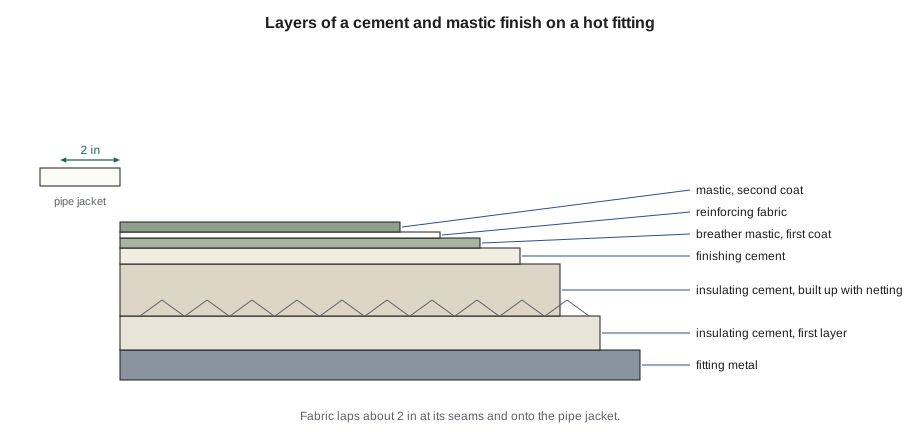
Bernie had one rule about cement that she repeated to every first-year, and she repeated it to Devon at the Kellerton condensate receiver before he so much as opened a bag: "Old mud is guilty until the survey says it isn't." Eight old fittings around the receiver had cracked, crumbling cement finishes. The plant's survey, updated the week before, listed every one of them as sampled and free of asbestos, with the lab report numbers on the sheet. Only then did she let Devon break the old finish off and show him how to put a new one on: insulating cement in layers, a skim of finishing cement, glass cloth bedded in breather mastic and a second coat of mastic over the top.
Before preformed covers and fabricated fittings were common, most fittings were insulated with cement: a wet, fibrous mix trowelled on in layers, built up to the thickness of the pipe insulation and finished smooth. Cement is still used today for irregular shapes that no preformed product fits, for filling voids and gaps around fittings, for repairs to old systems and for a hard finish. Mastics, thick coatings applied wet with a brush, trowel or glove, are used over cement, over fitting insulation and over joints, either to keep weather out while letting vapor escape on hot work or to stop vapor on cold work. This lesson covers both, how they are applied to fittings and the safety rule that comes before either: never disturb an old cement finish until you know what is in it.
Old cement and asbestos
For much of the last century, insulating and finishing cements, and the fitting insulation made from them, often contained asbestos. A cracked, gray or white cement finish on an elbow, valve or tee in an older building or plant is one of the most common places to find it, and it is often not obvious from looking. INS-110 covered the rules: the owner's survey must identify asbestos-containing materials before work starts, a suspect material that is not on the survey means stop work, and only trained and authorized workers, under the procedures the regulations require, may remove it. INS-230 covers asbestos in detail.
- Before breaking or cutting any old cement finish, check that it is on the survey and has been sampled and found free of asbestos, or that it has been removed by the abatement contractor.
- If it is not on the survey, or the survey does not match what you see, stop, keep others away and tell your foreperson. Do not sample it yourself.
- Even cement known to be free of asbestos contains mineral fibers and dust: wet it before breaking it, avoid dry sweeping and wear the respiratory protection your job's hazard assessment calls for.
Note: New insulating cements are made without asbestos. When you mix them, the dust is still a hazard to your lungs and eyes. Mix in a well-ventilated place, pour water first and add the powder slowly, and wear the eye and respiratory protection on the product's safety data sheet.
Insulating cement and finishing cement
Insulating cement is a mixture of mineral fibers, usually mineral wool, with clay or other binders, sold as a dry powder in bags. Mixed with water to a stiff paste, it can be trowelled or hand-packed around any shape and hardens as it dries. The hydraulic-setting kind, covered by ASTM C449, sets partly by chemical reaction with the water as well as by drying, so it hardens more reliably on thick builds. Insulating cement has a much higher thermal conductivity than pipe covering or blanket, so it is a poor insulator for its thickness; it is used where nothing else fits, for filling and for building a base.
Finishing cement is a denser, smoother mix used as a hard top coat over insulating cement or over other fitting insulation. It gives a surface that stands up to handling and takes a mastic or paint. Some products are both: a single cement used for the build-up and, troweled harder, for the finish. Read the bag and the data sheet; they give the mixing ratio, the coverage, the layer thickness, the surface temperatures it can be applied to and the drying time.
| Product | What it does | Typical use on fittings |
|---|---|---|
| Insulating cement | Fills and insulates irregular shapes; hardens as it dries and sets | Build-up on odd fittings, filling voids, repairs, base under finishing cement |
| Finishing cement | Hard, smooth top coat | Over insulating cement or over fitting insulation, under mastic or paint |
| Breather mastic | Weather barrier coating that lets vapor out | Over hot fitting insulation and cement, indoors or out |
| Vapor retarder mastic | Low-permeance coating that stops vapor | Over cold fitting insulation, at joints and vapor stops |
| Reinforcing fabric | Glass, polyester or other open-weave cloth | Bedded in mastic to resist cracking |
| Lagging adhesive and cloth | Canvas or glass cloth pasted on with adhesive or coating | Commercial mechanical room fittings, painted finish |
Applying insulating cement to a fitting
Insulating cement goes on in layers, each pressed firmly onto the one below. A typical method for a hot fitting:
- Clean the fitting: remove loose scale, old finish and oil. Cement does not bond to oil or loose rust.
- Mix the cement with clean water to the consistency on the bag, usually a stiff paste that holds its shape on a trowel. Mix only what you can use before it begins to set.
- If the fitting is hot, apply a thin first coat pressed hard into the surface, so it bonds and dries without blistering. Some cements can be applied only within a range of surface temperatures; check the data sheet.
- Build up in layers to the thickness of the adjoining pipe insulation, letting each layer firm up before the next, as the data sheet says. Thick single layers slump, crack and take a long time to dry.
- On thick builds, large fittings and vertical surfaces, wrap the fitting in galvanized wire netting or expanded metal lath, standing just off the surface, so the cement keys into it and is held while it dries.
- Trowel the last layer to the shape of the fitting, flush with the pipe insulation on each side, and let it dry before the finish goes on.
Where the fitting has a regular shape, a faster and better method is to insulate most of it with pieces of pipe covering or blanket and use cement only to fill the gaps and bring the surface to a smooth shape. A fitting built entirely of cement uses a lot of material and insulates poorly for its thickness.
Worked problem
How much cement?
At the Kellerton receiver, one of the eight fittings is an NPS 3 tee (3.5 in across), 6 3/4 in along the run and 3 3/8 in from the center to the end of the branch. Devon is to build it up with 2 in of insulating cement. Treating the run and branch as short cylinders, estimate the volume of cement with 15 in 100 added for waste. The maker's data sheet gives about 1 cubic foot of wet cement per 50 lb bag.
Show solution
- Outside diameter of the build-up: 3.5 + 2 × 2 = 7.5 in.
- Cross-section of the cement ring: π ÷ 4 × (7.5² − 3.5²) = 0.7854 × (56.25 − 12.25) ≈ 34.6 in².
- Run: 34.6 × 6.75 ≈ 233 in³. Branch, taking its full 3 3/8 in as a rough allowance: 34.6 × 3.375 ≈ 117 in³.
- Total: 233 + 117 = 350 in³; with waste: 350 × 1.15 ≈ 402 in³, about 0.23 ft³.
- Bags: 0.23 ÷ 1 ≈ 0.23 bag.
Answer: About 400 cubic inches, roughly a quarter of a bag, for one NPS 3 tee. The branch allowance is generous, which covers the extra around the crotch of the tee. Eight fittings of mixed sizes need about two bags; Bernie has Devon bring three, since a bag opened in the damp of a boiler house does not keep.
Breather mastics and vapor retarder mastics
Mastics look alike in the pail, and the most important thing to know about any of them is which kind it is. A breather mastic is a weather barrier: it keeps rain and washdown water out but lets water vapor pass, so moisture inside hot insulation can escape as the system heats up. A vapor retarder mastic has a very low permeance: it stops water vapor, and it is used on cold work to keep humid air away from the cold surface. Using a vapor retarder mastic on a hot system can trap moisture inside the insulation; using a breather mastic on a cold system lets vapor in, and the insulation gets wet.
Mastics also differ in their temperature ranges, fire and smoke ratings, resistance to sunlight and chemicals and suitability for food areas. Kellerton's food areas, for example, require coatings the plant has approved for use near food. Check the data sheet and the specification before opening a pail.
Applying mastic with reinforcing fabric
On fittings, mastic is almost always applied with a reinforcing fabric bedded in it, because a fitting's curved and irregular surface cracks an unreinforced coating as the pipe heats, cools and moves. The usual method, sometimes called a three-step finish, is:
- Prepare the surface: insulation or cement clean, dry and firm; on hot work, cement fully dry.
- Apply a first coat of mastic at the wet thickness on the data sheet, brushed, gloved or trowelled to an even film.
- While the first coat is wet, bed the reinforcing fabric into it, smoothing out wrinkles and air pockets, with the fabric lapped about 2 in at its own seams and carried onto the adjoining pipe jacket by about 2 in.
- When the first coat has set enough, as the data sheet says, apply a second coat at the specified wet thickness, covering the fabric completely so its weave no longer shows.
Wet film thickness, measured with a notched gauge pressed into the wet coat, is the way to check that each coat is thick enough. The data sheet gives the wet thickness for each coat and the coverage per pail. The relationship is simple: in metric, one liter spread over one square meter makes a film one millimeter thick; in US units, one gallon spread over one square foot makes a film 1,604 mils thick, a mil being a thousandth of an inch.
Worked problem
How much mastic?
The eight Kellerton receiver fittings have about 34 ft² of finished surface. The breather mastic's data sheet calls for two coats, each 1/16 in (62.5 mils) wet. How much mastic is needed with 15 in 100 added for waste, and how many 5 gallon pails?
Show solution
- One gallon covers 1,604 ÷ 62.5 ≈ 25.7 ft² per coat.
- One coat: 34 ÷ 25.7 ≈ 1.32 gal. Two coats: about 2.65 gal.
- With waste: 2.65 × 1.15 ≈ 3.0 gal.
- Pails: 3.0 ÷ 5 = 0.6, so one pail.
Answer: About 3 gallons, so one pail. Devon checks the first coat with a wet film gauge on each fitting; on the second fitting, the gauge reads only about 40 mils, and he adds more before bedding the cloth.
Weather, temperature and curing
Cements and mastics are wet products, and the conditions when they are applied decide whether they work:
- Temperature: most cements and water-based mastics must not be applied below a minimum air and surface temperature, often around 40 °F, or they will not dry or will freeze. On hot surfaces, there is a maximum too.
- Rain: outdoor work must be protected until the finish has set enough to shed water, which can take hours. A sudden shower on fresh mastic washes it off the fitting.
- Drying before covering: insulating cement must be dry before mastic goes over it, or the moisture is trapped. On hot systems, warming the line gently can help it dry, but only as the data sheet allows.
- Curing before service: some mastics need days to cure fully. Do not put a newly finished cold fitting into service, or allow washdown on a newly finished fitting, before the coating is cured enough.
Lagging cloth and painted finishes
In many commercial mechanical rooms, fittings are finished with lagging: canvas or glass cloth pasted over the fitting insulation with a lagging adhesive or a fire-retardant coating, then painted to match the piping color scheme. It is a traditional, durable finish that looks neat and takes paint well. The method is the same as for mastic and fabric: first coat, cloth bedded in, smooth out wrinkles, overlap the seams and the adjoining jacket, and a finish coat. On cold work, lagging is not a vapor retarder on its own; the fitting must also have a vapor retarder under or within the finish, as lesson 10 explains.
Common mistakes
MistakeBreaking an old cement finish before checking the survey.
InsteadConfirm the material is on the survey and free of asbestos, or has been abated; if not, stop and report.
MistakeBuilding a whole fitting out of insulating cement.
InsteadInsulate most of it with covering or blanket and use cement to fill and shape.
MistakeApplying insulating cement in one thick layer.
InsteadBuild up in layers, with wire netting on thick builds.
MistakeUsing a vapor retarder mastic on a hot fitting, or a breather mastic on a cold one.
InsteadCheck which kind the pail is and what the specification calls for.
MistakeApplying mastic without reinforcing fabric on a fitting.
InsteadBed reinforcing fabric in the first coat and cover it with the second.
MistakeThinning mastic to make it go further.
InsteadApply it at the wet thickness on the data sheet, checked with a gauge.
Summary and key terms
- Old cement finishes often contained asbestos: never disturb one until the survey shows it is free of asbestos or it has been abated.
- Insulating cement fills and shapes irregular fittings; finishing cement gives a hard top coat; ASTM C449 covers mineral fiber hydraulic-setting cement.
- Apply cement in layers to clean surfaces, with wire netting on thick builds, and let it dry before finishing.
- Breather mastics let vapor out on hot work; vapor retarder mastics stop vapor on cold work; never mix them up.
- Mastic on fittings is applied with reinforcing fabric bedded between two coats, lapped about 2 in, at the specified wet thickness.
- Temperature, rain, drying and curing time decide whether a cement or mastic finish lasts.
- Insulating cement
- A mineral fiber and binder mix, applied wet, that fills and insulates irregular shapes.
- Hydraulic-setting cement
- Cement that sets partly by chemical reaction with water as well as by drying.
- Finishing cement
- A dense cement used as a hard, smooth top coat.
- Breather mastic
- A weather barrier coating that lets water vapor pass.
- Vapor retarder mastic
- A low-permeance coating that stops water vapor, used on cold work.
- Reinforcing fabric
- Open-weave cloth bedded in mastic to resist cracking.
- Wet film thickness
- The thickness of a coating while wet, measured with a notched gauge.
- Lagging
- Canvas or glass cloth pasted over insulation with adhesive or coating, often painted.
Practice problems
Work each problem on paper first, then reveal the answer to check.
What must be checked before breaking an old cement finish?
Show answer
That the survey shows it is free of asbestos, or that it has been abated.
Why is insulating cement applied in layers?
Show answer
Thick single layers slump, crack and take too long to dry.
A coat is to be 40 mils wet over 80 ft². About how much mastic is needed for that coat?
Show answer
1,604 ÷ 40 ≈ 40 ft² per gallon, so about 2 gallons.
Which mastic goes on a chilled water fitting?
Show answer
A vapor retarder mastic.
How far should reinforcing fabric lap onto the adjoining pipe jacket?
Show answer
About 2 in, or as specified.
Lesson quiz · 5 questions
Score 60% or more to complete this lesson.
Create a free account to save your progress, take quizzes and earn a certificate.