
INS-210 · Lesson 6 of 12 · 23 min
Flanges and flanged fittings
▶ Video coming soon A video version of this lesson is on the way.
At the Kellerton outage, the two flange pairs where the old asbestos-covered valves had been were the first thing Devon insulated on the new header. He ran the pipe covering right up to the back of each flange, tight and neat, and was proud of it until Marcel came by with a stud bolt in his hand. "Pull this out," Marcel said, holding it against the flange where a stud would go. It could not move more than a finger's width before it hit Devon's insulation. "Next time somebody changes that gasket, they cut your work off with a knife. Cut it back. Bolt length and a bit."
Flanges are the joints of a piping system that are made to come apart. Every flanged joint has a gasket that may leak, bolts that may need tightening and a reason to be opened one day: to replace a valve, to put in a blind, to clean or inspect. Insulation on and beside flanges has to allow for all of that. This lesson covers the kinds of flanges insulators meet, how far to stop pipe insulation from a flange, the two common ways of covering a flange pair, and the flanged fittings, blinds and specialty flanges that need their own details.
Flanges and their sizes
A flange is a ring with bolt holes, welded, threaded or otherwise joined to the end of a pipe or fitting, so it can be bolted to another flange with a gasket between them. Common types are the weld neck flange, with a long tapered hub butt-welded to the pipe; the slip-on flange, which slides over the pipe and is fillet-welded; the threaded flange; the lap joint flange, which turns loosely on a stub end; and the blind flange, a solid plate that closes the end of a line. Flanges are made in pressure classes, such as Class 150 and Class 300 under ASME B16.5. For the same pipe size, a higher class flange is larger across, thicker and has more or larger bolts.
For insulators, the numbers that matter are the flange outside diameter, the thickness of the pair, the length of the bolts or studs and whether the flange has a hub. As examples, an NPS 2 Class 150 flange is about 6 in across, an NPS 4 about 9 in, an NPS 6 about 11 in and an NPS 8 about 13 1/2 in. Compare those with the outside diameter of the pipe insulation: on small pipe with thin insulation, the flange is bigger than the insulation; on large pipe with thick insulation, the insulation is often bigger than the flange. That comparison decides which kind of flange cover you build.
Cutting the pipe insulation back
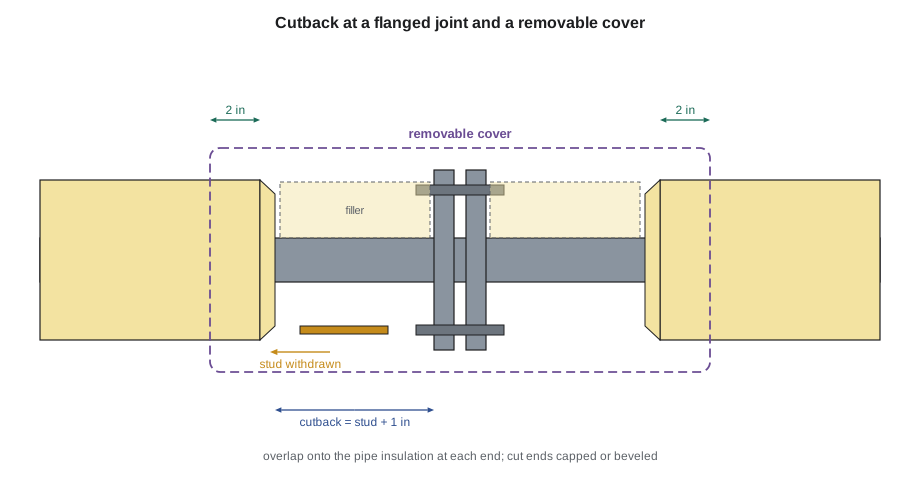
The bolts in a flanged joint are usually studs: threaded rods with a nut on each end. To take one out, a mechanic removes one nut and slides the stud out through the holes in both flanges. On the side it comes out, it needs a clear space at least as long as the stud. If the pipe insulation runs right up to the back of the flange, the stud hits it, and the insulation is cut away.
So pipe insulation beside a flange is stopped short of the flange, leaving a cutback. A common specification rule is to stop the insulation a distance equal to the bolt or stud length plus about 1 in from the back of the flange, on both sides of the joint, so the studs can be removed in either direction. The bare pipe in the cutback and the flanges themselves are then covered with a flange cover that can be removed. Where the specification gives a different rule, follow it; on some cold-service specifications, the pipe insulation runs to the flange and is finished there with a vapor stop, and the flange cover is built over it.
The end of the pipe insulation at a cutback must be finished, not left raw. Bevel the end of rigid insulation at about 45° so it sheds water, or cap it with a metal or PVC end cap, cement or a short, sealed jacket wrap, as the specification calls for. A beveled end is also easier for a flange cover to overlap and seal against.
Two ways to cover a flange pair
Flange covers come in two common forms, depending on whether the flanges are larger or smaller than the pipe insulation beside them.
- Overlapping cover, where the pipe insulation is larger than the flanges: the cover's bore is sized to the outside of the pipe insulation, and it overlaps the insulation at each end. Inside the cover, the bare pipe in each cutback is filled with a removable filler, a short section of pipe covering or a pad, of the same thickness as the pipe insulation. The flanges sit inside the filler space.
- Stepped cover, where the flanges are larger than the pipe insulation: the cover's bore is sized to the outside of the flanges and nuts, and each end has a collar or end ring that steps down to close on the pipe insulation.
Either form can be a removable blanket, a two-piece fabricated box of rigid insulation with a metal jacket, or a two-piece preformed cover. The case study in lesson 12 shows how removable blankets for the Kellerton valve station were measured; INS-340 covers how blankets are patterned and sewn.
Worked problem
An overlapping cover on the Kellerton header
An NPS 8 Class 150 flange pair on the Kellerton header is 2 3/8 in thick, with flanges 13 1/2 in across and studs 4 1/2 in long. The pipe, 8.625 in across, has 3 in mineral wool. Using the rule of stud length plus 1 in, find the cutback on each side, the gap between insulation ends, the cover length with a 2 in overlap at each end, and the cover's bore and outside diameter for a 3 in cover.
Show solution
- Cutback: 4.5 + 1 = 5.5 in on each side, from the back of each flange.
- Gap between insulation ends: 2.375 + 2 × 5.5 = 13.375 in, 13 3/8 in.
- Cover length: 13.375 + 2 × 2 = 17.375 in, 17 3/8 in.
- Pipe insulation outside diameter: 8.625 + 2 × 3 = 14.625 in, larger than the 13 1/2 in flanges, so this is an overlapping cover.
- Cover bore: about 14 3/4 in, a slip fit over the 14 5/8 in insulation. Outside diameter: 14.75 + 2 × 3 = 20.75 in.
Answer: A cover about 17 3/8 in long, 14 3/4 in bore and 20 3/4 in outside, with two removable fillers of 3 in covering, each 5 1/2 in long, over the bare pipe in the cutbacks. Marcel had Devon cut his insulation back by 5 1/2 in on both sides of both flange pairs, bevel the ends and fit the fillers, and the blankets went on over them.
Worked problem
A stepped cover on small pipe
An NPS 2 Class 150 flange pair on low-pressure condensate has flanges 6 in across. The pipe, 2.375 in across, has 1 1/2 in insulation. The cover is to clear the flanges by 1/4 in all round and be 1 1/2 in thick. Which kind of cover is it, and what are its bore, outside diameter and end collar sizes?
Show solution
- Pipe insulation outside diameter: 2.375 + 2 × 1.5 = 5.375 in, smaller than the 6 in flanges, so this is a stepped cover.
- Bore: 6 + 2 × 0.25 = 6.5 in.
- Outside diameter: 6.5 + 2 × 1.5 = 9.5 in.
- End collars: from 9 1/2 in outside down to 5 3/8 in, to close on the pipe insulation.
Answer: A stepped cover, 6 1/2 in bore and 9 1/2 in outside, with end collars closing down to 5 3/8 in. On small pipe, the stepped cover is the usual form.
Leaks, drains and inspection
Operators often want to know when a flange starts to leak. A leak hidden under insulation can soak the insulation, start corrosion under it and, on steam, cut a groove in the flange face over time. Removable flange covers on hot service are often made with a small drain or weep opening at the bottom, so a leak shows as a drip or a wisp of steam, and with a fastening that lets an inspector lift one side and look without taking the whole cover off. Where a specification calls for a leak indicator, fit it as shown; where it does not, ask whether one is wanted before you build a fully sealed cover over a flange that operators want to watch.
On lines carrying hazardous fluids, flanges sometimes have spray shields or flange guards: wraps of fabric or metal that stop a leak from spraying, sometimes with a patch that changes color when the fluid touches it. A spray shield is not insulation, and insulation must not be put over one unless the specification says how. If you find shields on a line you are to insulate, ask before you go further.
Flanged fittings
Many fittings come with flanges instead of welded or threaded ends: flanged elbows and tees on large water mains, flanged valves, flanged strainers and flanged spools that are removed for maintenance. Treat each flanged fitting as two problems: the fitting itself, insulated as an elbow, tee or valve, and each flanged joint, cut back and covered so it can be broken. On a flanged elbow, for example, the elbow body can be insulated permanently with segments, and the flanged joints at each end get removable covers. On a flanged spool that is taken out for cleaning, the whole spool and both joints may need one removable cover.
Some flanges carry fittings of their own that must stay clear:
- Orifice flanges: flanges with small tapped holes for flow measurement, with tubing or valves screwed into them. Keep the taps and their valves accessible, and do not bend the tubing.
- Spectacle blinds and spacers: a plate between two flanges that can be turned to open or blind the line. Keep the handle of the blind clear and do not insulate it in place.
- Insulating flange kits: on some lines, gaskets, sleeves and washers that electrically isolate one side from the other. Do not make a metal path across them with jacketing, bands or wire.
- Flanges at equipment: pump, exchanger and tank nozzles. Insulation stops where the equipment insulation begins; the details are in INS-310.
Blind flanges and dead ends
A blind flange closes the end of a line or a branch. On a hot header, a blind flange at the end is a disc of hot metal facing the room, often with a hub and bolts behind it, and it loses heat like any other flange. Cover it with a removable end cap: a disc of insulation the thickness of the pipe insulation, sized to the outside of the flange cover or the pipe insulation, fastened to a short cylindrical cover that overlaps the insulation behind the flange. On cold dead ends, the end cap is part of the vapor retarder and must be sealed like any other joint.
Dead legs, short branches with a blind flange or a closed valve at the end, are a special concern. On hot water and steam they can collect water; on domestic hot water they can grow bacteria at temperatures below the setpoint. The insulator does not design these, but a dead leg that has been left bare or with damaged insulation is worth noting on a survey sheet, because insulation helps keep its temperature closer to the main.
Cold flanges
On cold service, flanges are insulated as fully as any fitting, and the vapor retarder must be continuous over them. There are two common approaches. In one, the pipe insulation runs right up to the flanges, finished with a vapor stop at the end, and a sealed flange cover is built over the joint, also sealed to the pipe jacket. In the other, the flange is enclosed in a removable cover designed for cold service, with a sealed vapor retarder on its outside and gasketed or taped joints that are resealed every time it is removed. Either way, a cold flange cover that is opened and not resealed will ice up. Lesson 10 covers vapor stops and sealing at cold fittings.
Common mistakes
MistakeRunning pipe insulation tight to the back of a flange.
InsteadCut it back by the stud length plus about 1 in, unless the specification says otherwise.
MistakeLeaving the cut end of the insulation raw.
InsteadBevel, cap or seal the cut end as specified.
MistakeSizing a flange cover to the flanges when the pipe insulation is larger.
InsteadCompare the two; use an overlapping cover with fillers when the insulation is larger, a stepped cover when the flanges are larger.
MistakeBuilding a sealed cover over a flange operators want to watch.
InsteadAsk whether a drain or leak indicator is needed.
MistakeInsulating over a spray shield, an orifice tap or a spectacle blind handle.
InsteadKeep them clear and ask how the specification wants them treated.
MistakeBridging an insulating flange kit with metal jacket or bands.
InsteadKeep a break in any metal finish across the isolated joint.
Summary and key terms
- Flanges are made to come apart; insulation beside them must let studs be removed and gaskets changed.
- Flange size depends on pipe size and pressure class; compare the flange diameter with the pipe insulation diameter.
- A common rule is to cut pipe insulation back from each flange by the stud length plus about 1 in and to finish the cut ends.
- Overlapping covers, with fillers in the cutbacks, are used when the pipe insulation is larger than the flanges; stepped covers when the flanges are larger.
- Hot flange covers may need drains or leak indicators; spray shields, orifice taps, spectacle blinds and insulating kits need special care.
- Cold flanges are fully insulated with a continuous, resealable vapor retarder.
- Weld neck flange
- A flange with a long tapered hub, butt-welded to the pipe.
- Blind flange
- A solid flange that closes the end of a line.
- Pressure class
- A rating, such as Class 150 or 300, that sets a flange's pressure rating and dimensions.
- Stud bolt
- A threaded rod with a nut on each end, used to bolt a flanged joint.
- Cutback
- The distance pipe insulation is stopped short of a flange so the studs can be removed.
- Flange cover
- Removable insulation over a flanged joint and the cutbacks beside it.
- Spray shield
- A wrap over a flange that stops a leak from spraying; not insulation.
- Dead leg
- A short branch closed at the end, where fluid does not flow.
Practice problems
Work each problem on paper first, then reveal the answer to check.
Why is pipe insulation cut back from a flange?
Show answer
So the studs can be removed without cutting the insulation.
Studs are 3 1/2 in long. Using the stud length plus 1 in rule, what is the cutback?
Show answer
3.5 + 1 = 4.5 in on each side.
NPS 6 pipe (6.625 in) has 2 in insulation; the flanges are 11 in across. Which kind of cover fits?
Show answer
Insulation OD 10.6 in is smaller than the 11 in flanges, so a stepped cover.
What is a weep opening on a flange cover for?
Show answer
To let a leak show as a drip or a wisp of steam.
What must not be done across an insulating flange kit?
Show answer
Make a metal path with jacketing, bands or wire.
Lesson quiz · 5 questions
Score 60% or more to complete this lesson.
Create a free account to save your progress, take quizzes and earn a certificate.